New Article on Custer's Last Stand

In my limited opinion, dividing his unit makes sense if he thinks the village is smaller than it turned out to be. Then it's a pincer movement with Benteen cutting off any escaping Indians.

The key isn't what we know now, it's what Custer knew, or thought he knew on that day.

If he does a better reconnaissance before attacking does he still split his force?

Probably not, but he certainly still makes the attack. Either way he's outnumbered. In the end it comes down to the effective fighting of the Sioux and Northern Cheyenne vs an under trained force made up of mostly immigrants and two key officers who didn't like nor trust Custer.
 
FYI Hollywood was mythologising Custer well into the last century, casting Errol Flynn, no less.
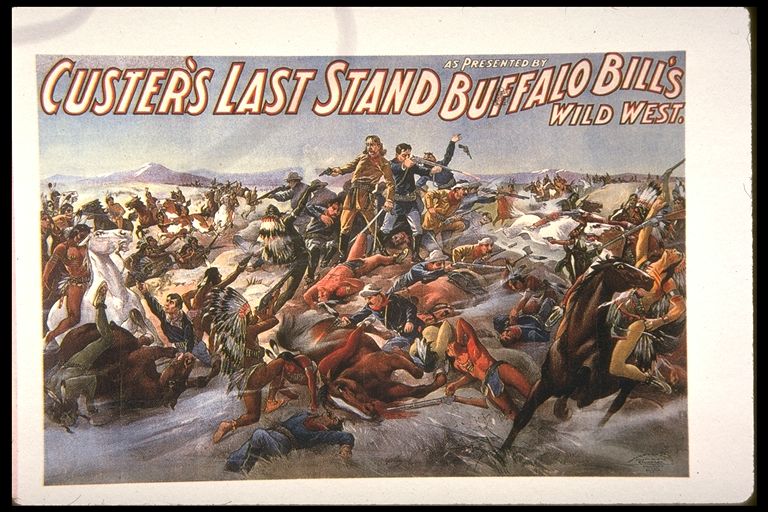
FYI? Do you understand how "for your information" is used? Sir, you are taking the tone of someone who believes he knows more than we do about the topic of discussion, when we know that through popular entertainment, including posters that hung in bars and saloons across the country,

299-image-700-450-fit.jpg


and recreations before packed houses the world over, including one for Queen Victoria,

img0079.jpg


Custer had been thoroughly mythologized before Errol Flynn was born.
I would not like to be fiddling with that thing with an army of injuns bearing down on me.
First, at the same time the British army was introducing the Martini-Henry, another single-shot rifle. Lots of armies thought their soldiers would waste ammunition if they had repeaters.

Second, please remove "injun" from your vocabulary. We who live in countries with populations of First Nations people recognize it as offensive, and it can color their perceptions of you and what you say.
Your wall of text kind of looks like a post-and-run but I'll proceed on the assumption that you're interested in a legitimate exchange of ideas.
While I'm junior-modding, that was unnecessarily snarky. I managed to not accuse, at least not in so many words, anglolawyer of talking down to his betters like an insolent pup so perhaps you should follow my lead. :D[BIG joke!];)
 
The key isn't what we know now, it's what Custer knew, or thought he knew on that day.

If he does a better reconnaissance before attacking does he still split his force?

Agreed. That was the thesis of my series of posts on Custer's decisions. I didn't find a lot to harshly criticize except the last one discussed: Custer's decision to delay his battalion's attack after committing Reno. And even here, it's not really a condemnation of Custer. I just don't understand what he was thinking. There's a real chance that there were circumstances that we aren't aware of that would make this decision more understandable.

If he could have determined there were no villages upstream, I think he would have kept Benteen with him. But no matter what, the pack train would have been far behind and vulnerable. That was a problem.

The split that really hurt was Benteen. He ended up finding nothing useful and the delay kept his important battalion out of the initial fight. On the other hand, maybe it would have made less difference than we think because Custer's delay may have had more to do with waiting for the pack train rather than Benteen.
 
Last edited:
While I'm junior-modding, that was unnecessarily snarky. I managed to not accuse, at least not in so many words, anglolawyer of talking down to his betters like an insolent pup so perhaps you should follow my lead. :D[BIG joke!];)

I know. I was sitting ready to apologize if he answered my comment...which he didn't (called it!).

The idea that the Indians had better weapons is one of those "fun facts" that will likely never die. The army carefully evaluated repeating rifles and decided the single-shots were better. I agree. But I do admit that there are certain limited situations where having rapid-fire capability would have been better.
 
Last edited:
FYI? Do you understand how "for your information" is used? Sir, you are taking the tone of someone who believes he knows more than we do about the topic of discussion, when we know that through popular entertainment, including posters that hung in bars and saloons across the country,

[qimg]https://wandervogeldiary.files.wordpress.com/2014/05/299-image-700-450-fit.jpg[/qimg]

and recreations before packed houses the world over, including one for Queen Victoria,

[qimg]https://www.csub.edu/~gsantos/jpgs/img0079.jpg[/qimg]

Custer had been thoroughly mythologized before Errol Flynn was born.
First, at the same time the British army was introducing the Martini-Henry, another single-shot rifle. Lots of armies thought their soldiers would waste ammunition if they had repeaters.

Second, please remove "injun" from your vocabulary. We who live in countries with populations of First Nations people recognize it as offensive, and it can color their perceptions of you and what you say.
While I'm junior-modding, that was unnecessarily snarky. I managed to not accuse, at least not in so many words, anglolawyer of talking down to his betters like an insolent pup so perhaps you should follow my lead. :D[BIG joke!];)

Heh, well before talking down to me, try aiming for a better understanding of my posts. The point of the Errol Flynn reference was not that glorifying Custer started with that film but that it didn't stop in the 19th century, as the person I was replying to had seemed to suggest. Thanks for weighing to support my argument btw.

That said, I have considerable respect for the learned posters on this thread and thank them warmly for deepening my understanding of the battle. I would not dream of talking down to them.

So, kindly go and 'junior mod' somewhere else, there's a good chap :D
 
Last edited:
I know. I was sitting ready to apologize if he answered my comment...which he didn't (called it!).

The idea that the Indians had better weapons is one of those "fun facts" that will likely never die. The army carefully evaluated repeating rifles and decided the single-shots were better. I agree. But I do admit that there are certain limited situations where having rapid-fire capability would have been better.
One of which would seem to be close quarters combat. I base this on the documentary previously mentioned, in which two guys side by side fired the carbine and one of the repeaters used by the injuns native Americans. The repeater got off 13 rounds in 30 seconds while the carbine managed 4. That's one reason I asked about the plan once Custer got into the village. If opposed, he would be at a disadvantage and if not opposed, what exactly was he planning to do, pull tent pegs out, put out the fires, drive off horses, what?
 
Heh, well before talking down to me, try aiming for a better understanding of my posts. The point of the Errol Flynn reference was not that glorifying Custer started with that film but that it didn't stop in the 19th century, as the person I was replying to had seemed to suggest. Thanks for weighing to support my argument btw.
...
So, kindly go and 'junior mod' somewhere else, there's a good chap :D
First, you are acting as if I do NOT have the attention span of a flea and remember any post other than the one I'm responding to. While I appreciate it, it has no basis in truth.

Second, I really do mean it about "injun." BIG no-no in the US and Canada.
 
First, you are acting as if I do NOT have the attention span of a flea and remember any post other than the one I'm responding to. While I appreciate it, it has no basis in truth.

Second, I really do mean it about "injun." BIG no-no in the US and Canada.

I am not 'acting as though' anything, just correcting your supercilious, patronising and misconceived post. Knock yourself out and show me I'm wrong.

Thanks for reminding me about the injun thing. Much appreciated :D
 
I am not 'acting as though' anything, just correcting your supercilious, patronising and misconceived post. Knock yourself out and show me I'm wrong.

Thanks for reminding me about the injun thing. Much appreciated :D

Be careful, he's your better remember.
 
I am not 'acting as though' anything,
Yeesh, it was a joke at my expense because you caught that I apparently missed the post you were originally replying to. I apologize for the lofty tone and that the written word does not allow me to show how I intend something without additional exposition, like "'I'll show that Englishman,' dropzone said with a wry smile that belied his aggressive words." Emoticons don't always cut it.

bluesjnr, you liked that "betters" crack, eh? I figured that one would show how over the top I realized I sounded so my joking intent would become more clear. It didn't. I don't post here enough to have built up a reputation of being a person who is rarely entirely serious. I will keep that in mind.
 
Yeesh, it was a joke at my expense because you caught that I apparently missed the post you were originally replying to. I apologize for the lofty tone and that the written word does not allow me to show how I intend something without additional exposition, like "'I'll show that Englishman,' dropzone said with a wry smile that belied his aggressive words." Emoticons don't always cut it.

bluesjnr, you liked that "betters" crack, eh? I figured that one would show how over the top I realized I sounded so my joking intent would become more clear. It didn't. I don't post here enough to have built up a reputation of being a person who is rarely entirely serious. I will keep that in mind.

Ah, OK. Sorry. I did indeed misread you. Let's call it quits.
 
Custer and Benteen

I said I'd make some comments on Benteen. I'll start with a description of the relationship between Benteen and Custer before moving on to the battle itself.

Benteen disliked Custer from their first meeting in 1867. He found Custer to be full of himself and later remarked that he had never heard "such bragging as was stuffed into me that night." It also didn't help that Custer made critical remarks about Benteen's commanding officer in the Civil War.

Custer no doubt felt superior to Benteen because he had attended West Point, served in the glamorous eastern theater under celebrated Phil Sheridan, and made a name for himself in the biggest battle of them all, Gettysburg. Benteen, in contrast, had gone to a southern military school and served mostly in backwater Arkansas and Missouri.

The initial bad feelings were worsened by a long string of perceived mistreatments, including detaching Benteen and leaving him idle while the 7th Cavalry was carrying out a mission.

Benteen's distaste for Custer escalated after the abandonment of Major Elliott at the Washita. The firing of Elliott's trapped men could be heard plainly in the distance but Custer refused to send help. (Note: this is Benteen's version of what happened. I haven't studied the Washita enough to judge but based on other accusations made by Benteen, the facts were probably less incriminatory than he paints them).

Two days before the battle Custer called a meeting in which he complained that some officers had been disloyally talking behind his back to General Terry. Benteen took the remarks to be directed towards him and openly challenged Custer to name the officers. Custer brushed him off saying his comments weren't directed towards him.
 
Custer and Benteen, Part 2

Here's an anecdote from one of Benteen's later letters. It shows Benteen's style of thinking and talking, and his contempt for Custer's character.

"At Fort Cobb, Ind. Ter. in winter of '68-'69, officers call was sounded one night from Regt. Hdqtrs. I sauntered up, the other officers being mostly there when I arrived. The officers were squatted around the inside of Custer's Sibley tent, (minus a wall), and Custer was walking around the center of tent with a rawhide riding whip in his hand.​

When all were assembled, he went on with a rambling story, stammering the while, that it had been reported to him that some one—or parties—had been belittling the fight at the Washita, &c., &c., and that if he heard any more of it, or it came to his ears who had done so, he would cowhide them, switching his rawhide the while.​

Being right at the door of tent, I stepped out, drew my revolver, turned the cylinder to see that 'twas in good working order, returned it lightly to holster, and went within. At a pause in the talk I said, "Gen. Custer, while I cannot father all of the blame you have asserted, still, I guess I am the man you are after, and I am ready for the whipping promised." He stammered and said, "Col. Benteen, I'll see you again., sir!​

Doubtless you can imagine what would have happened had the rawhide whirred!"​

Custer then stalked out. But that wasn't enough for Benteen. He grabbed a reporter from the NY Herald and instructed him to write down everything that was about to happen. He then led the reporter to Custer's room to confront him again about Custer's threat to whip the person responsible. Custer, Benteen reported, "wilted like a whipped cur."

This was quintessential Benteen. I'd like to see a report of this incident from another witness but haven't run across one. I think it's likely there was some kind of confrontation, but doubt it happened quite as neatly as Benteen describes.
 
Last edited:
Wow! That is some level of poison. It would indeed be interesting to know whether anything backs up Benteen's story (the reporter maybe?). Doesn't that affect your estimate of Custer's and Benteen's actions on the day? For instance, might not an over-confident Custer have detached Benteen and his column precisely in order to relegate his role to one of irrelevance?
 
If anybody is interested in seeing a picture of the last order (come quick) and reading Benteens account of the fateful day (written before any enquiry) in a letter to his wife, then click here.

It makes interesting reading along with a wealth of links leading to further insights.
 
Wow! That is some level of poison. It would indeed be interesting to know whether anything backs up Benteen's story (the reporter maybe?). Doesn't that affect your estimate of Custer's and Benteen's actions on the day? For instance, might not an over-confident Custer have detached Benteen and his column precisely in order to relegate his role to one of irrelevance?

It certainly raises the possibility that it affected decision-making but I don't know how to go any further than that. No one knows what Custer was really thinking other than through the snippets of conversation reported for that day and the famed last order. He didn't have an officer's call where he explained what he was doing and why. His closest friends who might have known more were with his battalion and died, too.

Benteen's animosity may have affected him but I think it would have been on the subconscious level. I don't believe he would ever purposely refuse to help Custer because he didn't like him. He was still a cavalry officer and a good one. And there were 200 other men with Custer who Benteen didn't hate.

I'll discuss this a bit more as I continue with my review of Benteen's actions.
 
If anybody is interested in seeing a picture of the last order (come quick) and reading Benteens account of the fateful day (written before any enquiry) in a letter to his wife, then click here.

It makes interesting reading along with a wealth of links leading to further insights.

It's a valuable account of the battle precisely because it was written soon afterwards and before the storm of criticism descended on Reno and him for "abandoning" Custer. There are a few inaccuracies but it's a good account and much more even-handed than his later writings.
 

Back
Top Bottom