• Security incident: ISF was recently accessed by intruders. Please change your password, and change it anywhere else you used it. Read more

South Carolina, tear down that flag!

But why would the war have happened? If that was the case the south would not have broken away.

And if Lincoln were not anti-slavery, why free the slaves by executive order (and work to make it permanent)?

Despite his claims of neutral opinions, Meadmaker is desperately trying to normalize pro-slavery attitudes in order to make the south's stance seem reasonable, if not sympathetic.
 
The Confederates decided on war long before any "Union fleet" approached Fort Sumter. They decided it on January 9, two months before Lincoln took office, when then-president Buchanan sent a single ship - a pointedly unarmed civilian merchant ship, to resupply Fort Sumter, and it was fired upon by Confederate forces. Those were the true "first shots" of the civil war - a military action, taken by the Confederate army, against a noncombatant target that didn't (couldn't, even) return fire.

They decided it on the day they seceded. They knew that the USA probably wouldn't accept their secession, and they were prepared to go to war over it.

There's no doubt about that. They were willing to go to war to keep slavery. The Union was willing to go to war to keep those states in the Union. (Or maybe there was some other reason the Union was willing to go to war. Fill in the real reason that the Union was willing to go to war, if it was something else. I'm amazed some times at the nits people pick in forum conversations.) Everyone involved was willing to go to war, so there was a war.

Everyone involved would have preferred that there had been no war at all, but whatever it is that they wanted, the other side wanted something else, and both sides were willing to go to war if need be to get what they wanted.
 
Last edited:
But why would the war have happened? If that was the case the south would not have broken away.

The abolitionist movement was growing, and they knew it. Abolitionists did not yet have the political power to elect leaders who supported abolition*, but it was a matter of time. Slavery was doomed in the United States, and the Southerners knew it.

*My evidence for that is that they didn't elect political leaders who supported abolition.
 
The abolitionist movement was growing, and they knew it. Abolitionists did not yet have the political power to elect leaders who supported abolition*, but it was a matter of time. Slavery was doomed in the United States, and the Southerners knew it.

*My evidence for that is that they didn't elect political leaders who supported abolition.

And they dreamed of expanding it to more of the world as well. But you are positing how we would view a war if we removed the motivation of why the war happened. In your hypothetical the north was proslavery so why did the civil war start in your alternate history?
 
The abolitionist movement was growing, and they knew it. Abolitionists did not yet have the political power to elect leaders who supported abolition*, but it was a matter of time. Slavery was doomed in the United States, and the Southerners knew it.

*My evidence for that is that they didn't elect political leaders who supported abolition.

So, cherry picking the white males, then? Was that also the basis of your earlier claim, or does this new wording indicate that you've realized you were making an assumption?
 
Last edited:
One is a band of fanatic forcefully removing aprt of history where they had no negative impact from , e.g. not slavery for example, and it was not the same country and civilization. the other is a request to have a symbol of enslavement , from a country the SAME country, nigh 165 years ago, which fought over civil war for that, removed from all federal property and monument.

It is in no way shape and form identical.

I do not think NAACP is right to ask for this, but this is utter bovine excrement to compare the two.

The Taliban and Isis at least believe they are saving good Muslims from idolatry and an eternity of damnation when they destroy statues and artifacts, the NAACP wants it done because some people's feelings are hurt.

The Islamic fanatics were able to destroy what they wanted because there were no consequences from a strong, established society who could punish them for their behavior.

I believe the NAACP, as well as other like-minded people, have the desire and would dynamite Stone Mountain if there were no consequences for their actions.
 
The abolitionist movement was growing, and they knew it. Abolitionists did not yet have the political power to elect leaders who supported abolition*, but it was a matter of time. Slavery was doomed in the United States, and the Southerners knew it.

*My evidence for that is that they didn't elect political leaders who supported [forcing] abolition [on the Southern states].

Fixed that for you, after all if the elected leaders hadn't supported abolition within their own states, abolition in the Northern states would not have happened so long before the Civil War.
 
And if Lincoln were not anti-slavery, why free the slaves by executive order (and work to make it permanent)?

Despite his claims of neutral opinions, Meadmaker is desperately trying to normalize pro-slavery attitudes in order to make the south's stance seem reasonable, if not sympathetic.

Yeah,he is doing a somewhat more sophisticated version of the standard Neo Confederate talking points.

Lincoln opposed slavery,but was not a abolitionist. His idea was to prevent it's expansion (the expansion of Slavery to new states was the issue that led to the war) and let it die a natural death. Time and time again,before the war, he stated he would not interfere with Slavery where it existed.
 
Fraud! South Carolina seceded on December 20, 1860. Six other states seceded shortly afterwards and together created the Confederacy on February 4th of the next year.

Lincoln's inaugural address wasn't given until March 4, a month later. He drew his "only one line in the sand" a month AFTER the birth of the Confederacy. And he gave no policy statements about his attitudes toward southern secessionism before his inauguration.

I had never read Lincoln’s first inaugural address. I’ve read more about Lincoln than I had before this thread. The more I read, the more I admire him. Sometimes I think that the leaders we call great are just the ones who happened to be in charge when something great happened, but I think Lincoln really was something special.

But, enough lofty rhetoric. Let us get down to picking nits about who is right and who is wrong. The address clearly says a couple of things. One is that he emphasizes he never has and never will try to abolish slavery. The other has to do with his willingness to go to war. Checkmite noted that all he said he would try to do was protect Federal property. That’s not complete. He would also continue to collect taxes, specifically "duties" i.e. tariffs. Let’s be clear what that meant. He would blockade Southern ports if necessary and collect taxes from any ship importing goods.

War was inevitable as long as the South insisted on independence.

Let’s try and remember why this matters.

Suppose a person commits some horrible crime. We can look and say that that person is a horrible person. Maybe his combination of genes caused his brain to develop without something important to humanity. Maybe it was an injury or illness that damaged him. Maybe he is emotionally incomplete, with no self control, and no empathy. For whatever reason, he’s no good. Lock him up or hang him or do what you do, because he’s just not right.

Now suppose an entire civilization commits some sort of atrocity. Can we say the same thing? They can’t all be brain damaged. They don’t all have poor genetic makeup. The people among the Nazis or Aztecs or ante-bellum Southerners can’t all be bad people. We can’t just explain away their behavior by saying there was something wrong with them. Societies like those are a product of human nature, not of some defect.

The comparison with the North was just to point out that while one group of Americans committed a great atrocity, the other group tolerated it, and indeed profited from it. The sins of each group differed possibly in degree, but not in kind. We try to spin the history and make one side look better, but neither side ought to look very good when judged by modern standards. They weren’t all that different, which shouldn’t be surprising. They were all people, exactly like you and me.

So let’s not demonize the people. The ideas were bad, but the people were people.

(Later: How this relates to Confederate flags.)
 
Yeah,he is doing a somewhat more sophisticated version of the standard Neo Confederate talking points.

Lincoln opposed slavery,but was not a abolitionist. His idea was to prevent it's expansion (the expansion of Slavery to new states was the issue that led to the war) and let it die a natural death. Time and time again,before the war, he stated he would not interfere with Slavery where it existed.

That's definitely a matter of debate and a complicated argument. But personally the evidence leads me to believe that he was an abolitionist, but publicly he spoke as a moderate in order to get elected.

The following passage from his letter to Joshua Speed as evidence:

You may remember, as I well do, that from Louisville to the mouth of the Ohio, there were, on board, ten or a dozen slaves, shackled together with irons. That sight was a continued torment to me; and I see something like it every time I touch the Ohio, or any other slave-border. It is hardly fair for you to assume, that I have no interest in a thing which has, and continually exercises, the power of making me miserable. You ought rather to appreciate how much the great body of the Northern people do crucify their feelings, in order to maintain their loyalty to the Constitution and the Union.

http://www.abrahamlincolnonline.org/lincoln/speeches/speed.htm

He was an abolitionist, he wanted slavery outlawed in the USA. He was however possibly willing to let it go on in order to avoid a catastrophic war. That doesn't mean he wasn't abolitionist by the actual definition of the word.
 
Lincoln opposed slavery,but was not a abolitionist.
I've only lately been re-familiarizing myself with this. My take from what I've read is that Lincoln's nuanced view was that slavery is a bad thing, but it was not the place of the federal government to make the decision for individual states. The territories, as you inferred, were a different matter and he was strictly opposed to allowing slavery to expand into them.
 
The Taliban and Isis at least believe they are saving good Muslims from idolatry and an eternity of damnation when they destroy statues and artifacts, the NAACP wants it done because some people's feelings are hurt.

The Islamic fanatics were able to destroy what they wanted because there were no consequences from a strong, established society who could punish them for their behavior.

I believe the NAACP, as well as other like-minded people, have the desire and would dynamite Stone Mountain if there were no consequences for their actions.

And everyday people destroy exactly the kind of graffiti that is so useful to historians and archaeologists!
 
The comparison with the North was just to point out that while one group of Americans committed a great atrocity, the other group tolerated it, and indeed profited from it. The sins of each group differed possibly in degree, but not in kind.
Possibly differed in degree, but not in kind? Are you kidding?


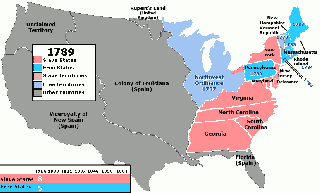
(click through for the animation)

For 70ish years, the North had been switching over to free states and working to keep slavery from spreading. The "tolerated" it because they didn't want the country to split apart. Heck, they were worried about that back when they were writing the Constitution.

We try to spin the history and make one side look better
Who is this "we"? You are the one spinning like a top here in defense of the Confederacy.

They weren’t all that different, which shouldn’t be surprising.
Not all that different except that one side fought for the primary purpose of maintaining the institution of slavery.
 
That's definitely a matter of debate and a complicated argument. But personally the evidence leads me to believe that he was an abolitionist, but publicly he spoke as a moderate in order to get elected.

The following passage from his letter to Joshua Speed as evidence:

You may remember, as I well do, that from Louisville to the mouth of the Ohio, there were, on board, ten or a dozen slaves, shackled together with irons. That sight was a continued torment to me; and I see something like it every time I touch the Ohio, or any other slave-border. It is hardly fair for you to assume, that I have no interest in a thing which has, and continually exercises, the power of making me miserable. You ought rather to appreciate how much the great body of the Northern people do crucify their feelings, in order to maintain their loyalty to the Constitution and the Union.

http://www.abrahamlincolnonline.org/lincoln/speeches/speed.htm

He was an abolitionist, he wanted slavery outlawed in the USA. He was however possibly willing to let it go on in order to avoid a catastrophic war. That doesn't mean he wasn't abolitionist by the actual definition of the word.

I think this is a good summary. If the South had stayed in the Union voluntarily, I think that it might have taken many years to abolish slavery in the South (by a slow, legal, democratic means culminating in a Constitutional amendment), but Lincoln, together with other abolitionist strong trends in the North, would have prevented expansion of slavery to the new territories and would probably have soon eliminated fugitive slave laws that required Northerner's to return escaped slaves to the South. But even this modest move toward progress, which would have taken even longer than did the all-too gradual anti-slave enlightenment of the North, was considered far too radical for the South. So they rebelled, initiated a war with the North, and lost. Probably further dooming it to a primarily rural economy.

So the South was its own worse enemy in this regard. But to suggest that the South was close to abolishing slavery on its own, or that the North was almost as pro-slavery as the South, is simply re-writing history.

I would also note that of the over 2 million Union solders, 92% were volunteers. To suggest that all these people signed up, fought and died but didn't see much of an ideological difference with the South, is just illogical.

I am not suggesting that the Northern did not include some people who were pro-slavery, or even a majority of racists (at the time it was very popular). But clearly the North and the South as wholes held very different views as to the legitimacy of slavery. Which the South was proud to verbalize during their declarations of secession. And which continued even after the Civil War as the North slowly became less willing to allow Jim Crow laws, and the South sought to solidify these, until the Federal government in the 1950s and 1960s intervened in the South.

Finally, as to flags. Yes, the USA flag was used during a history that included some good events and some very bad ones. Yet it was created to symbolize formation of a new nation, not specifically to symbolize the bad. It currently symbolizes the nation, for all of its good and bad., and no one created the American flag to expressly symbolize the bad, such as the destruction of the Native Americans. I don't know of any national flag that doesn't encompass some bad history as some good history. In contrast, the Confederate flag was created to symbolize a pro-slavery revolt, and later revived to symbolize segregation forever. It doesn't symbolize a country, and when asked as to the positive things that it symbolizes, its supporters have yet to come up with anything significant (typically a "Well, Southern Tradition, or States Rights." Yet when asked exactly what tradition or rights these were, the supporters fall strangely silent.

 
Last edited:
For 70ish years, the North had been switching over to free states and working to keep slavery from spreading. The "tolerated" it because they didn't want the country to split apart.

You could argue that they "tolerated it" because they, you know, respected States' rights.
 
You could argue that they "tolerated it" because they, you know, respected States' rights.

No; attempts to interfere with the Fugitive Slave Act, and the forbidding of slave owners to travel with slaves in free states shows that abolitionist (or even simply free-soil) northerners did not believe slavery was a legitimate "States' right" to be respected. Rather, they "tolerated it" because as Upchurch's map illustrates, until 1858 there was always either a majority or equal number of slave states in the Union. This, plus the fact that slave states had disproportionate representation in the House since 1787 thanks to the "three-fifths compromise" that allowed them to count 3/5ths of their state's slaves as population when determining their allotment of delegates, meant that no significant anti-slavery action could be gotten through Congress until free-state representation finally overtook slave-state representation in the years just prior to the Civil War. Northerners even had a popular term for this imbalance, they referred to it as the "Slave Power".

Secession happened because southern slave states lost political control of Congress and basically threw a tantrum, knowing that the writing was on the wall for slavery.
 
Last edited:
No; attempts to interfere with the Fugitive Slave Act, and the forbidding of slave owners to travel with slaves in free states shows that abolitionist (or even simply free-soil) northerners did not believe slavery was a legitimate "States' right" to be respected. Rather, they "tolerated it" because as Upchurch's map illustrates, until 1858 there was always either a majority or equal number of slave states in the Union. This, plus the fact that slave states had disproportionate representation in the House since 1787 thanks to the "three-fifths compromise" that allowed them to count 3/5ths of their state's slaves as population when determining their allotment of delegates, meant that no significant anti-slavery action could be gotten through Congress until free-state representation finally overtook slave-state representation in the years just prior to the Civil War. Northerners even had a popular term for this imbalance, they referred to it as the "Slave Power".

Secession happened because southern slave states lost political control of Congress and basically threw a tantrum, knowing that the writing was on the wall for slavery.

Oh, I know. I just think it is funny that the North is being criticized for not adequately trying to stomp on States' rights. As you say, they didn't have the federal clout to do it, but I just find the complaint ironic.
 

ISF - Join now!

Every member here is approved by hand. No bots, no spam, just people who care about evidence and honest debate.

Membership is free!

Create your free account

Back
Top Bottom