The Historical Jesus III

Status
Not open for further replies.
Pliny-the_Younger's letter refers to Christians and a Christ. His contemporaries also wrote about Christ/Chrestus, Chrestians, and Christians. Suetonius refers to a 'Chrestus' (in Vitae Claudius 25.4). Hadrian's letter to Servianus refers to Christians in Egypt worshiping Serapis. Tacitus's Annals 15.44 refers to 'Chrestians' and Christ. All outside Judea or Galilee.

Actually Tacitus's Annals 15.44 does NOT refer to "Christ" but to a "Chrstus"...there is no vowel between the "r" and the "s" and so what the word is rendered is subject to the whims of the translator.

"For example, although Josephus identified the founder of the tribe of Christians as Jesus, Tacitus identified him as “Chrestus”..." (2009) The Cradle, the Cross, and the Crown and that is a pro-historicial Jesus book.

In fact, many 19th century works try to connect Suetonius "Chrestus" and Tacitus' "Chrstus" even when they render Tacitus' word as "Christus"

Remsburg who held that Jesus had existed as a flesh and blood man stated "This passage, accepted as authentic by many, must be declared doubtful, if not spurious, for the following reasons:

1. It is not quoted by the Christian fathers.

2. Tertullian was familiar with the writings of Tacitus, and his arguments demanded the citation of this evidence had it existed.

3. Clement of Alexandria, at the beginning of the third century, made a compilation of all the recognitions of Christ and Christianity that had been made by Pagan writers up to his time. The writings of Tacitus furnished no recognition of them.

4. Origen, in his controversy with Celsus, would undoubtedly have used it had it existed.

5. The ecclesiastical historian Eusebius, in the fourth century, cites all the evidences of Christianity obtainable from Jewish and Pagan sources, but makes no mention of Tacitus.

6. It is not quoted by any Christian writer prior to the fifteenth century.
7. At this time but one copy of the Annals existed and this copy, it is claimed, was made in the eighth century -- 600 years after the time of Tacitus.
8. As this single copy was in the possession of a Christian the insertion of a forgery was easy.

9. Its severe criticisms of Christianity do not necessarily disprove its Christian origin. No ancient witness was more desirable than Tacitus, but his introduction at so late a period would make rejection certain unless Christian forgery could be made to appear improbable.

10. It is admitted by Christian writers that the works of Tacitus have not been preserved with any considerable degree of fidelity. In the writings ascribed to him are believed to be some of the writings of Quintilian.

11. The blood-curdling story about the frightful orgies of Nero reads like some Christian romance of the dark ages, and not like Tacitus.

12. In fact, this story, in nearly the same words, omitting the reference to Christ, is to be found in the writings of Sulpicius Severus, a Christian of the fifth century.

13. Suetonius, while mercilessly condemning the reign of Nero, says that in his public entertainments he took particular care that no human lives should be sacrificed, "not even those of condemned criminals."

14. At the time that the conflagration occurred, Tacitus himself declares that Nero was not in Rome, but at Antium.

Many who accept the authenticity of this section of the "Annals" believe that the sentence which declares that Christ was punished in the reign of Pontius Pilate, and which I have italicized, is an interpolation."

So with Tacitus we have a passage that no one even knew about until the 15th century, involves a "Chrstus" (whatever that is), and the Chrestians part has been tampered with. :boggled:

It is the same pattern we see again and again with non Christian works that are used to support a historical Jesus and if this si the best they can produce then they are in trouble.
 
Last edited:
Actually Tacitus's Annals 15.44 does NOT refer to "Christ" but to a "Chrstus"...there is no vowel between the "r" and the "s" and so what the word is rendered is subject to the whims of the translator.

It is the word translated as 'Christians' that has been confirmed to have been manipulated.

The letter "E" was the original and there is NO "I"

All words with letters "RI" are consistent except the word ChRIstian.

Tacitus' Annals 15.44 is completely useless to argue for an historical Jesus since it has been confirmed to be manipulated and does not identify any person called Jesus of Nazareth.

It is void of logic to assume that the name Christ could only refer to a man when Christians of antiquity also admitted Christ was a Spiritual being and separate from Jesus.
 
It is the word translated as 'Christians' that has been confirmed to have been manipulated.

The letter "E" was the original and there is NO "I"

All words with letters "RI" are consistent except the word ChRIstian.
Tacitus' Annals 15.44 is completely useless to argue for an historical Jesus since it has been confirmed to be manipulated and does not identify any person called Jesus of Nazareth.

It is void of logic to assume that the name Christ could only refer to a man when Christians of antiquity also admitted Christ was a Spiritual being and separate from Jesus.

The highlighted part is not true. Here is the relevant page and over in the margin you can see a "Chrifiixru". Note that the "ri" is clearly defined there so either we have another hand mucking around in the margins or the writer wasn't consistent in his "ri" and for that determination we need as much of this version of Annuals as we can get and see how often the scribe effectively dropped his "i"s and if they also dropped "e"s as well.
 
The highlighted part is not true. Here is the relevant page and over in the margin you can see a "Chrifiixru". Note that the "ri" is clearly defined there so either we have another hand mucking around in the margins or the writer wasn't consistent in his "ri" and for that determination we need as much of this version of Annuals as we can get and see how often the scribe effectively dropped his "i"s and if they also dropped "e"s as well.

What???

You are looking in the MARGIN!!! The words in the MARGIN are NOT part of the supposed original or copy.

I am dealing with the TEXTS in Annals 15.44 --NOT the margin.

There are at least 10 HANDWRITTEN words in the TEXTS that use the very same 'RI' combination.


https://en.wikipedia.org/wiki/Tacitus_on_Christ#/media/File:MII.png

The very same HANDWRITTEN combination of 'RI' is found in the following words.

Line 1 --mariti

Line 2--principis

Line 4--rumori

Line 5--Christus

Line 5--imperitante

Line 8--originem

Line 11--crimine

Line 12--generis

Line 13--ludibria

Line 14-- interirent

An examination of the copy of Tacitus' Annals do show that the 'RI' combination for 'Christians' is IRREGULAR.
 
Last edited:
Actually Tacitus's Annals 15.44 does NOT refer to "Christ" but to a "Chrstus"...there is no vowel between the "r" and the "s" and so what the word is rendered is subject to the whims of the translator.

"For example, although Josephus identified the founder of the tribe of Christians as Jesus, Tacitus identified him as “Chrestus”..." (2009) The Cradle, the Cross, and the Crown and that is a pro-historicial Jesus book.

In fact, many 19th century works try to connect Suetonius "Chrestus" and Tacitus' "Chrstus" even when they render Tacitus' word as "Christus"
< snip >
So with Tacitus we have a passage that no one even knew about until the 15th century, involves a "Chrstus" (whatever that is), and the Chrestians part has been tampered with. :boggled:

It is the same pattern we see again and again with non Christian works that are used to support a historical Jesus and if this si the best they can produce then they are in trouble.
Here is the relevant page and over in the margin you can see a "Chrifiixru". Note that the "ri" is clearly defined there; so either we have another hand mucking around in the margins, or the writer wasn't consistent in his "ri" and for that determination we need as much of this version of Annals as we can get and see how often the scribe effectively dropped his "i"s and if they also dropped "e"s as well.
... the pro-historical Jesus author Köstenberger in 2009 clearly states " ... Tacitus identified him as “Chrestus” and evidently misunderstood the title "Christ" as a proper name"
There's a whole lot to unpackage there. I think it needs experts in those types of texts to unpackage it properly in both a Middle Ages context and an early Christianity context; as well in context of other possible uses of 'Chrestian' and 'Chrestus' around early Christianity and outside it.

I think the main issues are
  • what the significance is if the reference to 'Chrestians' existed up to the 4th C & persisted
  • what the significance is if 'Chrestians' persisted until the 11th century

Use of 'Chrestus' (or not) also has relevance; as does when 'Chrestus' became a name.
 
There's a whole lot to unpackage there. I think it needs experts in those types of texts to unpackage it properly in both a Middle Ages context and an early Christianity context; as well in context of other possible uses of 'Chrestian' and 'Chrestus' around early Christianity and outside it.

I think the main issues are
  • what the significance is if the reference to 'Chrestians' existed up to the 4th C & persisted
  • what the significance is if 'Chrestians' persisted until the 11th century

Use of 'Chrestus' (or not) also has relevance; as does when 'Chrestus' became a name.

AFAIK the last Christian work to refer to themselves as 'Chrestians' as late as the Codex Alexandrinus (400-440).

There is evidence for 'Chrestus' being a name and title back as far as the 5th century BCE (Mitchell, James Barr (1880) Chrestos: a religious epithet; its import and influence; Pleket, H.W.; Stroud, R.S.. "Egypt. Funerary epithets in Egypt. (26-1702)." Supplementum Epigraphicum Graecum. Current editors: A. T. R.S. R.A. Chaniotis Corsten Stroud Tybout. Brill Online, 2015. The sources of CHRESTOS and CHRISTOS in Antiquity The sources of "Chrestian" [χρηστιανος]
and "Christian" [χριστιανος] in Antiquity
)

The video No Jesus in the Bible shwos that our oldest work with a clear date range Codex Sinaiticus shows that we have an abbreviation where "Christ" should appear.

The author of that video stated "I have yet to find any text dated prior to the 4th century that has the words for Jesus, Christ or Christian spelled out."
 
And Codex Sinaiticus used 'Chrestians' rather than "Christians",
cf. the reference in Acts in later Bibles to "first being called Christians in Anticoch" (Acts 11:26; Acts 26:28).

There is also 1 Peter 4:16, "Yet if any man suffer as a Christian, let him not be ashamed; but let him glorify God on this behalf."
 
Last edited:
AFAIK the last Christian work to refer to themselves as 'Chrestians' as late as the Codex Alexandrinus (400-440) ...

The video No Jesus in the Bible shwos that our oldest work with a clear date range Codex Sinaiticus shows that we have an abbreviation where "Christ" should appear.

The author of that video stated "I have yet to find any text dated prior to the 4th century that has the words for Jesus, Christ or Christian spelled out."
But we know that it was the custom of early scribes to use an abbreviation for the name of Christ, and other divine terms. Are you stating that the NS abbreviation in question represents the personal name "Chrestus" and refers to a person bearing that name?

May I ask you this? Do you believe that when, for example, Acts 11:26 informs us that
... the disciples were called Christians first at Antioch.
the word in the earliest versions was "Chrestians" and that the author intended it to be inferred that the disciples were followers of an individual called by the personal name "Chrestus"?

But you have no grounds for any such suggestion, unless you will kindly set them down in response to this: for as my source tells us
Metzger lists 15 such expressions from Greek papyri: the Greek counterparts of God, Lord, Jesus, Christ, Son, Spirit, David, Cross, Mother, Father, Israel, Savior, Man, Jerusalem, and Heaven. These nomina sacra are all found in Greek manuscripts of the 3rd century and earlier, except Mother, which appears in the 4th.
 
But we know that it was the custom of early scribes to use an abbreviation for the name of Christ, and other divine terms. Are you stating that the NS abbreviation in question represents the personal name "Chrestus" and refers to a person bearing that name?

Go back to The sources of "Chrestian" [χρηστιανος] and "Christian" [χριστιανος] in Antiquity page that I referenced recently

Two of our oldest manuscripts that actually spell out the title talk about "Jesus Chrestos" NOT Jesus Christ. This appears in PGM IV. 3007-86, NHC:7, and among the Manichaean Manuscripts. Then there is the Deir Ali Inscription.

"But be diligent beloved, and come to the assistance of your brother; for thus it behooves your charity in Chrest" (NHC:7)

As the page states this is passed off as a "misspelling". But remember the translated Jewish bible with its correct spelling of 'christ' had been bouncing around since the 2nd century BCE so how were these people keep getting it wrong when they had a reference on how the word was correctly spelled readily available. :boggled:


May I ask you this? Do you believe that when, for example, Acts 11:26 informs us that the word in the earliest versions was "Chrestians" and that the author intended it to be inferred that the disciples were followers of an individual called by the personal name "Chrestus"?

Remember Chrestus was also used as a title nearly as long as it had been used as a name.

"CHRESTOS PROTOS THESSALOS LARISSAIOS PELASGIOTES ETON IH

"Chrestos, the first, a Thessalonian from Larissa, Pelasgiot 18 years old Hero."

Dr. Clarke shows, the word Chrestos is found on the epitaphs of almost all
the ancient Larissians; but it is preceded always by a proper name."
...

"Chresterion is not only "the seat of an oracle", but an offering to, or for, the oracle."

"Chrestes is one who explains oracles, "a prophet and soothsayer", and Chresterios one who serves an oracle or a god."


But you have no grounds for any such suggestion, unless you will kindly set them down in response to this: for as my source tells us

I have grounds but then you are clearly not reading the references otherwise you would know what they were. :mad:

Logically the term "Chrestos" would have more meaning to the gentiles Paul was trying to reach via it variants:
* chraomai: consulting an oracle
* chresterion: "the seat of an oracle" and "an offering to, or for, the oracle.''
* Chrestes: one who expounds or explains oracles, "a prophet, a soothsayer;"
* chresterios: one who belongs to, or is in the service of, an oracle, a god, or a "Master"

Don't these variants of "Chrestos" far better fit what Jesus was thought to be by the early Chrestians?

In fact, if you look around you will find that Marcion used Chrestos as the title for (Isu Chrestos) so here again we see Chrestos rather then Christos.

I think Marcion's bible might have been the trigger that started the process by which Chrestianity became Christianity and started strengthening what few ties to Judaism it had.

Jesus Chrestos became Jesus Christ and his followers eventually became Christians but all the baggage from the original title and it related variants remained: he was the seat of the oracle (ie god) and the offering to that oracle. He was a prophet and soothsayer. He was in the service of God.

The more you look at it Jesus Chrestos to a gentile audience makes far more sense then Jesus Christ. Chresto by its very nature could be tied to many things that directly relate to Jesus while there is nothing to really connect the term christ (messiah) to those ideas
 
Last edited:
AFAIK the last Christian work to refer to themselves as 'Chrestians' as late as the Codex Alexandrinus (400-440).

There is evidence for 'Chrestus' being a name and title back as far as the 5th century BCE (Mitchell, James Barr (1880) Chrestos: a religious epithet; its import and influence; Pleket, H.W.; Stroud, R.S.. "Egypt. Funerary epithets in Egypt. (26-1702)." Supplementum Epigraphicum Graecum. Current editors: A. T. R.S. R.A. Chaniotis Corsten Stroud Tybout. Brill Online, 2015. The sources of CHRESTOS and CHRISTOS in Antiquity The sources of "Chrestian" [χρηστιανος]
and "Christian" [χριστιανος] in Antiquity
)

The video No Jesus in the Bible shwos that our oldest work with a clear date range Codex Sinaiticus shows that we have an abbreviation where "Christ" should appear.

The author of that video stated "I have yet to find any text dated prior to the 4th century that has the words for Jesus, Christ or Christian spelled out."


Fascinating!!! Thanks for that information!
 
Go back to The sources of "Chrestian" [χρηστιανος] and "Christian" [χριστιανος] in Antiquity page that I referenced recently

Two of our oldest manuscripts that actually spell out the title talk about "Jesus Chrestos" NOT Jesus Christ. This appears in PGM IV. 3007-86, NHC:7, and among the Manichaean Manuscripts. Then there is the Deir Ali Inscription.

"But be diligent beloved, and come to the assistance of your brother; for thus it behooves your charity in Chrest" (NHC:7)

As the page states this is passed off as a "misspelling". But remember the translated Jewish bible with its correct spelling of 'christ' had been bouncing around since the 2nd century BCE so how were these people getting it wrong when they had a references on how the word was correctly spelled readily available. :boggled:

Remember Chrestus was also used as a title nearly as long as it had been used as a name.

"CHRESTOS PROTOS THESSALOS LARISSAIOS PELASGIOTES ETON IH

"Chrestos, the first, a Thessalonian from Larissa, Pelasgiot 18 years old Hero."

Dr. Clarke shows, the word Chrestos is found on the epitaphs of almost all
the ancient Larissians; but it is preceded always by a proper name."
...

"Chresterion is not only "the seat of an oracle", but an offering to, or for, the oracle."

"Chrestes is one who explains oracles, "a prophet and soothsayer", and Chresterios one who serves an oracle or a god."

I have grounds but then you are clearly not reading the references otherwise you would know what they were. :mad:

Logically the term "Chrestos" would have more meaning to the gentiles Paul was trying to reach. A variant of it was one who explained oracles as well as being the "a prophet and soothsayer" while another variant was "one who serves an oracle or a god". Now doesn't that sum up Jesus far better then the term christ?

In fact, if you look around you will find that Marcion used Chrestosas the title for (Isu Chrestos)
Sorry, I asked a couple of specific questions. Can you please reply to them? Here they are again.

Are you stating that the NS abbreviation in question represents the personal name "Chrestus" and refers to a person bearing that name?

Do you believe that when, for example, Acts 11:26 informs us that the word in the earliest versions was "Chrestians" and that the author intended it to be inferred that the disciples were followers of an individual called by the personal name "Chrestus"?
 
The greek words for chrestos and christos were used hundreds of years before the myth fables called the new testament. Chrestos means good and christos means anointed. An HJ who was supposed to be a rebel or blasphemer was neither good or anointed. In addition there is no historical data for Jesus the good or anointed from Nazareth outside apologetics.
 
Last edited:
Sorry, I asked a couple of specific questions. Can you please reply to them?

I DID answer them, just not in the way you wanted. :D


The sources of "Chrestian" [χρηστιανος] and "Christian" [χριστιανος] in Antiquity page that I referenced recently

Two of our oldest manuscripts that actually spell out the title talk about "Jesus Chrestos" NOT Jesus Christ. This appears in PGM IV. 3007-86, NHC:7, and among the Manichaean Manuscripts. Then there is the Deir Ali Inscription.

"But be diligent beloved, and come to the assistance of your brother; for thus it behooves your charity in Chrest" (NHC:7)

As the page states this is passed off as a "misspelling". But remember the translated Jewish bible with its correct spelling of 'christ' had been bouncing around since the 2nd century BCE so how were these people keep getting it wrong when they had a reference on how the word was correctly spelled readily available. :boggled:

Are you stating that the NS abbreviation in question represents the personal name "Chrestus" and refers to a person bearing that name?

I answer that with this:

Remember Chrestus was also used as a title nearly as long as it had been used as a name.

"CHRESTOS PROTOS THESSALOS LARISSAIOS PELASGIOTES ETON IH

"Chrestos, the first, a Thessalonian from Larissa, Pelasgiot 18 years old Hero."

Dr. Clarke shows, the word Chrestos is found on the epitaphs of almost all
the ancient Larissians; but it is preceded always by a proper name."
...

"Chresterion is not only "the seat of an oracle", but an offering to, or for, the oracle."

"Chrestes is one who explains oracles, "a prophet and soothsayer", and Chresterios one who serves an oracle or a god."
 
Last edited:
@ maximara

You did not respond to my questions. Let's try them one at a time. Here is the first one again.

Do you believe that the word in the earliest versions of Acts 11:26 was "Chrestians" and that the author intended it to be inferred that the disciples were followers of an individual called by the personal name "Chrestus"?
 
@ maximara

Here is the second question. To clarify; I am pointing out that the abbreviation of Christos or Chrestos is one of a dozen or so "nomina sacra" then consistently used for divine names and similar terms.

Are you stating that the NS abbreviation in question represents the personal name "Chrestus" and refers to a person bearing that name?

My question is not "did there exist people called Chrestus in the Roman Empire?".
ETA And my question is not "was Chrestus ever applied to people as an epithet in the Roman Empire?".
 
Last edited:
Do you believe that the word in the earliest versions of Acts 11:26 was "Chrestians" ...
.
It is Chrestians in Acts 11:26 in the Codex Sinaticus <- that is a direct link to an image of the original and translation of it.

All 3 mentions in Codex Sinaiticus are to 'Chrestians': Acts 26:28; 1 Peter 4:16.

and that the author intended it to be inferred that the disciples were followers of an individual called by the personal name "Chrestus"?
The author/s may not have known about the specific etymology of the word.

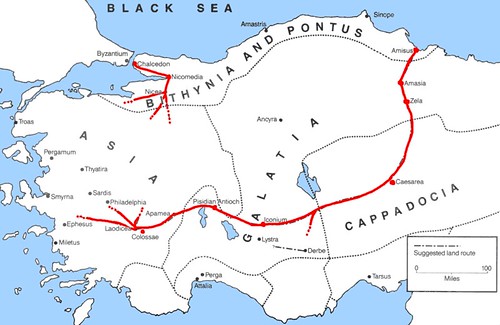
Given the likelihood 1 Peter was written to people in Asia and Anatolia*, and Acts is quite Pauline, and Paul was active nearby , the particular passages may well refer to a particular regional belief-system.

1 Peter 1:1
"Peter, an apostle of Jesus Christ, To God’s elect, strangers in the world, scattered throughout Pontus, Galatia, Cappadocia, Asia and Bithynia,"
.

Proposed Map for 1 Peter from http://quizpad.blogspot.com.au/2012/01/who-was-1-peter-written-to.html

6660394507_8d8a6c620e.jpg
 
Tertullian talked about Christians being called "Chrestians". He doesn't appear to be aware of a separate group by that name, and seems to be assuming that "Chrestians" referred to "Christians".

From here: http://www.earlychristianwritings.com/text/tertullian06.html

The name Christian, however, so far as its meaning goes, bears the sense of anointing. Even when by a faulty pronunciation you call us "Chrestians" (for you are not certain about even the sound of this noted name), you in fact lisp out the sense of pleasantness and goodness. You are therefore vilifying in harmless men even the harmless name we bear, which is not inconvenient for the tongue, nor harsh to the ear, nor injurious to a single being, nor rude for our country, being a good Greek word, as many others also are, and pleasant in sound and sense. Surely, surely, names are not things which deserve punishment by the sword, or the cross, or the beasts.​

I'm not aware of evidence for a non-Christian group called "Chrestians", if that is what is being argued.
 
Last edited:
GDon lack of knowledge does not help the HJ argument. Since he argued that christians were called chrestians then people of antiquity who did not believe the Jesus stories were also called chrestians. For example Marcion and the Marcionites would be called chrestians. Marcion taught his followers that the son of God was without birth and without flesh.
 
Sorry, I asked a couple of specific questions. Can you please reply to them? Here they are again.

Are you stating that the NS abbreviation in question represents the personal name "Chrestus" and refers to a person bearing that name?

Do you believe that when, for example, Acts 11:26 informs us that the word in the earliest versions was "Chrestians" and that the author intended it to be inferred that the disciples were followers of an individual called by the personal name "Chrestus"?

You avoid the point in my reply:

Remember Chrestus was also used as a title nearly as long as it had been used as a name.

"CHRESTOS PROTOS THESSALOS LARISSAIOS PELASGIOTES ETON IH

"Chrestos, the first, a Thessalonian from Larissa, Pelasgiot 18 years old Hero."

Dr. Clarke shows, the word Chrestos is found on the epitaphs of almost all
the ancient Larissians; but it is preceded always by a proper name."


Move over we have a

* a record of baptism involving "Chrest" in a Cemetery of Callisto's sepulchral inscription (268 CE)

* the Deir Ali Inscription (318 CE) to "Lord and Saviour JS the Good (χρηστοu)

* PGM IV. 3007-86 (c 4th century): "Hail, God of Abraham; hail, God of Isaac; hail, God of Jacob; Jesus Chrestos..."

* The Manichaean Manuscripts (4th century): "I Mani, the Apostle of [Je]su Chrestos (xphctoc) and all the other brethren that are with me ...."
 
Last edited:
Status
Not open for further replies.

Back
Top Bottom