• Quick note - the problem with Youtube videos not embedding on the forum appears to have been fixed, thanks to ZiprHead. If you do still see problems let me know.

Global warming discussion III

Status
Not open for further replies.
Let us get the bad taste of WUWT ignorance and delusions out of our mouths with some real climate science :D!
Global climate models describes what the initial value and boundary value problems are:
Chaotic nature of the climate system
The chaotic nature of the climate system was first recognized by Lorenz (1969, 1975), defining two types of problems associated with predictability:

•Predictability of the first kind, which is essentially the prediction of the future evolution of the atmosphere, given some knowledge of its initial state. Predictability of the first kind is therefore primarily an initial value problem, requiring a detailed set of good observations describing the actual conditions at the start of the modelling experiment. Daily numerical weather prediction is a typical example of this.

•Predictability of the second kind, in which the objective is to predict the evolution of the statistical properties of the climate system in response to changes in external forcings over time. Predictability of the second kind is essentially a boundary value problem, requiring good information on all external factors which might influence climate over time, e.g., variations in land use, ozone, aerosols, volcanic eruptions, solar variations, etc..

Georgi (2005) demonstrates why climate prediction generally should be considered an initial value problem.
 
Looking at the abstract of the paper, it appears Lloyd is talking about standard deviation of temperature considered as a time series sampled at hundred-year intervals, and is not talking about the standard deviation of temperatures averaged over those centuries. If so, then he's talking about weather, not climate...


Hell, the word "climate" doesn't even appear in the abstract, the listed keywords, or the sample image of the first page.
 
Hell, the word "climate" doesn't even appear in the abstract, the listed keywords, or the sample image of the first page.

it appears in four places in the body of the paper, in the following four sentences:

Pg. 1 in Introduction = third sentence first paragraph: "However, quantifying the impact requires the determination of some feedbacks in the climate system, and it has not thus far been possible either to measure these feedbacks to any degree of precision, or to agree on the physical principles that would allow their rigorous calculation."

Pg. 2 twice in the first sentence of a paragraph near the top of the page: "Davies and Hunt3 discussed the problem of detecting climate change in the presence of climate variability."

pg. 5 first sentence of Section 4. Discussion and Conclusion with the rather bizarre assertion that: " A single site on earth cannot describe the global climate, but it can clearly track changes in global temperatures to a reasonable degree."

Likewise it is mentioned in the titles of 10 works cited in their references

Unfortunately, the body of the paper lends no compelling support that the author actually understands the meaning of the term or the science related to such understandings.
 
Yikes. Shame on me.

Despite not having the access to see the few mentions of the term, you struck the nail head squarely with regard to the paper's lack of accurately describing or discussing Climate or climate change.
 
Anything that uses the word 'detrended' in climate publications immediately raises alarm bells unless they are looking for the triggers for internal variability. Tamino has used that to look at residuals to explain the factors involved, but always explains his reasoning. To try and deny the trend using detrended data is ridiculous.

The fascination with detrending seems to that if you remove the trend then there is no trend.
 

I like the way that WUWT is such a broad church. He publishes Anything that denies accepted climate science, even though most of them are mutually exclusive and contradict each other. You cant disprove something that way. It makes no logical sense. All it does is prove that you have no idea what any of those papers actually mean because if you did you would have to know that most of them must be wrong.
 
I like the way that WUWT is such a broad church. He publishes Anything that denies accepted climate science, even though most of them are mutually exclusive and contradict each other. You cant disprove something that way. It makes no logical sense. All it does is prove that you have no idea what any of those papers actually mean because if you did you would have to know that most of them must be wrong.

Great point.
 
Gore Speech today at Berkeley

Oops it was a month ago,

Streamed live on Apr 29, 2015

Al Gore, former Vice President of the United States and chairman of The Climate Reality Project, delivered his talk: Reality of the Climate Crisis and Road Forward for Humanity. The event was part of the Berkeley Haas School of Business' Dean's Speaker Series

https://www.youtube.com/watch?v=di-aimmdiDA


Oh,...speaking of climate reality leaders:
https://www.youtube.com/watch?v=KB7fVKT7lH8
 
Last edited:
Meanwhile Nature magazine has this authoritative article offering a few decades respite.

A new study, by scientists from the University of Southampton and National Oceanography Centre (NOC), implies that the global climate is on the verge of broad-scale change that could last for a number of decades.

The change to the new set of climatic conditions is associated with a cooling of the Atlantic, and is likely to bring drier summers in Britain and Ireland, accelerated sea-level rise along the northeast coast of the United States, and drought in the developing countries of the Sahel region. Since this new climatic phase could be half a degree cooler, it may well offer a brief reprise from the rise of global temperatures, as well as resulting in fewer hurricanes hitting the United States.

The study, published today in Nature, proves that ocean circulation is the link between weather and decadal scale climatic change. It is based on observational evidence of the link between ocean circulation and the decadal variability of sea surface temperatures in the Atlantic Ocean.


http://phys.org/news/2015-05-global-climate-verge-multi-decadal.html

The kids just got lucky. Plenty more snowboarding.
 
This is only a localized phenomena...NAO only shifts heat around in the Atlantic ocean basin as PDO does in the Pacific.
More heat may end up in the ocean but it does not change the gain...just where it ends up.

It's no respite globally if oceans are included.
 
Meanwhile Nature magazine has this authoritative article offering a few decades respite.

A new study, by scientists from the University of Southampton and National Oceanography Centre (NOC), implies that the global climate is on the verge of broad-scale change that could last for a number of decades.

The change to the new set of climatic conditions is associated with a cooling of the Atlantic, and is likely to bring drier summers in Britain and Ireland, accelerated sea-level rise along the northeast coast of the United States, and drought in the developing countries of the Sahel region. Since this new climatic phase could be half a degree cooler, it may well offer a brief reprise from the rise of global temperatures, as well as resulting in fewer hurricanes hitting the United States.

The study, published today in Nature, proves that ocean circulation is the link between weather and decadal scale climatic change. It is based on observational evidence of the link between ocean circulation and the decadal variability of sea surface temperatures in the Atlantic Ocean.


http://phys.org/news/2015-05-global-climate-verge-multi-decadal.html

The kids just got lucky. Plenty more snowboarding.

So, do you think record hot years, globally, during a negative AMO will convince people that something is wrong? or is that too esoteric a concept to be popularly grasped?

AMO variance generally isn't much over 0.5oC/decade. Current aerosol levels are dropping, high latitude albedo changes are dramatic and the current annual global increase is an accelerating increase of ~0.14oC/year. It is certainly possible that we will still see increasing global temps averages. Especially as AMO cycles tend to primarily impact the N. Atlantic region, and that area has increased in average temps much faster than the planet as a whole. It is quite possible that we have already surpassed AMO's influence by enough that its global influence has been devalued with respect to anthropogenic influences. even if this study's analysis is correct about an impending AMO transition. Many climate studies and models indicate the possibility of weakening AMO (and PDO) cycles as the high latitudes warm.
 
The article actually says reprise, not respite, which is a silly mistake to make as the word means the opposite of the one intended.

Is the effect of AMO comparable to ENSO, or would a change to an El Nino dominated phase there swamp it?
 
The article actually says reprise, not respite, which is a silly mistake to make as the word means the opposite of the one intended.
It's just a university press release. I'd guess someone was trying to spell reprieve/respite, made a hash of it, and let the spelling corrector take over.

ETA: The research paper's abstract correctly says respite.

This article from last year provides some background.
 
Last edited:
I like the way that WUWT is such a broad church. He publishes Anything that denies accepted climate science, even though most of them are mutually exclusive and contradict each other. You cant disprove something that way. It makes no logical sense. All it does is prove that you have no idea what any of those papers actually mean because if you did you would have to know that most of them must be wrong.


I like that too :D It's called balance ! It also shows the science is far from being "settled" in climate change :cool:

New Paper Confirms the Drivers of and Processes behind the Atlantic Multidecadal Oscillation
As could be expected, the alarmist mainstream media have so far chosen to ignore a paper that discusses an upcoming multidecadal natural suppression of global warming…probably because indicates the slowdown in global surface warming should continue and it implies the natural variability of the North Atlantic contributed to the global warming we have seen since the mid-1970s.


NASA: El Niño driven ‘stagnant upper-air pattern spread numerous storms and heavy rains [into] central Texas’ no mention of ‘climate change’
The climate zealots were out in force this week trying to link the rains in Texas to ‘climate change’. The press release from NASA makes no such connections, but instead blames a mundane weather pattern induced by El Niño.
 
Does not show that at all....it adds to the understanding of "inside the box " changes the AGW is driving in terms of it's affect on NAO, PDO and ENSO ocean changes.

None of those change the radiative balance at all other than minor impact on albedo.

The rain in Texas is not "caused" by AGW, but it sure as hell is influenced by it.

It found that one in five extreme rain events experienced globally are a result of the 0.85C global rise in temperatre since the Industrial Revolution, as power plants, factories and cars continue to pump out greenhouse gas emissions.

http://www.nature.com/articles/ncli...nN1Kg==&tracking_referrer=www.theguardian.com

Cities in non-tropical areas are simply not equipped to deal with monsoon level deluges.
The event in Toronto cost near a billion dollars ....and the little town of Burlington Ontario got a month of rain in 24 hours.

Same with Brisbane Australia....not equipped for the level of rainfall now occurring more frequently.

ENSO brings altered weather.
AGW forces the weather more frequently into the extremes....

This is going to be one wild year for extremes.

SSTA-April-17-2015.png


already is...note the record areas.

march-temps.jpg


There is ONE record coldest and that has some serious implications for Europe. If you understood some climate science you'd know what that anomaly implies.
 
Is the effect of AMO comparable to ENSO, or would a change to an El Nino dominated phase there swamp it?

Not sure how much El Nino (predominantly equatorial pacific ocean process) directly influences and shapes North Atlantic processes (AMO). We've had a positive AMO for most of the last 30-40 years. A negative AMO would normally (absent any other strong influences) cause a cooler North Atlantic region for a few decades, which would spill into N.E. seaboard region of N. America and Europe making summers a little drier and winters colder with more snow accumulations at high altitudes and latitudes. The point I was making, however, is that there are other strong influences in this region rght now, I'm not sure that the slight cooling of the North Atlantic region due to a negative AMO will make much difference given the much greater warming effects of the higher latitudes we are seeing due to AGW.
 
There is ONE record coldest and that has some serious implications for Europe. If you understood some climate science you'd know what that anomaly implies.


When are you going to deal with this ...

When Will Climate Scientists Say They Were Wrong?
Day after day, year after year, the hole that climate scientists have buried themselves in gets deeper and deeper. The longer that they wait to admit their overheated forecasts were wrong, the more they are going to harm all of science.

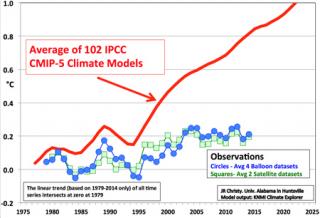
The story is told in a simple graph, the same one that University of Alabama’s John Christy presented to the House Committee on Natural Resources on May 15.

The picture shows the remarkable disconnect between predicted global warming and the real world.
 

First and foremost, neither climate models not the IPCC make predictions, they make projections of the data and trends based upon current and past analyses of observed data.

After this point is understood, we can discuss the accuracy and legitimacy of the portrayal presented in the Michael's illustration.
 
Status
Not open for further replies.

Back
Top Bottom