CapelDodger
Penultimate Amazing

Yeah, I'm blaming the Met tooIt's raining now. The forecast has been saying it was going to rain here Monday morning for about a week.
 .
.
Yeah, I'm blaming the Met tooIt's raining now. The forecast has been saying it was going to rain here Monday morning for about a week.
.
I note that Piers is declaring this period (13/14) a success on the Weather Action website.
http://www.weatheraction.com/displayarticle.asp?a=472&c=5
Three things are being used to confirm the forecast:
i) A Facebook conversation about storms in Seattle – the forecast does mention ‘some thunder’ for this area.
ii) A very misleading headline “BIGGEST hail for 30 years” The link leads to a posting by a resident of Everett who had never seen hail of the size shown, the photograph shows a not very large piece of hail in the hand of a young boy.
iii)Finally a couple of Severe Thunder Warnings are used to confirm the forecast. I see no evidence that these warnings materialised into actual storms.

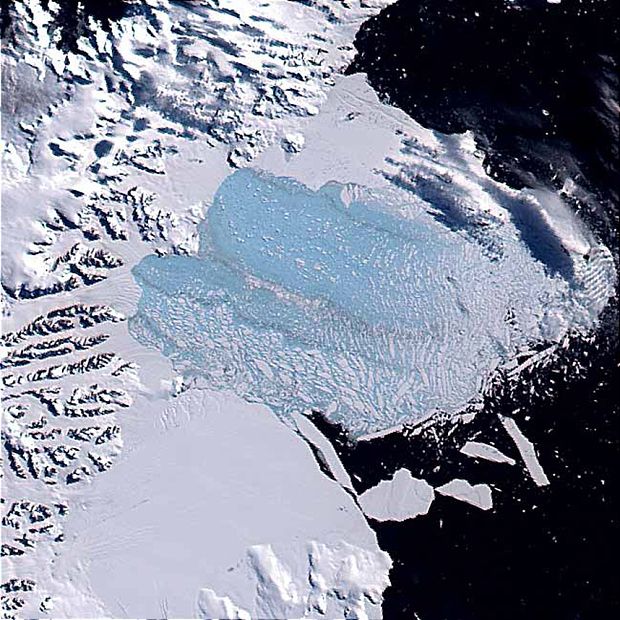
After 10,000 years giant Antarctic ice-shelf will be gone by 2020, Nasa report says
New Nasa studies warn of "bad news for our planet" as looming crack threatens to shatter Larsen B ice-shelf into pieces
It's not clear if Corbyn is basing his predictions on a model of some kind or if he's just making intelligent guesses, but either way his results are not particularly impressive.
Published on 29 Apr 2014
In his talk, Piers Corbyn described the failure of standard meteorology (SM) in outlook, theory, and practice. He included: signals in real meteorology data unexplained by SM; real role of jet stream, stratosphere, electro-jets, magnetosphere, solar wind, solar corona, and the Moon; the total inability of SM to explain: sudden stratospheric warmings and its consequences, tropical storm intensifications, angular momentum concentration in tornadoes; and the need for something else such as electromagnetic plasma explanations; the theoretical basis of non-standard long range weather forecasting on a real planet; a summary on his WeatherAction forecasting skill and examples; and the future of forecasting and meteorology, climate 'science' and science in general.
Piers Corbyn began recording weather and climate patterns at the age of five, constructing his own observation equipment. He obtained a first-class honors degree in physics at Imperial College London. In 1969, he became the first president of the Imperial College Students' Union to be directly elected by the student body. He later studied astrophysics in 1979 at Queen Mary College, London, and then began examining the relationship between Earth's weather and climate and solar activity. Following many years of weather prediction as an occupation, Piers formed WeatherAction in 1995, where he sells web-accessible long-range monthly forecasts for Britain and Ireland, Europe, and the USA plus special forecasts of 'Red Weather periods' and related increases in thunder/tornado and earthquake risk.
www.weatheraction.com
The robot sub surveys, which were spot-checked by drilling and shipboard tests, suggest Antarctica's average ice thickness is considerably higher than previous estimates. On average, the thickness of the ice was 4.6 to 18 feet (1.4 to 5.5 m). In the three regions it surveyed, the robot sub found that deformed, thickened ice accounted for at least half of and as much as 76 percent of the total ice volume, the researchers report.
"Our study shows that we're probably missing some of this thick ice, and we need to try to account for that when we try to compare what we see in models and satellites to what we see in the field," Maksym said.
The thickest ice measured during the survey was about 65 feet (20 m) thick, in the Bellingshausen Sea, Maksym told Live Science. In the Weddell Sea, the maximum ice thickness hit more than 45 feet (14 m), and offshore of Wilkes Land, the ice was about 53 feet (16 m) thick.
Growing sea ice surrounding Antarctica could prompt scientists to consider relocating research stations on the continent, according to the operations manager of the Australian Antarctic Division.
Rob Wooding said that resupplying Australia's Mawson Station -- the longest continuously operated outpost in Antarctica -- relied on access to a bay, a task increasingly complicated by sea ice blocking the way.
"We are noticing that the sea ice situation is becoming more difficult," Wooding told a media briefing on Monday ahead of two days of meetings between top Antarctic science and logistics experts in Hobart, the capital of Tasmania.
Others keep raising questions about him and It's just polite to answerCan we please keep Corbyns astrology drivel to the other thread?

Corbyn is a scientist don't you knowThis one is supposed to be about science.

That's just how he claims to produce his forecasts. It's obviously nonsense, intelligent guesswork would be more likely to produce a few hits.Here is the man himself explaining about the Sun - Earth connection and a bit of how his method works.
I'm sorry, you're quite right. I won't respond to it again.Can we please keep Corbyns astrology drivel to the other thread? This one is supposed to be about science.

...Corbyn is a scientist don't you know
"He obtained a first-class honors degree in physics at Imperial College London. In 1969, he became the first president of the Imperial College Students' Union to be directly elected by the student body. He later studied astrophysics in 1979 at Queen Mary College, London, and then began examining the relationship between Earth's weather and climate and solar activity."
Have a nice day
Woo hoo, makes me a scientist too...! Except I don't carry out research and publish my results either.Two points ...
Others keep raising questions about him and It's just polite to answer
Corbyn is a scientist don't you know
"He obtained a first-class honors degree in physics at Imperial College London. In 1969, he became the first president of the Imperial College Students' Union to be directly elected by the student body. He later studied astrophysics in 1979 at Queen Mary College, London, and then began examining the relationship between Earth's weather and climate and solar activity."
Have a nice day
Can we please keep Corbyns astrology drivel to the other thread? This one is supposed to be about science.
Woo hoo, makes me a scientist too...! Except I don't carry out research and publish my results either.

The loss of the ice shelf isn't directly harmful as it is already floating. Unfortunately it will mean that the glacier feeding it will flow faster, and that is directly harmful in terms of sea level rise.
The loss of the ice shelf isn't directly harmful as it is already floating. Unfortunately it will mean that the glacier feeding it will flow faster, and that is directly harmful in terms of sea level rise.

Growing sea ice surrounding Antarctica could prompt scientists to consider relocating research stations on the continent, according to the operations manager of the Australian Antarctic Division.
Mmm could that be caused by this volcanic action ????
Scientists Discover Undersea Volcano Off Antarctica
New Underwater Volcano Found
Anyway, there is an unprecedented amount of sea ice in the Antarctic with no sign of stopping and it's a lot thicker than they thought. Didn't you see my post HERE or just scroll up the page
Anyway, there is an unprecedented amount of sea ice in the Antarctic with no sign of stopping and it's a lot thicker than they thought. Didn't you see my post HERE or just scroll up the page

"In all, Mount St. Helens released 24 megatons of thermal energy, 7 of which was a direct result of the blast. This is equivalent to 1,600 times the size of the atomic bomb dropped on Hiroshima" (U.S. Geological Survey).
at a conference full of Velikovsky cranks, HaigHere is the man himself ...
 ! So we know that Piers Corbyn has lost touch with reality enough to be fooled into appearing at a crank conference.
Is Antarctica losing or gaining ice?Antarctic sea ice has been growing over the last few decades but it certainly is not due to cooling - the Southern Ocean has shown warming over same period. Increasing southern sea ice is due to a combination of complex phenomena including cyclonic winds around Antarctica and changes in ocean circulation.
The Ice isn't melting mythSatellites measure Antarctica is gaining sea ice but losing land ice at an accelerating rate which has implications for sea level rise.
Ice mass loss is occuring at an accelerated rate in Greenland, Antarctica and globally from inland glaciers. Arctic sea ice is also falling at an accelerated rate. The exception to this ice loss is Antarctic sea ice which has been growing despite the warming Southern Ocean. This is due to local factors unique to the area.
Obviously not, Haig - read the contents ofMmm could that be caused by this volcanic action ????
