• Security incident: ISF was recently accessed by intruders. Please change your password, and change it anywhere else you used it. Read more

Donte Stallworth's reflections on 9/11 CTs...

1. Are you sure that's the *only* analysis? And what does the size of the fuel tank have to do with the steel in the buildings? The much larger planes used on 9/11 had a lot of fuel at the time of impact and that fuel burned up in what, 5-10 minutes? Frank De Martini

2. The buildings withstood the impacts. The jet fuel burned up long before the collapses occurred. So, according to the POV you defend, the fires from flammable material within the Twin Towers were the heat source that caused the collapses. However, you don't know what failed (nor probably care), but you know for sure that the fires from the office materials is the culprit, along with the impacts the buildings absorbed just as they were designed to do.


A larger load of accelerant will start more extensive fires quicker. The structural damage was far worse than the 707 would have inflicted.

Have you done the kinetic energy calculations yet?
 
A larger load of accelerant will start more extensive fires quicker. The structural damage was far worse than the 707 would have inflicted.

Have you done the kinetic energy calculations yet?

1. Again, the larger amount of jet fuel burned up well before either Tower collapsed. That left the existing flammable materials to do the heavy-lifting. And you contend that those office materials burned hot enough to effect the Towers' remaining support structures?

2. Obviously, the Towers absorbed them nonetheless.
 
1. He confirms the buildings ability to absorb a large aircraft impact.

Which they did. Both towers stood after the initial impacts even though they were 5-7 times greater than what was modeled in the 1960's.

Your point?

2. The effects of burning jet fuel wasn't known in the 1960's? You buy that?

Fire was not modeled back in the slide-rule era. Couldn't be. It would be extremely difficult to do even today. Yes, that is 100% plausible.

3. He says that he didn't have access to fireproofing systems. Why would he need them anyway? Jet fuel burning office materials did not = hot enough fires in the 1960's to cause steel to fail and collapse to the ground in a hurry.

Acting like a true CT - concentrating on only one element (the fires) while ignoring the physical damage from impact and its effect on fire suppression systems and structural members.

4. How many skyscrapers around the world have been on fire for hours-and-hours and did not globally fail like the Twin Towers and Building 7 on 9/11?

Doesn't matter. See #3

So a half-century ago a crude slide-rule model was done to assess what might happen if a Boeing 707 (smaller and lighter than a 767) on landing approach (low fuel load, much lower speeds than 9/11) were to impact the Twin Towers. The model showed the buildings would survive the initial impact. As a point of historical fact on 9/11/2001 both towers survived much more severe initial impacts long enough for thousands of people to escape.

I would say the buildings performed rather well. How about you?
 
Last edited:
Most people to miss the key impact of heat on a steel frame - elongation, warping and connection destruction. The towers failed because the frame members... largely braces expanded and pushed columns out of axcial alignment and failed the connections/splices.
LOSS / lowering of yield strength was not the mechanism/cause leading to the failure/collapse of the frame.
 
1. Again, the larger amount of jet fuel burned up well before either Tower collapsed. That left the existing flammable materials to do the heavy-lifting. And you contend that those office materials burned hot enough to effect the Towers' remaining support structures?

You're missing the point. The heavier load of kerosene was spread over a larger area of more floors than in the case of the proposed 707, leading to greater stresses on the building. But, yes, in the end it was office material that did the "heavy lifting. It's just that there was far more of it involved than the 707 would have ignited, and the buildings' physical integrity was more compromised by impact on 9/11.

Have you done the KE calculations yet?
 
1. Again, the larger amount of jet fuel burned up well before either Tower collapsed. That left the existing flammable materials to do the heavy-lifting. And you contend that those office materials burned hot enough to effect the Towers' remaining support structures?
What, larger amount.

Jet fuel, 66,000 pounds/10,000 gallons is equal in heat energy to 315 tons of TNT. Do you want this in joules?
Thus both jet fuel fires were only 630 tons of TNT in heat energy.

The office fires which you seem to think are smaller, were equal in heat energy of over 2,700 tons of TNT.

Which one is bigger? Gee, NIST only used the office fires to model the heat, they ignored your "larger" amount of jet fuel, and you have thus expose the fact you never read NIST, or studied 911.


2. Obviously, the Towers absorbed them nonetheless.
The idea was not to absorb the energy of impact, it was to stop the plane at the shell Mr Bond.

As for damage by the plane, it would not cause a collapse, it was fire. Did the plane dislodge fire proofing, yes.


...
So what did the fire make fail?
Wow, who knows? With office fires equal in heat energy of 2,7000 TONS of thermite, and not counting the jet fuel in that, what could fire do?

Gee, who knows; you don't
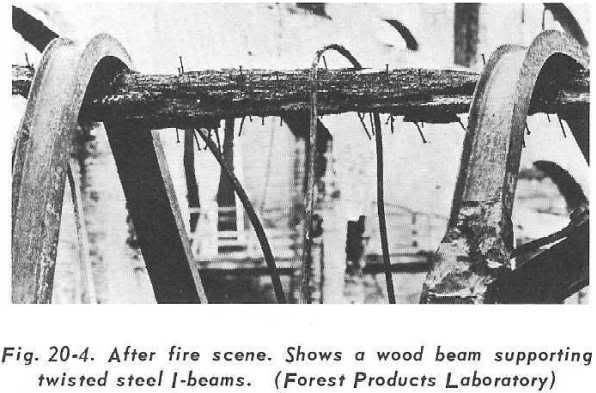
woodsteelfire.jpg

I do.

The WTC was designed to stop a plane at 180 mph, stop it. It was not a hard thing to design in because Robertson and the engineers decided to move the interior columns to the exterior, the shell would be the inner column removed to open up floor space. Thus the exterior would stop a 707 low on fuel, lost in the fog. Robertson did not consider fire inside the WTC, the 707 would not enter the building at 180 mph. Do the math, you will find out.

There was talk of a study at 600 mph, there is no record.

There are two aspects of a plane crash; will the plane topple the WTC, how could it, the WTC could handle hurricane winds, a plane would not be more in energy than the hurricane winds; would not topple over.

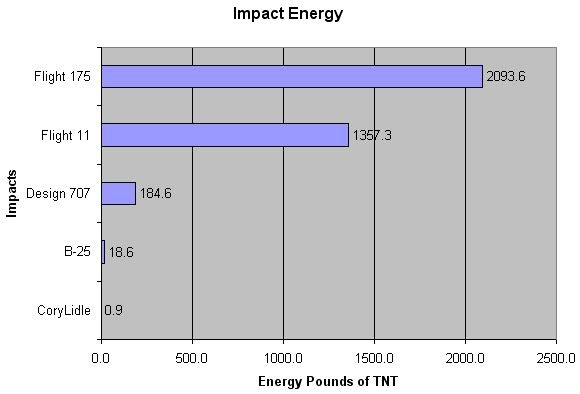
But the aircraft impact is based on the ESB B-25 impact; the B-25 entered the building and did a lot of damage. The ESB B-25 kinetic energy was equal to 18 pounds of TNT. Yet it entered the building
The WTC exterior was over 10 times stronger than the ESB exterior, and would stop, STOP, a 707 at 180 mph, with kinetic energy equal to 180 pounds of TNT.

On 911 flight 11 had 1300 pounds of TNT in kinetic energy, 7 times the amount the WTC shell would stop.
Flight 175 had 2093 pounds of TNT in kinetic energy, 11 times the energy the WTC would stop.

I bring math, you bring BS, and quote-mined opinions based on BS you googled from 911 truth. Now you are in full repeat BS from 911 truth, Gish Gallop mode.


The exterior of the WTC would have stopped the aircraft at the shell, if they were going below 200 mph.
impactenergywtc.jpg

Flight 11 was not going 200 mph, it was going 470 mph.
Flight 175 was not going 200 mph, it was going 590 mph.
Flight 11 and 175 were not lost in the fog, they were used as weapons of mass destruction - found in the skies of the USA.

The fire was not a factor because a plane lost in the fog, landing has no options to fly except to landing. Thus there is no fuel, and remaining fuel would burn on the exterior, with some spilling inside, but the systems would not be damaged inside, because the plane would be stopped outside.

No big deal, 911 truth fails to comprehend the design Robertson did, and that it stops the plane; on 911 the impacts exceeded the design to stop a plane by 7 and 11 times. This is significant. The design claim ends at 180 mph.
BTW Frank De Martini is not an engineer, so quote-mining him makes your opinion dumber. And his statement is false.
https://www.youtube.com/watch?v=1pvEge5HPJU
He says fully loaded, it was a 707 at 263,000 pounds, low on fuel, lost in the fog. Fully loaded would be 333,000 pounds, which means the fuel is now gone, a plane is trying to land, out of fuel, unable to divert, lost in the fog. Math, you failed to use math.

You don't do research, and when you read, you don't understand what you read; as you quote mine and make up nonsense.
https://www.nae.edu/Publications/Br...ecurity/ReflectionsontheWorldTradeCenter.aspx
https://www.nae.edu/File.aspx?id=7345
http://en.wikipedia.org/wiki/B-25_Empire_State_Building_crash
Robertson design was to stop the plane, at the shell. There would be no major fire.
The B-25 with only 38,978,660 joules at impact entered the ESB, a 707 at 386,215,069 joules would be stopped by the WTC.

You don't study before you make up BS.
Read before you make up more nonsense.
https://www.nae.edu/File.aspx?id=7345

 
Last edited:
Where is Jango?

1. He confirms the buildings ability to absorb a large aircraft impact.
Nope, Robertson confirms his design was 180 mph, not 470 mph, not 590 mph. We have a failure to understand the limits of the design.


2. The effects of burning jet fuel wasn't known in the 1960's? You buy that?
That is not what he said, if you are going to be skeptical, stick to the facts. Redo
To the best of our knowledge, little was known about the effects of a fire from such an aircraft, and no designs were prepared for that circumstance. Indeed, at that time, no fireproofing systems were available to control the effects of such fires. https://www.nae.edu/File.aspx?id=7345
Was there a study of fires started by massive aircraft impact at 4,379,776,421 joules, with 10,000 gallons of jet fuel in the 60-70s when he designed the buildings. I am not sure how you can question a statement he makes, he did the design. What is your point? Who did a study for a fire started on multiple floors in a few seconds with 10,000 gallons of accelerant, and with extra air from holes and broken windows feeding the biggest office fires in history; so big they destroyed the building in less than 2 hours. Office fires which continued for weeks? You know of a bigger office fire start in seconds?

3. He says that he didn't have access to fireproofing systems. Why would he need them anyway? Jet fuel burning office materials did not = hot enough fires in the 1960's to cause steel to fail and collapse to the ground in a hurry.
Fire destroys the strength of steel, not sure what your BS statement mean, it is nonsense.

Again, you state BS based on zero research, and failed comprehension of what he said. He says he created fireproofing systems.
We developed the concept of and made use of the fire-rated shaft-wall partition system, which is now widely used in place of masonry and plaster walls. https://www.nae.edu/File.aspx?id=7345
You make up BS based on failed comprehension.

4. How many skyscrapers around the world have been on fire for hours-and-hours and did not globally fail like the Twin Towers and Building 7 on 9/11?
Why do you ask questions? JAQ, is a sign or BS from 911 truth.
Better question, how many buildings have had big holes, lots of windows broken, fireproofing destroyed, and 10,000 gallons of burning jet fuel start fires on multiple floors with 6 to 10 core columns destroyed by an aircraft impacts at high speed.


Ironically, zero or little research was done, and when presented with sources you quote mine the wrong meaning; quote mine more BS and makeup dumber claims, and dumber questions.
 
You're missing the point. The heavier load of kerosene was spread over a larger area of more floors than in the case of the proposed 707, leading to greater stresses on the building. But, yes, in the end it was office material that did the "heavy lifting. It's just that there was far more of it involved than the 707 would have ignited, and the buildings' physical integrity was more compromised by impact on 9/11.

Have you done the KE calculations yet?

I don't need too. Increased mass + increased speed = more force than what was designed for from the 707's mass + speed. Yes, that is self-evident. The buildings nonetheless absorbed both enormous blows and did not immediately collapse.

The problem thus, is the lack of precise information in-between the time of the impacts to the time of the collapses. I've seen variations of the estimates on the remaining intact support structures. Where do you hold that estimate to be, say, percentage wise of post-impact intact support structures?
 
I don't need too. Increased mass + increased speed = more force than what was designed for from the 707's mass + speed. Yes, that is self-evident. The buildings nonetheless absorbed both enormous blows and did not immediately collapse.
True.

The problem thus, is the lack of precise information in-between the time of the impacts to the time of the collapses.
Partially true but it is neither "The problem" nor even "The most important problem". IMNSHO. :teacher:
I've seen variations of the estimates on the remaining intact support structures. Where do you hold that estimate to be, say, percentage wise of post-impact intact support structures?
I suggest that understanding will be easier if we work from the bigger picture and known facts. Trying to work from unknown details will always be problematic. Get a frame around the issue first THEN assess whether or not you have enough info. And if you are missing details THEN use "best case/worst case" reasoning. :teacher:

I've been tempted to OP the thread to meet your challenge:
It would be a welcomed occurrence to be casually "walked-through" the technical aspects because as I've said before, my hang up is the initiation sequence, such as, What Had To Fail To Cause The Global Collapse.

To use terms I've seen you use before: What caused the "top block" to collapse.

I was not lying when I said I haven't seen that argument. I said that because I haven't seen that argument...
But forget the OP - lets start the process here:

My procedural ground rules:

1) It will be my explanation. Not relying on NIST, Bazant or any other authority;
2) My objective for this stage of discussion process will be that you comprehend the form of "cascade failure" which initiated the collapses of both Twin Towers;
3) I will leave the possibility of CD in the mix to avoid pre-emptive strikes from either "side";
4) I will start from known facts which should be points of agreement;
5) I will progress in steps - advancing to the next step once we agree on the current step;
6) My process will include explanation of some aspects of engineering which are critical to progress of the cascade failures and which are commonly misunderstood in these discussions;
7) I will be looking for agreement and understanding of the points I make - not vaguely stated or more global counter assertions which are not specifically directed at the points I am making; AND
7) It will be qualitative - not quantitative.

So those are my ground rules - is there anything you want clarified?

Step One - Defining and agreeing the scenario.


The overall scenario for collapse initiation extends from "aircraft impact" through to "Top Block" falling bodily. The sequence and key points being:
A) Aircraft Impact caused damage and started fires;
B) Damage accumulated as a consequence of fires and any CD which may have been performed;
C) The damage increased to the stage where the "Top Block" started to descend bodily;
D) We may need the intermediary step of "Point at which remaining columns are no longer able to support top block". (Which led immediately to failure of all those columns which has survived to that point.)
E) Top Block descending bodily marks the end of our interest for this topic. (I will take it to the point where "ROOSD" driven progression is under way.)

Do you agree those five identify/scope the scenario? Do you have any you want to add to define the scenario?

Once we agree those scenario and starting point factors I would go on to explain:
P) The failure is in vertical load carrying - vertical load carrying is the function of columns - failure of columns is therefore the main contributor to collapse initiation - and we have two main reasons for failure viz (i) cutting by impact or CD and (ii) failure in axial overload.
Q) Understanding the balance of factors in failure by axial overload- that is the one place where temperature will be relevant and it is a column by column specific balance of factors. (But we dont need to know the details for every column...we only need generic understanding.)
R) Concepts of "load redistribution" which are central to cascade failure - including why they must be understood in 3D and why load redistribution does not proportionately follow the proportion of already failed columns.

Those will do as starters. Without doubt we will identify more as discussion progresses.

Are you comfortable with:
X) The procedural basics - I will be presenting my explanation NOT responding to other person’s ideas of their own explanation; AND
Y) The starting points for the scenario?

Your turn Jango. ;)


PS - add this in somewhere - "As I progress I will identify common misunderstandings which my explanation should help correct. I'll make them anonymous - without fear or favour to which side the errors come from." :)
 
Last edited:
... is the lack of precise information in-between the time of the impacts to the time of the collapses. ...
another failed claim; let me fill in the "in-between" time you ignore... massive fires, with the heat energy more than 2,700 tons of thermite; oops, that fills in the in-between time - did you miss the fires?

You offer no information, or insight, only failed claims based on ignoring facts, and evidence.

You left out the 11,000,000,000,000 joules of heat energy in the WTC towers due to office fires alone, prior to collapse. Not to mention the 1,300,000,000,000 joules in heat energy from the jet fuel, times two, at impact time. How did you ignore this fact?
 
Last edited:
Oz, please OP this. No one will ever search this in a Stallworth thread, and I am fairly sure it's madly off-topic anyway (as if anyone here cared by this point in time :o)
 
Oz, please OP this. No one will ever search this in a Stallworth thread, and I am fairly sure it's madly off-topic anyway (as if anyone here cared by this point in time :o)

Agreed. This has the potential to be the start of an intelligent and informative thread, and God knows we could do with a few of those.

Dave
 
Oz, please OP this. No one will ever search this in a Stallworth thread, and I am fairly sure it's madly off-topic anyway (as if anyone here cared by this point in time :o)

Agreed. This has the potential to be the start of an intelligent and informative thread, and God knows we could do with a few of those.

Dave
You win. Done. This thread

Members please ignore my post #109 in this thread.
 

ISF - Join now!

Every member here is approved by hand. No bots, no spam, just people who care about evidence and honest debate.

Membership is free!

Create your free account

Back
Top Bottom