• Security incident: ISF was recently accessed by intruders. Please change your password, and change it anywhere else you used it. Read more

Antibiotics, bacteria, resistance & inherited traits

And this bit is critical. Let's not forget, the body's native mechanisms are fighting the bacteria as well - you don't really kill all the bugs with an antibiotic anyhow. But you do have to kill enough that the body can deal with the rest.

So, even if you have some antibiotic resistance, you can still cure the infection if you reduce the number of bacteria enough.

Resistance isn't an all-or-none thing. It's more like how much of the forest do you have to protect to stop the wildfire? Some of the trees can burn and go out, sometimes a fire-break will do, and sometimes you better get as many planes dumping stuff as you can.

Some antibiotics don't kill even one microbe - many are 'bacteriostatic' and simply slow growth. Discontinuing the course gives the bacteria an opportunity to bounce back enough to shed to other hosts, and post-exposure, a disproportionate percentage will be resistant to the antibiotic. The new host gets inoculated with predominately resistant bacteria from the start.
 
So when the CDC says we've reached the "End of Anti-biotics" what does that mean? How are we supposed to fight future 'superbugs"?
 
So when the CDC says we've reached the "End of Anti-biotics" what does that mean? How are we supposed to fight future 'superbugs"?

It's hyperbole.

Relatively little research funding is devoted to researching new antibiotics because pretty much nobody uses them for mare than a couple of weeks. There are exceptions, for example, TB antibiotics are a six month course. Been there, done that. Not fun.

Pharma companies are more inclined to work on drugs that are high value or long term scenarios purely on commercial grounds.
 
It's hyperbole.

Relatively little research funding is devoted to researching new antibiotics because pretty much nobody uses them for mare than a couple of weeks. There are exceptions, for example, TB antibiotics are a six month course. Been there, done that. Not fun.

Pharma companies are more inclined to work on drugs that are high value or long term scenarios purely on commercial grounds.

I think the economic value of a product is calculated differently. Firstly, antibiotics are not just for humans. They're used in food production. But even short term human use can be very profitable for a high volume of customers. Antibiotics have a huge potential footprint: everybody, plus agriculture. Secondly, infections can be incredibly dangerous and often fatal, even for minor injuries. The value of that short course is very high if the alternative is death or permanent disability.

My understanding is that, at the moment, there's a lot of investment in antibiotic research (both from pharmaceuticals and governments). It's considered an imminent crisis. The reason there's not much progress is that there's not a lot of ideas that are panning out.
 
I think the economic value of a product is calculated differently. Firstly, antibiotics are not just for humans. They're used in food production. But even short term human use can be very profitable for a high volume of customers. Antibiotics have a huge potential footprint: everybody, plus agriculture. Secondly, infections can be incredibly dangerous and often fatal, even for minor injuries. The value of that short course is very high if the alternative is death or permanent disability.

My understanding is that, at the moment, there's a lot of investment in antibiotic research (both from pharmaceuticals and governments). It's considered an imminent crisis. The reason there's not much progress is that there's not a lot of ideas that are panning out.

There have have been a lot of reasons that new antibiotics would not be as profitable as other types of drugs (such how they get approved for each use and type of infection and also how much people are comfortable paying). This is why congress passed the GAIN act (modeled after the very successful orphan drug laws) a few years ago to simulate more investment. You're right though that a lot of the low hanging fruit in that field has been picked already. This is also kind of true for pharma as a whole.
 
Last edited:
Pharma companies are more inclined to work on drugs that are high value or long term scenarios purely on commercial grounds.
Palliatives for chronic conditions are where the money is, not cures. The return customers, not the drop-ins. Cures are mostly pursued in universities and other non-commercial institutions.

For pharma companies antibiotics are a bit of a pain, like the charity gigs you have to do for image. Pushing them into agribusiness just lessens the pain a little, and may be a path out of the career equivalent of death-in-life by demonstrating the right kind of spirit.

It's no coincidence that the push-back against the heliobacter pylori theory died away as soon as Glaxo's patent on Zantac expired. The returns on that particular palliative were pretty boggling.
 
They do win. Methicillin-resistant staphylococcus aureus is an antibiotic resistant strain of bacteria which resists all treatment except for vanomycin. Until 1997, when strains of MRSA turned up which were now resistant to vanomycin. Evolution is one bad mother.
Actually you are referring to HA MRSA for hospital acquired. The CA MRSA (community acquired) that is responsible for most infections is still treatable with different classes of antibiotics.

A particular cytotoxin has made the organism successful and is responsible for the spread of this pathogen around the world.

Panton–Valentine leukocidin (PVL) is a cytotoxin—one of the β-pore-forming toxins. The presence of PVL is associated with increased virulence of certain strains (isolates) of Staphylococcus aureus. It is present in the majority[1] of community-associated Methicillin-resistant Staphylococcus aureus (CA-MRSA) isolates studied[2][3] and is the cause of necrotic lesions involving the skin or mucosa, including necrotic hemorrhagic pneumonia. PVL creates pores in the membranes of infected cells. PVL is produced from the genetic material of a bacteriophage that infects Staphylococcus aureus, making it more virulent.[4]

And now another major strain has emerged: LA MRSA, (livestock acquired).
In June 2011, the discovery of a new strain of MRSA was announced by two separate teams of researchers in the UK. Its genetic makeup was reportedly more similar to strains found in animals, and testing kits designed to detect MRSA were unable to identify it.[65] This MRSA strain, Clonal Complex 398 (CC398), is responsible for Livestock-associated MRSA (LA-MRSA) infections.[54] Although it is known to be more persistent in colonizing pigs and calves, there have been cases of LA-MRSA carriers with pneumonia, endocarditis, and necrotising fasciitis.[66]


A recent news item claimed a ninth-centry remedy found in an old-english manuscript made from onions, garlic and cow bile was up to 90% effective against it.

http://www.bbc.co.uk/news/uk-england-nottinghamshire-32117815
It was talking about eye infections, I was thinking about topical uses.
I don't think I'd like to put onions, garlic, or cow bile in my eyes.
A lot of things are toxic to the microorganisms in vitro (in the test tube) but aren't useful in vivo (in your body) This discovery does not mean this ancient folk remedy has any real value other than an interesting lead to follow.


...
The fast mutation rate means that if there is no selection pressure for a trait (because an antibiotic is not being used, for example) then it will get lost, like sight in cave fish.

Even better, if there is a cost associated with the antibiotic resistance, that would lead to a selective pressure against the trait in the absence of the antibiotic.
We've seen from HIV though, that said dormant resistance can readily reemerge so the genetic code is probably not lost.

Another interesting trait in some microorganisms is when they are exposed to a toxin, they shut off their own DNA/RNA repair mechanisms thus increasing the rate of mutation.
 
A lot of things are toxic to the microorganisms in vitro (in the test tube) but aren't useful in vivo (in your body) This discovery does not mean this ancient folk remedy has any real value other than an interesting lead to follow.
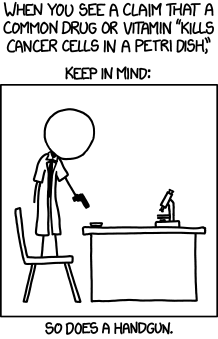
http://xkcd.com/1217/
cells.png


Now, if it selectively kills cancer cells in a petri dish, you can be sure it's at least a great breakthrough for everyone suffering from petri dish cancer.


I'd say that as this had been used as a salve does mean that it's likely to be appropriate as a topical salve.
 
We've seen from HIV though, that said dormant resistance can readily reemerge so the genetic code is probably not lost.

I can speak to this, as it was my master's thesis.

The resistant code is not really dormant in the same way as we see with bacteria; it's just that the back-and-forth-mutation among strains involves so few base pairs that it re-emerges frequently and will re-dominate in the right environment.
 
As I understand it, the problem isn't that the dose is too low to kill an individual bacterium, but too low to kill them all, leaving just the most-resistant variant(s). Those can then multiply. The antibiotic is providing the evolutionary selective pressure.

Yes, that's how I understood it, as well. How do bacteria form resistance?
 
Yes, that's how I understood it, as well. How do bacteria form resistance?

If the question is about an source for a de novo trait, rather than plasmid transmission, for example, the answer is 'random mutation' or 'optimized combination of existing traits'.
 
So when the CDC says we've reached the "End of Anti-biotics" what does that mean? How are we supposed to fight future 'superbugs"?

One article I read mentioned the possibility of reusing old antibiotics from the 60s. By the following decade, there had already been a few groups of bacteria that developed resistance to those drugs, and that pattern followed for subsequent new drugs.

It's certainly feasible but I don't know how long it would take for certain bacteria to lose the ability to resist popular drugs from the mid-century. And even if it somehow worked on today's hardest bugs, I don't think the effect would last very long. I think it would look like an engineer trying to relearn some calculus and picking it up faster than they could when they first took it in undergrad.
 
This paragraph is from an article on Shigellosis, an intestinal infection which is causing some concern in the US at the moment:

Drug resistance develops when bacteria comes into contact with antibiotics at doses that are too low to kill them. When that happens, bacteria adapts to the drug and passes their newly developed resistance on to subsequent generations. It’s unclear exactly why drug-resistant Shigella has increased in the US, but it’s likely that this has something to do with people who don’t finish taking the antibiotics that have been prescribed to them.​

Source: http://www.theverge.com/2015/4/2/8335021/Shigellosis-cdc-drug-resistant-intestinal-illness

Can the highlighted portion be accurate? How does a "newly developed resistance [pass] on to subsequent generations" in any sense, outside of long-debunked Lammarkian evolution theory? Is the writer of the article over-simplifying to the point of garbling the actual process? Please help me understand.

The statement is literally wrong, but operationally correct.

Bacteria have the proven capacity to evolve antibiotic resistance through a combination of natural selection and inherited random variation. Inherited random variation occurs all the time, but the inherited variants don't dominate the population because they generally lose the competition between the bacteria. If a bacterial population is exposed to small doses of antibiotic, such that a fraction of bacteria are killed immediately, a small number of the bacteria with an inherited resistance will survive. They will take over the habitats where the low resistance bacteria used to live. Once the high resistance bacteria take over the population, there is still random variation in the population. Some of the random variation ADDS to the antibiotic resistance of the bacteria in the new population. So the new population includes a few bacteria even more resistant than the few bacteria that were resistant before the antibiotic was added.

If the dosage of antibiotic is increased slowly, such that only a fraction of the bacteria are killed each generation, the process is repeated over and over. No matter what the final concentration of antibiotic is, the result of gradual increase in dosage is a population of bacteria immune to that level of concentration.

Humans can also evolve antibiotic resistance, bu they do it slower than bacterium. A bacterium can divide every hour. A person can live many decades. So a bacterium can develop antibiotic resistance to concentrations high enough to kill a human. Humans can't keep up with bacteria by evolving because they reproduce too slowly.

The phrase 'inherited random variation' is used here to avoid equivocation with the word 'mutation'. Some people equivocate to diminish the concern for this very important problem. Some people will deny that evolution leads to antibiotic resistance by claiming that evolution only includes point mutation, for example. I include de nova mutation, gene duplication, and lateral gene transmission. These different 'random mutations' can all contribute to antibiotic resistance.

The meaning of the word 'adaption' is rather ambiguous in common speech. The word is often used in a way that implies an inherited variation that isn't random.This sort of thing is Lamarkian evolution.

Incidentally, there is a pseudo-Lamarkian type of development called transgenerational epigenetic inheritance.This is probably not what Lamark had in mind, but it has a superficial resemblance. This is also probably not what the the article was talking about. However, research is being done to determine how important it is.

 

ISF - Join now!

Every member here is approved by hand. No bots, no spam, just people who care about evidence and honest debate.

Membership is free!

Create your free account

Back
Top Bottom