• Quick note - the problem with Youtube videos not embedding on the forum appears to have been fixed, thanks to ZiprHead. If you do still see problems let me know.

God enthusiasm

People are saying that you can't be a "proper" skeptic (whatever that means) unless you are a god skeptic, and that's the part I don't agree with.

I see God as a part of the supernatural. How can you be skeptical of one type of supernatural but believe other types? Is it okay to believe in Santa but not aliens or okay to believe in angels but not ghosts? How does that work?
 
Obviously none of us is free of blind spots, but you have to at least admit not applying critical thinking to god beliefs is a double standard.
No, I have to do no such thing. It's not a double standard, it's simply choosing your battles. As you say, none of us is free of blind spots. It would be hypocritical to claim that because you have a blind spot, you therefore can't call yourself a skeptic.

Being a skeptic does not mean that you have to actively apply critical thinking skills to every possible aspect of existence. It means that you are aware of and use skeptical tools, but it carries no obligation that you must apply those tools to every moment of every day of your life.

Some skeptics - Martin Gardner, for example - found it comforting to believe in a supreme being, even though he knew full well that there was no evidence of such a thing's existence. Is he therefore not a skeptic?

As skeptics we should be welcoming whoever we can, not excluding people from our special club if they won't recite the requisite verses about how awesome tigers are.

NOMa is a flawed philosophy.
They're not necessarily the same thing. NOMA only applies inasmuch religion makes no testable claims. I think you would agree that there are times when it does, but there are also times when it doesn't, and at those times skepticism does not (and can not) apply.
 
There are bigfoot enthusiasts, alien enthusiasts, and ghost enthusiasts, so how are god enthusiasts any different?

If you can be a bigfoot skeptic, alien skeptic, and ghost skeptic then why not god skeptic?

These all seem to be beliefs or lack of belief in imaginary things. Why do people insist on classifying them differently? For example, if you are afraid of ghosts, you are childish; but if you are afraid of God, you are righteous? Why is it that if you think zombies might burrow out of the ground you've probably been watching too many zombie movies but a similar belief about Jesus only makes you a Christian? Believing that if you write to Santa he'll bring you presents makes you naiive but believing that if you pray to God he'll reward you makes you devout?

God seems to be the childhood fantasy that adults feel comfortable holding onto. But I am baffled about the malice. If one child told another that he hoped the other child would get stomped to death by reindeer or strangled by elves for not believing in Santa, you would probably feel that therapy was in order and it would not be defended if an adult said it. Yet, if a religious person suggests that Hurricane Katrina was punishment for a gay pride parade or suggests that God will destroy an entire nation that is often defended. Is God the delusion that adults feel comfortable defending?


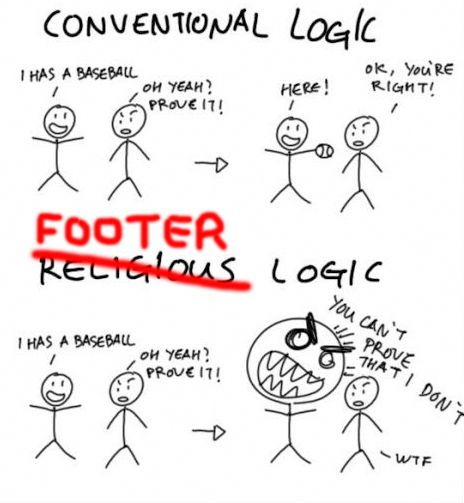
This represents how I feel about both subjects. (russell's teapot comes to mind)

religion_zpsbee9780e.jpg


I believe one day religions will be looked at as one of the largest hoaxes of all time. Certain extremists have been warping and manipulating people with catastrophic consequences.
 
Skeptic ginger is I think correct, NOMA is flawed. I like Gould in fact I'm rereading his book on the burgess shale but I have never understood the position that some claims are untestable and science should not be involved.
Any religious text you pick makes many claims about the cosmos which are ,and should be,refuted.
 
Skeptic ginger is I think correct, NOMA is flawed. I like Gould in fact I'm rereading his book on the burgess shale but I have never understood the position that some claims are untestable and science should not be involved.
Any religious text you pick makes many claims about the cosmos which are ,and should be,refuted.
My comp was getting a poor signal that's why I posted twice. I didn't think the first worked and I'm a comp dumbo.
 
Last edited:
They're not angry at God, not really. They're really angry at people that aren't really Christians, people who use the love of God for their own purposes. God really loves people and won't let the true love be prostituted. This is why it's primarily used to bestow touch downs. No exploitation is allowed of God's true love.
Cosi cosi, sos so...
Truth is some people just don't understand, can' t conceive atheism - or so they say or behave like. Thus, in their minds, when I say "I am atheist" what I am actually doing is moving away from some Abrahamic god because he did something that somehow hurted me. I am misbehaving, not unlike a child running away from home because (s)he is angry with hers/his parents.

"Why are you angry with UFOs?" and "why are you angry with bigfoots" are very rare. Sure, I've read some sentences which could be seen as rough analogues.
 
if a religious person suggests that Hurricane Katrina was punishment for a gay pride parade or suggests that God will destroy an entire nation that is often defended.
Actually, in moderately sensible countries like Australia, such claims are widely derided by religious and non religious alike.

I hate to say it but when we hear those claims in Australia, we don't so much think "stupid rreligious" as "stupid Americans "
 
NOMa is a flawed philosophy.

I had to look this up: http://en.wikipedia.org/wiki/Non-overlapping_magisteria

is the view advocated by Stephen Jay Gould that science and religion each represent different areas of inquiry - fact vs. values - so that there is a difference between the "nets" over which they have "a legitimate magisterium, or domain of teaching authority," and these two domains do not overlap

I wasn't familiar with the term. As far as I can tell, Gould was partially correct from a brain functional or cognitive point of view but not correct in terms of fact versus values. My cognitive theory includes prejudice. I can probably also include religious belief. However, just because the brain tends towards prejudice does not mean that it is something to hold onto and never examine.
 
They're not necessarily the same thing. NOMA only applies inasmuch religion makes no testable claims. I think you would agree that there are times when it does, but there are also times when it doesn't, and at those times skepticism does not (and can not) apply.

Sure it can. Let's take the ultimate untestable god, the invisible dragon/god in my garage, aka the god of the gaps. [Edited to add: On rereading, I may have misunderstood what "those times" were. If they're not times when a god-claim is untestable, my apologies, and I'll just leave the following as a discussion of untestable gods that's not necessarily a response to your post.)

If someone claims there is a god of the gaps, I can be skeptical because

1) there's no reason to believe in it, and

2) it's an example of anthropomorphizing or seeing agency, because a god of the gaps will generally either be a personification (a life force, a consciousness) or an agent (it created the universe and then never interferes). This is such a human bias that without other evidence, my default assumption would be the god is a human construct rather than a real thing.
 
Last edited:
Cosi cosi, sos so...
Truth is some people just don't understand, can' t conceive atheism - or so they say or behave like. Thus, in their minds, when I say "I am atheist" what I am actually doing is moving away from some Abrahamic god because he did something that somehow hurted me. I am misbehaving, not unlike a child running away from home because (s)he is angry with hers/his parents.

"Why are you angry with UFOs?" and "why are you angry with bigfoots" are very rare. Sure, I've read some sentences which could be seen as rough analogues.
I heard this old canard again just the other day, that atheists are people who are mad at god.

I've tried to address this with the occasional theist we get here who expresses this view, but they just clam up.

The best I can figure is that the mere existence of an atheist is too uncomfortable, or threatening, so this is a sort of defense mechanism, insisting that atheists don't exist. Those who claim to be must have other motivations.
 
I heard this old canard again just the other day, that atheists are people who are mad at god.

I've tried to address this with the occasional theist we get here who expresses this view, but they just clam up.

The best I can figure is that the mere existence of an atheist is too uncomfortable, or threatening, so this is a sort of defense mechanism, insisting that atheists don't exist. Those who claim to be must have other motivations.

I would have to quote from the Book of Dreams Past.

The Pink Angora Lion spoke to God, demanding, "Am I not pink?"
And God replied, "Thou art pink; there is none pinker."
The Pink Angora Lion demanded again, "Am I not furry?"
And God replied, "Thou art furry beyond measure."
The Pink Angora Lion asked, "Then am I not holy who is pink and furry?"
But God had no answer and spoke not.
 
There are bigfoot enthusiasts, alien enthusiasts, and ghost enthusiasts, so how are god enthusiasts any different?

If you can be a bigfoot skeptic, alien skeptic, and ghost skeptic then why not god skeptic?

People fear death, so religion as a defense mechanism is more understandable despite there being no evidence for God.

Additionally the Asch Conformity Experiments showed us long ago how many people are going to continue to conform to religion no matter how obviously wrong it is logically. When their family, neighbors, friends, and all manner of social functions (weddings, funerals, charity, etc.) are tied up in the church then people just go along without questioning.

On logic alone - no difference. But the motivation to suspend logic is stronger with religion.
 
Sure it can. Let's take the ultimate untestable god, the invisible dragon/god in my garage, aka the god of the gaps. [Edited to add: On rereading, I may have misunderstood what "those times" were. If they're not times when a god-claim is untestable, my apologies, and I'll just leave the following as a discussion of untestable gods that's not necessarily a response to your post.)

If someone claims there is a god of the gaps, I can be skeptical because

1) there's no reason to believe in it, and

2) it's an example of anthropomorphizing or seeing agency, because a god of the gaps will generally either be a personification (a life force, a consciousness) or an agent (it created the universe and then never interferes). This is such a human bias that without other evidence, my default assumption would be the god is a human construct rather than a real thing.
You can be skeptical, sure. Anyone can be skeptical of anything. I could be skeptical that the sky is blue, if I've never seen it. But you can only apply the tools of skepticism - up to and including the scientific method - to things that actually have evidence.

If someone claims a non-interventionist deity, for example, there can be no physical evidence of its existence. You can be skeptical of it, but that won't actually do any good. There has to be some physical manifestation in order to apply skeptical tools to.

An interventionist god, on the other hand, would be expected to leave physical evidence of its interventions. Those can certainly be examined using all the tools at our disposal.
 
No, I have to do no such thing. It's not a double standard, it's simply choosing your battles. As you say, none of us is free of blind spots. It would be hypocritical to claim that because you have a blind spot, you therefore can't call yourself a skeptic.
Which is not what I said. I didn't say not to choose your battles. I didn't say having a blind spot made you not a skeptic.

I merely said skeptics should at least acknowledge they are choosing to have said blind spot or choosing not to do battle with certain unsupportable beliefs. Just admit that is what is going on. It doesn't mean you are not a skeptic anymore than the crazy right wingers on the forum aren't skeptics in the science parts of their brains. ;)

What I find disingenuous is trying to excuse god beliefs as NOMa, as if somehow critical thinking doesn't apply, but only to some gods, mind you, certainly not to all god beliefs.

Being a skeptic does not mean that you have to actively apply critical thinking skills to every possible aspect of existence. It means that you are aware of and use skeptical tools, but it carries no obligation that you must apply those tools to every moment of every day of your life.
I agree.

Some skeptics - Martin Gardner, for example - found it comforting to believe in a supreme being, even though he knew full well that there was no evidence of such a thing's existence. Is he therefore not a skeptic?
So why not apply this same principle to the placebo effect of homeopathy? That's where it becomes a problem for me. It's a double standard any way you look at it. Call it the god placebo, that's fine.

Magical thinking has a documented benefit in the grieving process. The placebo effect has some minor uses in medicine. Just don't tell me it's more than that or that certain god beliefs are different, special, in some way other unsupportable beliefs are not.

As skeptics we should be welcoming whoever we can, not excluding people from our special club if they won't recite the requisite verses about how awesome tigers are.

They're not necessarily the same thing. NOMA only applies inasmuch religion makes no testable claims. I think you would agree that there are times when it does, but there are also times when it doesn't, and at those times skepticism does not (and can not) apply.
I agree with Phil Plait's don't be a dick position. But for me personally, I cannot distinguish woo god beliefs from 'special' god beliefs. For me personally, it's inconsistent with an evidence based POV. But I don't care if someone else takes comfort in their god belief.

What does bother me, however, is when I say the evidence supports the conclusion that all gods are fictional human inventions, I get accused of some kind of offensive wrongdoing. Other than that, I don't think blind spots make one not a skeptic.

 
Sure it can. Let's take the ultimate untestable god, the invisible dragon/god in my garage, aka the god of the gaps. [Edited to add: On rereading, I may have misunderstood what "those times" were. If they're not times when a god-claim is untestable, my apologies, and I'll just leave the following as a discussion of untestable gods that's not necessarily a response to your post.)

If someone claims there is a god of the gaps, I can be skeptical because

1) there's no reason to believe in it, and

2) it's an example of anthropomorphizing or seeing agency, because a god of the gaps will generally either be a personification (a life force, a consciousness) or an agent (it created the universe and then never interferes). This is such a human bias that without other evidence, my default assumption would be the god is a human construct rather than a real thing.
Sorry but you lost me here.

What do you think of the conclusion: the evidence overwhelmingly supports the conclusion all gods are human fictional inventions?
 
I heard this old canard again just the other day, that atheists are people who are mad at god.

I've tried to address this with the occasional theist we get here who expresses this view, but they just clam up.

The best I can figure is that the mere existence of an atheist is too uncomfortable, or threatening, so this is a sort of defense mechanism, insisting that atheists don't exist. Those who claim to be must have other motivations.
It goes back to the double standard. I can call homeopathy woo, no problem. But if I say, all gods are fiction, I am being a dick.

If I say the evidence overwhelmingly supports the conclusion, all mammals on Earth are DNA based lifeforms, no problem. I need not examine every genome in order to draw a broader conclusion about the mammals whose genomes have not been examined. But if I say the evidence overwhelmingly supports the conclusion, all gods are human generated fiction, I am accused of not applying the scientific principle that one cannot prove gods don't exist.
 
... If someone claims a non-interventionist deity, for example, there can be no physical evidence of its existence. You can be skeptical of it, but that won't actually do any good. There has to be some physical manifestation in order to apply skeptical tools to....
The logical problem here is twofold:

1) Such a non-interventionist deity is an irrelevant diety.

2) If said god in not intervening, how would humans be aware of said god?
 
You can be skeptical, sure. Anyone can be skeptical of anything. I could be skeptical that the sky is blue, if I've never seen it. But you can only apply the tools of skepticism - up to and including the scientific method - to things that actually have evidence.

If someone claims a non-interventionist deity, for example, there can be no physical evidence of its existence. You can be skeptical of it, but that won't actually do any good. There has to be some physical manifestation in order to apply skeptical tools to.

An interventionist god, on the other hand, would be expected to leave physical evidence of its interventions. Those can certainly be examined using all the tools at our disposal.

What are "skeptical tools"? I'd say common sense, knowledge of mental illness and various lesser human biases, and that kind of thing, are skeptical tools just as much as experimentation, physical evidence, and so forth.

If a real, living, literal neighbor told me he had the infamous invisible dragon in his garage, I could apply those kinds of skeptical tools and form a fairly solid opinion about whether there really was a kind of dragon in his garage.
 

Back
Top Bottom