• Security incident: ISF was recently accessed by intruders. Please change your password, and change it anywhere else you used it. Read more

Miracle of the Shroud II: The Second Coming

Status
Not open for further replies.
Agreed. It almost certainly represents the Shroud. What conclusions can we draw from its presence there, about the object's authenticity? I suggest none.

And if the contrast in the illustration is at all typical of its then appearance, that argues very strongly that it was at the time of quite recent manufacture.

As I noted above, that part about the greater contrast back then is consistent with other descriptions we have of the shroud from that time, about how the image was bright. As I said, for ~1500 years, it stayed bright, but in 500 years it fades completely away? Some bizarre fading that is.
 
Charles Freeman refers to a large number of engravings of the Shroud during expositions, over quite a long period of time, in which it is almost always shown clearly delineated, wearing a loincloth (and sometimes a crown of thorns), with clear space between the upper arms and the body, and well defined feet not touching and splayed slightly apart. His contention is that they are all so similar that they must be based on a common model - the Shroud. However, he does not explain the fairly large number of "extractum ex originale" copies, from roughly the same period of time, showing a very faint image, with no loincloth, and the feet ill defined and either overlapping or at least pointing inwards. These too are all sufficiently similar for us to suppose they must come from a common model. The trouble is: the two models are sufficiently dissimilar for us to wonder who is copying what! As to the 'correct' image, whichever it is, I have to disagree with Charles on cultural grounds as to its origin. A miraculous image of Jesus should be clearly miraculous - in other words not at all 'natural looking.' Other miraculous images (particularly Veronicas) are obvious paintings, but that doesn't matter (to a true believer), as Jesus was quite as capable of miraculously producing a painting as of any other image. In this case, a forger might have gone out of his way to produce a brightly coloured illustration of Christ lying on the Shroud. For the Quem Quaeritis ceremony, however, exactly the opposite was required. the miracle was the miracle of the resurrection, not that of the Shroud, which only served as evidence of the main event. As such, the Shroud image, if there was one should do its best to look like the imprint left behind by a sweaty, bloody body.

So, paradoxically, although I like Freeman's suggestion that the Shroud was made as a prop, I believe it must then have resembled the Shroud as it is now, a faint image resembling a contact print, whereas the well defined and obvious fakes he shows in his engravings fit the 'straight forgery of a miracle' scenario better. I really can't decide what the truth is.

Thanks. Very clear now. I thought I was missing something.
 
<snippage of extensive nonsense and lies>
Pathetic
You repeat your practice of regurgitating long debunked nonsense and outright lies.

Take for example your nonsense about the mythical "contamination" on the cloth. You have repeatedly refused to acknowledge that the three laboratories performing the radiocarbon dating were quite aware of the probability of contaminants on the surface of their samples and took appropriate measure to eliminate his problem. As I detailed previously varied methods and reagents were used and yet all samples showed the same age, indicating the magic "contamination" clung too so pathetically by shroudies is a non-issue.

Then there's your out of context quote from Ball, why re you and your fellow shroudies so afraid to quote what he said fully? :rolleyes:
Likewise there's your quote-mine of Dawkins, someone who sill fully accepts the radiocarbon dating.

Then there's your (parroted) claims of "peer-reviewed" evidence that the sampled section of the shroud was different from the main cloth. Which was again addressed previously and dealt with. There was no such testing because there was no sample from the testing with a genuine provenance.


Now you may have a psychological need to believe in Jesus (and I hope you recover from this problem) and lack the blind faith to accept he existed without a crutch such as the shroud. But still do you think people here will accept you repetitively posting the same crap over and over again without pointing it out?

None of which changes reality in the slightest. The shroud is still a medieval fake, still fooling the desperate and the gullible, as it was intended to.
 
Last edited:
[Jabba's argument] wants to cast doubt on the doubt; but this meta-doubt does nothing to advance the original claim; it's just a tactic to shift the burden of proof away from those who properly have it.
[...edited only for brevity and clarity]

Exactly. The burden of proof is on those making the miraculous claim that the Cloth in Question is the burial cloth of one Jesus Christ from the first century CE.
 
Last edited:
First, I want to address the scholarship of Jabba's post.

I noted immediately that all articles are from the same source. And that source is so clearly biased that it's in the very URL. While this isn't proof that the research in question is invalid, it certianly demonstrates a lack of rigor in his search for information, which calls into question his conclusions. When an honest, rational researcher wants to know the answer to some controversial question they seek out people who disagree with them, as well as or in preference to those who disagree. I have spent innumerable hours looking papers saying that alluvial fans have a high paleontological sensitivity precisely because I disagree with the conclusion--and in order to justifiably (and with intellectual honesty) hold that position I must know thier arguments as well as, if not better than, they do. To refuse to look at those who disagree with one's conclusions is a confession that one is not confident in them.

As for the information in them....it's largely nonsense, from what I've seen, clearly starting from the absolute and unquestionable position that the shroud is real. The only people who would possibly be surprised by potential errors in C14 are those who don't know how the process works. I strongly recommend that anyone interested in this discussion read the chapters of "Isotopes: Principles and Applications" (Third Edition) on carbon isotopes, both stable and unstable. These issues are clearly presented in those chapters. That work has nothing to do with the shroud; it's a work intended for geologists, to train them in how to use radiometric and stable isotopic anayses in their professions (in fact, I reviewed the stable isotopic chapter today for work). In particular, it discusses such things as biases in uptake of plants regarding isotopes, the ratios of various isotopes of carbon one can expect (which provides for a rough-and-ready estimate for how much was originally in the thing), and calibration curves for carbon dating (note the "s" there; there are multiple ways to do it).

The "new thread" concept is pure fantasy. We have discussed this before--"invisible" patches are stated by those who do these professionally to only be invisible from the outside and at a distance. Anyone examining a patched cloth in detail will see the patch. Most techniques use THE SAME THREADS AS THE REST OF THE CLOTH, making such a patch meaningless to C14 dating. For this concept to be true it would have to involve an as-yet unspecified patching technique, used only on this cloth and nowhere else, far beyond what we can generate today. It would involve re-spinning the individual threads, something that is essentially impossible given the alleged age of the cloth (assuming the shroud believers are right, the original threads would be well over a thousand years old at the time).

If someone wishes to postulate new threads let us see precisely what evidence there is for them being new. What SPECIFIC data supports this nonsense? How were the threads integrated into the shroud in such a way that experts failed to notice them?

As for contamination, I've addressed that more than adequately. The fact that the samples were cleaned--as were the standards--shows that this is a non-issue, but even if it weren't it's not something that supports Jabba's argument. The calcuations are in the old thread; the amount of contamination necessary to produce the results we see (assuming ad arguendum the cloth is ancient) constitute a mass of more than that of the sample being contaminated. This argument is akin to saying that a baker didn't notice that fully half his flour was actually arsenic; such a scenario boggles the mind.

As for the statemend allegedly by Dawkins, it's meaningless. Dawkins is a biologist, not an isotopic chemist, and we cannot assume he knows anything more about radiocarbon dating than an isotopic geochemist would know about reverse transcriptase. He's included because certain mentalities cannot comprehend the fact that science doesn't have prophets or authorities--to such mentalities, Dawkins saying something is identical to science as such saying something. Nothing could be further from the truth. Dawkins can spout out whatever he wishes, and it won't affect the radiometric dating community one iota. Secondly, to admit that there is controversy is leagues away from admitting there is VALID controversy. Evolution is a controversial topic; it does not follow that Creationists therefore are probably right. The concept that if two people disagree, the answer is somewhere in the middle (which this argument rests on, with a snearing nudge that the middle is that the shroud is true) is a fallacy. Most often, one side is simply wrong.

All of this is irrelevant. We KNOW the shroud doesn't depict a person. We KNOW the provenance of the shroud, through historic documents. And even if we foudn that it was 2,000 years old, the most critical links are still missing: the one showing that this shroud is of Jesus (remember, similarity to the Biblical description is irrelevant considering the fact that such torture wasn't uncommon at the time and the Biblical description is just about the best-known description of an exicution in history), and that Jesus is somehow divine. If the cloth were proven to be 2,000 years old it wouldn't even prove the image was; someone could have vandilized a historic artifact. Many manuscripts have been found where exactly that occurred.

I wish to again re-itterate the sheer offensiveness of these posts. Jabba is flat-out accusing these labs, and the folks who performed the tests, of fraud. There is no other interpretation. This is just about the most serious accusation you can make against another person in science, sufficient to by itself ruin careers and destroy lives. Richard Owen was the most respected anatomist, biologist, and paleontologist in England until such an accusation was substantiated. Jabba is substantiating these accusations by links to papers he hasn't read (or demonstrably failed to understand), vague hand-waving of critical issues, and rhetorical tactics more suited to TMZ than a scientific debate. An accusation of this magnitude needs to be treated with the utmost care, and the accuser needs to firmly prove beyond rational doubt the accusation. That's simple justice. Jabba has failed to do so, after serveral years.
 
[snipped for brevity] Jabba is substantiating these accusations by links to papers he hasn't read (or demonstrably failed to understand), vague hand-waving of critical issues, and rhetorical tactics more suited to TMZ than a scientific debate. An accusation of this magnitude needs to be treated with the utmost care, and the accuser needs to firmly prove beyond rational doubt the accusation. That's simple justice. Jabba has failed to do so, after serveral years.


Where is the evidence of a 2,000 year old shroud? No other argument matters in the absence of such evidence. /rhetoric
 
The Shroud and its medieval origins.

I am sorry that my History Today article once freely available on the web has now been placed behind a pay wall but I can summarise my argument.

The first point to make is that no authenticist seems to be able to provide evidence that dates the Shroud to the first century. I have asked again and again without anY serious response.
The second point is that with the restrictions to accessing the Shroud, we should concentrate on finding similar features in other surviving textiles from before 1500. This has not yet been done in any systematic way.

I have recently reworked my thesis for a presentation and summarise it as follows in five points.
1) Start with the weave as this was in place before any images. It is typical in length and width of a medieval treadle loom, only known since AD 1000. Length was no problem on such a loom as the extra was rolled up on rollers. Width depended on the reach of the single weaver. 113-4 cms was very typical, the English ell as a measure of cloth in fact, and there are lots of examples that are almost identical in width with the Shroud. The three-in-one herringbone weave is not difficult on this loom and an example from the fourteenth century in linen is to be found in the Victoria and Albert Museum. The z spin of the yarn is typical of the western not eastern ( where it is s spin) spinning of the Shroud yarn. Experts have told me that it is virtually impossible to conceive of a loom able to weave the Shroud in ancient times and that the survival of linen (outside the arid climate of Egypt) would be quite extraordinary. Basically we are looking at a medieval weave.
2) Authenticists are completely unable to agree on how the images may have been made. They make the assumption that the Shroud today is as when it was made but this overlooks the natural decay of medieval painted linens, very few of which survive. The paint on these images was applied to a linen surface that had been sealed with a gesso of calcium carbonate mixed with animal protein and was only on the very outer fibrils. The evidence from the Shroud shows us that there were calcium carbonate covering much of the surface and that the original images were just on the outer surface. The argument is then that the Shroud had originally a painted surface that has disintegrated. I give the Saxon Zittau Veil as a similar example of a disintegrated medieval pigment surface which has left shadowy images behind. I am seeking expert opinion on this but it would appear that the denser the original paint, the lighter the area underneath after their pigments have disintegrated giving the misleading impression that the original painting was a negative.
So there must be a concentration on what the painting looked like originally. We know from an account of 1517 that the images could be seen from a distance and this is backed by many depictions of expositions. There appear several features now lost, the Crown of Thorns still in place, long hair at the back, a gap between the elbows and body on the back image, thumbs in place. As we have about fifty depictions of the Shroud, and some descriptions of the original vividness of the blood stains, there is a great deal of work to be done to reconstruct the original images. We also,have some painted copies of the Shroud that also show features now lost. It would be inconceivable that the Shroud would have had the impact on enormous crowds as it did in Turin from 1578 onwards,if it were not visible from a distance. One problem is why the painter chose to represent Christ's head as if he were standing- was he not able to imagine how the hair would look if he was lying down? The gap between the elbows and the body on the back image shows that crossed arms in the front would have been impossible and so shows that the artist made little attempt to match his two bodies- they are not even of the same height.
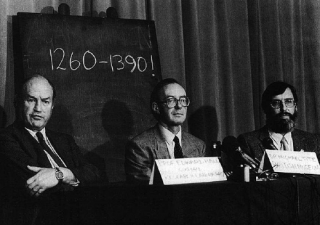
3) What dates the Shroud more precisely than the radiocarbon dating ( that in my view has never been successfully challenged) is the iconography. The bloodstains and scourge marks are still on the Shroud and the pattern of bloodstains, especially those on the arms, are not known before the fourteenth century when an emphasis on blood cults first became popular. The all-over scourge marks, very difficult to achieve on an actual body, are first known in the iconography of the fourteenth century in response to the use of Isaiah 1.6 as a premonition of the Passion. The painting on the Shroud could hardly be earlier than 1300 and because it fits so well with other examples ( e.g. The Holkham Bible of 1330 where the sguiggles of the head blood are almost identical with those of the Shroud ) I would go for 1320-50. This is spot in the middle of the radio- carbon date of 1260- 1390 but more precise.
4) Very few authenticists have studied relic cults as a whole and they have missed the point that most relics assumed to be authentic were not deliberate fakes but objects of unknown origin which became associated with miracles or visions. This would explain why in 1390 the anti-pope Clement VII allowed pilgrims to visit the Shroud and even gain an indulgence but it had to be publicly announced that it was not authentic. He Would not have been able to do this if there had been any suspicion that the Shroud had been faked. No forger would have been so stupid as to add two images to a burial cloth when there was no precedent for this in the gospels or contemporary iconography where, in the west, Christ was shown being laid out on a single sheet. One has to remember that as an authentic relic the Shroud was a failure until linked to the prestige and propaganda skills of the dukes of Savoy.
5) So if no forger would have painted on images , why were they there? The best fit hypothesis is that they were created for the Easter Quem Queritis ceremony in which the grave cloths ( linen as recorded in the gospels) were paraded as a symbol of the resurrection of Christ. The drama was enhanced by painting an imprint of his body even to the extent of placing the lance wound on the left rather than on the conventional right of the body.
This has been suggested before but not since 1907.
If true, this is an exciting find. The grave clothes were venerated as part of the ceremony and in the case of the Shroud must have gained some added spiritual significance for Clement VII to have allowed an indulgence simply for visiting the exposed cloth, despite his order that it not be seen as authentic. It also places the Shroud in at the birth of medieval drama as these ceremonies involved reenacting the gospel story and as such were the forerunners of the famous Passion plays. So much better than branding the Shroud as a mere forgery !

The evidence all fits together neatly and I am working now on getting expert opinions to take things on and looking for other artefacts that have similar features in the weave, painting techniques and iconography to those of the Shroud. The signs are good so far that everything will fall into place to sustain a coherent explanation of the origins of the Shroud- a ceremonial grave cloth transformed into a relic.
<respectfully hidden for space>

Welcome!

Well done, and well said!
 
Welcome to the forum!

Very well written. If I may be so bold as to make a suggestion:

The first sentence of the second bullet:

2) Authenticists are completely unable to agree on how the images may have been made.

does not add anything. So what if they are unable to agree? It implies there would be a glimmer of hope for the authenticists if they just agreed. The rest of the point is well written and researched, but I don't think this statement is needed nor relevant to the subsequent text.
 
So what if [authenticists] are unable to agree? It implies there would be a glimmer of hope for the authenticists if they just agreed.
It is a common complaint of authenticists that non-authenticists have been unable to produce a copy that exactly matches all the characteristics of the Shroud. They use this as evidence the Shroud is authentic. Is does not do any harm now and again to reflect their views in a non-authenticist mirror, and say that as authenticists cannot explain how an image could have arisen from a shrouded corpse, that (by their own reasoning) is itself evidence that the Shroud is not authentic.

It's a little petty, but, once in a while....
 
Thank you for your very enlightening post Charles Freeman, and welcome to ISF. This thread has not really benefited from any new information from a competent source in a long time. I was wondering whether you might share your thoughts with us on the apparent artistic liberties taken with artists' representations of the shroud as displayed in public. The position of the hands, for instance, is not in agreement with the actual Shroud when rendered in the engraving that has been shown a few posts ago.
 
It is a common complaint of authenticists that non-authenticists have been unable to produce a copy that exactly matches all the characteristics of the Shroud. They use this as evidence the Shroud is authentic. Is does not do any harm now and again to reflect their views in a non-authenticist mirror, and say that as authenticists cannot explain how an image could have arisen from a shrouded corpse, that (by their own reasoning) is itself evidence that the Shroud is not authentic.

It's a little petty, but, once in a while....

Fair enough. The sentence was just a little jarring to me.
 
I hope you don't mind if I break your text up a bit to make it easier for some of us to read.

I am sorry that my History Today article once freely available on the web has now been placed behind a pay wall but I can summarise my argument.

The first point to make is that no authenticist seems to be able to provide evidence that dates the Shroud to the first century. I have asked again and again without any serious response.

The second point is that with the restrictions to accessing the Shroud, we should concentrate on finding similar features in other surviving textiles from before 1500. This has not yet been done in any systematic way.

I have recently reworked my thesis for a presentation and summarize it as follows in five points.

1) Start with the weave as this was in place before any images. It is typical in length and width of a medieval treadle loom, only known since AD 1000. Length was no problem on such a loom as the extra was rolled up on rollers. Width depended on the reach of the single weaver. 113-4 cms was very typical, the English ell as a measure of cloth in fact, and there are lots of examples that are almost identical in width with the Shroud.

The three-in-one herringbone weave is not difficult on this loom and an example from the fourteenth century in linen is to be found in the Victoria and Albert Museum. The z spin of the yarn is typical of the western not eastern ( where it is s spin) spinning of the Shroud yarn. Experts have told me that it is virtually impossible to conceive of a loom able to weave the Shroud in ancient times and that the survival of linen (outside the arid climate of Egypt) would be quite extraordinary. Basically we are looking at a medieval weave.

2) Authenticists are completely unable to agree on how the images may have been made. They make the assumption that the Shroud today is as when it was made but this overlooks the natural decay of medieval painted linens, very few of which survive. The paint on these images was applied to a linen surface that had been sealed with a gesso of calcium carbonate mixed with animal protein and was only on the very outer fibrils.

The evidence from the Shroud shows us that there were calcium carbonate covering much of the surface and that the original images were just on the outer surface. The argument is then that the Shroud had originally a painted surface that has disintegrated.

I give the Saxon Zittau Veil as a similar example of a disintegrated medieval pigment surface which has left shadowy images behind. I am seeking expert opinion on this but it would appear that the denser the original paint, the lighter the area underneath after their pigments have disintegrated giving the misleading impression that the original painting was a negative.

So there must be a concentration on what the painting looked like originally. We know from an account of 1517 that the images could be seen from a distance and this is backed by many depictions of expositions. There appear several features now lost, the Crown of Thorns still in place, long hair at the back, a gap between the elbows and body on the back image, thumbs in place.

As we have about fifty depictions of the Shroud, and some descriptions of the original vividness of the blood stains, there is a great deal of work to be done to reconstruct the original images. We also,have some painted copies of the Shroud that also show features now lost. It would be inconceivable that the Shroud would have had the impact on enormous crowds as it did in Turin from 1578 onwards,if it were not visible from a distance.

One problem is why the painter chose to represent Christ's head as if he were standing- was he not able to imagine how the hair would look if he was lying down? The gap between the elbows and the body on the back image shows that crossed arms in the front would have been impossible and so shows that the artist made little attempt to match his two bodies- they are not even of the same height.

3) What dates the Shroud more precisely than the radiocarbon dating ( that in my view has never been successfully challenged) is the iconography. The bloodstains and scourge marks are still on the Shroud and the pattern of bloodstains, especially those on the arms, are not known before the fourteenth century when an emphasis on blood cults first became popular. The all-over scourge marks, very difficult to achieve on an actual body, are first known in the iconography of the fourteenth century in response to the use of Isaiah 1.6 as a premonition of the Passion.

The painting on the Shroud could hardly be earlier than 1300 and because it fits so well with other examples ( e.g. The Holkham Bible of 1330 where the sguiggles of the head blood are almost identical with those of the Shroud ) I would go for 1320-50. This is spot in the middle of the radio- carbon date of 1260- 1390 but more precise.

4) Very few authenticists have studied relic cults as a whole and they have missed the point that most relics assumed to be authentic were not deliberate fakes but objects of unknown origin which became associated with miracles or visions. This would explain why in 1390 the anti-pope Clement VII allowed pilgrims to visit the Shroud and even gain an indulgence but it had to be publicly announced that it was not authentic.

He Would not have been able to do this if there had been any suspicion that the Shroud had been faked. No forger would have been so stupid as to add two images to a burial cloth when there was no precedent for this in the gospels or contemporary iconography where, in the west, Christ was shown being laid out on a single sheet. One has to remember that as an authentic relic the Shroud was a failure until linked to the prestige and propaganda skills of the dukes of Savoy.

5) So if no forger would have painted on images , why were they there? The best fit hypothesis is that they were created for the Easter Quem Queritis ceremony in which the grave cloths ( linen as recorded in the gospels) were paraded as a symbol of the resurrection of Christ. The drama was enhanced by painting an imprint of his body even to the extent of placing the lance wound on the left rather than on the conventional right of the body. This has been suggested before but not since 1907.

If true, this is an exciting find. The grave clothes were venerated as part of the ceremony and in the case of the Shroud must have gained some added spiritual significance for Clement VII to have allowed an indulgence simply for visiting the exposed cloth, despite his order that it not be seen as authentic. It also places the Shroud in at the birth of medieval drama as these ceremonies involved reenacting the gospel story and as such were the forerunners of the famous Passion plays. So much better than branding the Shroud as a mere forgery !

The evidence all fits together neatly and I am working now on getting expert opinions to take things on and looking for other artefacts that have similar features in the weave, painting techniques and iconography to those of the Shroud. The signs are good so far that everything will fall into place to sustain a coherent explanation of the origins of the Shroud- a ceremonial grave cloth transformed into a relic.
 
Last edited:
[...]

I wish to again re-itterate the sheer offensiveness of these posts. Jabba is flat-out accusing these labs, and the folks who performed the tests, of fraud. There is no other interpretation. This is just about the most serious accusation you can make against another person in science, sufficient to by itself ruin careers and destroy lives.

Agreed. It's scientific misconduct, and it is a career-ender. That's one reason I keep coming back to this thread.
 
It is my pleasure to be taken seriously- those folks over at Shroud Story are somewhat different. And thanks for the welcome - I should have been here years, ever since my The Closing of the Western Mind was published over ten years ago.

Serious research in the Shroud has hardly begun. While Hugh Farey and I may disagree about the nature of some of the depictions, it is extraordinary that they have never been gathered onto a single database so that the legitimate issues raised by these depictions and descriptions can be assessed freely. Although it seems clear that the Shroud was woven on a medieval treadle loom, this has not been spelt out publicly by any weave expert ( though it has to me in private).

The fact remains that no relevance evidence that dates the Shroud to pre-medieval times has ever been found and we should be exploring the Shroud within a medieval context.

Above all we must move on from the idea that it is a fake. If it is not it makes it much more interesting! What was it an original of?
 
Above all we must move on from the idea that it is a fake. If it is not it makes it much more interesting! What was it an original of?
I think it is a "fake" in the sense that it was not, as claimed, the cloth in which the corpse of Jesus was wrapped and entombed. In that sense it is a fake, or it has had false claims made about it. In regard to different claims, it may not be a fake.
 
Charles Freeman;10504[.. said:
] Above all we must move on from the idea that it is a fake. If it is not it makes it much more interesting! What was it an original of?


I am a spokesperson for no one on this thread but myself. Having said that, I would offer the estimate that people here are often using the terms "fraud" and "fake" as synonyms for "not the authentic burial cloth of Jesus Christ, but presented as such".

This would fit with your opinion that it was a prop used in religious ceremonies from the period.
 
Last edited:
This is a good question. The best selection of depictions of the Shroud is in the 1998 catalogue of the collection of the dukes of Savoy. It is not easy to find- I use the copy in the Cambridge University Library. I once went through the positions of the hands in about fifty depictions and did find discrepancies although over some periods ( and we are basically talking of 1578 to 1750) there was remarkable consistency.

These depictions were made by different artists over 170 years. Some were very carefully done, others were rushed out as souvenirs of particular expositions in Turin. Certainly one should not accept that they are all accurate. What I have tried to do is to pick out consistent images.

A key one is the Crown of Thorns. In pre-1300 iconography it was never shown in burial scenes of Christ. After then it was increasingly shown (but not always). Almost every depiction of the Shroud shows it in place giving circumstantial evidence that if the Shroud was painted by an artist, it would have been post 1300.

Again the gap between the elbows and body on the back image is almost always shown in depictions. Today it is obscured by the fire marks. Yet this 'pose' cannot match up with the crossed hands at the front showing that the artist did not try to match the two bodies ( and more significantly for some that the images on the Shroud were not from the same wrapped body).

If we could have an open access database showing every depiction and add to it the descriptions of the impact of the original bloodstains, then we could start the in- depth research on how the images on the Shroud looked before, in my opinion, the pigments disintegrated.
 
I am a spokesperson for no one on this thread but myself. Having said that, I would offer the estimate that people here are often using the terms "fraud" and "fake" as synonyms for "not the authentic burial cloth of Jesus Christ, but presented as such".

This would fit with your opinion that it was a prop used in religious ceremonies from the period.

Personally speaking, I cant't make out what exactly Charles is claiming. He/she/it seems to oscillate between claims to the extent that it is uncertain what it is that Charles claims actually are.
 
Status
Not open for further replies.

ISF - Join now!

Every member here is approved by hand. No bots, no spam, just people who care about evidence and honest debate.

Membership is free!

Create your free account

Back
Top Bottom