• Quick note - the problem with Youtube videos not embedding on the forum appears to have been fixed, thanks to ZiprHead. If you do still see problems let me know.

Global warming discussion III

Status
Not open for further replies.
A model that post-dicts temperatures more successfully than any predecessor model and you want to discredit it ! LOL

Hardly a surprise :rolleyes:

Verification not found.

Given that Monckton is known to misunderstand, misinterpret and misrepresent established fact on a regular basis, particularly when it comes to climate science, I'm not particularly convinced.
 
You do realize that the reviewing process precedes publication, yes? :cool:

Journal review precedes publication, big difference between getting published in a reputable journal and the meat grinder that is peer review once the journal is published and your work must meet the challenges of the body of your peers, most of whom are carefully looking for any errors or mistakes and most important repeatability in order to have fodder for their own follow-on publications shredding or supporting your work.

Pre-publication journal review is more akin to grammar/spell-checking along with a group of field peers smell-testing the methods and procedures of you work to make sure that they are appropriate to the types of conclusions being derived. It is not an in-depth review of your actual research and findings. Post publication peer review is what determines whether or not your research is professionally profound or piddling stains.
 
A model that post-dicts temperatures more successfully than any predecessor model and you want to discredit it ! LOL

Hardly a surprise :rolleyes:
What's hardly a surprise is that any postdiction wouldn't be better than any prediction. It's always trivially easy to make a postdiction. Yesterday I postdict a high of 58 degrees F for my location.......Gee I was right!:D :rolleyes: 100% accuracy! I must be the worlds best weatherman!:rolleyes:

Come back when you find a model that actually predicts with accuracy. Then you might have something. Right now all you have is fail.
 
Journal review precedes publication, big difference between getting published in a reputable journal and the meat grinder that is peer review once the journal is published and your work must meet the challenges of the body of your peers, most of whom are carefully looking for any errors or mistakes and most important repeatability in order to have fodder for their own follow-on publications shredding or supporting your work.

Pre-publication journal review is more akin to grammar/spell-checking along with a group of field peers smell-testing the methods and procedures of you work to make sure that they are appropriate to the types of conclusions being derived. It is not an in-depth review of your actual research and findings. Post publication peer review is what determines whether or not your research is professionally profound or piddling stains.


Wrong, two of the reviewers had doubts at first ...

Schrodinger's Cat January 16, 2015 at 7:53 am
The IPCC continued with models designed to give strong amplification of warming even though observation showed that this was wrong. Two of the reviewers had at first opposed the paper on the ground that it questioned the IPCC’s predictions.

Wow. This is how climate science is conducted.

Well done, Monckton et al.

--- snip ---

David Socrates January 16, 2015 at 8:41 am
True, we have no idea how many other journals rejected the paper before it was accepted by the Chinese.

Reply
Monckton of Brenchley January 16, 2015 at 9:42 am
One usually does not know how many journals reject a paper before a journal eventually accepts it. So the sneering “David Socrates” is not making a particularly serious or useful or scientific point. However, for the record, the paper was submitted only to the Science Bulletin and, after due peer review, was accepted.
 
NASA, NOAA Find 2014 Warmest Year in Modern Record

The year 2014 ranks as Earth’s warmest since 1880, according to two separate analyses by NASA and National Oceanic and Atmospheric Administration (NOAA) scientists.
The 10 warmest years in the instrumental record, with the exception of 1998, have now occurred since 2000. This trend continues a long-term warming of the planet, according to an analysis of surface temperature measurements by scientists at NASA’s Goddard Institute of Space Studies (GISS) in New York.
In an independent analysis of the raw data, also released Friday, NOAA scientists also found 2014 to be the warmest on record.
“NASA is at the forefront of the scientific investigation of the dynamics of the Earth’s climate on a global scale,” said John Grunsfeld, associate administrator for the Science Mission Directorate at NASA Headquarters in Washington. “The observed long-term warming trend and the ranking of 2014 as the warmest year on record reinforces the importance for NASA to study Earth as a complete system, and particularly to understand the role and impacts of human activity.”

Since 1880, Earth’s average surface temperature has warmed by about 1.4 degrees Fahrenheit (0.8 degrees Celsius), a trend that is largely driven by the increase in carbon dioxide and other human emissions into the planet’s atmosphere. The majority of that warming has occurred in the past three decades.

 
What's hardly a surprise is that any postdiction wouldn't be better than any prediction. It's always trivially easy to make a postdiction. Yesterday I postdict a high of 58 degrees F for my location.......Gee I was right!:D :rolleyes: 100% accuracy! I must be the worlds best weatherman!:rolleyes:

Come back when you find a model that actually predicts with accuracy. Then you might have something. Right now all you have is fail.


You would say that wouldn't you ;)

The paper is getting a lot of attention ... Of 2261 downloads of the 11 papers downloadable in the current issue, Monckton of Brenchley et al. (2015) accounts for 1708, or about three-quarters of all downloads.:eek:

John Whitman January 16, 2015 at 10:26 am
Monckton, Legates, Soon & Briggs,

Congratulations on getting a paper published with an independent basis for climate estimates; one that exposes the unscientific exaggerations of the IPCC’s estimates of warming from CO2.

I am almost finished with reading the paper.

John

Reply
TRoy January 16, 2015 at 10:36 am
“Never ever assume that because the truth is not currently fashionable it should not currently be spoken. Never ever assume that if the truth continues quietly to be spoken it will not in the end prevail.”

Above statement made by Lord Monckton is simply amazing. Really. Truly resonated with me.

Reply
John Shade January 16, 2015 at 10:43 am
Excellent initiative. Busy studying it. I like their style of taking the IPCC at face value, using their beloved notion of ‘forcing’ as the way to incorporate the impact of CO2 (a way very convenient for the programmer of big models, as well as those which can be run on a calculator!) without being distracted by complexities such as spatial variations, and then showing how very weak is the case for alarm. Well done the four authors!


Why models run hot: results from an irreducibly simple climate model PDF

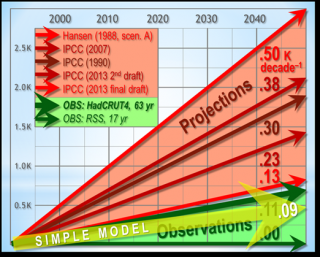
Fig. 6 Near-term global warming projections (brick-red region) on
[0.13, 0.50] K decade–1, compared with observations (green region)
that fall on [0.0, 0.11] K decade–1, and the simple model’s 21stcentury
warming projections (yellow arrow), falling on 0.09 [0.06,
0.12] K decade–1
 
Last edited:
Congratulations to Monkton et al. for creating a model that post-dicts temperatures more successfully than any predecessor model. :D

Looking at this paper, and more specifically the "irreducibly simple climate-sensitivity model" proposed as the core element of this paper's research, there is this general description:

The simple model, encapsulated in Eq. (1), determines the temperature response DTt to anthropogenic radiative forcings and consequent temperature feedbacks over any given period of years t:

(see pdf for formula)

where qt is the fraction of total anthropogenic forcing represented by CO2 over t years, and its reciprocal allows for non-CO2 forcings as well as the CO2 forcing; DFt is the radiative forcing in response to a change in atmospheric CO2 concentration over t years, which is the product of a constant k and the proportionate change (Ct / C0) in CO2 concentration over the period [3, 32]; rt is the transience fraction, which is the fraction of equilibrium sensitivity expected to be attained over t years; and k? is the equilibrium climatesensitivity parameter, which is the product of the Planck sensitivity parameter k0 [4] and the open-loop or system gain G, which is itself the reciprocal of 1 minus the closedloop gain g, which is in turn the product of k0 and the sum ft of all temperature feedbacks acting over the period.

"Obfuscation" may well be more appropriate than "simplification," the portion that is of particular curiosity is the explanation of how they derived "k" which is what they use as the climate sensitivity parameter. They claim this is derived from a multiplication of the Planck sensitivity factor by "the open-loop or system gain G" which they state is the "reciprocal of 1 minus the closed loop gain g" which they then state is the result of multiplying the Planck sensitivity factor (again?) by the "sum of all temperature feedbacks acting over the period."

Mathematically, this seems to resemble a dog chasing his own tail within a mud puddle. Most curious of all is their employment of open-loop gain and closed-loop gain factoring elements which I am completely unaware of having any relation to climate science or general physics application and sound suspiciously like electrical engineering circuit design constants based upon the physical properties of how electrical current flows through the physical structure of feedback loop circuits (if I'm understanding the EE terms properly).
 
You would say that wouldn't you ;)

The paper is getting a lot of attention ... Of 2261 downloads of the 11 papers downloadable in the current issue, Monckton of Brenchley et al. (2015) accounts for 1708, or about three-quarters of all downloads.:eek:

Given the size of the political echo chamber through which it is being trumpeted and promoted this is hardly surprising, of more interest would be the reviews and assessments of its content among reputable science publications over the next month or so.
 
Looking at this paper, and more specifically the "irreducibly simple climate-sensitivity model" proposed as the core element of this paper's research, there is this general description:


"Obfuscation" may well be more appropriate than "simplification," the portion that is of particular curiosity is the explanation of how they derived "k" which is what they use as the climate sensitivity parameter. They claim this is derived from a multiplication of the Planck sensitivity factor by "the open-loop or system gain G" which they state is the "reciprocal of 1 minus the closed loop gain g" which they then state is the result of multiplying the Planck sensitivity factor (again?) by the "sum of all temperature feedbacks acting over the period."

Mathematically, this seems to resemble a dog chasing his own tail within a mud puddle. Most curious of all is their employment of open-loop gain and closed-loop gain factoring elements which I am completely unaware of having any relation to climate science or general physics application and sound suspiciously like electrical engineering circuit design constants based upon the physical properties of how electrical current flows through the physical structure of feedback loop circuits (if I'm understanding the EE terms properly).


And yet "Mathematically, this seems to resemble a dog chasing his own tail within a mud puddle" does SO MUCH BETTER than the IPCC DOG's :D
 
Wrong, two of the reviewers had doubts at first ...

Your anecdotes do not relate at all to anything in the statements from me that you quoted, please explain how they demonstrate that my statements were in anyway "Wrong".
 
And yet "Mathematically, this seems to resemble a dog chasing his own tail within a mud puddle" does SO MUCH BETTER than the IPCC DOG's :D

And thus the level of comprehension is demonstrated and the "word-saladness" explanation for lack of perceived internal contradiction is proofed.
 
Your anecdotes do not relate at all to anything in the statements from me that you quoted, please explain how they demonstrate that my statements were in anyway "Wrong".

Let me draw you a picture :)


Fig. 6 Near-term global warming projections (brick-red region) on
[0.13, 0.50] K decade–1, compared with observations (green region)
that fall on [0.0, 0.11] K decade–1, and the simple model’s 21stcentury
warming projections (yellow arrow), falling on 0.09 [0.06,
0.12] K decade–1


That should make it clearer for you ;)
 
NOAA's state of the climate report for 2014 is up:

http://www.ncdc.noaa.gov/sotc/global/2014/13


Does the Uptick in Global Surface Temperatures in 2014 Help the Growing Difference between Climate Models and Reality?

As illustrated and discussed, while global surface temperatures rose slightly in 2014, the minor uptick did little to overcome the growing difference between observed global surface temperature and the projections of global surface warming by the climate models used by the IPCC.
 

Wow, so there are observations for temperatures out to 2040?

Well.. no. It looks like they took the observed rate of warming and extrapolated it out to generate the green region, and they did so using the period from 1990-2014. Calculating the rate of warming is fairly sensitive to the choice of start and end points for the dataset (I'm surprised they didn't start from 1998), but even so, the observed warming seems higher than 0.11 K/decade:

[qIMG]http://www.ncdc.noaa.gov/sotc/service/global/global-land-ocean-mntp-anom/201401-201412.png[/qIMG]

I'm seeing something more like 0.14-0.15 K/decade, just by eyeballing this chart, if 1990 and 2014 are chosen as the endpoints.

It should also be pointed out that when using projections that were made 20+ years ago, as some of the projections selected in this paper were, it would be useful to put them in the context of any relevant assumptions that were made regarding our future greenhouse gas emissions (when citing Hansen's 1988 paper, deniers usually show his Scenario A prediction, since it is the most pessimistic, and omit Scenarios B and C entirely).
 
Please, feel free to continue to provide supporting evidence to my "word-salad" theorem for as long as you are capable,...it is appreciated.


Sure, no problem :D

Scientists balk at ‘hottest year’ claims: Ignores Satellites showing 18 Year ‘Pause’ – ‘We are arguing over the significance of hundredths of a degree’ – The ‘Pause’ continues
Climate Depot's Marc Morano: 'Claiming 2014 is the 'hottest year' on record based on hundredths of a degree temperature difference is a fancy way of saying the global warming 'pause' is continuing.'

Astrophysicist Dr. Dr David Whitehouse: 'The NASA press release is highly misleading...talk of a record is scientifically and statistically meaningless.'

Climatologist Dr. Roy Spencer: ‘Why 2014 Won’t Be the Warmest Year on Record’ (based on surface data)– ‘We are arguing over the significance of hundredths of a degree’

Climatologist Dr. Pat Michaels debunks 2014 ‘hottest year’ claim: ‘Is 58.46° then distinguishable from 58.45°? In a word, ‘NO.’
 
Last edited:

That is, again, not a temperature graph. That is a temperature anomaly graph. That is a graph of the difference in temperature between that year and some chosen number. In this case, the average temperature between 1880 and 2014. The red line is 2014. As you can see, 2014 is above nearly all of the graph, meaning 2014 is exceptionally warm.

However, there is something wrong with the graph. I can't find another temperature anomaly graph that puts 1910 so high.
 
Last edited:
Status
Not open for further replies.

Back
Top Bottom