Hopefully we don't engage in deceit in these various roles the way one must to be a BLAARGer.We all play a variety of roles - business owner/employee, parent, sibling, consumer, entertainer, proponent, skeptic, etc.

-
Security incident: ISF was recently accessed by intruders. Please change your password, and change it anywhere else you used it. Read more
You are using an out of date browser. It may not display this or other websites correctly.
You should upgrade or use an alternative browser.
You should upgrade or use an alternative browser.
Seeing Cryptids: The Problems
- Thread starter jerrywayne
- Start date
William Parcher
Show me the monkey!

- Joined
- Jul 26, 2005
- Messages
- 27,654
Bigfootery doesn't look like a cross section of a community or of America. It's mostly men and almost entirely white. I don't know why other races aren't really involved in Bigfootery.No harm in enjoying what you do and the simple truth is that people from a small but broad cross-section of the community enjoy the Bigfoot phenomenon...
River
Illuminator

- Joined
- Mar 26, 2009
- Messages
- 4,962
I'm not offended - I find the similarities between extreme Bigfoot-belief and extreme Bigfoot-skepticism to be fascinating. I am pleased that you are not taking the bait because, as I've already said, I am playfully goading you into legal action to prove your case and you would lose big time if you did...
"if you tried to prove a legal case where there is none i would win bigtime!" LOL?
The hilarity continues below...
Are you, yourself, not cherry picking your own definition of what is or is not fraud?
No, I'm telling you the intended meaning as it was posted, along with definitions since you have a hard time understanding (or rather, insist on not understanding) English well. You seem to be attempting to infer alternative meanings to terms used, even when intended definitions are blatantly pointed out. Another means of dishonesty...
Bigfoot is not fraud because it is a social construct that only extreme proponents and skeptics appear to take seriously. It is the performance of belief. Folklife. Entertainment. My definition of the term simply allows fraud to be quantified objectively. Your definition can be subjectively applied to anything which appears to be fraudulent whether it actually is or not. Elements of belief, folklife, and entertainment appear fraudulent under your definition but are clearly not actually/legally so...
Hardly! Also highly entertaining that you would label it as such. Perhaps it has this meaning to yourself, but not to many proponents. Would you call Meldrums "work" in the field of bigfootery performance art? Folklife? Entertainment? How about Ketchums or Dyers? You seem to avoid the world of bigfoot as most of us know it to be. How would you classify the folks mentioned above in your labels?
Blobsquatches and big, fake-looking footprints look like evidence of Bigfoot to proponents just as the things quoted above look like fraud to you. Be it civil law, criminal law, or whatever the onus is on you to prove/demonstrate your case that it is fraudulent just as is expected of proponents to prove/demonstrate theirs. In both cases, judgement as to their respective validity should not be left to the claimants themselves (be they proponents or skeptics) but to higher, more knowledgeable sources who specialize in such things. Proponents proclaiming that they have evidence of Bigfoot (but failing to formally demonstrate it) is ridiculous. Skeptics proclaiming fraud (which carries distinct implications of illegality) but also failing to formally demonstrate it is no less so...
If Bigfoot is actually more about the performance of belief, folklife, entertainment then consumers are getting exactly what they paid for - hence zero case of Bigfoot fraud. It's not rocket-science...
It has already been proven that all resolved bigfoot claims have the outcome of three categories. Feel free to prove otherwise at anytime on that by the way. The case for bigfoot has been demonstrated time and again. Bigfoot = people in one of three categories. 1) Hoaxing/lying/fabricating. 2) Mentally deluded. 3) Occasionally mistaken identity. Bigfoot has been proven. How many examples would you need when ALL resolve to one of those three examples? Feel free to point any resolved bigfoot claims that are not in those categories. Are you suggesting that proponents and skeptics alike have not witnessed this? (prove differently at any time *crickets*) Again, hilarious! "it's fake but its not fraud" Then label it as fake/lore/role playing and not a real entity, then it's not fraud.
Why is it ok for you to impose your loose definition of "fraud" which notably doesn't include any legal implications but not for me to impose mine which does? Are you denying that "fraud" carries any legal connotation at all? That's a bit naive, isn't it...
Are you seriously asking why is it OK for me to specify the meaning of a term I used in a sentence?? haha You can imply whatever meaning you wish, just don't expect to put words (or your own meanings of them) in others mouths/sentences.
Bottom line is that you can do, say, and believe whatever you like but, like Chris who investigates Bigfoot but not the people themselves, you are simply seeking to justify what you already "know" - and that devalues the good debunking work that you bring to the table. However, it also demonstrates that skeptics are human too - and that is a good thing...
The point you seem to deflect from often is; I don't have a problem with monsters and vampires, ghosts etc. I have a problem with labeling them as real entities. That is the rub here. If you tell stories, call them stories. If you write a fictional book, put it in the fiction section. Don't expect skeptics (or most people) to accept this crap as real. Then we have no issues at all with your role playing games. What danger is there in that? Not fun if its "fake"? Only fun if you're lying/deceiving someone?
That brings up a whole other set of social issues. ;-)
Last edited:
The Shrike
Philosopher

Bigfootery doesn't look like a cross section of a community or of America. It's mostly men and almost entirely white. I don't know why other races aren't really involved in Bigfootery.
In America, yes mostly white. Native Americans too, although it's folklore thrust upon them from white guys, sadly. There are apparently plenty of non-caucasians involved in promoting yeti, orang-pendek, and yeren lore.

You seem to be occupied with Bigfootery more than Bigfoot.
Since there is no such thing as Bigfoot, pretty much anything else would be more fulfilling as a source of study.
William Parcher
Show me the monkey!
- Joined
- Jul 26, 2005
- Messages
- 27,654
Do Bigfooters have an explanation for why Bigfoot does not reveal itself to races other than white folks?
The Shrike
Philosopher
^False premise: Native Americans claim to see bigfoots, and Asians claim to see bigfooty things in their home countries.
LTC8K6
Penultimate Amazing

^False premise: Native Americans claim to see bigfoots, and Asians claim to see bigfooty things in their home countries.
Bigfoot is a specific American creation, iirc.
I thought that Asians saw Yetis or Abominable Snowmen.
And yeah, the whole thing seems to be an obvious social construct to keep the kids from wandering off. This is like having a 60-page thread about Santa Claus.
And yeah, the whole thing seems to be an obvious social construct to keep the kids from wandering off. This is like having a 60-page thread about Santa Claus.
Last edited:
William Parcher
Show me the monkey!
- Joined
- Jul 26, 2005
- Messages
- 27,654
I said...^False premise: Native Americans claim to see bigfoots, and Asians claim to see bigfooty things in their home countries.
I'm talking about North America where Bigfoot is claimed to live. I didn't say that NAs and other non-white races never ever claim to see Bigfoot in North America. I'm saying that the racial make-up of American Bigfootery does not reflect the racial make-up of America. For example, we might expect that the number (and percentage) of black Americans seeing and reporting Bigfoot to be similar to the percentage of blacks living in America. Yet it doesn't seem to be that way. If Bigfoot was a real animal I think that we should expect the sightings to reflect the actual racial/gender "cross-section" of America. Why isn't it like that?Bigfootery doesn't look like a cross section of a community or of America. It's mostly men and almost entirely white. I don't know why other races aren't really involved in Bigfootery.
I wasn't talking about countries outside of North America, but you did. OK, I'll use Bhutan as an example. I would expect that "wild man" witnesses would be reflective of the racial (ethnic) make-up of Bhutan and not a skewed non-representative cross-section of that country. If the representation is different than that of the country itself then I am curious why.
Another question - where is the Bigfootery in Mexico? Does Bigfoot not live in Mexico at all? We have Bigfooters and sightings in the border states but it all seems to stop at the border and doesn't continue beyond.
William Parcher
Show me the monkey!
- Joined
- Jul 26, 2005
- Messages
- 27,654
...and about 30 other kinds of wild bipedal hominoids.I thought that Asians saw Yetis or Abominable Snowmen.
In Guanajuato, he's a chupacabra. Only 3 feet tall, but that's probably due to diet or something. It couldn't be that it's a myth. And how could a guy who travels 50 feet in 2 steps ever get across the border, when busboys and house-painters do it every day?Another question - where is the Bigfootery in Mexico? Does Bigfoot not live in Mexico at all? We have Bigfooters and sightings in the border states but it all seems to stop at the border and doesn't continue beyond.
The Shrike
Philosopher
I'm saying that the racial make-up of American Bigfootery does not reflect the racial make-up of America. . . . If Bigfoot was a real animal I think that we should expect the sightings to reflect the actual racial/gender "cross-section" of America. Why isn't it like that?
I see where you're going and largely agree that bigfooting's predominant whiteness hearkens to a social/cultural construct more strongly than to an actual biological entity. The inference is easily countered, however, by the fact that rural populations and hunters and anglers in the US are overwhelmingly white. In other words, if there were real bigfoots out there, it's white people who'd more often be in a position to encounter them.
William Parcher
Show me the monkey!
- Joined
- Jul 26, 2005
- Messages
- 27,654
But Bigfooters ought to realize that you don't have to actually live in the woods to see a Bigfoot. You don't even have to get out of your vehicle. They are seen along roads and highways.
So Shrike, would you say?...
"Hey Parcher, look at this map of Bigfoot sightings. The fact is that non-white people just aren't in these places and they don't go to or go through these places."
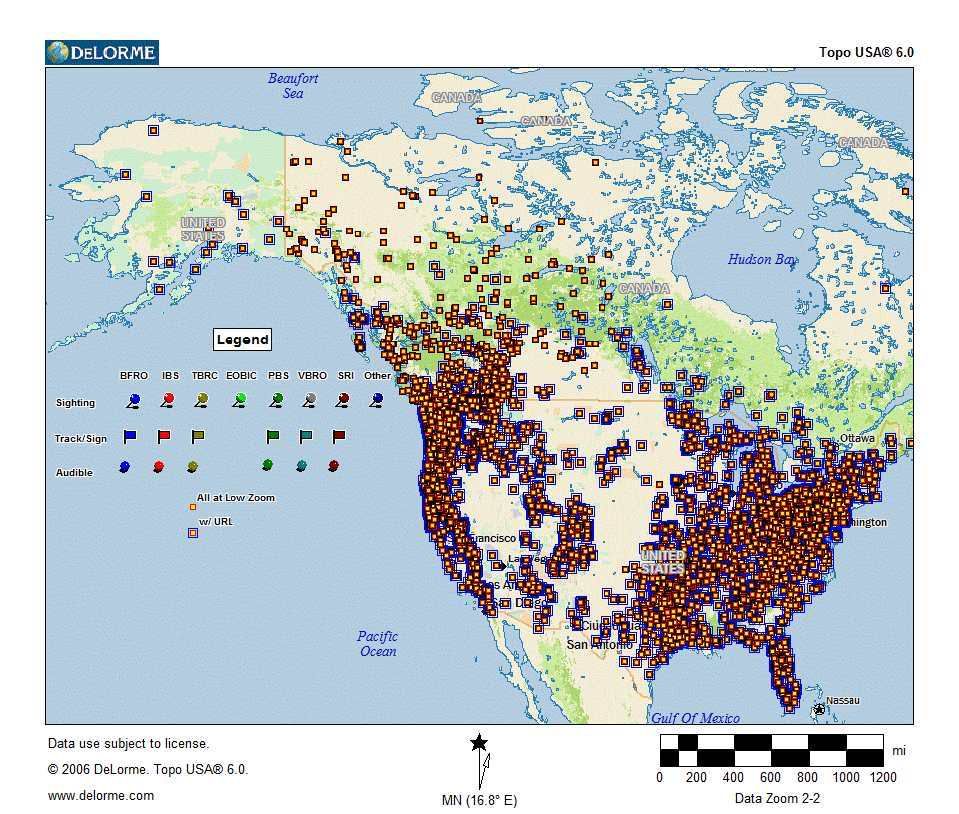
So Shrike, would you say?...
"Hey Parcher, look at this map of Bigfoot sightings. The fact is that non-white people just aren't in these places and they don't go to or go through these places."
Last edited:
William Parcher
Show me the monkey!
- Joined
- Jul 26, 2005
- Messages
- 27,654
Those are only the officially documented sightings. We are told by Bigfooters that there could be hundreds or thousands more that are not documented.
The Shrike
Philosopher
So Shrike, would you say?...
"Hey Parcher, look at this map of Bigfoot sightings. The fact is that non-white people just aren't in these places and they don't go to or go through these places."
I'd add some weasel words but yes, I would say that.
For starters, scale plays an important role in the interpretation of that map. One of those county-sized blocks would cover my hometown rural community in Upstate NY and the city that was our county seat about 10 miles away. The city might have been ethnically diverse, but it was nothing but white folks in the forests and fields where I grew up. In our rural community, I'd see a live black person once a year, when the Jehovah's Witnesses were out canvassing for lost souls.
To broaden and lengthen my anecdotal experience, I've been involved in natural resource management since the mid-1980s, working at four universities in four eastern states. My one non-academic post was as a state employee also involved in natural resources conservation. I've met thousands of students, professionals, and constituents during that time, from a broad spectrum of "outdoor" interests related to hunting, fishing, birding, forestry, grassland management, etc. These people have been overwhelmingly caucasian. The fact that our parent professional society (The Wildlife Society) is actively encouraging the development of a more diverse workforce leads me to believe that my personal impressions are generalizable.
Now it might be interesting to examine ethnic differences in bigfoot belief in a region like the rural South with plenty of blacks and whites driving through, living in, and exploring the same mostly forested areas. At a national scale, however, it'd be really difficult to tease out bigfootery as a white social construct when it's overwhelmingly white folks driving through, living in, and exploring the squatchy places.
I know that it's personal bias, but the bigfoot sightings in the Chicago suburbs / Cook County Forest Preserves make me laugh the most. No bigfoot would ever have to cross a street or hit up a Burger King in those scenarios.
William Parcher
Show me the monkey!
- Joined
- Jul 26, 2005
- Messages
- 27,654
Shrike, so your argument that non-whites don't see Bigfoot because these people just "aren't out there"... Is that a kind of strawman or is it a genuine defensible argument?
William Parcher
Show me the monkey!
- Joined
- Jul 26, 2005
- Messages
- 27,654
Are there non-whites in those places and are they reporting Bigfoot encounters?I know that it's personal bias, but the bigfoot sightings in the Chicago suburbs / Cook County Forest Preserves make me laugh the most. No bigfoot would ever have to cross a street or hit up a Burger King in those scenarios.
ChrisBFRPKY
Illuminator

- Joined
- Jun 14, 2012
- Messages
- 4,449
The Kentucky species foot can somehow strike ball first, and still not show a deeper impression for the ball.
Whatever way the foot lands, somehow it makes flat straight tracks most of the time...even when taking a deliberately long stride to avoid leaving tracks in a certain spot.
AFAIK, we have never even seen a track indicating a turn made by a bigfoot.
Bolding mine: Oh, but you have seen a track indicating a right turn. That same track is also placed directly on a plow line in a field and has half the foot above the plow line and the other half below it in the much softer tilled ground at the heel. Wonderful example of flexibility. FYI, it also stepped on one of those green walnuts seen in the pics at the heel, forcing it down to where the top of the walnut was at a depth of about 2 inches. That would mean the bottom of the green walnut was about 2 inches deeper than the track, so altogether the walnut is sitting 4 inches deeper than it was before being stepped on. Can you do that? I can't.
Then I'm afraid that puts another huge doubt in my mind about the photo that is purported to be that of a Bigfoot that has been posted above. (http://www.bfrpky.com/PICT0026.JPG).
The first thing I see is a distinct sideways brushing of the small stones in one specific place that should not be seen in a single track.
Either the entire "foot" shifted sideways - or it did not. There is no logical reason for one small area to shift that far. That strongly indicates that more than one object made impressions in what you call one track.
Also, one can easily see the etches in the soil from where the stones were - to where they finish up after the movement. Some of the lengths of the straight line cuts in the soil are many times the diameter of the stones. Therefore - the stones did not just roll over under pressure.
The second thing I see is a distinct ridge that outlines the edge of the track adjacent to the shifted area.
That is not logical if the object making the track is not solid. There should be a gradual depression that slowly and smoothly fades - not a ridge - if what is making the depression is supple and/or cushioned (like a primate foot).
A ridge in ground like that could only be the result of a hard, inflexible object.
Given the sideways movement in only one place in the track that resulted in a sharply defined ridge - it appears to me that the track was either purposely altered by a sideways brushing of a hard object like a boot - or it is an impression made of multiple, overlapping, imprints.
IMHO, of course.
You have a very good eye. The track in the center of the lane was a right print, of course you'd see a slightly deeper impression on the right edge of the track as compared to that of the left due to the vault effect back to the left foot. That feature in itself is very persuasive for arguing the validity of the track, not its dismissal.
To argue that it was made by a stomper is also feasible with the info you have available in the pic since this track is mostly flat, but again, the other tracks from the right and left sides suggested flexibility, eliminating the stomper theory. Chris B.