• Security incident: ISF was recently accessed by intruders. Please change your password, and change it anywhere else you used it. Read more

'What about building 7'?

Status
Not open for further replies.
If there was an enduring total power failure, it was news to both Mr. Jennings and FEMA.


Wrong again. The emergency generators do not restore normal power. There would be some lighting (normally about a third of normal and other essential(see the elevator company resetting controls) ). Explains perfectly why they both said emergency lights went off at the time of the "explosion". The collapse of the North tower took out the gen-sets.
 
Last edited:
Why was it dark on the eighth floor. Well if one looks atpage 10 of NCSTAR 1A its a schematic of that floor. It shows that upon exiting the stairs they would be across the hall from a large enclosed room. Moving east they would run into an enclosed boardroom which they would then skirt by going north, towards more enclosed rooms. Only after passing to the north of, and east of, the boardroom, would they be able to see windows. Thus little natural light until that point. If Jennings did knock out more windows its most likely they were further west than the one at the NE corner since they would have passed them on the way to that location.

What might Hess have said in the edited out portion of the BBC interview?
Since MM is OK with making these things up, how about something along the lines of
" in the dark and dust we missed the exit to the seventh floor and instead exited on the eighth". Editing for time, the BBC producer decided that this part added little to the story.
 
Last edited:
Wrong again. The emergency generators do not restore normal power. There would be some lighting (normally about a third of normal and other essential(see the elevator company resetting controls) ). Explains perfectly why they both said emergency lights went off at the time of the "explosion". The collapse of the North tower took out the gen-sets.

Certainly the ones on the fifth floor south wall.

Its also quite possible to restore power to the OEM and yet not have video on the monitors if there was no power to the cable feed amplifier supplying feeds to TVs, or whatever path the video feed came into the room.
 
Last edited:
Certainly the ones on the fifth floor south wall.

It's believed and I see no reason to doubt that the dust clouds would shut down the gen-sets pdq. They are not designed to run under the conditions of 9/11. All large gen-sets are set-up to shut down when their air filters get dirty. By dirty this means normal poor care, this threshold would occur within minutes of the collapse.

This is one of the main reason I don't belief the main diesel tanks could fuel the fires. The diesels have to run to supply the power to transfer the fuel to the day tanks and the headers. NIST saw no evidence (vent shutters open) that would support such a belief.
 
Wrong again. The emergency generators do not restore normal power. There would be some lighting (normally about a third of normal and other essential(see the elevator company resetting controls) ). Explains perfectly why they both said emergency lights went off at the time of the "explosion". The collapse of the North tower took out the gen-sets.

The gen sets would supply power to the designated emergency circuits (as determined by the system design. The emergency lights should not have gone off, they should be powered by a UPS. If they did go off, that means the the circuit was compromised.
 
Why was it dark on the eighth floor. Well if one looks atpage 10 of NCSTAR 1A its a schematic of that floor. It shows that upon exiting the stairs they would be across the hall from a large enclosed room. Moving east they would run into an enclosed boardroom which they would then skirt by going north, towards more enclosed rooms. Only after passing to the north of, and east of, the boardroom, would they be able to see windows. Thus little natural light until that point. If Jennings did knock out more windows its most likely they were further west than the one at the NE corner since they would have passed them on the way to that location.

I wonder why you think they came down the west stairwell, and not the east stairwell? From what I have read, my conclusion have always been that they most likely came down the east stairwell. In that case they would have entered what looks like an open space with cubicles. But it would of course still be dark after the collapse of WTC 1, due to dense dust cloud.
 
Maybe this might be a better approach:

MM: What are the comment points of agreement with other witnesses? Certainly Mr Jennings was not the only one reporting observations that morning.
 
Why Jennings and Hess broke another window

As I noted back in post #2288; NIST wrote that Jennings and Hess in addition to the window they broke at the northeast corner, they also broke a window near the center of the north face.

The reason for this is likely the attempt to rescue the head of security for SSB, who walked up the west stairwell after the collapse of WTC 2, to see if all his personnel were out of the building:
He made it down to the 7th floor, where he stopped because he could not see or breathe at this point. He broke a window near the center of the north face to yell for help. A ladder truck pulled up, but could not reach the window because of the Con Edison building extension at the lower floors.
Source NIST NCSTAR 1-9 , page 296 and 297.

So it is quiet reasonable that Jennings and Hess would move to the center of the building and break a window, in the hope of getting rescued together with the man on the floor below.

In addition to the account by EMT Niocle Ferrell that I posted in post #2294;this is also mentioned in New York Times the day after:
Frank Carino, 36, a New York firefighter, said he had tried to rescue men on the seventh and eighth floors of one building but the ladder of his aerial truck did not reach high enough. ''They had broken the windows and they were yelling out at us the stairways were on fire,'' he said. ''One of the men was using a megaphone.'' He added that he believed that the two were rescued by firefighters within the building.

Note the man with the bull horn, that must have been the former head of security for SSB:
He was in the building for the first and second tower collapsing, could not breath or see anything. He had no flashlight, just the bullhorn.

When I looked again at the video with Hess calling for help from the northeast corner of WTC 7, I heard at 0:23 in the video someone calling with what sounds like a loudspeaker, while the camera operator is filming damaged cars behind WTC 7, close to the northwest corner of the building (the Con Edison substation can be seen and heard in the background, the station was still energized after the WTC complex lost power when WTC 2 collapsed, NCSTAR 1-9 page 655).


Parts of what he says is not intelligible, but what can be heard is; "...two of my people...operator...we were at the 44 and the building was partially collapsing again". What he says is consistent with what NIST writes on page 296 and 297 in NCSTAR 1-9:
At approximately 10:00 a.m., a WTC 7 security manager was concerned that he might still have personnel on the 44th floor and started up the “A” (west) stairway to get his people out of the building. At 10:28 a.m.,when WTC 1 collapsed, he had reached the 30th floor, and then continued up the stairway. There was rubble just before the 44th floor landing, and the stairway swayed or vibrated. Smoke or dust was swirling around. During this climb, he opened doors on the 23rd floor to check for OEM staff, and the floor was full of smoke or dust. He also opened a door on the 26th floor to check for occupants and found none.
Note that the person int the video is not aware of the extent of the collapse, he is talking about partial collapse.

So looks like the video contains both Hess from floor 8th, and the voice of Mulroy from floor 7.
 
Last edited:

In response to the interviewer's question about hearing the 2nd plane hit, he speculates on an unknown, but obviously he is aware from watching the News later that the 2nd attack occurred while he was in 7 WTC.
​


I am going to revisit what I wrote in post #2294 about Jennings arriving at WTC 7 unaware of the second attack. It is entirely possible that he did not notice that the second tower was burning, depending on the direction he came in from, or if he noticed it, he thought the fires were caused by the first attack. And as a consequence of this he gets his timeline wrong, when he attempts to make sense of what he experienced after getting home later in the day.

This is nothing unique, here from the story of firefigheter Bertram Springstead:

We were driving down, sirens the whole way down. We get there. We stepped off the rig, and I look up and I noticed that both towers were on fire now. We didn't realize at the time that another plane had hit. We didn't see it and couldn't hear it while responding. I just figured the other tower was on fire from stuff flying from the other building. So we really didn't know there was a second plane

And then on his way down the stairwell after the collapse of WTC 2 (which he did not understand was the collapse of WTC 2 until later), he is told about possible more planes coming:
I didn't even know there was more than one plane at this point. We didn't know there was a second plane.


Here is another example from the story of firefighter Michael Macko:
He stopped. And I got out. It was pretty much like a war zone at that point. I hadn’t even known that the other tower had gotten hit at that point.
At home, outside in his garden, he heard on the radio that a plane had hit the WTC; saw the fire in the distance; went by a local firehouse in College Point in Queens; then to his own firehouse of Ladder 8 north of the WTC area; hitched a ride with an ambulance down to WTC. Following his ride on the map, it is very likely that he jumped off the ambulance at the northeast corner of WTC 7 without being aware of the second attack. Then he made his way to West Street shortly before WTC 2 collapsed.

So if these persons could arrive at WTC without being aware the second attack against WTC 2; why then can't Jennings arrive inside an evacuated EOC sometime after 09:45 without being aware of the second attack? Because of this he confuses the collapse of WTC 2 with the second attack.​


Additionally, from their 23rd floor location, halfway up 7 WTC, Mr. Hess and Mr. Jennings should have experienced more than just a loss of lighting.

Mr. Hess, who in his BBC interview made great play of the 5-10 seconds of building shake he believed was caused by 1 WTC's collapse, apparently experienced none of this while alone with Mr. Jennings in the silent OEC.

​


The question is fair enough, especially when other persons in the building describes shaking and tremendous noise when WTC 2 collapsed. But the answer to that question I would say can be found in how the Emergency Operations Center was built to be protected against all kinds of threats.

The facility's command center is on the 23rd floor. Its walls are reinforced to withstand wind gusts of up to 160 miles per hour. It's also bulletproof and bomb-resistant, with its own air supply, an 11,000 gallon water supply and three backup generators.
Source: CNN June 7 1999

Bulletproofed, the center features some of the most advanced computer and telecommunications equipment available and is hardened to withstand bombs, hurricanes, power failures and other crises.
Source: New York Times June 8 1999

In this New York Times article from November 27 1999, you will find a figure showing the layout of the Emergency Operations Center. Note the thick walls.

In this presentation by Richard Rotanz from 2002 you will find a partial floor diagram showing in more detail the construction of the exterior walls on floor 23rd. (Transcript of the presentation, the presentation slides linked above may not contain all the slides he is talking about)

Even more details about the center can be found in the paper "IMPROVISING 9/11: ORGANIZATIONAL IMPROVISATION FOLLOWING THE WORLD TRADE CENTER DISASTER":
The New York City EOC on the twenty-third floor of 7 World Trade Center (7WTC) was constructed in 1999 and was one of the most sophisticated facilities of its type in the world. As one high-ranking Mayor’s Office of Emergency Management (OEM) official stated, the EOC had “more bells and whistles than [one] could imagine.” The $13 million facility was built to withstand winds of up to approximately two hundred miles per hour. The exterior walls were constructed with steel framing, numerous layers of drywall, and Kevlar. The facility had three 500 KVA backup generators, a 6,000 gallon fuel-tank, an 11,000 gallon portable water supply, and a backup system for heating, ventilation, and air conditioning.

When they have put in so much effort to protect the walls, it would not be entirely unreasonable to also think that they put in a shock dampening floor above the existing floor slab, to protect fragile equipment against shockwaves from bomb explosions in the vicinity, transferred through the building structure.

In addition to this, I am quiet certain that the EOC's operations room was located on the north side of WTC 7 away from WTC 1 and 2, due to it's large size, since the layout of WTC 7 have more available floor space on the north side. With ordinary office space for day to day work on the south side; used by the permanent staff. Something supported by the account of Sgt Bylicki.

In view of this, it would be fair say that their experience of the collapse of WTC 2 would have been much more subdued, compared with what other in the building experienced. As Jennings said, he had no way of knowing what was going on the outside since the EOC was closed off from everything. That would certainly also include considerably subdued noise from the outside to, judging from the wall construction. And also possibly reduced shaking(depending on my speculation in relation to the floor construction being correct or not).

Anyway the shaking should have been a bit more subdued compared with collapse of WTC 1, since WTC 2 were further away, and the collapse did not hit WTC 7 with large pieces of steel.​
 
Last edited:
Re: Subject: Why Jennings and Hess broke another window

As I noted back in post #2288; NIST wrote that Jennings and Hess in addition to the window they broke at the northeast corner, they also broke a window near the center of the north face.

THEY DID NOT.

Read your own evidence. A security officer broke a window on the 7th floor.

As I posted previously, this is the other window I believe Mr. Jennings broke. It is also on the 8th floor, midway down the east side of 7 WTC.

WTC7ESBrokenWindow_zpsa61fdd0f.jpg


It is a clear breakout with a white office wall behind.


The reason for this is likely the attempt to rescue the head of security for SSB, who walked up the west stairwell after the collapse of WTC 2, to see if all his personnel were out of the building:
NIST NCSTAR 1-9 said:
"The security officer had reached the 30th floor when the building shook as WTC 1 collapsed, and the stairwell became dark. He began to descend and stopped at the 23rd floor to see if anyone was on the OEM floor. He opened the door to check for staff that might have been present and saw that the area was filled with smoke. He made it down to the 7th floor, where he stopped because he could not see or breathe at this point. He broke a window near the center of the north face to yell for help."

At the time he was looking into the OEM on the 23rd floor, according to Mr. Jennings, he and Mr. Hess were in the 8th floor NE corner office.

Of additional interest here is that this private security officer for a business on the 44th floor decided to return to that floor after the collapse of 2 WTC in order to check that his personnel had all safely evacuated.

After pausing at the 10th floor, because his police officer escort could not go on, he continued on and managed to climb as high as the 30th floor.

At that point in time he experienced the building shake as 1 WTC collapsed.

This is quite a stairwell climb to make between the two collapses.

Why I make note of this, is Mr. Jennings claimed he was jumping stairwell landings in his hurried descent from the 23rd floor to the 6th floor. I've descended a similar stairwell distance at a normal pace in several minutes.

According to the BBC (based on the NIST Report), Mr. Jenning's descent was supposed to have occurred following the collapse of 2 WTC and ending at the 6th floor stairwell landing when 1 WTC supposedly collapsed.

NIST NCSTAR 1-9 said:
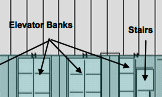
"Two New York City employees had gone to the OEM Center on the 23rd floor and found no one there. As they went to get into an elevator to go downstairs, the lights inside WTC 7 flickered as WTC 2 collapsed. At that point, the elevator they were attempting to catch no longer worked, so they started down the staircase."


ElevatorandStairs7WTC_zps84be6a3d.png


In the half hour between those collapses, and at the speed Mr. Jennings says he was moving down the stairwell, it makes absolutely no sense that the explosion he encountered upon reaching the 6th floor stairwell landing was the penetrating debris from 1 WTC collapsing.

The only support for the claim that 2 WTC collapsed just prior to the Jennings and Hess descent from the 23rd floor, is in an interview Mr. Hess gave to Channel 9 News after being rescued later that morning.

Michael Hess said:
"Yes I was. I was up in the Emergency Management Center on the 23rd floor..and when all the power went out in the building..ahh..another gentlemen and I walked down to the 8th floor [later corrected as meaning the 6th floor, where indeed, the lights went out] where there was an explosion..and we'd been trapped on the 8th floor with smoke, thick smoke all around us for about an hour and a half. But the New York Fire Dept., as terrific as they are just came and got us out."

Curiously, Mr. Jennings in none of his interviews makes mention of a power failure precipitating their 23rd floor departure and even the BBC failed to reveal any repeat of this claim when they interviewed Mr. Hess.

This uncorroborated, and unrepeated claim fails to undermine Mr. Jenning's testimony that the timing of their evacuation occurred immediately following his receiving a call from his superior where he was told to leave immediately!

Mr. Jennings could have descended to the 6th floor and then retreated to the 8th floor in 10 minutes or less.

According to the 9/11 Commission, OEM’s command center was evacuated at 9:30 a.m. due to reports of further unaccounted for planes.

OEM Commissioner, John Odermatt, top deputy to Richard Sheirer (the director of the Mayor’s Office of Emergency Management (OEM), said that after the first plane hit [8:46 am], he left only two staffers at the WTC 7's OEM command center.

As Mr. Jennings emphatically stated, sometime after arriving at the 8th floor, he looked, and he saw, that both the WTC twin towers were still standing.

His timeline fits.
 
I wonder why you think they came down the west stairwell, and not the east stairwell? From what I have read, my conclusion have always been that they most likely came down the east stairwell. In that case they would have entered what looks like an open space with cubicles. But it would of course still be dark after the collapse of WTC 1, due to dense dust cloud.

West, mostly because it fits the destruction of the SW corner by WTC 1 debris. It explains the "wall" they encountered in the stairwell, assuming that the corner damage also damaged the west stairwell.
However, if the stairs changed direction at the sixth floor they might have simply turned the wrong way in the dark and encountered a wall where they expected stairs.

It might be better explained if the OEM exited closer to the west or east stairs.
 
Last edited:
As Mr. Jennings emphatically stated, sometime after arriving at the 8th floor, he looked, and he saw, that both the WTC twin towers were still standing.

His timeline fits.
Well then. According to his quote, he also knew the two towers collapsed right?

Barry Jennings said:
When we made it back to the 8th floor. As I told you earlier, both buildings were still standing because I looked... two... I looked one way, looked the other way, now there's nothing there.

According to that statement, he first saw the two towers, and then noted that when he looked "the other way", nothing was there.
 
Re: Subject: Why Jennings and Hess broke another window


THEY DID NOT.

Read your own evidence. A security officer broke a window on the 7th floor.

As I posted previously, this is the other window I believe Mr. Jennings broke. It is also on the 8th floor, midway down the east side of 7 WTC.

[qimg]http://i1265.photobucket.com/albums/jj515/Miragememories/WTC7ESBrokenWindow_zpsa61fdd0f.jpg[/qimg]

It is a clear breakout with a white office wall behind.
I suggest that you go back and read post my #2289 again very carefully, especially the second quote I provided from the NIST report.
 
MM said:
As Mr. Jennings emphatically stated, sometime after arriving at the 8th floor, he looked, and he saw, that both the WTC twin towers were still standing.

His timeline fits.


MM, can we step through this logically?

Upthread you conceded that he can't have broken the NE window before the collapse of WTC1, based on photographic evidence, right?

This means that when he broke the window, talked to people in the street, observed them running away and coming back (twice) they can't have been responding to the Tower collapses as they must have already happened. Right? By your own admission it has to be true.

This leaves you having to assume that they arrived on the 8th before the collapses, saw the Towers standing, and remained there for at least 30 minutes not noticing the Tower collapses, the vibrations, the impacts on WTC7 itself, the dust clouds rolling by .... and only then did he break the window.

Is this what you believe?


The gen sets would supply power to the designated emergency circuits (as determined by the system design. The emergency lights should not have gone off, they should be powered by a UPS. If they did go off, that means the the circuit was compromised.
If memory serves only the exit lights and a small percentage of lights in the stair-wells need to be UPS when back-up generators are used. It's assumed they are the "uninterrupted" supply.
 
As I noted back in post #2288; NIST wrote that Jennings and Hess in addition to the window they broke at the northeast corner, they also broke a window near the center of the north face.

THEY DID NOT.

Read your own evidence. A security officer broke a window on the 7th floor.

As I posted previously, this is the other window I believe Mr. Jennings broke. It is also on the 8th floor, midway down the east side of 7 WTC.

WTC7ESBrokenWindow_zpsa61fdd0f.jpg


It is a clear breakout with a white office wall behind.
I suggest that you go back and read post my #2289 again very carefully, especially the second quote I provided from the NIST report.

Okay, I re-evaluated your post.

First of all, I disagree with your assessment that the east side window (shown above) is only a single layer break.

Regarding the NIST claim that suggests the second window was in the middle of the north face on the 8th floor.


NCSTAR_1-9 said:
Review of various images of the north face of WTC 7 revealed that the face appeared undamaged, with the exception of two locations on the 8th floor, where window glass was broken out prior to the time when fires began breaking windows on the face.

A view of the undamaged lower nine floors at the northwest corner was shown in Figure 5–87.

Figure5-87_zps89e10086.png

Figure 5–87. Cropped photograph of a partial view of the west face of WTC 7 looking down Washington Street between WTC 7 on the left and the Verizon Building on the right. The time is unknown, but the shadows suggest that it was before noon.


CroppedFigure5-91_zps6d13108f.png

Figure 5–91. Cropped photograph showing the east side of the lower floors of the north face and an oblique view of the east face. Image intensities were adjusted and floor numbers were added. [I added additional cropping because of space issues]
As noted above, window 8-42A was open on the northeast corner of the 8th floor. This window is visible in Figure 5–91. This cropped image is taken from the same photograph as Figure 5–12.


Figure5-12Reduced_zpsc6b76a27.png

Figure 5–12. Photograph of the east side of the north face of WTC 7.
The original photograph was cropped, and the intensities were adjusted.


The other open window observed on this side of the building was 8-47B.

8-47B_zps76e66c9a.png

Figure 5-32 [cropped]

This open window is visible in Figure 5–30 above the left hand edge of the fire burning on the 7th floor. This window was also broken out by people trapped in the building after WTC 1 collapsed.


Figure5-30Comp1_zpsdcec483b.png

Figure 5–30. Photograph showing the north face of WTC 7 around 3:13 p.m. on September 11. Floor numbers have been added, and the image intensity has been adjusted.

Not that this second window location is a critical point, but for the sake of argument, I think the image I show on the east side is more definitive of a broken window than the weak offering by the NIST in Figure 5-30. Even with the brightness enhanced it is very difficult to determine an open window.
 
Your quote from Mr. Jenning's account above reveals no occurrence of a power outage.

In response to the interviewer's question about hearing the 2nd plane hit, he speculates on an unknown, but obviously he is aware from watching the News later that the 2nd attack occurred while he was in 7 WTC.

If he was experiencing the collapse of 2 WTC at this time, he should have experienced much more than just inactive TV monitors.

Mr. Jennings said the OEC was closed off from everything.

Mr. Hess's account differs from that of Mr. Jenning's and FEMA's.

If there was an enduring total power failure, it was news to both Mr. Jennings and FEMA.

FEMA said:
"Con Ed reported that “the feeders supplying power to WTC 7 were de-energized at 9:59 a.m.” It is believed that the emergency generators came on line immediately."

Additionally, from their 23rd floor location, halfway up 7 WTC, Mr. Hess and Mr. Jennings should have experienced more than just a loss of lighting.

Mr. Hess, who in his BBC interview made great play of the 5-10 seconds of building shake he believed was caused by 1 WTC's collapse, apparently experienced none of this while alone with Mr. Jennings in the silent OEC.
The question is fair enough, especially when other persons in the building describes shaking and tremendous noise when WTC 2 collapsed. But the answer to that question I would say can be found in how the Emergency Operations Center was built to be protected against all kinds of threats.


Source: CNN June 7 1999


Source: New York Times June 8 1999

In this New York Times article from November 27 1999, you will find a figure showing the layout of the Emergency Operations Center. Note the thick walls.

In this presentation by Richard Rotanz from 2002 you will find a partial floor diagram showing in more detail the construction of the exterior walls on floor 23rd. (Transcript of the presentation, the presentation slides linked above may not contain all the slides he is talking about)

Even more details about the center can be found in the paper "IMPROVISING 9/11: ORGANIZATIONAL IMPROVISATION FOLLOWING THE WORLD TRADE CENTER DISASTER":


When they have put in so much effort to protect the walls, it would not be entirely unreasonable to also think that they put in a shock dampening floor above the existing floor slab, to protect fragile equipment against shockwaves from bomb explosions in the vicinity, transferred through the building structure.

In addition to this, I am quiet certain that the EOC's operations room was located on the north side of WTC 7 away from WTC 1 and 2, due to it's large size, since the layout of WTC 7 have more available floor space on the north side. With ordinary office space for day to day work on the south side; used by the permanent staff. Something supported by the account of Sgt Bylicki.

In view of this, it would be fair say that their experience of the collapse of WTC 2 would have been much more subdued, compared with what other in the building experienced. As Jennings said, he had no way of knowing what was going on the outside since the EOC was closed off from everything. That would certainly also include considerably subdued noise from the outside to, judging from the wall construction. And also possibly reduced shaking(depending on my speculation in relation to the floor construction being correct or not).

Anyway the shaking should have been a bit more subdued compared with collapse of WTC 1, since WTC 2 were further away, and the collapse did not hit WTC 7 with large pieces of steel.

I don't believe that the OEM was built to the level of sound proofing that your post wants us to believe.

From 911 Commission brief with Mike Catalano said:
"He was in the Chill box when the first plane hit and even in a sound proof room heard the boom."

If Mike Catalano reported hearing the plane crash from a sound proof location, I would expect people in the 23rd floor OEM to perceive the even louder sound of 2 WTC collapsing.
 
Last edited:
If memory serves only the exit lights and a small percentage of lights in the stair-wells need to be UPS when back-up generators are used. It's assumed they are the "uninterrupted" supply.

Exit lights, emergency lights (including the stairs) would all be UPS. Forget what the code is, but it requires 'x' amount of footcandles throughout for emergency lighting. Generators are not considered an UPS since they take time to get up speed. For exit and emergency lights, they need to be on battery.
 
Status
Not open for further replies.

ISF - Join now!

Every member here is approved by hand. No bots, no spam, just people who care about evidence and honest debate.

Membership is free!

Create your free account

Back
Top Bottom