• Quick note - the problem with Youtube videos not embedding on the forum appears to have been fixed, thanks to ZiprHead. If you do still see problems let me know.

OOS Collapse Propagation Model

Status
Not open for further replies.
I think the core issue with MT's arguments is that he's very confusing in presentation... I get what his arguments are and I get some of us might be confused about the topics some of the time, but when I find my self agreeing with him it's almost like he then turns it back. Kind of why I stopped debating with him... though nothing personal about it. At the end of the day he makes arguments that i'd give better credit for than a lot of the TM posts that have been around these parts in recent years
 
I think the core issue with MT's arguments is that he's very confusing in presentation... I get what his arguments are and I get some of us might be confused about the topics some of the time, but when I find my self agreeing with him it's almost like he then turns it back. Kind of why I stopped debating with him... though nothing personal about it. At the end of the day he makes arguments that i'd give better credit for than a lot of the TM posts that have been around these parts in recent years
thumbup.gif
Spot on.

He is right on what he is trying to say on this topic...

...not very clear at saying it. And references to his "Book" or "paper" are guaranteed turn-offs from many of us.

The ironic fact is that M_T resurrected this thread after tfk ridiculed Major_Tom on the central issue of OOS progression in favour of Bazant as an explanation of the real event.

Cut through the ridicule and personal attack crap and you will find that nearly everyone here agrees with M_T against tfk on those two issues viz:
a) "ROOSD" (however you label it) was the lead process of progression; AND
b) Bazant does not "literally" apply to the real event.

I've said it before but ....on two out of the 3 or 4 key issues we are all in agreement... If we stopped the personal ridicule stuff we could easily agree the others - but accepting that M_T is right would be a big step down for some.
 
Last edited:
I don't care that he is a Truther, or had been one.

I just don't care about what he has to say. There's no point to it, at least that he has made clear to me. He doesn't like someone's model. Big whoop, publish a letter in the journal. Will M_T's work mean anything for building design, or reinforcement? Will it stop terrorists? Has he applied any of it to a simulation? Does it advance engineering principles one jot?

Does it keep stirring the pot? There you have it.
 
...The tone of this discussion looks like something from 14 year olds. Obviously intelligence has nothing to do with maturity.
The central issue is that Major_Tom is right on three key points which are related. They are:
1) The leading process of WTC1 and WTC2 progression was material falling down the "tube" of the office space - resulting in peel off of the perimeter as a second mechanism;
2) The Bazant papers do not address the "real mechanism" and are wrong when they apply their "one-dimensional" "columns in line" mechanism to the WTC collapses as if that 1D simplification was the real event;
3) There was in 2010 and still is in recent posts "confusion" about the limits of applicability of Bazant's works to the real events. The "confusion" in scare quotes because there can be no excuse for those who are wrong persisting in their wrong claims.

"Debunker" members here seem unable to relate to the fact that a person they have decided is a truther could be right on some issues where they are wrong.

And there is a fourth issue - one of lexical taxonomy. Denial of the need to label the specific WTC mechanism as ROOSD because there is an existing generic label "progression".

That one is analogous to saying 'we don't need words for "apple" or "orange" because there is a word "fruit"' OR putting it in engineering - we don't need a word for "bolts" or "welds" because there is a word "fasteners".

Then the repeated demands for "math" or "FEA" when the issues in dispute are ones of defining a problem, poor logic or failures of reading comprehension. NONE of those are amenable to math or FEA computation.
 
I don't care that he is a Truther, or had been one.

I just don't care about what he has to say. There's no point to it, at least that he has made clear to me. He doesn't like someone's model. Big whoop, publish a letter in the journal. Will M_T's work mean anything for building design, or reinforcement? Will it stop terrorists? Has he applied any of it to a simulation? Does it advance engineering principles one jot?

Does it keep stirring the pot? There you have it.

I think ROOSD does shed light on the vulnerability to certain design strategies... hull and core with long span light weight floor systems... to catastrophic runaway failures. I believe this ROOSD would not occur in the older steel frame designs (bays, not column free). I believe this strategy was done for multiple reasons with economics being the driving force and something that developers are after.

So understanding ROOSD should lead to structural design which is not vulnerable to it. And I believe that this HAS been adopted though not formally set forth in code as perhaps it should be.

My take away is the deign participated to some extent in its own demise. That's troubling.

Ozzie's post above was spot on. Well put!
 
I think ROOSD does shed light on the vulnerability to certain design strategies... hull and core with long span light weight floor systems... to catastrophic runaway failures.

Then I believe that this is where failing to understand Bazant leads you astray, and that this misunderstanding sheds light on why the ROOSD's descriptive narrative is no substitute for quantitative analysis. On the one hand, you want to say that Bazant is irrelevant because floors were sheared away from columns, rather than buckling columns; on the other, you ignore that Bazant would be highly relevant if the floors and connections had been strong enough to transfer the dynamic loads to the columns.
 
In the end that is about understanding the bazant model for what its worth. The original work im familiar with stated as disclaimer that it was a simplified model, so when reading it one just needs to understand that it applies to a specific c a se under specific conditiins. Its this scope of applicability that a lot of times determines how valid the work is. Obviously other factors come into play but as far as bazant goes thats the core of it. And I think within those conditions it achieved its goal
 
Then I believe that this is where failing to understand Bazant leads you astray, and that this misunderstanding sheds light on why the ROOSD's descriptive narrative is no substitute for quantitative analysis. On the one hand, you want to say that Bazant is irrelevant because floors were sheared away from columns, rather than buckling columns; on the other, you ignore that Bazant would be highly relevant if the floors and connections had been strong enough to transfer the dynamic loads to the columns.

Shoulda coulda woulda... the connections were not and so this crushing of columns is irrelevant.

The math for ROOSD is in the material design load tables... The issues is no one explained the ROOSD process which shows how the FLOOR collapse led to column failures... and total destruction... NO COLUMNS WERE CRUSHED...

You, Mr B et al are missing the story here. Man up dude... actually I could care less.... Mr B does not explain what happened...
 
NO COLUMNS WERE CRUSHED...

Really? Can you point me to the section of M_T's "book" that explains this?
dscn1924.jpg


I'll hunt up the reference if you insist, but I believe I read somewhere that about 25% of the core columns were buckled.

Man up dude...

LOL, I seem to recall that at one point, you were decrying that the discussion had devolved to be about egos...

ETA:
... the connections were not [that strong] and so this crushing of columns is irrelevant.

You completely missed my point that the crushing of columns would be relevant if you propose that shorter spans and stronger connections would have avoided total collapse.
 
Last edited:
Really? Can you point me to the section of M_T's "book" that explains this?
[qimg]https://www.metabunk.org/sk/dscn1924.jpg[/qimg]

I'll hunt up the reference if you insist, but I believe I read somewhere that about 25% of the core columns were buckled.


LOL, I seem to recall that at one point, you were decrying that the discussion had devolved to be about egos...

ETA:


You completely missed my point that the crushing of columns would be relevant if you propose that shorter spans and stronger connections would have avoided total collapse.

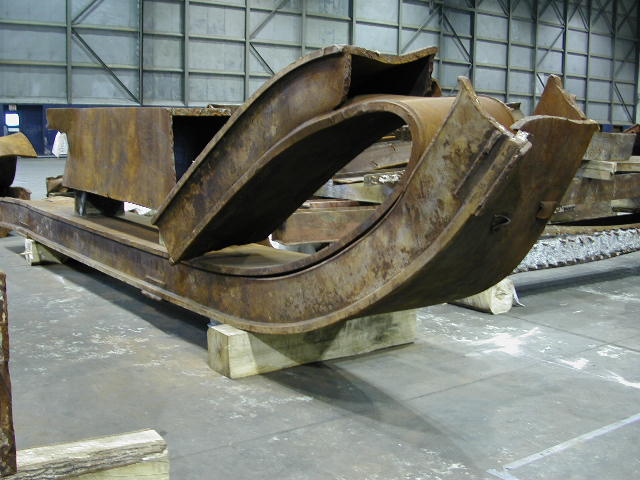
Pictured column was not crushed. It was obviously one of, if not the last remain column connected to the core structure above in 2wtc which lost all the other columns and this single column saw what has left of most of 30 something floors of loads/mass and so it.... BUCKLED like a pretzel...

Once the number of remaining columns... not destroyed by the plane or pushed out of axial alignment by expending bracing steel dropped to a capacity below the service loads at the time.... all those columns would buckle. This discussion relates to the column capacity (so called safety factor) and the service load they carried. As columns were being taken out of load carrying FOS dropped on individual columns which would obviously buckle. No two columns were alike nor saw the same loads.
 
Pictured column was not crushed. It was obviously one of, if not the last remain column connected to the core structure above in 2wtc which lost all the other columns and this single column saw what has left of most of 30 something floors of loads/mass and so it.... BUCKLED like a pretzel...

Once the number of remaining columns... not destroyed by the plane or pushed out of axial alignment by expending bracing steel dropped to a capacity below the service loads at the time.... all those columns would buckle. This discussion relates to the column capacity (so called safety factor) and the service load they carried. As columns were being taken out of load carrying FOS dropped on individual columns which would obviously buckle. No two columns were alike nor saw the same loads.

That's plausible, but I would expect something a little stronger to support an all-caps claim that "NO COLUMNS WERE CRUSHED." Anyway, you still didn't respond to my point. Would you, please?
 
That's plausible, but I would expect something a little stronger to support an all-caps claim that "NO COLUMNS WERE CRUSHED." Anyway, you still didn't respond to my point. Would you, please?

Buildings collapse when the frame comes apart.
When it does the frame can no longer carry the floors and super imposed loads... the floors with no support collapse to the ground.
 
Buildings collapse when the frame comes apart.
When it does the frame can no longer carry the floors and super imposed loads... the floors with no support collapse to the ground.

Well, my point was that even if you made the floors and connections infinitly strong, then the question of whether or not the columns could absorb the energy makes Bazant's analysis relevant. Even the BV model that M_T has such heartburn with does not require column-on-column impact if the connections were strong enough to transfer all the dynamic loads to the columns.
 
Last edited:
Well, my point was that even if you made the floors and connections infinitly strong, then the question of whether or not the columns could absorb the energy makes Bazant's analysis relevant. Even the BV model that M_T has such heartburn with does not require column-on-column impact if the connections were strong enough to transfer all the dynamic loads to the columns.

What energy? What is coming down?
 
Well, my point was that even if you made the floors and connections infinitly strong, then the question of whether or not the columns could absorb the energy makes Bazant's analysis relevant. Even the BV model that M_T has such heartburn with does not require column-on-column impact if the connections were strong enough to transfer all the dynamic loads to the columns.

What energy? What is coming down?

The limit case is the falling upper section imparting its entire dynamic load onto, or transfered to, the columns. Bazant's calcs on that limiting case, which is the best case senario for collapse arrest, indicates that the columns could not withstand that load had this limiting case been the reality..

That IS NOT to say in any way shape or form that it is expected that the entire dynamic load WAS transfered to the columns. Its a hypothetical limiting case.

That's how I see it.

perhaps I'll start a poll.
 
I think ROOSD does shed light on the vulnerability to certain design strategies... hull and core with long span light weight floor systems... to catastrophic runaway failures. I believe this ROOSD would not occur in the older steel frame designs (bays, not column free). I believe this strategy was done for multiple reasons with economics being the driving force and something that developers are after.

So understanding ROOSD should lead to structural design which is not vulnerable to it. And I believe that this HAS been adopted though not formally set forth in code as perhaps it should be.

My take away is the deign participated to some extent in its own demise. That's troubling.

Ozzie's post above was spot on. Well put!
ROOS does not explain anything, the way the buildings collapsed is due to its design - a known factor when designed.
If you have the video of collapse you have MT's collapse model.

Troubling?
Yeppers, ignore the 10 terrorists and two airplanes, and join Richard Gage the liar. I think terrorists are were the trouble, the building did its job. Troubling is Richard Gage spreading lies, or McVeigh.

Did you get those links, did you like the math?

What a load of BS. The WTC would stop an airliner going 250 mph, and the ESB could not stop an 18 pounds of TNT KE impact, the WTC would stop a greater than 187 pounds of TNT KE impact.

What will you say is a 2000 pounds of TNT kinetic energy aircraft impact hit the ESB.

Like the rock slide avalanche BS, stop slinging so much BS. It seem a reflection of how you fell for Gage's BS.
 
The limit case is the falling upper section imparting its entire dynamic load onto, or transfered to, the columns. Bazant's calcs on that limiting case, which is the best case senario for collapse arrest, indicates that the columns could not withstand that load had this limiting case been the reality..

That IS NOT to say in any way shape or form that it is expected that the entire dynamic load WAS transfered to the columns. Its a hypothetical limiting case.

That's how I see it.

perhaps I'll start a poll.

If this is the *case* Mr B makes... it's really hooey in a sense... totally akin to Gage's 81 columns disappearing over 8 floors in an instant. Mr. B... you can't get the top section to drop straight down with dynamic load from a 12' drop. It's idiotic to bother to even contemplate such absurdity.

What had to have happened (Mr B et al) is that some how SOME amount of mass was disengaged from the structure and fell... It fell not on COLUMNS... but it fell on FLOORS.

There appears to have been something else going on. That was the columns were being compromised... first by the plane strike and then by heat related process.. The net result was that these processes OVER time drove down the capacity of the columns that we left and they couldn't support the loads and so they buckled and this released the rest of the mass which hadn't been freed from the structure and fallen (on to floors).

So the interesting thing... to me... is HOW did the heat work from impact to release?

a) did it drive the capacity of enough columns down for them to buckle under the constant load?

b) did it cause the connections to fail leading longer unbraced column length and columns with decreased capacity?

c) did it cause the frame to warp... columns pushed laterally from expanding bracing... with axial alignment destroy and OAL (aggregate) column capacity driven down below service loads?

One of, All of the above or a combination of them. Or perhaps someone has some other ideas about how heat did it.

This is what was going on Mr B and your math has nothing to do with any of the above. I am sure your math is fine... but it has nothing to do with the collapse of the top section of the towers now with the collapse of the undamaged lower section.

 
Status
Not open for further replies.

Back
Top Bottom