• Quick note - the problem with Youtube videos not embedding on the forum appears to have been fixed, thanks to ZiprHead. If you do still see problems let me know.

Merged Global Warming Discussion II: Heated Conversation

Status
Not open for further replies.
im not convinced the heat left the system. but i admit, im totally ignorant about the geosphere's heat content.

Departing on the text you quoted, once you talked about the geosphere I had no idea what heat were you talking about. I always supposed you had used geosphere as a nick for lithosphere, as you mentioned hydrosphere and atmosphere separately. In what is traditionally called the energy budget of the Earth, some 45-47 TW are contributed by the planet's crust and mantle, about a 1/3500th of what we get from the Sun. You may imagine that heat to be radiated into space, but the system that accounts for most of it is what I explained: sea water radiates energy into space in the middle of the polars nights and dawns and ice is formed leaving a heavy brine at -1.8°C to dissolve in more cold water and sink as a cold downstream reaching the ocean bottom, a distributed stream that may amount at certain dates as much as 5 Sverdrups. That's why most of the sea water is between -2°C and 5°C, in spite of the inners of the planet to be white hot and the surface temperature to average 14°C. That part of the hydrosphere is the climatic anchor that avoids surface temperatures to make even crazier excursions for even longer times during "common" events like Toba-like eruptions, 1km-diametre meteorite impacts, methane clathates sacks bursts, or the original event of masses of biped apes fancying to drive fast and furious. But unlike those ephemeral mega-events, the apes continue to come and behave the same way.

If you were talking about other thing, be clear. Your two-line posts start to resemble those of denialists' here, verbal Rorschach tests thought more to elicit long replies, just for the fun of it, than to foster an exchange of ideas.
 
Last edited:
Departing on the text you quoted, once you talked about the geosphere I had no idea what heat were you talking about. I always supposed you had used geosphere as a nick for lithosphere, as you mentioned hydrosphere and atmosphere separately. In what is traditionally called the energy budget of the Earth, some 45-47 TW are contributed by the planet's crust and mantle, about a 1/3500th of what we get from the Sun. You may imagine that heat to be radiated into space, but the system that accounts for most of it is what I explained: sea water radiates energy into space in the middle of the polars nights and dawns and ice is formed leaving a heavy brine at -1.8°C to dissolve in more cold water and sink as a cold downstream reaching the ocean bottom, a distributed stream that may amount at certain dates as much as 5 Sverdrups. That's why most of the sea water is between -2°C and 5°C, in spite of the inners of the planet to be white hot and the surface temperature to average 14°C. That part of the hydrosphere is the climatic anchor that avoids surface temperatures to make even crazier excursions for even longer times during "common" events like Toba-like eruptions, 1km-diametre meteorite impacts, methane clathates sacks bursts, or the original event of masses of biped apes fancying to drive fast and furious. But unlike those ephemeral mega-events, the apes continue to come and behave the same way.

If you were talking about other thing, be clear. Your two-line posts start to resemble those of denialists' here, verbal Rorschach test thought more to elicit long replies, just for the fun of it, than to stimulate an exchange of ideas.

with geosphere i meant not the heat coming from the planet's core. that is minimal, but for example evaporation of soil water etc.

but seems you talk about oceans and cryosphere.
 
with geosphere i meant not the heat coming from the planet's core. that is minimal, but for example evaporation of soil water etc.

but seems you talk about oceans and cryosphere.

Strange use of the term geosphere, then. Why don't you call it just "ground"?

When moist evaporates, if you think the heat comes from the ground itself, then soil water evaporation turns the soils colder. Do have soils any natural source of heat other than the sun, the air above them and the infinitesimal fraction coming from the deep?

And, what had to do the seasonal variation of sea level with the heat content of the soils?
 
Strange use of the term geosphere, then. Why don't you call it just "ground"?

When moist evaporates, if you think the heat comes from the ground itself, then soil water evaporation turns the soils colder. Do have soils any natural source of heat other than the sun, the air above them and the infinitesimal fraction coming from the deep?

And, what had to do the seasonal variation of sea level with the heat content of the soils?

shortwave radiation directly warms up the soil.
i see no reason as to why its a strange to call it geosphere.
and your objection "if you think the heat comes from the ground itself" does not make much sense to me.

Virtually all the energy in the climate system comes from the Sun.
 
Before getting into other issues, why does TRMM register the "tropics" as between 37°N-37°S? I was always taught that the tropics exist between the tropics of Capricorn and Cancer and lie between 23.5°N/S (roughly 2/5 of the Earth's surface area -> (2 sin(23.5°))r = 0.398) so while 40% isn't far off, there is a big difference between the swath between 37° N/S and the swath between 23.5° N/S. In fact the TRMM website lists 23.5° N/S as the bounds of the tropics as well, so this may indeed be one of the errors you are referring to, but while they say 37° their numbers say that they are using 23.5° in their calculations.

Overall, its a wiki "answers" webpage, anyone expecting rigorously accurate details on such are probably fooling themselves about the purpose and effort put into such websites.

Back to this, there are some formulas that are wrote down in every global warming sceptic's notebook. One of those is the area of a spherical cap. From that comes one piece of information every global warming sceptic should know by heart: everything between 30°S and 30°N makes half of the world's area; each cap from 30° latitude to closest pole makes just a quarter of the planet area. That is, everything from the parallel of Houston, TX, to the North Pole, including Cairo, Egypt; Basra, Tijuana, Casablanca and Shanghai -New Delhi is out for less than 80 miles-, accounts just for 25% of the planet, in spite of what so many of its inhabitants believe as they have find in Mercator projection an extension of their self-esteem.

Using the formula, the area between -37° and +37° makes ...pip pip pip pap pip ... about 60% of the whole planet and not 40%. The source is bull, but so was the source about the water vapour.

Let's allow ourselves to be sceptic.
 
shortwave radiation directly warms up the soil.
i see no reason as to why its a strange to call it geosphere.
and your objection "if you think the heat comes from the ground itself" does not make much sense to me.

Virtually all the energy in the climate system comes from the Sun.

You're increasingly skidding in your chain of reasoning. And believe me, English is not your main problem, in spite of your characterization of a phrase starting with "if" as an objection.

I'm not replying any further comment of yours containing "does not make much sense to me" because you don't really seem to want things explained to you, but rather answers you may like, spoon-fed without asking them, without saying please, without saying thank you and without showing in the meantime your limitations for others to see. Not a way to learn, nor a way to interact with others.
 
You're increasingly skidding in your chain of reasoning. And believe me, English is not your main problem, in spite of your characterization of a phrase starting with "if" as an objection.

I'm not replying any further comment of yours containing "does not make much sense to me" because you don't really seem to want things explained to you, but rather answers you may like, spoon-fed without asking them, without saying please, without saying thank you and without showing in the meantime your limitations for others to see. Not a way to learn, nor a way to interact with others.

sorry, when it does not make much sense to me, i say so (and with that i also run the risk of exposing my ignorance, or lack of comprehension), note, i did not say you are wrong, or you make no sense at all, i said it does not make much sense to me what you say.
and as to learning, i am very interested in learning more about our climate system. but to learn , i actually need to understand what you try to say, and sofar i just don't. nor do you explain it in a way that i would understand it.

"without showing in the meantime your limitations for others to see."
what does that even mean? another sentence of yours , that makes no sense to me, im sorry. i do think it is the problem of english not being our first language.

ETA: and to teach me what you seem to be saying, it would be sufficient to show me a graph or some data showing the heat content over all systems decreasing since start of the year. and shortly explain why that is.
 
Last edited:
Another forum I am on a poster has asked the question: "can anyone recommend any good documentaries or articles that show a link between human derived ghg's and temperature?"

I think it's an honest request, but I'm not sure what would be a good place to start, I think he wants something a little more technical.

I'm going to say the Skeptical Science website, but just wondering if you guys could maybe recommend some other resources.
 
Another forum I am on a poster has asked the question: "can anyone recommend any good documentaries or articles that show a link between human derived ghg's and temperature?"

I think it's an honest request, but I'm not sure what would be a good place to start, I think he wants something a little more technical.

I'm going to say the Skeptical Science website, but just wondering if you guys could maybe recommend some other resources.

i think that uis currently some of the best around

https://royalsociety.org/~/media/Ro...nce-causes/climate-change-evidence-causes.pdf
 
Another forum I am on a poster has asked the question: "can anyone recommend any good documentaries or articles that show a link between human derived ghg's and temperature?"

I think it's an honest request, but I'm not sure what would be a good place to start, I think he wants something a little more technical.

I'm going to say the Skeptical Science website, but just wondering if you guys could maybe recommend some other resources.

There are several documentaries that summarize the science, but I don’t know of any that really walk you through how those results are obtained.

The past week’s episode of Cosmos may be an ok starting point. An Inconvenient Truth is actually pretty good, but it may be a bit dated on a couple points now. Even though it’s quite accurate in its representation of the science you would probably get an “I refuse to believe anything in it because it’s being narrated by a Democrat” response so it’s probably not what you’re looking for

In terms of walking you though the science step by step, I’d recommend Spencer Weart’s book The Discovery of Global Warming. It’s basically a timeline of the key discoveries and describes what they are, why they are important, etc. It basically walks you though how scientists got to the current state of understanding.

A lot of the book is replicated here
http://www.aip.org/history/climate/index.htm#contents
 
"without showing in the meantime your limitations for others to see."
what does that even mean? another sentence of yours , that makes no sense to me, im sorry. i do think it is the problem of english not being our first language.

OK. But you have to understand that the questions are aimed to the participants to use what they know to arrive to some critical conclusions. You quoted a post of mine where I spoke of seasonal sea level change -its value, not its causes- and dropped bellow it "i'm not convinced the heat has left the system" (sic). Were you quoting my post just to call my attention or in order to add to it? If the latter, what do you think I was talking about in the quoted text? If you were an Usian and 50 or older, I would able to say "Who do you think I am? Carnac?" and both of us would laugh.

It's as simple as this: if you don't know something ask specifically what you don't know, if you still don't understand, say "I suppose A implies B, am I right?" or a similar approach. And if you still don't understand, accept that situation patiently. You can't understand everything.
 
OK. But you have to understand that the questions are aimed to the participants to use what they know to arrive to some critical conclusions. You quoted a post of mine where I spoke of seasonal sea level change -its value, not its causes- and dropped bellow it "i'm not convinced the heat has left the system" (sic). Were you quoting my post just to call my attention or in order to add to it? If the latter, what do you think I was talking about in the quoted text? If you were an Usian and 50 or older, I would able to say "Who do you think I am? Carnac?" and both of us would laugh.

It's as simple as this: if you don't know something ask specifically what you don't know, if you still don't understand, say "I suppose A implies B, am I right?" or a similar approach. And if you still don't understand, accept that situation patiently. You can't understand everything.

i specifically asked, if you mean to say that the heat content over all systems is decerased.

you said that is exactly what you meant.

then you show TSI and some sea level data...

you also said be a bit scepetic. but sorry, this is not enough data for me to accept the claim that the heat content over all systems decreased since january 1.
and i said i am not convinced that the heat left the system, (radiated off to space)
i did look up unsmoothed OHC and yes, OHC decreases seasonally from jan to june.
i also looked up CERES OLW Data and also there a seasonal increase in outgoing long wave radiation from Jan to June.
but that still leaves open quantifications of the heat content in the cryosphere and geosphere.
and so i still have not enough data to accept that the HC over all systems decreases.
i lack the knowledge to really quantify all those systems and there is relatively little data avaible besides the atmopshere and oceans.
and even there most used sources are all smoothed.

i do tend to belive you, especially as you are considered as one to know his stuff about this, but you wanted scepticism. so i didn't just want to accept your word for it. or try to gues, oh well OHC goes down, atmosphere warms, more OLW so it must be that you are right.

what i really was looking for was a quantification of the heat content of all the systems of the planet but cannot find anything, nor did you provide anything.

maybe i am misstaken and all other systems are neglectable, and i do know that the heat content of the atmosphere did not increase enough to compensate the heat content loss in the oceans. and the amount of increased OLW is anough to acount for it, but i simply don't know. but would like to know. because its a funy question and counterintuitive.
so excuse my scepticism.
 
Last edited:
btw:

"Thank you for contacting NSIDC. I do see the errors you are referring to in the table at the bottom of the page. I will get those corrected as soon as possible.

Thanks for letting us know.

Best Regards,
xxxxxxxxxxxxxxx
NSIDC User Services"

lets see how long it takes :D
 
i do tend to belive you, especially as you are considered as one to know his stuff about this, but you wanted scepticism. so i didn't just want to accept your word for it.

I didn't ask my word to be accepted nor I would like it to be that way -unless in a trial-. In fact I made questions departing from statements. I can assure you that about 75% of those statements are true, and 25% are not. Otherwise nobody would learn anything.

Let me tell you something. You detected seasonal variations in OHC. But did you detected the cause? I hope so. If the answer is yes, please share it with the rest of the readers. If you do so, I promise I will add to what you commented in your last post. If you haven't arrive there yet, I must refrain myself in doing so until this first bit is complete (I think I give plenty of clues. I even said don't be too Copernican because you were as wrong as him)
 
Another forum I am on a poster has asked the question: "can anyone recommend any good documentaries or articles that show a link between human derived ghg's and temperature?"

I think it's an honest request, but I'm not sure what would be a good place to start, I think he wants something a little more technical.

I'm going to say the Skeptical Science website, but just wondering if you guys could maybe recommend some other resources.

The IPCC reports themselves are very fine references

http://www.ipcc.ch/

For human activities specifically, try:

http://www.ipcc.ch/report/ar5/wg1/

The AIP e-book/guide mentioned above is probably the most thorough compendium of references and explanations of the last 1-200 years of climate science discovery and understanding. Both the Royal Society and PNAS has a whole library of online references and studies excellent sources one and all. My personal favorite texts would have to include Dr. Pierrehumbert's "Principles of Planetary Climate" which is probably more technical than is generally discussed here, but an excellent look at the underlying physics and planetary dynamics involved. "The Warming Papers" by David Archer is also a good solid look at the formative climate science and human involvement studies (many of the actual papers in the AIP climate science history book are laid out and discussed).

If you have a more specific topic of information you are seeking, I can probably help you narrow down the list to best fit resources. Most of these are pretty general in scope and coverage.
 
Last edited:
Well actually got into the thread without a 10 minute wait.

Alec with all due respect....TWO ESLs trying to communicate when you are being obtuse isn't helping your E effort.

The macro energy dynamics at equinox are astoundingly complex just as the air/ice/ocean interface is at the microscale.

You do not have to numerate to understand concepts and visualize processes.

Reading a table of numbers for sea temperature - you might visualize the shift over time of a proto-El Nino.
I prefer this

monster-kelvin-wave.gif


I don't need to know how to calculate the thermal energy to melt a cubic KM of ice. I do need to know approximately what that portends short term and long term.

I have to trust places like NOAA to do the math and present the situation visually.

Sometimes they make errors.

I could the spot the error in this far easier than a table of numbers.

sn-elninoR.jpg


Even Gavin missed it first time around and it was his department.

We all have different ways to approach our knowledge of the world and we rely on each other to reinforce and interpret and point out errors where they occur.

I need visuals not numbers...I rely on others to make sure those visuals reflect the numbers underlying their creation..

I'm all for challenges but I think you overshoot expecting the level of numeracy needed tho I dare say there are those here that are equally comfortable as you are.

Sort of like I'm comfortable in English and concept communication as that's my turf.

So far on your inquistive exercise as to seasonal mysteries in the geosystems.....mark is....making an effort ;)
 
i specifically asked, if you mean to say that the heat content over all systems is decerased.

you said that is exactly what you meant.

then you show TSI and some sea level data...

you also said be a bit scepetic. but sorry, this is not enough data for me to accept the claim that the heat content over all systems decreased since january 1.
and i said i am not convinced that the heat left the system, (radiated off to space)
i did look up unsmoothed OHC and yes, OHC decreases seasonally from jan to june.
i also looked up CERES OLW Data and also there a seasonal increase in outgoing long wave radiation from Jan to June.
but that still leaves open quantifications of the heat content in the cryosphere and geosphere.
and so i still have not enough data to accept that the HC over all systems decreases.
i lack the knowledge to really quantify all those systems and there is relatively little data avaible besides the atmopshere and oceans.
and even there most used sources are all smoothed.

i do tend to belive you, especially as you are considered as one to know his stuff about this, but you wanted scepticism. so i didn't just want to accept your word for it. or try to gues, oh well OHC goes down, atmosphere warms, more OLW so it must be that you are right.

what i really was looking for was a quantification of the heat content of all the systems of the planet but cannot find anything, nor did you provide anything.

maybe i am misstaken and all other systems are neglectable, and i do know that the heat content of the atmosphere did not increase enough to compensate the heat content loss in the oceans. and the amount of increased OLW is anough to acount for it, but i simply don't know. but would like to know. because its a funy question and counterintuitive.
so excuse my scepticism.


I didn't ask my word to be accepted nor I would like it to be that way -unless in a trial-. In fact I made questions departing from statements. I can assure you that about 75% of those statements are true, and 25% are not. Otherwise nobody would learn anything.

Let me tell you something. You detected seasonal variations in OHC. But did you detected the cause? I hope so. If the answer is yes, please share it with the rest of the readers. If you do so, I promise I will add to what you commented in your last post. If you haven't arrive there yet, I must refrain myself in doing so until this first bit is complete (I think I give plenty of clues. I even said don't be too Copernican because you were as wrong as him)
The seasonal variation is due to the difference in sea area between the hemispheres. You see similar variation in the CO2 concentration because of spring / summer vegitation growth in the Northern Hemisphere.
 
The macro energy dynamics at equinox are astoundingly complex just as the air/ice/ocean interface is at the microscale.

You do not have to numerate to understand concepts and visualize processes.

The seasonal variation is due to the difference in sea area between the hemispheres. You see similar variation in the CO2 concentration because of spring / summer vegitation growth in the Northern Hemisphere.


I think is not too much to have ...

... asked one question ...
How come the average global temperature has climbed some 2.7°C since January 1st, yet the planet has become cooler?
... being astounded (subject: myself) by the lack of an immediate answer ...

... added this trigger-reflection one ...

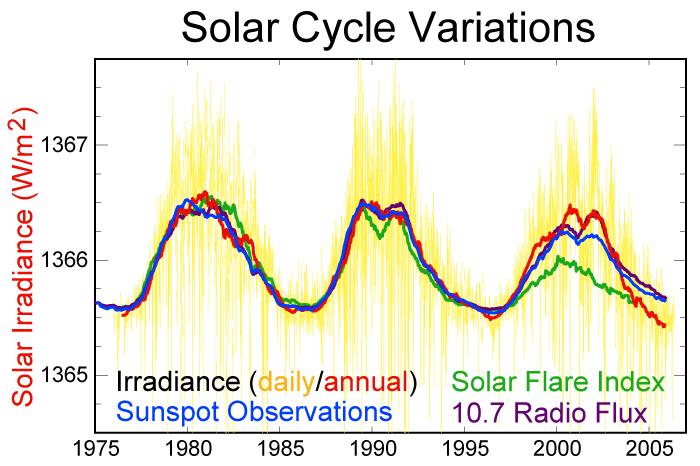
Some related questions that can help to answer my previous questions. We have this famous figure, used so many times:


It is safe to say that on January 1st this year solar irradiance was some value between 1360 and 1370 watts per square metre?

... nothing yet ...

... provided these hard data ...
About the TOA flux changes -related with wavelengths of solar radiation and not from Earth reradiation-, my bad for offering a clue as a question, so I'm going to change its format:

The figure is quite correct and its variations are originated in the Sun's internal affairs, and though I don't know the value for January 1st 2014, I can tell that the value for January 1st 2013 was 1407.8427 watts per square metre (source). Who would've thought during such a weak solar cycle, harbinger of cooling according to diehard denialists? (In January 1st 2004 it was just 1407.7946 watts per square metre :wink:)
... told twice not to be too Copernican ...

... and yet not have elicited the beginning of an answer.

Well, here it goes part of it:

One of the possible reasons for the Earth to be warmer on January 1st than it is this date is the Earth having an elliptic orbit and the Sun being in one of its focuses (yes, too numerical an answer :rolleyes:). Do you remember the terms aphelion and perihelion? Well, typically on January 4th, the Earth is closer to the Sun so it can gather some 1408 W/m2 top of the atmosphere. On the contrary, typically on July 4th -a joyful day I'm typically lighting firecrackers and singing the anthem aloud "Ô Canada! Terre de nos aïeux" (because the party takes me several days being a Latin from the Highlands)- the planet is in its farthest point and only gets just some 1316 W/m2.

Was it much to ask? Too specialized? Too numeric? When you replied some denialist memes with Milankovich Cycles, what did you have in mind? But forget these cycles and take it from here. You already mention hemispherical asymmetries. Well, account for them -and I'm not saying "give me the figures"-. The question stands still unanswered.

Four years in the past I'm sure none of you would have had any problem mentioning this bit.
 
Status
Not open for further replies.

Back
Top Bottom