Merged Global Warming Discussion II: Heated Conversation

Status
Not open for further replies.
No replies?

How about just spotting one big fat error in this 150-word paragraph?

Besides, almost 2 years have passed since I posted this image regarding awful mistakes in this NSIDC webpage.

[qimg]http://www.internationalskeptics.com/forums/picture.php?albumid=907&pictureid=6638[/qimg]

No one has told here what the blunders are yet -there was only a ridiculous series of post by r-j regarding this- nor anyone has written them to correct the page.

I seem to remember someone pointing out the obvious blunders in that image before, but I can't find it so I might be mistaken. Anyway, 1 km2 is about 0.4 mi2, not about 0.6.
 
i meant your first question about warming / cooling planet.

The question was:
How come the average global temperature has climbed some 2.7°C since January 1st, yet the planet has become cooler? I don't have the figures now but I wouldn't be surprised if the planet had lost in five months more heat than she gained from January 1st 1970 to January 1st 2014. Is not this proper "global cooling"?
Don't you think the average global temperature has climbed some 2.7°C since January 1st?

Don't you think the planet has become colder in the same period?

If the answer to both is "I dunno", saying that you didn't understand the question is not an option.

You can leave the rest of the question for a time after the first part should have been properly replied.
 
I seem to remember someone pointing out the obvious blunders in that image before, but I can't find it so I might be mistaken. Anyway, 1 km2 is about 0.4 mi2, not about 0.6.

Well done!

It looks like an employee developing the website tried to "enrich" the text he or she was given and converted square kilometres to square miles using the rate to convert lineal kilometres to lineal miles. As a consequence the average Arctic sea ice extent is about the size of North America during winter, and the average extent during the hottest month is about the size of Canada maybe plus Alaska. A coarse misrepresentation. There are four instances of this blunder.

Besides, the same person, obviously an innumerate, did the soft mistake of using the exact number given by the calculator (just omitting the decimals as many innumerates are told to do in K-12 just to get them to the prom and out), so 15,000,000 km2 got converted to exactly 9,320,568 mi2, what looks like this old joke:

"-How old are these geological formations?
-70,000,003 years, ma'am.
-What? How do you know so exactly?
-Because a geologist told me they were 70 million years old, and that happened exactly three years ago."

In comparison, in the same image, there are sensible conversions at the bottom, made by someone who really knew what she or he was doing.

The difficulty to get an answer to that during 20 months, and the much probable dismissal of it as a minor concern on the part of those who should better be ashamed of not spotting it instantly, all that speak volumes of the quality of the participation on this thread, what comes from paying attention to the barbarians who constantly try to degrade it.

Well DC, now you can write the note!
 
The question was:
Don't you think the average global temperature has climbed some 2.7°C since January 1st?

Don't you think the planet has become colder in the same period?

If the answer to both is "I dunno", saying that you didn't understand the question is not an option.

You can leave the rest of the question for a time after the first part should have been properly replied.

for me that contradicts eachother, maybe its just my english.
when the global average temperature rises, the planet does not become colder but warmer. more heat accumulated in the atmosphere and the oceans, plus the heat that goes into the melting of ice.

i don't get the question.
 
Well done!

It looks like an employee developing the website tried to "enrich" the text he or she was given and converted square kilometres to square miles using the rate to convert lineal kilometres to lineal miles. As a consequence the average Arctic sea ice extent is about the size of North America during winter, and the average extent during the hottest month is about the size of Canada maybe plus Alaska. A coarse misrepresentation. There are four instances of this blunder.

Besides, the same person, obviously an innumerate, did the soft mistake of using the exact number given by the calculator (just omitting the decimals as many innumerates are told to do in K-12 just to get them to the prom and out), so 15,000,000 km2 got converted to exactly 9,320,568 mi2, what looks like this old joke:

"-How old are these geological formations?
-70,000,003 years, ma'am.
-What? How do you know so exactly?
-Because a geologist told me they were 70 million years old, and that happened exactly three years ago."

In comparison, in the same image, there are sensible conversions at the bottom, made by someone who really knew what she or he was doing.

The difficulty to get an answer to that during 20 months, and the much probable dismissal of it as a minor concern on the part of those who should better be ashamed of not spotting it instantly, all that speak volumes of the quality of the participation on this thread, what comes from paying attention to the barbarians who constantly try to degrade it.

Well DC, now you can write the note!

Yeah the fact that the numbers at the bottom match the actual conversion rate close enough and don't have a ridiculous amount of significant digits seems to indicate that the person putting this online thought it was a good idea to make it easier for people that are used to miles to be able to read the numbers at the top and emulated what the figures at the bottom look like, without understanding what they were doing.

I'm still not sure about where you are going with your question though. On the face of it, it seems to contradict itself. If this is not something due to mixing different reference frames as suggested earlier or due to something being lost in translation, then either it does contradict itself/is nonsensical or you must have phrased your question the way you did on purpose. But I don't see what that purpose might be.
 
for me that contradicts eachother, maybe its just my english.
when the global average temperature rises, the planet does not become colder but warmer. more heat accumulated in the atmosphere and the oceans, plus the heat that goes into the melting of ice.

i don't get the question.

I'm still not sure about where you are going with your question though. On the face of it, it seems to contradict itself. If this is not something due to mixing different reference frames as suggested earlier or due to something being lost in translation, then either it does contradict itself/is nonsensical or you must have phrased your question the way you did on purpose. But I don't see what that purpose might be.

That might raise the question "do I have to explain the 'difference' between temperature and heat?"

If prefer to follow the paths taught in higher education centres to solve this kind of problems:

"I have the feeling that two parts of the question clash. They don't contradict. Who am I to say they contradict if I cannot explain immediately why?"

"So let's start analysing it. «average global temperature rose 2.7°C since January 1st». First, what temperature is that suppose to be? and once I get it, if I get it, is that really true? I have doubts so I may scan typical global temperatures until I find some similar value" Want a clue? Let's try these sources (1 - 2)"

"Now, what does it mean «the planet has become colder»? Certainly the question seems to look rather scientific than mere chat at the laundrymat while waiting the drying cycle to finish, so I would bet colder means less thermal energy ..."

-follow this pattern; macdoc already did, partly-

Of course, there is basic information covering different scientific disciplines, including how the planet works, that is needed to follow. But there's a big web out there and anyone can ask questions.

My goal is recovering the level we had here five years ago. It was a pleasure reading posts written by Trakar, macdoc, lomiller, pixel42, a unique person, CapelDodger, and a lot more that are every bit their equals. Some other high quality posters too, but they haven't participated any longer. Even other denialists and deniers participated, and they were wrong but way much better than the bunch of red-nosed, loud-colour-patch wearing people who have been emerging in legions from the same tiny car during the last 12-24 months.

My friends -I like to think they are- have forgot much of what they knew, just because they indulged themselves in an antagonistic debate with people who only know how to survive in the alleys of life.

 
Last edited:
Let me get this straight, we are not mixing frames of reference therefore we are not saying: "The difference of the total heat content in J of the earth on jan 1st 1970 and on jan 1st 2014 is less than the total amount of energy in J that the earth radiated between jan 1st 2014 and may 30th 2014", right?
 
Let me get this straight, we are not mixing frames of reference therefore we are not saying: "The difference of the total heat content in J of the earth on jan 1st 1970 and on jan 1st 2014 is less than the total amount of energy in J that the earth radiated between jan 1st 2014 and may 30th 2014", right?

Depending what you call "frame". The planet is a whole and the system which energy we're measuring remains to be the same. But the phrase is indeed correct if you swap the dates in the first part and -hmm, I'm giving away a half of the answer- change radiated by lost.

For you -and others- you may try simple reality checks based on principia or two/three variables in the system.
 
That might raise the question "do I have to explain the 'difference' between temperature and heat?"

If prefer to follow the paths taught in higher education centres to solve this kind of problems:

"I have the feeling that two parts of the question clash. They don't contradict. Who am I to say they contradict if I cannot explain immediately why?"

"So let's start analysing it. «average global temperature rose 2.7°C since January 1st». First, what temperature is that suppose to be? and once I get it, if I get it, is that really true? I have doubts so I may scan typical global temperatures until I find some similar value" Want a clue? Let's try these sources (1 - 2)"

"Now, what does it mean «the planet has become colder»? Certainly the question seems to look rather scientific than mere chat at the laundrymat while waiting the drying cycle to finish, so I would bet colder means less thermal energy ..."

-follow this pattern; macdoc already did, partly-

Of course, there is basic information covering different scientific disciplines, including how the planet works, that is needed to follow. But there's a big web out there and anyone can ask questions.

My goal is recovering the level we had here five years ago. It was a pleasure reading posts written by Trakar, macdoc, lomiller, pixel42, a unique person, CapelDodger, and a lot more that are every bit their equals. Some other high quality posters too, but they haven't participated any longer. Even other denialists and deniers participated, and they were wrong but way much better than the bunch of red-nosed, loud-colour-patch wearing people who have been emerging in legions from the same tiny car during the last 12-24 months.

My friends -I like to think they are- have forgot much of what they knew, just because they indulged themselves in an antagonistic debate with people who only know how to survive in the alleys of life.
i don't know, i always had trouble with english, especially in combination of your english and strange way to express yourself.
 
i don't know, i always had trouble with english, especially in combination of your english and strange way to express yourself.

That shouldn't be much of a problem, really. I suppose you look up every word or concept you're not sure, as I do without exception. Otherwise, how would I learn?

Some problem may arise about the use or the terms warmer and cooler in situations like this one: Is liquid brine -15% of NaCl in weight- at a temperature of -6°C warmer than ice -made of distilled water- at -3°C? If, at the beginning, both were liquids at +10°C, which one lost more thermal energy to reach the state previously described? Both replies "seem" to pose some sort of contradiction.

But there's nothing like that -or just a teeny-weeny bit of it- in the scenarios in my questions.
 
That shouldn't be much of a problem, really. I suppose you look up every word or concept you're not sure, as I do without exception. Otherwise, how would I learn?

Some problem may arise about the use or the terms warmer and cooler in situations like this one: Is liquid brine -15% of NaCl in weight- at a temperature of -6°C warmer than ice -made of distilled water- at -3°C? If, at the beginning, both were liquids at +10°C, which one lost more thermal energy to reach the state previously described? Both replies "seem" to pose some sort of contradiction.

But there's nothing like that -or just a teeny-weeny bit of it- in the scenarios in my questions.

i simply don't understand what you mean by "the planet has become colder"

i am aware that when we talk about temperature, that we are talking about the temperature of the atmosphere only, and of that actually some 1.5m above the ground.

and i am aware of the difference of temperature and heat.
yet i don't get what you meant by became colder. with planet i asume you mean the whole planet, atmosphere, oceans, cryosphere, biosphere and geosphere.
but colder, did the heat content over all system decrease?
 
i simply don't understand what you mean by "the planet has become colder"

i am aware that when we talk about temperature, that we are talking about the temperature of the atmosphere only, and of that actually some 1.5m above the ground.

and i am aware of the difference of temperature and heat.
yet i don't get what you meant by became colder. with planet i asume you mean the whole planet, atmosphere, oceans, cryosphere, biosphere and geosphere.
but colder, did the heat content over all system decrease?

Exactly that. (But about the geosphere, I can't give guarantees, but about its first 15 metres)

[And I promise this is going to show connections with all the typical global warming truths and denialist myths he have discussed for years]
 
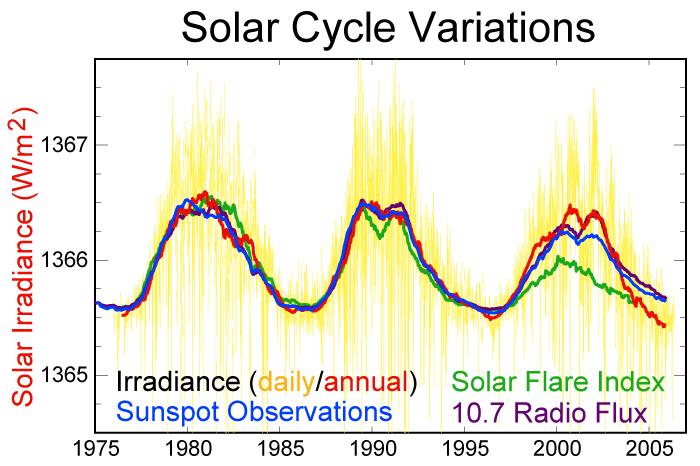
Some related questions that can help to answer my previous questions. We have this famous figure, used so many times:

Solar-cycle-data.png


It is safe to say that on January 1st this year solar irradiance was some value between 1360 and 1370 watts per square metre?

I'm taking some data from the ocean heat content/basin data series page.

For instance, for the South Atlantic, the value for Jan-Mar 2014 in the layer 0-700m was 2.419 x 10E22 Joules. The value for Jul-Sep 2013 for the same section and layer was 1.462 x 10E22 Joules. Does it mean that the Atlantic Ocean, south of the Equator, warmed less than 10E22Joules in those six months?

You got in an earlier post a figure showing the global mean sea level time series with seasonal signals removed. Here you have the same figure but with seasonal signals retained. And here the raw data. If you subtract the values in this file to the those in the previous file you can get how strong the seasonal signals are. Does it say something to you?
 
Interesting, i was not aware of the geosphere's heat content and how much it fluctuates.
but did that heat leave the system (radiated off to space) or has it just redistrubited (but then the heat content off all systems did not decrease)?
is that what we see in the CERES TOA flux changes during a year?
 
Interesting, i was not aware of the geosphere's heat content and how much it fluctuates.
but did that heat leave the system (radiated off to space) or has it just redistrubited (but then the heat content off all systems did not decrease)?
is that what we see in the CERES TOA flux changes during a year?

I meant, there are no measures of variations in the thermal energy content within the geosphere so I can't tell. The fraction of that energy than comes into the hydrosphere and atmosphere is minimal and pretty constant: about 90 miliWatt per square metre, with minimum in the continental areas -some 5 to 10 miliWatt per square metre- as continents are thick insulation plates. Most of the heat comes into deep ocean waters and is in the end cancelled in the equation by part of the stream of chilly water coming from the brine left when sea ice is created in the polar areas each cold season.

About the TOA flux changes -related with wavelengths of solar radiation and not from Earth reradiation-, my bad for offering a clue as a question, so I'm going to change its format:

The figure is quite correct and its variations are originated in the Sun's internal affairs, and though I don't know the value for January 1st 2014, I can tell that the value for January 1st 2013 was 1407.8427 watts per square metre (source). Who would've thought during such a weak solar cycle, harbinger of cooling according to diehard denialists? (In January 1st 2004 it was just 1407.7946 watts per square metre ;))
 
Last edited:
By this time, some of you should've used the raw data at sealevel.colorado.edu and inferred that there are seasonal signals accounting for a 10mm sea level yearly oscillation, and that such oscillation should've reach a minimum by May 20th, and now it goes up to its maximum by October 15th. We're today, pretty much, in the minimum sea level, seasonally speaking. Is there much snow around you and overflown rivers right now, out there, in the hemisphere turning away from our galaxy's centre? I know that the Siberian watershed is a bitch but, a maximum in October 15th? What's happening?
 
By this time, some of you should've used the raw data at sealevel.colorado.edu and inferred that there are seasonal signals accounting for a 10mm sea level yearly oscillation, and that such oscillation should've reach a minimum by May 20th, and now it goes up to its maximum by October 15th. We're today, pretty much, in the minimum sea level, seasonally speaking. Is there much snow around you and overflown rivers right now, out there, in the hemisphere turning away from our galaxy's centre? I know that the Siberian watershed is a bitch but, a maximum in October 15th? What's happening?

im not convinced the heat left the system. but i admit, im totally ignorant about the geosphere's heat content.
 
Status
Not open for further replies.

Back
Top Bottom