• Quick note - the problem with Youtube videos not embedding on the forum appears to have been fixed, thanks to ZiprHead. If you do still see problems let me know.

WTC, Fire, and building collapse

MrSkunkwork100

Scholar
Joined
Sep 12, 2011
Messages
67
“...Fire can't weaken steel or cause it to fail! It's steel for crying out loud!”
How many times have we heard THIS argument? This seems to mostly be an argument advanced by people who really haven't bothered to examine how steel is made, or how steel is manufactured and fabricated.

This is a photo taken on the 60 freeway, east of Los Angeles, in Montebello, CA. A tanker truck carrying 8,800 gallons of gasoline crashed into the Paramount blvd. bridge causing the gasoline to erupt into a fireball. "Concrete girders and columns were damaged by the fire, which sent black smoke over the freeway as the gasoline burned. Portions of the 60 Freeway were closed for about three days after the crash."--NBCLosAngeles.com.

Basically, the damage from the fire was so bad that it forced the closure of the freeway for three days--which, for a major metropolitan area like that, is an eternity. This is similar to the destruction caused by the fire in One Meridian Plaza in Philidelphia, PA. In that fire (which burned 8 floors) the damage to the builidng was so bad, that the builidng was rendered useless.


This is the aftermath of a similar event in Okland, CA on the I-580, San Rafael/Richmond bridge. Here, we have a similar occurrance, but where the bridge the tanker was on, actually collapsed due to the fire. Both cases involved a situation involving a tanker truck catching fire and the contents burning for a period afterward. One collapsed, while the other was simply damaged to the point that it was rendered useless. As we all know well, bridges are constructed of more robust construction--extensively using concrete along with steel and meant to support constantly fluctuating stresses and loads.

Question:
Does it really matter that one collapsed and one didn't? Both were subjected to roughly the same damage impetus, involving fire and identical liquid fuel. I ask, because often, the debate is framed in terms of "possible"--which can and often is put into the realm of the personally subjective. I don't see that it makes a difference, because there are all kinds of variables at play in each individual incident.

Any thoughts?
 
I am pretty sure that steels weakness to fire have been know since the start of steel constructions. It is likely covered at some lenght in arcitechts school. ;)

It is not as if anyone (sane/just somewhat knowledgable) need further examples.
 
I am pretty sure that steels weakness to fire have been know since the start of steel constructions. It is likely covered at some lenght in arcitechts school. ;)

It is not as if anyone (sane/just somewhat knowledgable) need further examples.

I agree. I think that the whole concept that conspiracy theorists are somehow unaware of the vulnerability of steel to fire--this long after the World Trade Center disaster--is completely disingenuous. :)
 
Steel has been said to have "melted" hundreds of times in normal fires.
 
I agree. I think that the whole concept that conspiracy theorists are somehow unaware of the vulnerability of steel to fire--this long after the World Trade Center disaster--is completely disingenuous. :)
I've never seen a truther actually acknowledge that the strength of steel reduces with increasing temperature even after they have been shown numerous graphs from multiple reliable sources proving this.
 
A major highway (Autobahn), the A57, is closed north of the city of Cologne, not far from where I live, because they must tear down and rebuild a bridge after a truckload of PVC plastic pipes had burned under it, destroying the steel reinforcement in the concrete. It will take them a couple of months to build a make-shift bridge as temporary solution, and a year to rebuild properly.
 
Happened here in east coast

I 95 truck carrying heating fuel struck bridge and caught fire

On March 26, 2004, a bridge on I-95 in Bridgeport, Connecticut was partly melted by the explosion of a tanker truck carrying over 11,900 gallons (45,000 L) of fuel oil. Repairs were estimated to take at least two weeks, but the highway was opened to northbound traffic in only a few days. Southbound traffic resumed about a week later.

Talked to one of the firemen involved at a dive show few days later

I 78 Newark - trash pile under bridge (this is Newark New Jersey after all) including discarded tires caught fire, allegedy from homeless living there (talk about trolls under bridge!)

A section of I-78 in Newark was closed off in August 1989 when a debris pile under a bridge caught fire and damaged the elevated highway. The road was opened nine days after the fire occurred.
 
I am pretty sure that steels weakness to fire have been know since the start of steel constructions. It is likely covered at some lenght in arcitechts school. ;)

It is not as if anyone (sane/just somewhat knowledgable) need further examples.

Actually more like since the advent of the blacksmith
 
“...Fire can't weaken steel or cause it to fail! It's steel for crying out loud!”
How many times have we heard THIS argument? This seems to mostly be an argument advanced by people who really haven't bothered to examine how steel is made, or how steel is manufactured and fabricated. [qimg]http://www.internationalskeptics.com/forums/imagehosting/thum_527884f51d417656a1.jpg[/qimg]

This is a photo taken on the 60 freeway, east of Los Angeles, in Montebello, CA. A tanker truck carrying 8,800 gallons of gasoline crashed into the Paramount blvd. bridge causing the gasoline to erupt into a fireball. "Concrete girders and columns were damaged by the fire, which sent black smoke over the freeway as the gasoline burned. Portions of the 60 Freeway were closed for about three days after the crash."--NBCLosAngeles.com.

Basically, the damage from the fire was so bad that it forced the closure of the freeway for three days--which, for a major metropolitan area like that, is an eternity. This is similar to the destruction caused by the fire in One Meridian Plaza in Philidelphia, PA. In that fire (which burned 8 floors) the damage to the builidng was so bad, that the builidng was rendered useless.

[qimg]http://www.internationalskeptics.com/forums/imagehosting/thum_527884f51d6f18e407.jpg[/qimg]


This is the aftermath of a similar event in Okland, CA on the I-580, San Rafael/Richmond bridge. Here, we have a similar occurrance, but where the bridge the tanker was on, actually collapsed due to the fire. Both cases involved a situation involving a tanker truck catching fire and the contents burning for a period afterward. One collapsed, while the other was simply damaged to the point that it was rendered useless. As we all know well, bridges are constructed of more robust construction--extensively using concrete along with steel and meant to support constantly fluctuating stresses and loads.

Question:
Does it really matter that one collapsed and one didn't? Both were subjected to roughly the same damage impetus, involving fire and identical liquid fuel. I ask, because often, the debate is framed in terms of "possible"--which can and often is put into the realm of the personally subjective. I don't see that it makes a difference, because there are all kinds of variables at play in each individual incident.

Any thoughts?

Here is just some information regarding the highway collapse. Saying it in any way gives credence to what happened on 9/11 is laughable.

http://prisonplanet.com/articles/may2007/010507ludicrousfreeway.htm

http://stopthelie.com/freeway_collapse.html
 
Here is just some information regarding the highway collapse. Saying it in any way gives credence to what happened on 9/11 is laughable.

http://prisonplanet.com/articles/may2007/010507ludicrousfreeway.htm

http://stopthelie.com/freeway_collapse.html

Omg, you mean a highway isnt a skyscraper?????? :jaw-dropp
Wow.
Good thing Tmd is here. Would never have figured that out. :rolleyes:

Point is, tmd, that steel fails in fires all the time. Truthers act like steel is practically indestructible without explosives or thermite, therefore showing that it really isnt, is perfectly valid.
 
Last edited:
Here is just some information regarding the highway collapse. Saying it in any way gives credence to what happened on 9/11 is laughable.

http://prisonplanet.com/articles/may2007/010507ludicrousfreeway.htm

http://stopthelie.com/freeway_collapse.html

Professor Steven Jones, a Ph.D. physicist and cold fusion expert, joined Alex Jones on the air yesterday to talk about the monumental differences between the two collapses.

Jones said that the notion that steel supporting columns completely melted from fire is impossible and that what actually happened was that thin supporting bolts were warped, resulting in the collapse of the bridge section. In comparison, the south tower of the World Trade Center imploded at almost free fall speed, proving that even if the "truss failure" theory was accurate, the building would not have collapsed in 10 seconds with no resistance and would not have aerosolized, turning concrete support pillars into dust.

Collapsed with no resistance? Aerosolized? concrete support pillars? Into dust?

I'm spin dizzy.
 
Professor Steven Jones, a Ph.D. physicist and cold fusion expert, joined Alex Jones on the air yesterday to talk about the monumental differences between the two collapses.

Jones said that the notion that steel supporting columns completely melted from fire is impossible and that what actually happened was that thin supporting bolts were warped, resulting in the collapse of the bridge section. In comparison, the south tower of the World Trade Center imploded at almost free fall speed, proving that even if the "truss failure" theory was accurate, the building would not have collapsed in 10 seconds with no resistance and would not have aerosolized, turning concrete support pillars into dust.


Collapsed with no resistance? Aerosolized? concrete
support pillars? Into dust?

I'm spin dizzy.

I doubt that even Jones referred to concrete pillars indicating that the article was written by someone with no
clue at all concerning the towers construction. Why give the author any credence for anything else he says?
tmd shows his inability to judge technical details YET AGAIN!
 
Last edited:
I saw some show on natgeo where they weakened a steel beam with jet fuel fires causing it to collapse. They showed the vid to occult preachers Gage, David Ray Griffen, and former occult priest, Dylan Avery, to show that steel DOES weaken under fires.

Gage's sad response was actually pretty funny and I cringed for the poor guy; he was noticeably embarrassed and defensive.

http://www.youtube.com/watch?v=CGsOkT__M7Y

8:00 it gets funny. Basically he says that it doesn't refute or address "the overwhelming evidence for explosive controlled demolition..."

Of course, one of the "evidences" occultists use is the claim that jet fuel fires aren't hot enough to weaken the steel, so it IS a problem for him and his body language shows that he knows it.
 
I've never seen a truther actually acknowledge that the strength of steel reduces with increasing temperature even after they have been shown numerous graphs from multiple reliable sources proving this.

Come to think of it, neither have I. They usually run to the 'symmetrical collapse is impossible by fire' goalpost shift.
 
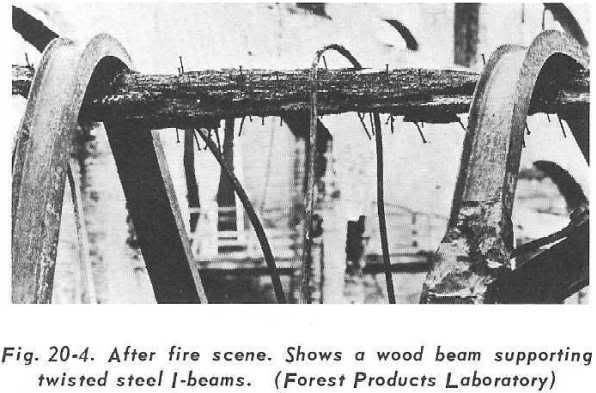
WARNING - 911 truth will call this melted steel

woodsteelfire.jpg

Fire - 1, Steel - 0

Fire -1, wood - 1

Wood products propaganda, true. Steel fails in fire, it is a fact 911 truth can't grasp.
 
Last edited:
Empirical science says truthers are wrong.... again!

From the Bazant, Le, Greening paper 'What Did and Did not Cause Collapse
of WTC Twin Towers in New York' pp. 1-2
'These effects of heating are further documented by the recent fire tests of Zeng et al.
(2003), which showed that structural steel columns under a sustained load of 50% to 70% of
their cold strength collapse when heated to 250C'


In fact at 88% of it's cold strength load, a column can fail at any temp above 150C!!.

From the paper

'Nevertheless, it can easily be explained that the stress in some surviving columns most likely
exceeded 88% of their cold strength 0. In that case, any steel temperature 150 C sufficed to
trigger the viscoplastic buckling of columns (Baˇzant and Le 2008). This conclusion is further
supported by simple calculations showing that if, for instance, the column load is raised at
temperature 250 C from 0.3Pt to 0.9Pt (where Pt = failure load = tangent modulus load), the
critical time of creep buckling (Baˇzant and Cedolin 2003, chapters 8 and 9) gets shortened
from 2400 hours to 1 hour
(note that, in structural mechanics, the term ‘creep buckling’ or
‘viscoplastic buckling’ represents any time-dependent buckling; on the other hand, in materials
science, the term ‘creep’ is reserved for the time-dependent deformation at stresses < 0.5 0,
while the time-dependent deformation at stresses near 0 is called the ‘flow’; Frost and Ashby
1982).
Therefore, to decide whether the gravity-driven progressive collapse is the correct explanation,
the temperature level alone is irrelevant (Baˇzant and Le 2008). It is meaningless and a
waste of time to argue about it without calculating the stresses in columns. For low stress,
high temperature is necessary to cause collapse, but for high enough stress, even a modestly
elevated temperature will cause it.
The fact that, after aircraft impact, the loads of some columns must have been close to
their strength limit can be clarified by Fig. 1. The asymmetry of aircraft impact damage
caused the stiffness centroid of the story to acquire a significant eccentricity, e (Fig. 1b). The
corresponding bending moment Pe of gravity load P = m0g (m0 = mass of the initial upper
falling part; and g = gravity acceleration) caused nonuniform axial shortening and axial stresses
in the surviving columns (Fig. 1e,h), which raised the stresses in the columns on the weaker side
of story much above the average stress due to gravity. The subsequent heating weakened the
overloaded columns on the weaker side (left side in the figure) more than those on the stronger
side, and caused gradually more and more of them to lose their load-carrying capability. This
further enlarged e and thus increased the nonuniformity of column deformations and stresses
(Fig. 1f,i), until the buckling of a sufficient number of columns led to the overall stability loss.
The observed multistory inward bowing of some perimeter columns (Fig. 1c), which reached
1.40 m, must have been a significant factor in stability loss, since the tripling of buckling length
reduces the column capacity 9-times. As noted by NIST, the bowing must have been caused
by sagging of heated floor trusses, due to their viscoplastic deformation (however, as pointed
out by Baˇzant and Le 2008, the differential thermal expansion could not have been the main
cause of bowing since a temperature difference of above 1000 C across the floor truss would be
needed to cause a curvature for which the truss span gets shortened by 1.40 m).'
 
Last edited:
I've never seen a truther actually acknowledge that the strength of steel reduces with increasing temperature even after they have been shown numerous graphs from multiple reliable sources proving this.


That's very true and that is more evidence of their dishonesty or is another example of them being disingenuous.
 
Omg, you mean a highway isnt a skyscraper?????? :jaw-dropp
Wow.
Good thing Tmd is here. Would never have figured that out. :rolleyes:

Point is, tmd, that steel fails in fires all the time. Truthers act like steel is practically indestructible without explosives or thermite, therefore showing that it really isnt, is perfectly valid.

Edx:


So true! In fact, that has to be one of the most common things truthers have said to me whenever debating or discussing 911: that somehow steel is completely immune to fire or heat and that the only way to melt steel, is by thermite. Societies have had no problem melting and fabricating steel LONG before the advent of thermite. Steel is fabricated without thermite all day, every day.
 
Last edited:

Back
Top Bottom