• Quick note - the problem with Youtube videos not embedding on the forum appears to have been fixed, thanks to ZiprHead. If you do still see problems let me know.

Unemployment falls below 9%

JoeTheJuggler

Penultimate Amazing
Joined
Jun 7, 2006
Messages
27,766
So despite the mess in Congress (brinksmanship, inability to compromise, the failed Super Committee, etc.), U.S. unemployment is at 8.6%, the lowest it's been since March of '09.


If it doesn't go back up significantly in the next year, is Obama a shoo-in for re-election? What if it continues to fall slightly, and the number is closer to 8% by election day? Does the GOP candidate stand any chance at all?

I realize it's not accurate or fair to hold the POTUS solely accountable or responsible for changes in unemployment, but by and large when an incumbent is running, it's the incumbent's election to lose. Of all the economic indicators, the one that means the most to the electorate pretty much has to be unemployment. (Maybe inflation if it's very high--but that's not much of an issue these days.)
 
I'm not sure if that is enough to give him any kind of a bounce. I found this article trying to look at the historic relationship between presidential elections and unemployment

http://www.outsidethebeltway.com/unemployment-and-presidential-elections/

Jimmy Carter and George H.W. Bush all faced high unemployment rates when they lost their re-election bids, and that was surely a factor in their defeats. But historically, the correlation between the unemployment rate and a president’s performance at the next election has been essentially zero.
 
So despite the mess in Congress (brinksmanship, inability to compromise, the failed Super Committee, etc.), U.S. unemployment is at 8.6%, the lowest it's been since March of '09.


If it doesn't go back up significantly in the next year, is Obama a shoo-in for re-election? What if it continues to fall slightly, and the number is closer to 8% by election day? Does the GOP candidate stand any chance at all?

That depends on a hell of a lot more than just the unemployment number. For example, that number can drop because more people get jobs, but it can also drop because more people stop looking for jobs. Those two scenarios would favor very different electoral outcomes.

But either way, Obama is vulnerable and will remain vulnerable. That doesn't mean he'll lose: Bush was vulnerable in 2004, but Kerry was too weak. The eventual Republican candidate might end up being similarly unable to exploit that vulnerability. But there's basically no chance for the economy to recover so much that Obama won't be vulnerable.
 
If the old Ronald Regan standard is to hold and people ask themselves, "Am I better off than I was four years ago?" then it is going to be a bit iffy. True, by most measures things are brighter than they were during the crash of 08, but a lot of people may not have realized how bad off they were at the time. They hadn't yet been unemployed for three years. They hadn't yet lost their houses. So what they may wind up asking themselves is "Why am I not a whole lot better off than I was four years ago?" That's a metric that Obama is going to find hard to fight, even though most economic indices will show that things are either the same or better than they were in 08.
 
I'm not sure if that is enough to give him any kind of a bounce. I found this article trying to look at the historic relationship between presidential elections and unemployment

http://www.outsidethebeltway.com/unemployment-and-presidential-elections/

But I don't think it's about an absolute correlation to the unemployment rate, but something more like what Tricky was talking about. How are things now compared to 3 years ago?

And I also think a lot of it is simply perception and not reality. (Again, the president can't fairly be held blameworthy or praiseworthy for a lot of what happens with the economy anyway.)

I suspect below 9% unemployment will result in a bump for Obama. Almost a year out from the election, though, it's probably not an important bump. A lot will ride, I think, on what happens between now and about next August.
 
That depends on a hell of a lot more than just the unemployment number. For example, that number can drop because more people get jobs, but it can also drop because more people stop looking for jobs. Those two scenarios would favor very different electoral outcomes.

I understand the difference (and the article I linked to even pointed out that people falling off the "unemployment" roles because they've given up contributed to this number), but I don't know that the difference is that significant to election outcomes.

Remember, Perry has done well in Texas just based on the stat that he added a lot of jobs. It doesn't matter that many of the jobs are part-time or low-paying or stolen from other states or funded by federal spending that he opposed. He still gets credit for adding jobs. (It also doesn't matter that in Texas, the office of governor is relatively weak, and his role in causing any of these outcomes is mighty tenuous.)
 
I had hoped that people would have gotten used to the idea that unemployment numbers have a lot of ambiguities. Usually it is lefties who bring that up to try to make poverty a larger issue, but for the past year or two righties have been bring it up to try to make Obama look worse.
 

That was a well-reasoned argument in support of a legitimate position, and a contribution to the discussion.

Oh wait--my mistake. It was not.

BTW, are you saying that unemployment is not at its lowest since March of '09? That's the sentence you quoted for you invaluable contribution.
 
It's a statistical illusion. Enough people gave up looking for jobs to drop the unemployment rate a bit. Whoopee. If we ever get out of this mess and people start getting back to work, the situation will be reversed and the unemployment rate will be kept artificially high.

In order to keep up with population growth, we need to add somewhere around 125k-150k jobs a month. We only added 120k, better than usual, but not really a sign of improvement.
 

It worked so well in the other thread, you thought you would bring it to this one. It would be nice if you could have some self control and keep your games to the threads they are already in, since for some reason (beyond me) people seem to think that by responding to you with facts and reason you'll engage in an honest discussion.
 
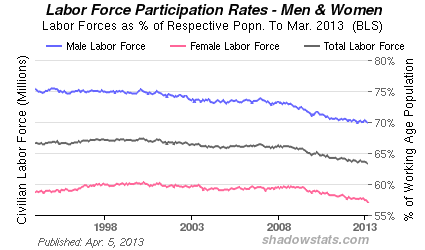
employment-participation-rates.gif


Oh, goody, the depression is over!! :boggled:
 
If it doesn't go back up significantly in the next year, is Obama a shoo-in for re-election? What if it continues to fall slightly, and the number is closer to 8% by election day? Does the GOP candidate stand any chance at all?

Hard to say. I don't think anyone really knows whether there's a magic number to reach for Obama to be reelected. I suspect it's going to have to do more with what happens in the election campaign: Who wins the debates, who doesn't make any really bad gaffes or have a scandal. And who people decide they like and/or trust more.
 
[qimg]http://www.shadowstats.com/imgs/charts/employment/employment-participation-rates.gif[/qimg]


Oh, goody, the depression is over!! :boggled:
Not by a long shot. I will take years to get us out of the Bush recession, especially with the GOP congress being led by a bunch of yahoos possessing an economic education consisting solely of having read Atlas Shrugged.

Daredelvis
 
We have found in Australia that it isn't the unemployment rate per se that matters politically, but whether it is rising or falling. A rate that is falling, even though slowly and from a high level, must be good news for Obama.
 
Let's hear what Paul Krugman has to say:

[T]he Treasury secretary, told The Times of London on Monday that he expected the U.S. economy to add two million jobs before the next election -- that is, almost 200,000 per month. His forecast was higher than those of most independent analysts; nothing in the data suggests that jobs are being created at that rate.

And:

Bear in mind that the payroll employment figure right now is down 2.6 million compared with what it was when the President took office. So the Treasury Secretary is predicting that his boss will be the first occupant of the White House since Herbert Hoover to end a term with fewer jobs available than when he started. This is what he calls success?

Okay, just kidding; obviously that 200,000 figure is wildly optimistic, and Krugman wasn't talking about Barack Obama; he was snorting at the idea of President Bush adding that many jobs per month, eight years ago.

Bush did manage to avoid going down with Hoover on job creation; by my estimate Obama will need about 1.6 million new jobs by next year to dodge that fate himself.
 
Hard to say. I don't think anyone really knows whether there's a magic number to reach for Obama to be reelected.

Of course there isn't. At least, not one which anyone could ever deduce with any certainty, and that wouldn't be contingent on how other events play out. And absent that, well, it doesn't matter if it exists in a purely abstract sense.

I suspect it's going to have to do more with what happens in the election campaign: Who wins the debates, who doesn't make any really bad gaffes or have a scandal. And who people decide they like and/or trust more.

Oh, that's definitely a big part of it. But unemployment is still going to be quite important. The higher unemployment is, the better Obama will need to do on all that other stuff. But there's no reason to think there are any cutoffs, and specific numbers which will change the situation discretely. I'm not trying to suggest that you're arguing otherwise, I'm just adding this for clarification.
 
As several people have pointed out, the falling "official" UE rate is not the same as falling UE. The falling rate is the direct result of people either giving up their job search or running out of UE benefits. Both categories are excluded from the "official" UE rate, but both are still unemployed.
 
What is baloney, the assertion that unemployment has dropped to 8.6%?

Yes. The real unemployment number is more like 23 percent:

From" John Williams Shadow Government Statistics


"The seasonally-adjusted SGS Alternate Unemployment Rate reflects current unemployment reporting methodology adjusted for SGS-estimated long-term discouraged workers, who were defined out of official existence in 1994. That estimate is added to the BLS estimate of U-6 unemployment, which includes short-term discouraged workers."

http://www.shadowstats.com/alternate_data/unemployment-charts
 
Last edited:

Back
Top Bottom