Caustic Logic
Illuminator
- Joined
- Apr 24, 2007
- Messages
- 4,494
I'm back!
Today I'd like to open a discussion into one particular, horrendouns incident of the Libyan Civil War. I call it "the Khamis Brigade shed massacre," while Physicians For Human Rights call it "the 32nd Brigade Massacre" in their fancy December report (PDF link). It was, as far as I know, the largest-scale and most famous mass killing of the conquest of Tripoli or perhaps the whole war.
Various sources can be found to explain it if you need a refresher, but it's the one you'll recall with a reported 153 total captives executed at sundown on August 23, before the guards "ran way like rats." Held by the 32nd - Khamis – Brigade, for suspicion of intent to seek freedom, the men and boys, aged maybe 14 to 70 (reports vary) were fired on by in their metal shack of a prison, and blasted apart by several hand grenades. There were quite a few who escaped, some shot dead as they ran. There were another 20-24, at least, who escaped the shed, survived the gauntlet, and knew to return to the scene on the 27th and 28th to speak with the media and share their many stories.
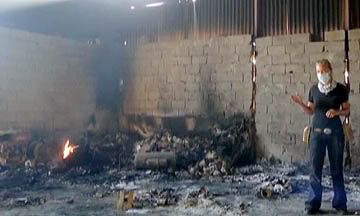
At some later time that allowed smoke and even flame still be rising on the afternoon of the 28th, as so famously seen around then, about 50 of the bodies were burned to skeletons and cinders inside the shed's main chamber (plus a few more charred in a smaller less-seen side-room). The rebel forces report they just found the site that way shortly after they finally chased the base's defenders away by mid-day on the 26th.
It was the shocking revelation of this atrocity of the crumbling regime that triggered the International Criminal Court's chief prosecutor Luis Moreno-Ocampo to announce he might seek an arrest warrant for brigade's head, Khamis Gaddafi. When Moreno-Ocampo visited Tripoli in late November to discuss Seif's trial, he visited the massacre site (article, video), on the 23rd. When UNSG Ban Ki Moon visited afew weeks earlier, he too took a saunter into this now-famous charnel house (article, photo).
Richard Spencer called it “the most clear-cut war crime of this six-month uprising. [...] The residents came out of their houses, and found the shed. The words "charnel house" have become a cliché of death; but on this occasion, there is no more accurate description.” I do not disagree. I just used it.
My opinion of what happened: Misrata brigades swept through late on August 23, after NATO “softening,” and executed all those left alive, or at least the black ones. With such a mess looking bad for them, they decided to make it look worse yet for the victims-made-villains. They piled the evidence into this shed – some of it, the rest perhaps in the dump trucks outside the shed - and burned it to anonymity.
Then, I think, they paid/cajoled some number of hard-up Gaddafi-hating Libyan guys, about two dozen total I know of (though our total might include volunteer copycats), at least, to make up stories about being there and managing to escape somehow.
I have plenty of specifics and my own works to link to, lumped into four main areas of consideration:
1) Un-official timeline clues
2) Loyalty clues and racial makeup of the shed victims
3) The witnesses, in general terms
4) A few witnesses, far more specific
Before I bring these, I'll allow alittle time for initial reactions, off-the-cuff preferred, but a read-up answer is fine too. What rubs you the wrong way about this thesis of mine? What makes you want to say "no way!"?
Today I'd like to open a discussion into one particular, horrendouns incident of the Libyan Civil War. I call it "the Khamis Brigade shed massacre," while Physicians For Human Rights call it "the 32nd Brigade Massacre" in their fancy December report (PDF link). It was, as far as I know, the largest-scale and most famous mass killing of the conquest of Tripoli or perhaps the whole war.
Various sources can be found to explain it if you need a refresher, but it's the one you'll recall with a reported 153 total captives executed at sundown on August 23, before the guards "ran way like rats." Held by the 32nd - Khamis – Brigade, for suspicion of intent to seek freedom, the men and boys, aged maybe 14 to 70 (reports vary) were fired on by in their metal shack of a prison, and blasted apart by several hand grenades. There were quite a few who escaped, some shot dead as they ran. There were another 20-24, at least, who escaped the shed, survived the gauntlet, and knew to return to the scene on the 27th and 28th to speak with the media and share their many stories.
At some later time that allowed smoke and even flame still be rising on the afternoon of the 28th, as so famously seen around then, about 50 of the bodies were burned to skeletons and cinders inside the shed's main chamber (plus a few more charred in a smaller less-seen side-room). The rebel forces report they just found the site that way shortly after they finally chased the base's defenders away by mid-day on the 26th.
It was the shocking revelation of this atrocity of the crumbling regime that triggered the International Criminal Court's chief prosecutor Luis Moreno-Ocampo to announce he might seek an arrest warrant for brigade's head, Khamis Gaddafi. When Moreno-Ocampo visited Tripoli in late November to discuss Seif's trial, he visited the massacre site (article, video), on the 23rd. When UNSG Ban Ki Moon visited afew weeks earlier, he too took a saunter into this now-famous charnel house (article, photo).
Richard Spencer called it “the most clear-cut war crime of this six-month uprising. [...] The residents came out of their houses, and found the shed. The words "charnel house" have become a cliché of death; but on this occasion, there is no more accurate description.” I do not disagree. I just used it.
My opinion of what happened: Misrata brigades swept through late on August 23, after NATO “softening,” and executed all those left alive, or at least the black ones. With such a mess looking bad for them, they decided to make it look worse yet for the victims-made-villains. They piled the evidence into this shed – some of it, the rest perhaps in the dump trucks outside the shed - and burned it to anonymity.
Then, I think, they paid/cajoled some number of hard-up Gaddafi-hating Libyan guys, about two dozen total I know of (though our total might include volunteer copycats), at least, to make up stories about being there and managing to escape somehow.
I have plenty of specifics and my own works to link to, lumped into four main areas of consideration:
1) Un-official timeline clues
2) Loyalty clues and racial makeup of the shed victims
3) The witnesses, in general terms
4) A few witnesses, far more specific
Before I bring these, I'll allow alittle time for initial reactions, off-the-cuff preferred, but a read-up answer is fine too. What rubs you the wrong way about this thesis of mine? What makes you want to say "no way!"?