
Checkmite
Skepticifimisticalationist

<table cellspacing=1 cellpadding=6 bgcolor=#666699 border=0><tr><td bgcolor=white><font face="arial, helvetica, sans-serif" color=#666699 size=2>Introduction by moderator Luke T.: Link to original topic:
http://www.internationalskeptics.com/forums/showthread.php?t=21966
</font></td></tr></table>
The ancient Egyptians and the Mayans both built pyramids - including some impressively large ones. Could the Mayans have been inspired by the Egyptian pyramids? Could there be a common cultural link between the two - a source independent of either, yet inspiring to both?
The short answer is no. The long and more detailed answer follows.
First of al, in case anyone wants to contest the Egyptians' claim to being the original pyramid builders, or that the Great Pyramid itself was built by them, let's take a look at how pyramids in Egypt evolved.
Thus, we begin in Egypt, around the year 2600 BCE. It's only the 3rd Dynasty; united Upper and Lower Egypt is still a fresh concept. Up until this point, Egyptians had been burying their noble dead in mastabas - low brick monuments which distinguished the upper class from the common class - who were buried under piles of rocks. After a few kings had passed on and been laid to rest in their mastabas - well, there were a number of mastabas about. Kings started having bigger and bigger mastabas built for them, so that people who walked by would be able to tell the difference between this king and his weaker predecessors. However, one day a king named Djoser had a rather inspired plan - one that was sure to make people remember his name for years. Something huge, and tall. He set his architects to work, and they drafted a plan for the first step pyramid - essentially a series of progressively smaller mastabas built on top of each other. The result was - for its time - magnificent.
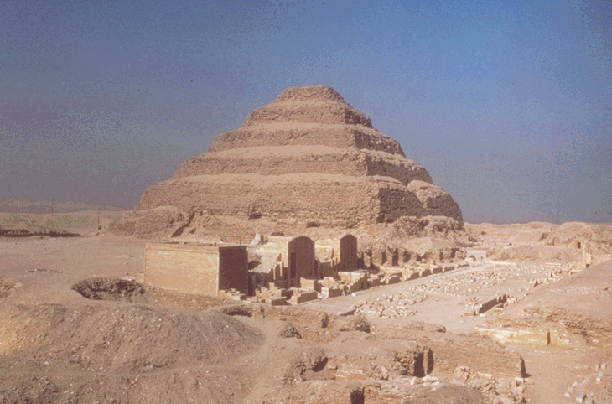
Of course, it wasn't really a pyramid - but it was the beginning of a beautiful friendship between Egyptian kings and big stone pointy things. After Djoser's first step pyramid, several others were built by him and a couple of kings afterwards. Djoser had started a trend!
Flash forward about 90 years. It's now the 4th Dynasty, and a king named Sneferu - probably seeing the fame that the step pyramid builders earned themselves - embarked on something grander. Instead of a rough mastaba, he wanted a smooth, even, and sharply-pointed monument. He also wanted it to be much bigger than anything that had ever been built before. So he sent his planners and laborers feverishly to work. The result was the Pyramid of Meidum, the first true pyramid:
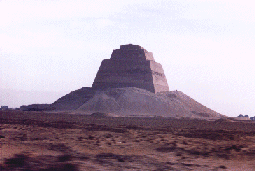
Wait a second, you say...that doesn't look any kind of pyramid at all, much less a true pyramid!
Well, it used to look like a pyramid. Or at least it was about to look like a true pyramid - but something terrible happened. Due to a serious design flaw, the Meidum pyramid collapsed during the final stages of, or soon after, construction. The sides of the pyramid literally slid off, leaving only the zuggerat-shaped stone core we see today. The huge piles of debris seen surrounding the core are the pulverized remains of the pyramid.
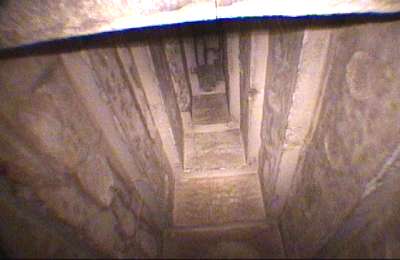
But Sneferu was a persistent old chap, and, having corrected his architects, commissioned a second pyramid. This one was built without any serious design flaws...okay, maybe a couple. Halfway up the pyramid, the architects realized that this pyramid would be too steep, too expensive, and take too long to build. So, they abruptly changed the slope of the pyramid, making it more gradual. The stress was still too great, so the engineers designed interior spaces with corbelled ceilings, to help relieve pressure:
Of course, at the top (and several other places in the pyramid), there was still more pressure than the engineers were comfortable with; however, by this time they were tired of expending so much effort correcting their mistakes, that they just braced some spots in the interior with cedar beams:
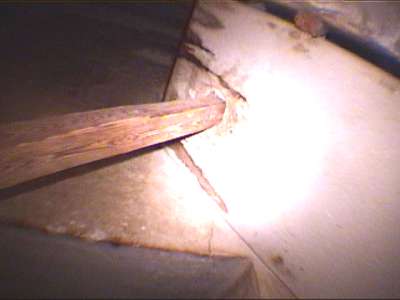
Yes, boys and girls - that cedar timber in the above photo is original - direct to you from 2570 (or so) BCE.
The result was worth the trouble, however. The Bent Pyramid of Sneferu:
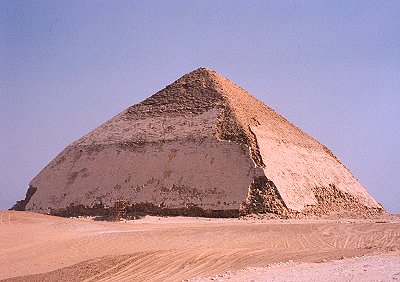
Bent Pyramid. Height: 105m. Base: 188.6m Slope: 54º, 42º
Sneferu had yet one more pyramid built before he finally gave up the ghost - the Red Pyramid. It was the first complete true pyramid, with corbelled ceilings and the design flaws from the previous pyramid corrected. The Red Pyramid seems a bit flatter than most Egyptian pyramids, because it has a shallower angle - the slope used on the top half of the Bent Pyramid was used for the entirety of the Red Pyramid.
After good old Sneferu died, the king Khufu took the reigns. Khufu literally outdid himself with the biggest "I'll show you!" project of them all - the Great Pyramid.
Some people don't think Khufu built the Great Pyramid. Many people still believe the only thing which attaches Khufu's name to the Great Pyramid is quarrymen's graffiti up high in the King's Chamber. Actually, this isn't true. A nearby "mastaba village" dated to the 4th Dynasty contained many remains and inscriptions, complete with mentions of King Khufu, and titles like "Director of the King's Project", "Overseer of the Side of the Pyramid", and similar titles. A huge work camp near the site of the Giza monuments also dates to the 4th Dynasty and shows evidence of over 50 years of occupation - for good reason; Khafre and Menkaure had their pyramids built right next to Khufu's, in succession. Khafre's and Menkaure's names are all over their pyramids, so it's obvious who built them. Now, Khufu predated Khafre and Menkaure, and heiroglyphic evidence indicates that he commissioned a huge pyramid project. The only pyramid on site that predates Khafre's and Menkaure's pyramids is the Great Pyramid. 2 + 2 = 4, and all that. Plus, the interior of the Great Pyramid features galleries, portcullises, and corbelled ceilings - all methods and features developed - through much trial and error, I hasten to add - by Sneferu's architects. So why wasn't Khufu's body found within his pyramid? Who knows - it could've been stolen, or perhaps he died before the pyramid was completely complete. The latter theory would explain why there's a distinct lack of inscriptions on the walls inside the burial chambers...
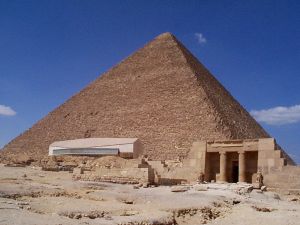
Great Pyramid of Khufu. Height: 146.6m. Base: 230.37m. Slope: 51º
Khafre's pyramid was built on higher ground to make it look taller than Khufu's. It's actually a little shorter. The pyramid also features no corbelled ceilings, because it has only one hall and chamber - at ground level. The rest of the pyramid appears solid. Khafre's pyramid (foreground), interestingly, still has some of its original limestone casing at the top:

Great Pyramid of Khafre. Height: 136.4m. Base: 215.25m. Slope: 53°
And of course, next comes Menkuare's pyramid, only about 1/4 the size of the others:
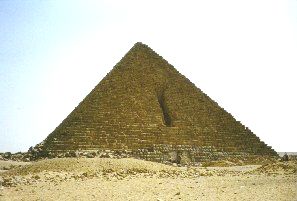
Pyramid of Menkuare. Height: 62m. Base: 105m. Slope: 51º[/b].
You've been able to see how the Egyptians developed their pyramids, and what they were used for - elaborate tombs. You've seen how they grew from extravagant piles of rock to smooth and precisely-shaped wonders, and you've seen the trial and error their designers went through to reach the pinnacle - the Great Pyramid of Khufu.
With Giza, our trip to ancient Egypt ends. Next, off to Mexico - to compare Egyptian and Mayan pyramids.
Unfortunately, our knowledge about the Maya is limited - and the sort of specifics we have about how particular pyramids were built in Egypt simply doesn't exist for Mayan structures. However, we do know a few things. For example, we know that Mayans never built true pyramids. All their pyramids were of the step variety, and almost exclusively were used as temples for the living, rather than tombs for the dead - the sole exception being the tomb of king Pacal, who was buried beneath the Temple of the Inscriptions at Palenque.
"Temples for the Living" is perhaps a bit of a misnomer, as services at the top of the temples often culminated in rather gruesome and abrupt sacrifices of human victims to please the gods. Mayan temples started out as simple low raised platforms, becoming taller and taller, with varying slopes and bases and heights - in fact, there seems to be no set "paradigm" for Maya pyramids, with the exception that they all had flat tops where the temples were, and of course they all had stairs.
The grand-daddy of Mayan pyramidity is the Temple of the Sun, located at Teotihuacan, where Mexico City now stands.
 Pyramid of the Sun. Height: 65m. Base: 228m x 216m. Slope: Unavailable
The Temple of the Sun is huge - it's the 3rd largest pyramid in the world. However, it is most unlikely that the Great Pyramid of Khufu and the Pyramid of the Sun were inspired by the same source. Their bases are similar, to be sure - however, the building method is different, the materials used are different, the applications and reasons for building the pyramids are different, and they don't even look similar - in fact, the Temple of the Sun is less than half the height of Khufu's pyramid.
To summarize - the only true similarity between Egyptian and Maya pyramids is that they start out wide and end narrow. Photos, specifications, and purposes suggest no remote link between the two. Of course, if there's some linking evidence I haven't been made aware of...then by all means, I would be happy to examine it.
http://www.internationalskeptics.com/forums/showthread.php?t=21966
</font></td></tr></table>
The ancient Egyptians and the Mayans both built pyramids - including some impressively large ones. Could the Mayans have been inspired by the Egyptian pyramids? Could there be a common cultural link between the two - a source independent of either, yet inspiring to both?
The short answer is no. The long and more detailed answer follows.
First of al, in case anyone wants to contest the Egyptians' claim to being the original pyramid builders, or that the Great Pyramid itself was built by them, let's take a look at how pyramids in Egypt evolved.
Thus, we begin in Egypt, around the year 2600 BCE. It's only the 3rd Dynasty; united Upper and Lower Egypt is still a fresh concept. Up until this point, Egyptians had been burying their noble dead in mastabas - low brick monuments which distinguished the upper class from the common class - who were buried under piles of rocks. After a few kings had passed on and been laid to rest in their mastabas - well, there were a number of mastabas about. Kings started having bigger and bigger mastabas built for them, so that people who walked by would be able to tell the difference between this king and his weaker predecessors. However, one day a king named Djoser had a rather inspired plan - one that was sure to make people remember his name for years. Something huge, and tall. He set his architects to work, and they drafted a plan for the first step pyramid - essentially a series of progressively smaller mastabas built on top of each other. The result was - for its time - magnificent.
Of course, it wasn't really a pyramid - but it was the beginning of a beautiful friendship between Egyptian kings and big stone pointy things. After Djoser's first step pyramid, several others were built by him and a couple of kings afterwards. Djoser had started a trend!
Flash forward about 90 years. It's now the 4th Dynasty, and a king named Sneferu - probably seeing the fame that the step pyramid builders earned themselves - embarked on something grander. Instead of a rough mastaba, he wanted a smooth, even, and sharply-pointed monument. He also wanted it to be much bigger than anything that had ever been built before. So he sent his planners and laborers feverishly to work. The result was the Pyramid of Meidum, the first true pyramid:
Wait a second, you say...that doesn't look any kind of pyramid at all, much less a true pyramid!
Well, it used to look like a pyramid. Or at least it was about to look like a true pyramid - but something terrible happened. Due to a serious design flaw, the Meidum pyramid collapsed during the final stages of, or soon after, construction. The sides of the pyramid literally slid off, leaving only the zuggerat-shaped stone core we see today. The huge piles of debris seen surrounding the core are the pulverized remains of the pyramid.
But Sneferu was a persistent old chap, and, having corrected his architects, commissioned a second pyramid. This one was built without any serious design flaws...okay, maybe a couple. Halfway up the pyramid, the architects realized that this pyramid would be too steep, too expensive, and take too long to build. So, they abruptly changed the slope of the pyramid, making it more gradual. The stress was still too great, so the engineers designed interior spaces with corbelled ceilings, to help relieve pressure:
Of course, at the top (and several other places in the pyramid), there was still more pressure than the engineers were comfortable with; however, by this time they were tired of expending so much effort correcting their mistakes, that they just braced some spots in the interior with cedar beams:
Yes, boys and girls - that cedar timber in the above photo is original - direct to you from 2570 (or so) BCE.
The result was worth the trouble, however. The Bent Pyramid of Sneferu:
Bent Pyramid. Height: 105m. Base: 188.6m Slope: 54º, 42º
Sneferu had yet one more pyramid built before he finally gave up the ghost - the Red Pyramid. It was the first complete true pyramid, with corbelled ceilings and the design flaws from the previous pyramid corrected. The Red Pyramid seems a bit flatter than most Egyptian pyramids, because it has a shallower angle - the slope used on the top half of the Bent Pyramid was used for the entirety of the Red Pyramid.
After good old Sneferu died, the king Khufu took the reigns. Khufu literally outdid himself with the biggest "I'll show you!" project of them all - the Great Pyramid.
Some people don't think Khufu built the Great Pyramid. Many people still believe the only thing which attaches Khufu's name to the Great Pyramid is quarrymen's graffiti up high in the King's Chamber. Actually, this isn't true. A nearby "mastaba village" dated to the 4th Dynasty contained many remains and inscriptions, complete with mentions of King Khufu, and titles like "Director of the King's Project", "Overseer of the Side of the Pyramid", and similar titles. A huge work camp near the site of the Giza monuments also dates to the 4th Dynasty and shows evidence of over 50 years of occupation - for good reason; Khafre and Menkaure had their pyramids built right next to Khufu's, in succession. Khafre's and Menkaure's names are all over their pyramids, so it's obvious who built them. Now, Khufu predated Khafre and Menkaure, and heiroglyphic evidence indicates that he commissioned a huge pyramid project. The only pyramid on site that predates Khafre's and Menkaure's pyramids is the Great Pyramid. 2 + 2 = 4, and all that. Plus, the interior of the Great Pyramid features galleries, portcullises, and corbelled ceilings - all methods and features developed - through much trial and error, I hasten to add - by Sneferu's architects. So why wasn't Khufu's body found within his pyramid? Who knows - it could've been stolen, or perhaps he died before the pyramid was completely complete. The latter theory would explain why there's a distinct lack of inscriptions on the walls inside the burial chambers...
Great Pyramid of Khufu. Height: 146.6m. Base: 230.37m. Slope: 51º
Khafre's pyramid was built on higher ground to make it look taller than Khufu's. It's actually a little shorter. The pyramid also features no corbelled ceilings, because it has only one hall and chamber - at ground level. The rest of the pyramid appears solid. Khafre's pyramid (foreground), interestingly, still has some of its original limestone casing at the top:
Great Pyramid of Khafre. Height: 136.4m. Base: 215.25m. Slope: 53°
And of course, next comes Menkuare's pyramid, only about 1/4 the size of the others:
Pyramid of Menkuare. Height: 62m. Base: 105m. Slope: 51º[/b].
You've been able to see how the Egyptians developed their pyramids, and what they were used for - elaborate tombs. You've seen how they grew from extravagant piles of rock to smooth and precisely-shaped wonders, and you've seen the trial and error their designers went through to reach the pinnacle - the Great Pyramid of Khufu.
With Giza, our trip to ancient Egypt ends. Next, off to Mexico - to compare Egyptian and Mayan pyramids.
Unfortunately, our knowledge about the Maya is limited - and the sort of specifics we have about how particular pyramids were built in Egypt simply doesn't exist for Mayan structures. However, we do know a few things. For example, we know that Mayans never built true pyramids. All their pyramids were of the step variety, and almost exclusively were used as temples for the living, rather than tombs for the dead - the sole exception being the tomb of king Pacal, who was buried beneath the Temple of the Inscriptions at Palenque.
"Temples for the Living" is perhaps a bit of a misnomer, as services at the top of the temples often culminated in rather gruesome and abrupt sacrifices of human victims to please the gods. Mayan temples started out as simple low raised platforms, becoming taller and taller, with varying slopes and bases and heights - in fact, there seems to be no set "paradigm" for Maya pyramids, with the exception that they all had flat tops where the temples were, and of course they all had stairs.
The grand-daddy of Mayan pyramidity is the Temple of the Sun, located at Teotihuacan, where Mexico City now stands.
The Temple of the Sun is huge - it's the 3rd largest pyramid in the world. However, it is most unlikely that the Great Pyramid of Khufu and the Pyramid of the Sun were inspired by the same source. Their bases are similar, to be sure - however, the building method is different, the materials used are different, the applications and reasons for building the pyramids are different, and they don't even look similar - in fact, the Temple of the Sun is less than half the height of Khufu's pyramid.
To summarize - the only true similarity between Egyptian and Maya pyramids is that they start out wide and end narrow. Photos, specifications, and purposes suggest no remote link between the two. Of course, if there's some linking evidence I haven't been made aware of...then by all means, I would be happy to examine it.
Last edited by a moderator:



 )
)