• Quick note - the problem with Youtube videos not embedding on the forum appears to have been fixed, thanks to ZiprHead. If you do still see problems let me know.

PS Audio Noise Harvester

mroek

Critical Thinker
Joined
Mar 2, 2004
Messages
377
Here's one of the most ingenious HiFi-related gimmicks I've ever seen:

http://psaudio.com/products/noiseharvester.asp

We all know that audio-buffs are always looking for tweaks to improve the sound from their expensive equipment (apparently there is ALWAYS room for improvement), and we also know that there is a plethora of products to help accomplish this mission.

PS Audio claims that this product "harvests" power line noise by storing it temporarily, and subsequently dumping it in a LED, giving a visual indication that it actually works. Adding more of them in parallell will of course be even better (more income for the seller being the primary improvement, I suspect). They could of course have used a plain resistor to dump the (purported) noise energy, but then the user would have no way of knowing that it works. Clever!

Please look at the demo video:

http://www.psaudio.com/downloads/harvester.wmv

The most interesting part comes at 04:15 minutes into the video. They connect a loudspeaker device to the power line to demonstrate (audibly) how much noise the light dimmer creates. Then they remove the loudspeaker device and plugs in the Noise Harvester, and proceed to show that the LED flashes when the dimmer is turned up. One can only guess why the audible indicator is removed....

I am an electronics engineer, and I would have to say that although I will not say with 100% certainty that this has no merit, I fail to see how this can actually do much (if anything), except generate income for PS Audio and their distributors.
 
I am an electronics engineer, and I would have to say that although I will not say with 100% certainty that this has no merit, I fail to see how this can actually do much (if anything), except generate income for PS Audio and their distributors.

I will say with 100% certainty that it has no merit. Power line noise doesn't affect a modern, digital amplifier. And you can't "harvest" noise, you can only filter it out. Even in a crude analog tube amp, where power line noise might cause a problem, you'll have a small filter on the line (a simple choke coil) that will eliminated.

This is 100% pure unadulterated moose cakes, and will affect your audio every bit as much.
 
99 bucks? For that?!!!:jaw-dropp

I do have to admit that I'd love to have one- to crack it open and find out just what 50-cent do-nothing box variant they're flogging to the ignorant.

I don't have 99 dollars worth of curiosity, though. :rolleyes:
 
I will say with 100% certainty that it has no merit. Power line noise doesn't affect a modern, digital amplifier. And you can't "harvest" noise, you can only filter it out. Even in a crude analog tube amp, where power line noise might cause a problem, you'll have a small filter on the line (a simple choke coil) that will eliminated.

This is 100% pure unadulterated moose cakes, and will affect your audio every bit as much.

I disagree with your interpretation of noise having no effect. There are no 100% digital amplifiers, since the signals sent to the speakers are analog.

The input to such an amplifier could be effected by noise and in theory, if enough was on the mains power, there is the possibility that inductance could lead to noise on the ground loop or even being passed through the power supply and picked up.


However...even if the power were really really dirty...like....you live next to a factory and have a subway line running off of your home current, through a crappy mercury-arc rectifier...

I still doubt this would help. A simple power conditioner....or even a UPS will do the trick just fine. And you don't need a big expensive power center either.
 
There is no doubt that power line noise sometimes can reach the loudspeakers, even in high end equipment. Light dimmers (simple DIAC/TRIAC-devices) are famous for creating a lot of noise, and this may be audible on the stereo.

I remain skeptical about this device, however. As a marketing trick, it is very clever. As a noise remover, well...
 
Complete, utter, and absolute BS.
Take a look at the pictures here. Whatever they were measuring, it wasn't a powerline. You get 60 Cycle AC out of an American power outlet. They've got a nasty spike on DC, and there's no AC to be seen. The accompanying text describes the pictures as showing the harvester removing the noise caused by a dimmer. This is a flat out lie. House hold light dimmers work on AC, so the either the description is false or the pictures are wrong.

The oscilloscope they are using is set to 5Volts per centimeter, so that spike is about 12 Volts. If you were to dump enough noise onto a household power line to cause a 12 volt spike, then you are probably talking about something on the order of several hundred watts of noise. Granted this is a very short peak (~20microseconds) but if it were to repeat 60 times per second, it would in fairly short order burn out the harvesters, which are claimed can remove "8 to 10 watts each."

Furthermore, the LED must be just an added "blinky." An LED that can dissipate 8 watts would probably be so bright you couldn't stand it. Think bright blue strobe light. Probably very distracting when you're trying to listen to classical music.

I find LED light bulbs rated for 3 watts continuous that can be used as replacements for the bulbs used in low voltage halogen track lights. Imagine how much brighter 8 watts would be.
 
Complete, utter, and absolute BS.
Take a look at the pictures here. Whatever they were measuring, it wasn't a powerline. You get 60 Cycle AC out of an American power outlet. They've got a nasty spike on DC, and there's no AC to be seen. The accompanying text describes the pictures as showing the harvester removing the noise caused by a dimmer. This is a flat out lie. House hold light dimmers work on AC, so the either the description is false or the pictures are wrong.

The oscilloscope they are using is set to 5Volts per centimeter, so that spike is about 12 Volts. If you were to dump enough noise onto a household power line to cause a 12 volt spike, then you are probably talking about something on the order of several hundred watts of noise. Granted this is a very short peak (~20microseconds) but if it were to repeat 60 times per second, it would in fairly short order burn out the harvesters, which are claimed can remove "8 to 10 watts each."

Furthermore, the LED must be just an added "blinky." An LED that can dissipate 8 watts would probably be so bright you couldn't stand it. Think bright blue strobe light. Probably very distracting when you're trying to listen to classical music.

I find LED light bulbs rated for 3 watts continuous that can be used as replacements for the bulbs used in low voltage halogen track lights. Imagine how much brighter 8 watts would be.


Um...I think you've missed the important thing. They obviously know what they are talking about because you can see their engineer creating some sort of diagram which I cannot really understand (or make out).

I see a couple resistors... a capacitor and...either another resistor or an inductor...or maybe it's just a scribble...can't tell.

Anyways... This dude obviously knows a lot more than us!
 
Errrmmm, this is pretty straightforward; from an audio point of view, the 60Hz (or 50Hz) sine wave on the power line is pure noise. There are, in addition to this, various devices (particularly appliances and dimmers) that can add various other noise to the lines, inside and outside your house; a well-designed power supply will take care of this problem. It already must do so, and even the most basic linear power supply (transformer, rectifier, input caps, 3-terminal regulator, output caps) is capable of handling surges and sags from the millisecond to the tens or perhaps hundreds of nanosecond regimes; they are designed to do so. I am constantly surprised that even industrial designers fail to put proper regulation and proper decoupling into power supplies and then expect that they will perform adequately for high-end audio; it is, IMHO, a scam. This even despite the fact that the Lin topology uses a differential amplifier at the front end to eliminate common-mode noise from the incoming signal; this is not sufficient to protect the output current driver transistors from power hum from the rails. I have encountered audiophiles who claimed that this was untrue, and that simple capacitive filtering was sufficient; I have proven conclusively that it is not, and also that proper regulation reduces the size of the needed capacitors by more than the cost of the regulator. (I will admit that the design I eventually used was not easy; 10A of 40V clean power is quite challenging, particularly in limited space, but I did eventually git 'er done, though not without a fan.)

There are power conditioners (generally isolation transformers, perhaps along with thyristors, or even just the thyristors themselves) that will eliminate millisecond- or microsecond-long surges and sags from the incoming sine wave; in general, the capacitors already necessary in the output of a power supply that will provide sufficient DC amperage to run a modern medium- to high-power three-stage Lin topology amplifier (and there are very few amps out there that don't use this topology, switchers and so forth, and they are very, very expensive and prone to odd behavior in the presence of challengine audio material- switchers remain much more an art than a science) already fix the sags, so really, unless you're putting a UPS in because you are experiencing regular second- to tenth-second sags, it's mostly a matter of having the thyristors to protect against surges.

I'd spend my $99 on an Isobar, personally- and in fact I have done so, in multiple cases. I do not use audio equipment that is not protected by one, and if the little light ever says the thyristors have gone out, I'll replace them- and consider it cheap insurance at the price, having seen quite a bit of other peoples' audio equipment that has been destroyed or seriously damaged by power hits. I am convinced that this type of damage occurs much more often than people think. I believe that it is very, very often the cause of mysterious unexplained equipment failures. The other demon is heat; and $50 worth of fans and ten minutes' work with a hole saw and a soldering iron can fix your entertainment system's heat problems permanently.

And I'll be frank: I tested ten amplifiers before I bought my Onkyo, AFTER I had tested eight different sets of speakers and settled on Polk Audio towers; and when I walked out of the store, I was (and remain) absolutely certain that I obtained the best equipment they had, at about a quarter the price of the "top of the line" products. You can hear the squeaking of the bats flying around the cave they recorded in, in between the tracks on Counterparts; you can pretty damn nearly tell what Jimmy and John are saying in the studio on Led Zeppelin III at the beginning of "Celebration Day;" the bass doesn't rob power from the guitar on "Etude;" and when the depth charges in Das Boot go off, the windows rattle. For under a grand. And I've had it ten years and have yet to hear a system that sounded better for under four. 'Nuff said.
 
Schneibster what kind of room do you have the polk towers in?
They are the right and left speakers for my entertainment system, which includes a 60" Hitachi Ultravision projection HDTV, the Onkyo, and many program sources (TiVOs both broadcast and DirecTV, including my latest acquisition, an HDTV DirecTV TiVO, a VCR, two DVDs (one for HD and one for SD), and a four-channel modulator). The system is in a two-tower oak entertainment center with the TV in the middle, on the long wall of my family room; the family room is about 18'x15', and opens on the short side into the kitchen and dining room, which are together about the same size as the family room and divided by an island. The walls are sheet rock, and the ceiling is 11'. I have all blinds and no curtains. The center speaker is the middle-of-the-line Polk, and is on top of the entertainment center; the surrounds are relatively cheap FM 900GHz on the back wall to either outside of my wife's and my chairs, and I run an Infinity subwoofer in the base of the right entertainment center tower.

The Polks are the top speaker they made at the time that didn't have an included subwoofer; IIRC, RT800s. The bass was relatively impressive, and certainly not muddy, but the subwoofer made a difference more for movie audio than music that was worthwhile.
 
99 bucks? For that?!!!:jaw-dropp

I do have to admit that I'd love to have one- to crack it open and find out just what 50-cent do-nothing box variant they're flogging to the ignorant.

I don't have 99 dollars worth of curiosity, though. :rolleyes:


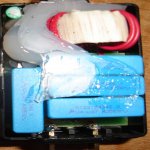
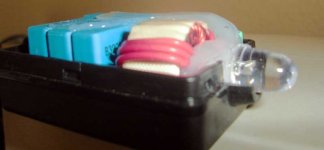
Well I bought one just to test and bust the myth with. It did nothing. I had 2 Electricians take it and test it on a scope and also repeat the tests just as PSA did and it helped nothing. Then we busted it apart. There are some film caps in it and resistors. All in all there are about 10 bucks worth of parts. We looked up the part numbers in a mouser catalog and the film caps could be bought for 15 cents.Here are pics.
 

Attachments

  • nhguts.jpg
    nhguts.jpg
    60.4 KB · Views: 53
  • nhside.jpg
    nhside.jpg
    27.9 KB · Views: 36
Um...I think you've missed the important thing. They obviously know what they are talking about because you can see their engineer creating some sort of diagram which I cannot really understand (or make out).

I see a couple resistors... a capacitor and...either another resistor or an inductor...or maybe it's just a scribble...can't tell.

Anyways... This dude obviously knows a lot more than us!

He has drawn a differential amplifier (which is irrelevant to the subject)....

It is a scam. Sure, it might actually pick up noise from the power line and use it to make the LED blink, but that doesn't mean the noise level is reduced in any way, elswhere on the line. That is the thing about line noise: It is very load resistant.

All this noise talk is funny. Audiophiles seem to think that their music sounds better if noise is reduced. Of course, it is nicer to listen to music if there is no noise, but tit doesn't change the sound of the music as such. It is just a distraction.

And it is very, very easy to find out if your equipment has noise: Just listen for it. Remove the input signal (like take out the disc from the player) and and turn the volume to max. Listen to the speakers. A good system should be silent as a tomb. If it is, you don't need to worry about noise. If it hums, hisses, snaps, crackles, or pops, you might want to do something about it.

Hans
 
He has drawn a differential amplifier (which is irrelevant to the subject)....

It is a scam. Sure, it might actually pick up noise from the power line and use it to make the LED blink, but that doesn't mean the noise level is reduced in any way, elswhere on the line. That is the thing about line noise: It is very load resistant.

All this noise talk is funny. Audiophiles seem to think that their music sounds better if noise is reduced. Of course, it is nicer to listen to music if there is no noise, but tit doesn't change the sound of the music as such. It is just a distraction.

And it is very, very easy to find out if your equipment has noise: Just listen for it. Remove the input signal (like take out the disc from the player) and and turn the volume to max. Listen to the speakers. A good system should be silent as a tomb. If it is, you don't need to worry about noise. If it hums, hisses, snaps, crackles, or pops, you might want to do something about it.

Hans
Wow, I don't know where to start.
 
Well I bought one just to test and bust the myth with. It did nothing. I had 2 Electricians take it and test it on a scope and also repeat the tests just as PSA did and it helped nothing. Then we busted it apart. There are some film caps in it and resistors. All in all there are about 10 bucks worth of parts. We looked up the part numbers in a mouser catalog and the film caps could be bought for 15 cents.Here are pics.
Ask for a refund and see how far you get.

Better yet, see if the FTC will prosecute for fraud. :rolleyes:

Seriously, is there any way you can draw a schematic of that and provide a parts list? I'm just curious, and you've already blown the 99 smackeroos.
 
Ask for a refund and see how far you get.

Better yet, see if the FTC will prosecute for fraud. :rolleyes:

Seriously, is there any way you can draw a schematic of that and provide a parts list? I'm just curious, and you've already blown the 99 smackeroos.

I could have had a refund they had a 30 day policy. I knew full well what I was doing when I bought it. I did not buy it because I thought it worked I bought it to take it apart test etc..

I would love to see the FTC go after clowns like these guys.I wouldnt know how to start it though.

I will dig it up and try to fully tear into it.
 
I could have had a refund they had a 30 day policy. I knew full well what I was doing when I bought it. I did not buy it because I thought it worked I bought it to take it apart test etc..
Who's having the placebo? The one who buys it with the intention of not hearing a difference or the one who buys it to test whether he does or not?
 
I have opened up mine as well, it's broken now. I wish I didn't because it does make a difference, it gives heavier bass among other things. I wanted to make myself believe it didn't make a difference so it would justify my broken Harvester, but I can't deny the truth. I had to pay for it.

yellow.box.JPG


top.JPG
 
Last edited:

Back
Top Bottom