• Quick note - the problem with Youtube videos not embedding on the forum appears to have been fixed, thanks to ZiprHead. If you do still see problems let me know.

Peak Oil: Should we be afraid?

portlandatheist

Illuminator
Joined
Jun 9, 2007
Messages
3,725
This is my first post and I wasn’t sure under what category to put this subject but since peak oilers and conspiracy theorists tend to go hand in hand I thought this might be a good place. I’m genuinely curious of what the different takes of the skeptic community has on this subject. I’m a long time atheist and skeptic and just recently read a bunch of Dawkins, Sam Harris, Christopher Hitchens and became a member of the skeptic society so I am new to the community as a whole.

First, What is “Peak Oil”?
The basic idea is that sooner or later, measured on a global level, oil production will reach a “peak” and then begin an irreversible decline. It is often stated that this will happen roughly when the world has harvested half the world’s oil supply but this is an oversimplification. For example, the oil sands in Alberta may contain roughly the same amount of oil as Saudi Arabia but if harvested at a maximum level, daily production rates would be fairly modest, even if they do last hundreds of years. In other words, the fundamental question in Peak Oil isn’t “How much oil is left?” or “How long will the world’s oil supply last?” but rather “When will oil production hit maximum global output and then go into a permanent and irreversible decline of output?”
You can read more at wikipedia

So here is my list of questions:

1. Do you believe/accept the fundamental notion of peak oil? I would think this would be a given since the only alternative to this idea would be that there is no upper limit of daily oil production and that it will go up and up forever.
2. If you accept #1, do you think Peak Oil will happen soon (within 10 years) or is it a far off problem? My own take is that peak oil is very hard to predict since technology changes constantly and unpredictably but I suspect it will likely happen within the next 10 years but this is only a complete guess on my part, I’m no expert in oil reserves
3. Is it a big deal? Peak oilers make the Y2K crowd look mild in comparison. Futhermore, many of them are 9/11 conspiracy theorists and have such extreme left wing politics that their credibility must be seriously called into question. Case and point: Michael Ruppert
4. What should our response be?


To give some context, the first time I ever heard about “Peak Oil” was at an anti war protest during the first gulf war where the speaker talked about the imminent end of civilization as we know it due to peak oil so I’ve heard people ‘cry wolf’ for a long time now so I don’t take their dire imminent predictions seriously. On the other hand, I do believe its inevitable and deserves some forethought. What do you think?
 
If oil is a renewable resource within a reasonable timeframe (like trees for the most part), then peak oil is nonsense. I've not heard that oil is naturally this way, nor have I heard of any technology that promises to give oil this quality.

If oil is not a renewable resource within a reasonable timeframe, peak oil will kick in sooner or later, depending on improvement in production technologies. At some point under this premise, the energy required to discover new sources of oil, extract it, and refine it into exploitable energy will exceed that exploitable energy, and peak oil will be upon us.

Discovery of new sources of oil will forestall the moment of peak oil. New technologies will forestall peak oil. Making oil a reasonably renewable resource will banish peak oil. Hubbard's equations say that peak oil is upon us. The stakes of peak oil are rather high, and so people do tend to get quite mad about it. Regardless of who espouses peak oil, the hypothesis stands and falls on its ability to describe reality.
 
Last edited:
Another point to keep in mind is the cost of extraction. If oil is $50 a barrel, it's not worthwhile to go dig up those tar sands in Alberta: if it's $80 a barrel, it becomes worthwhile.

There's no question that oil is finite; peak oil will be a reality sooner or later. The question becomes, as stated in the OP, when? My own feeling is that the peak is fairly close, within 20 years or so, and once supply starts to drop we'll see $10/gal. gas within a few years.

The laws of supply and demand will spur the development of alternative fuels better than any government program will.
 
There were great fears of "peak wood" in medieval times. Okay, they didn't use those terms, but at one point deforestation of Europe was so severe there were doom and gloom prophecies about how medieval society would totally run out of wood.

I think peak oil will occur. But I do not believe it will peak because we are not capable of producing more. Peak oil will occur because demand for it will peak.

Currently crude oil can be extracted exceedingly easily. Yet as new technologies develop and crude oil deposits dwindle the recovery of alternative forms such as oil shale and tar sand will become profitable. The US, for example, has enough oil in the form of oil shale to supply all of its industry at current level for centuries.

The Venezuelan and Canadian tar sands contain more oil than the remainder of the world's oil reserves combined.

Just as with wood, we will develop new resources and technologies for renewing and more efficiently using oil long before it runs out. US industry, for example, is currently twice as efficient in terms of oil consumption than it was 30 years ago.

And peak oil is nothing new. The apocalyptic visions of economic collapse crop up every couple of decades.

-Gumboot
 
1. Do you believe/accept the fundamental notion of peak oil? I would think this would be a given since the only alternative to this idea would be that there is no upper limit of daily oil production and that it will go up and up forever.
2. If you accept #1, do you think Peak Oil will happen soon (within 10 years) or is it a far off problem? My own take is that peak oil is very hard to predict since technology changes constantly and unpredictably but I suspect it will likely happen within the next 10 years but this is only a complete guess on my part, I’m no expert in oil reserves
3. Is it a big deal? Peak oilers make the Y2K crowd look mild in comparison. Futhermore, many of them are 9/11 conspiracy theorists and have such extreme left wing politics that their credibility must be seriously called into question. Case and point: Michael Ruppert
4. What should our response be?

1. Yes. We've been using more oil per year than we've been discovering for some time now, so peak oil appears inevitable.
Peak%20Oil%20Production.jpg


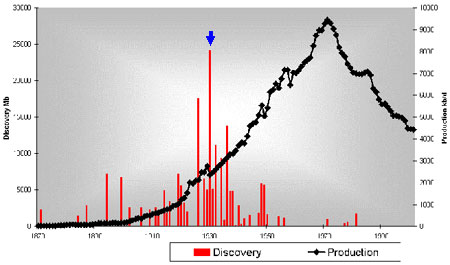
It's interesting to compare to the US production & discovery curves:
1-oil-discoveries.jpg

Note that the availability of new technologies and the discovery of the Alaska North Shore fields did nothing to stop the downward trend.

2. Between now and 5 years time. Cantarell (Mexico) has peaked, North Sea has peaked, indications are that Ghawar (massive Saudi field) is close to peaking if it hasn't already.

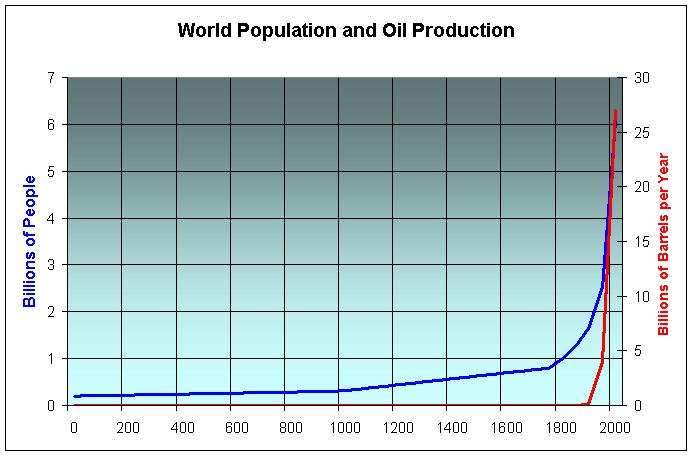
3. Yes it is a big deal - without fossil fuels the exponential population growth we have seen in the past couple hundred years would not have been possible. Basically we have found ways of turning nonrenewable oil & natural gas into food - through the Haber-Bosch process, Green Revolution fertilizers, herbicides etc.... We are in a serious "overshoot" situation and getting back down to sustainable levels is going to be painful to say the least.
Paul%202.jpg

Paul%203.jpg


4. We should probably try to shift to a sustainable, non-growth oriented economy, with localized food production, etc.. Richard Heinberg has a good book on this called "Powerdown". The way the system is set up though, we'll probably end up going full speed ahead until oil prices and availability force catastrophic change.
 
Yes. We've been using more oil per year than we've been discovering for some time now, so peak oil appears inevitable.

One of the major reasons for that is that the price of oil has been so low that it hasn't been worth looking for anything but huge fields that have been easy to exploit.

Between now and 5 years time. Cantarell (Mexico) has peaked, North Sea has peaked, indications are that Ghawar (massive Saudi field) is close to peaking if it hasn't already.

And yet those that are in the companies don't seem quite so worried cause we know what we currently have and can expect to produce.

Yes it is a big deal - without fossil fuels the exponential population growth we have seen in the past couple hundred years would not have been possible. Basically we have found ways of turning nonrenewable oil & natural gas into food - through the Haber-Bosch process, Green Revolution fertilizers, herbicides etc.... We are in a serious "overshoot" situation and getting back down to sustainable levels is going to be painful to say the least.

Or not. The Green Revolution might just have to accept that much of the world's energy in the future is going to be coming form sources they don't like, specifically Nuclear Fission and Fusion, either directly as electricity or stored in Hydrogen or a similar form. Still if they are that upset about it they can always forgo the use of energy and go live in a cave somewhere. By the time we get close to Oil Peak there will be a number of options on the table.

We should probably try to shift to a sustainable, non-growth oriented economy, with localized food production, etc.. Richard Heinberg has a good book on this called "Powerdown". The way the system is set up though, we'll probably end up going full speed ahead until oil prices and availability force catastrophic change.

Or we could accept that there are alternatives to fossil fuels that are usable instead of trying to demonize them.
 
I have read Richard Heinberg’s books “The Party is Over” and “Powerdown” but have not read “The Oil Depletion Protocol”
I’ll specifically address Heinberg’s notions that I disagree with:
-9/11 was an inside job, some of the hijackers are still alive, 9/11 was a pretense to rape Afghanistan of its vast riches, etc. I find it pathetic and sad that these people shot themselves and their cause in the foot with this nonsense.
-not only does he appear to be anti-capitalist and anti-globalization but anti economic growth of any kind. Even if all his dire predictions come to pass and the economy goes through drastic decline, there will always be areas of growth. I wonder if he would be opposed to growth in the bicycle market? Perhaps I’m misinterpreting him but he comes across as very anti growth.
-Many Peak Oilers including Heinberg have this fundamental notion that capitalism is dependent on economic growth and cannot work in a shrinking economy. I disagree with this fundamental premise that is the jumping off point for many of their other recommendations. While economic growth is nice, whole economies can shrink, corporations can shrink in scale and still remain viable. I’m all ears on any coherent reasons that would explain why capitalism would fail in an economy that is not growing. I would further argue that capitalism at a fundamental level, encourages efficiency and innovation compared to planned economies which seems like something we will need to meet the challenges of expensive energy.
-Like global warming, instead of having an honest discourse and discussing the science and the ramifications, these issues become obscured by politics. In the case of Heinberg, Peak Oil is used as a jumping off point to push his extreme left wing politics. This isn’t to say he is right or wrong about Peak Oil itself, its just that his politics cloud the issue.
 
Nietzsche said:

"When you peek into the oil, the oil peeks back."

I think that's what he said...:boggled:
 
I've advocated nuclear power for years to almost no avail. My last year in college I had a debate in a class over nuclear power. My opponents actually tried to use the power plant in The Simpsons as a reason not to use nuclear power. I'm not making that up. Most in the class were squarely against it from the get go (I've mentioned before I went to a hippy college) so I probably didn't change any minds but it was, The Simpsons reference aside, an intelligent and lively debate.
 
Or we could accept that there are alternatives to fossil fuels that are usable instead of trying to demonize them.


Given the Kiwi reluctance to embrace Nuclear power, our eagerness to jump on the Kyoto band wagon, and this latest round of the government preventing power suppliers from disconnecting customers that aren't paying, I'm expecting electricity prices to rise much more significantly than petrol prices in the following years.

-Gumboot
 
Lol - seems Kiwis care about peak oil :P

My responses to your questions:

portlandatheist said:
1. Do you believe/accept the fundamental notion of peak oil? I would think this would be a given since the only alternative to this idea would be that there is no upper limit of daily oil production and that it will go up and up forever.

Yep - it's a pretty straightforward concept. The main unknowns are unfound commercially viable reserves (I suspect minimal) and the exact amount remaining in exsiting reserves. Neither of these changes the fundamental issue though.

portlandatheist said:
2. If you accept #1, do you think Peak Oil will happen soon (within 10 years) or is it a far off problem? My own take is that peak oil is very hard to predict since technology changes constantly and unpredictably but I suspect it will likely happen within the next 10 years but this is only a complete guess on my part, I’m no expert in oil reserves

I think to some extent we are experiencing the impact of oil production peaks now. The literal peak of production is not nearly as important as the point at which the industry acknowledges it - thats when the economic problems associated with scarcity will hit the fan. So long as the industry keeps insisting there is heaps left the market won't react. The Hirsch Report is about as good an analysis as we need to react imo.

portlandatheist said:
3. Is it a big deal? Peak oilers make the Y2K crowd look mild in comparison. Futhermore, many of them are 9/11 conspiracy theorists and have such extreme left wing politics that their credibility must be seriously called into question. Case and point: Michael Ruppert

It is a big deal because it will be the first global resource shortage of a resource that really matters. The economic implications of peak oil are substantial and if not reacted to, pretty dire. I think the CTers underestimate (or claim deliberate efforts against) the worldwide response. We have the capacity to shift from oil pretty quickly if scarcity forced us to. Unfortunately it seems we wont make any substantial proactive reaction thanks to politicians being politicians.

portlandatheist said:
4. What should our response be?

Personally I'd argue for substantial tidal, wave and wind farms to power whichever of hydrogen or battery wins the technological battle (both are essentially transportable electricity). Nuclear is a short-mid term solution internationally (although peak uranium is an issue) but is clearly not a solution in NZ (although it has been seriously considered in the past - I have a early 80s Government forecast that predicted 10,000 MW of Nuclear in NZ by 2020!)

A personal vision of mine is that I think biofuels should be targetted purely at public transport, not cars. 100% biofuel buses and trains is much more useful than 3-5% ethanol/biodiesel fueled cars. Much easier to control, much better for publicity, and manageable and probably even sustainable long term. Also in New Zealand (and i suspect its the same everywhere) if we replaced 5% of our oil with biofuels, after one year we would be back at the same level of oil consumption as the previous year so really it doesn't achieve much.

It is a fascinating issue.
 

Back
Top Bottom