Michelangelo Hid Brain Image In Sistine Chapel Ceiling?

As a great admirer of the Sistine Chapel frescoes, I began the linked article with deep skepticism. But the neurosurgeons who noted this may indeed have a point.

The musculature of God's neck in the Separation of Light from Darkness fresco looks very unusual, especially compared with Michelangelo's other paintings of the same anatomical area. It does correspond with known neck anatomy, but only if exaggerated and stylized, which the artist did not typically do, preferring a heightened realism in his human figure art.

God's neck anatomy better corresponds with the anatomy of the human brain stem, which as a dissector of human cadavers Michelangelo would have known well.

ETA: More complete analysis here. "Although we recognize the perils of overinterpreting a masterpiece like Michelangelo's Separation of Light From Darkness, we submit that the anatomic incongruities in this fresco are not accidental and warrant an explanation."
 
Last edited:
I think there's a middle way that, actually, is all that the scientists in question are suggesting, i.e. that it's neither the secret and profane code that the tabloids would have us accept, nor pure coincidence, but an urge on the part of the artist to draw upon an interesting piece of anatomy in the rendering of a more mundane one. Could it even have been subconscious?
 
I think there's a middle way that, actually, is all that the scientists in question are suggesting, i.e. that it's neither the secret and profane code that the tabloids would have us accept, nor pure coincidence, but an urge on the part of the artist to draw upon an interesting piece of anatomy in the rendering of a more mundane one. Could it even have been subconscious?

Knowing Michelangelo, I cannot believe that it would have been accidental or subconscious. He was extremely meticulous in his planning and careful in his execution. His attention to muscular detail is largely what separates him from his contemporaries -- even from Leonardo, who also studied and understood anatomy, but tended to sublimate it in his finished paintings to the luminous quality of human skin, obscuring the underlying musculature.

Michelangelo painted robust, superhuman figures with pronounced and powerful muscles, by which he was fascinated and about which he knew a great deal. He would not have subconsciously painted the anatomy of the human brain onto a human neck, even the human neck of God, in my educated opinion.

Nor do I accept that it was some kind of "secret or profane code". Likely he did it as a visual pun, to connect one segment of the anatomy with another in a kind of in-joke, or demonstration of knowledge, among artists. Perhaps that could be called a "secret code", but not in the hush-hush conspiratorial sense that we might imagine today.
 
I've seen this theory before, several years ago, only it didn't stop with the brain. Someone pointed out all the major organs are hidden there somewhere. Wish I could find the article again, it had nice outlines and everything.
 
Here is one such page... but it only has one such image. I remain unconvinced, since the shoulder joint had to be arranged just so in order to find correspondences, which are tenuous at best. But this is only one image, and I'll allow that there may exist other, better correspondences which I've not yet seen.
 
Maybe a bit of a stupid question: Michelangelo seems to have indeed studied anatomy. But do we have any idea whether or not he actually sketched or at least studied a human brain?
 
I've seen this theory before, several years ago, only it didn't stop with the brain. Someone pointed out all the major organs are hidden there somewhere. Wish I could find the article again, it had nice outlines and everything.

I was going to say, this isn't a new idea. I think people have been discussing it for at least two hundred years now, but barring necromancy it's not really possible to figure out what was in the artist's head. Apart from "gosh, I do like meaty-looking round bodies!"
 
Maybe a bit of a stupid question: Michelangelo seems to have indeed studied anatomy. But do we have any idea whether or not he actually sketched or at least studied a human brain?

In the interest of historical accuracy, allow me to pick a nit. M. does not "seem to have indeed studied anatomy". There is no question that he did. We have hundreds of his drawings attesting to this fact (and he destroyed hundreds more before his death). Here is one:

http://www.aworldtowin.net/images/images380/006.jpg

To the question, "do we have any idea whether or not he actually sketched or at least studied a human brain?", though we lack such a drawing, we can make a logical inference that yes, he most likely did. It is a matter of documentary record that Michelangelo sought special dispensation from the Church to dissect cadavers. His contemporary biographers assert he had his very own dissecting room at the Church of Santo Spirito in Florence, where a prior provided him with corpses for the purposes of study and research. [Condivi A. The Life of Michelangelo (transl A Sedgwick Wohl, edited by H Wohl). London: Phaidon, 1976: 17, 59, 99, 147.] Later in life the artist continued to dissect corpses, and contemplated publishing a book on anatomy to be written with his doctor, a medical consultant to the Vatican. [Eknoyan G, DeSanto NG. Realdo Colombo (1516-1559): a reappraisal. Am J Nephrol 1997;17: 261-8]

So we have a driven, ambitious and gifted artist who we know extensively dissected cadavers for anatomical and artistic research. Though we do not have any drawings to support the conclusion, it is only a short and easily supportable leap to state that he at least studied the human brain, and given his thoroughness in all areas of his work, he very probably drew one, too.
 
Coincidence. Which is not an extreme statement considering the complexity of the painting. I'm surprised we don't see helicopters and spaceships in it too.

The woman under God's arm is stunning. It must be good to be God.
 
I think the more specific term you're looking for is "pareidolia", which can be defined as seeing images in places where they are not supposed to be (like a devil's face in a cloud of smoke, for example).

Pareidolia is a "coincidence" of sorts, whereby random chance, the workings of physics or photographic anomalies appear to produce patterns that approximate some other, recognized form. But more than mere coincidence is required to explain or describe the second part of the pareidolia equation, which is a purely mental and/or visual phenomenon.

Even having studied Michelangelo's work since childhood, I cannot declare with authority or confidence whether we are seeing pareidolia/coincidence at work in these organ-like shapes in the Sistine Chapel frescoes, or whether, as some claim, the artist painted them in of his own initiative and volition.

But I will repeat that I find it extremely unlikely that an expert anatomist such as Michelangelo, who is known and documented to have dissected and examined human cadavers throughout his lifetime, would have "accidentally" or "coincidentally" painted human organs into figurative shapes where those organs did not belong.

As I stated upthread, Michelangelo was a meticulous planner, who sketched in excruciating detail the figures and forms which he then transferred onto the surfaces of his paintings. I find it highly unlikely that a brain stem, for example, would have "accidentally" appeared in a certain painting of his of a neck, especially when all other necks he painted did not show those same, brain-stem-like forms.

In closing, we don't see "helicopters and spaceships" in his work primarily because Michelangelo painted the rounded, organic forms of the human figure almost exclusively, barring only fabrics draped over such figures, masonry and architectural elements which have the verisimilitudinous look of imperfect handicraft, and incidental props such as martyrs' relics. He did not typically paint vehicles, vessels or other such objects which would lend credence to the identification of modern, hard-lined, post-industrial technologies in his work.
 
Isn't the neck basically a brain stem anyway? Of course there's a similarity. I just don't think it's meant to symbolise the interior brain stem. It just looks like a neck to me, and I'm an artist of sorts, so I should be able to imagine all sorts of weird things. It looks like a muscly neck, typical of Michelangelo.

The thing I do find odd is that his God has boobs. :)
 
Thanks. I know pareidolia, just can't spell it. :D

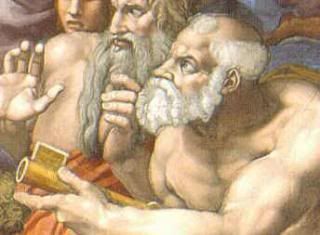
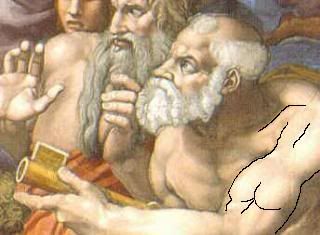
No disrespect, but I easily found what looks like one of the subjects pointing a gun at Jesus in 'The Last Judgment' painting. I still think we tend to see things that aren't there, maybe because we're just human and that's what we do.

 
:D

Furthermore, Michelangelo's painted someone mooning us in that pic!

michelangelo1.jpg
michelangelo2.jpg


;)
 
Isn't the neck basically a brain stem anyway? Of course there's a similarity. I just don't think it's meant to symbolise the interior brain stem. It just looks like a neck to me, and I'm an artist of sorts, so I should be able to imagine all sorts of weird things. It looks like a muscly neck, typical of Michelangelo.

...snip...

I agree with you - just been looking at a few of his other works in which he has painted exposed and stretching necks and they are all ropey looking necks with plenty of texture.
 
Thanks. I know pareidolia, just can't spell it. :D

No disrespect, but I easily found what looks like one of the subjects pointing a gun at Jesus in 'The Last Judgment' painting. I still think we tend to see things that aren't there, maybe because we're just human and that's what we do.

[qimg]http://www.internationalskeptics.com/forums/imagehosting/thum_10614c31a73a99213.jpg[/qimg]

Hah, you've got me there! That's Peter with the keys of judgement, but yes, the barrel looks similar to a modern gun!
 

Back
Top Bottom