• Quick note - the problem with Youtube videos not embedding on the forum appears to have been fixed, thanks to ZiprHead. If you do still see problems let me know.

Government regulation saving lives

a_unique_person

Director of Hatcheries and Conditioning
Joined
Jul 19, 2002
Messages
49,633
Location
Waiting for the pod bay door to open.
There has been a lot of press about the agressive speed camera/radar gun campaign against drivers. The amount taken from fines has gone up, and many people just viewed the exercise a a cynical money making exercise.

The results are in.

http://www.theage.com.au/articles/2003/11/17/1069027048173.html

People are now paying less than they were in fines, because they are slowing down. Most importantly of all, the road toll has taken a dramatic dive.

But the lower revenue from speed and other fines suggests that the crackdown on speeding motorists is working - and making the roads safer. Victoria's 2003 road toll yesterday stood at 296 - 55 fewer than at the same time last year, according to the Transport Accident Commission.

The TAC also confirmed last night that the 12-month rolling road toll - 342 deaths as at yesterday - was the lowest on record.

I am getting used to just sticking to the speed limit, and it really doesn't make much difference in travel time. It is less stressful, and you do feel safer. You also have a better chance of getting to your destination in one piece.

The government likes the revenue, for sure, but at the same time, it will be making massive savings due to the reduction in the accident rate, as will those who pay to have their cars insured.
 
a_unique_person said:
I am getting used to just sticking to the speed limit, and it really doesn't make much difference in travel time. It is less stressful, and you do feel safer. You also have a better chance of getting to your destination in one piece.

The government likes the revenue, for sure, but at the same time, it will be making massive savings due to the reduction in the accident rate, as will those who pay to have their cars insured.

Not enough data to make these conclusions. First, you have to look at death rates per some distance standard. In the U.S., the rate is per 100,000,000 miles driven. Second, there could be many contributing factors (seatbelt use, safer cars, etc). In the U.S., rates have been declining for many years, even though speed limits have increased.

u.s. mv statistics
 
Re: Re: Government regulation saving lives

BTox said:


Not enough data to make these conclusions. First, you have to look at death rates per some distance standard. In the U.S., the rate is per 100,000,000 miles driven.

Normally, I would say yes. But a drop of 55 to 296 is a massive change.


Second, there could be many contributing factors (seatbelt use, safer cars, etc). In the U.S., rates have been declining for many years, even though speed limits have increased.

u.s. mv statistics

Seatbelts have been compulsory for many years. Australia has a fatality rate of 10/100,000, compared to the US of about 15. The rate of decrease in Australia is still quite steep, the US it has about levelled off.
http://www.abs.gov.au/ausstats/abs@.nsf/0/9AFD4E13D7DA281FCA2569DE0028B40C?Open&Highlight=0,crash
 
a_unique_person said:
There has been a lot of press about the agressive speed camera/radar gun campaign against drivers. The amount taken from fines has gone up, and many people just viewed the exercise a a cynical money making exercise.

The results are in.

http://www.theage.com.au/articles/2003/11/17/1069027048173.html

People are now paying less than they were in fines, because they are slowing down. Most importantly of all, the road toll has taken a dramatic dive.


I am getting used to just sticking to the speed limit, and it really doesn't make much difference in travel time. It is less stressful, and you do feel safer. You also have a better chance of getting to your destination in one piece.

The government likes the revenue, for sure, but at the same time, it will be making massive savings due to the reduction in the accident rate, as will those who pay to have their cars insured.

Did you see the report on 'Today Tonight' today?? It seems you don't have to be speeding to get got by the speed cameras. The report was very interesting.

Don't get too comfy cruising along the streets of your city, especially Melbourne, as due to the incorrect setting up of these cameras by the operator, the cameras are going off when there are no cars going by. One man who lives where a camera was set up at the front of his house, was booked for speeding as he was driving out his driveway.

I think only several years of having the cameras everywhere, will give a real view of whether they are slowing the road toll. It is a revenue raising exercise, full stop. With the secondary effect of safer roads for users.

If a person wishes to obtain a taxi licence or become a driving instructor etc but his record shows speeding offences because he was booked for doing a couple of 'Ks' over the limit, he may not get the job. Not fair! It's good to see they (cameras) have been turned off.:(
 
Re: Re: Government regulation saving lives

Always Free said:


Did you see the report on 'Today Tonight' today?? It seems you don't have to be speeding to get got by the speed cameras. The report was very interesting.

As I said, the Government likes the revenue, but the justification for them is also holding, road deaths are down remarkably. This will also mean an even larger reduction in injuries and damage to cars. The roads are just safer when everyone is driving more carefully.

TT is the type of show that likes to beat up anything. I have worked on programming similar road sensors to the ones used as 'fixed' speed cameras, that is, the ones that use pizo electric sensors under the road. They are only 1.5 meters apart, when the place I worked at felt that 3 meters, or more, when you are measuring cars on a high speed road, is much more accurate and less prone to error. You will note that the company that installed the systems, pol tech, has gone into receivership. The problem was that the CEO was getting paid over 200,000 dollars a year when they really needed to be investing in getting their technology sorted out better.

The basic fact is, the technology is very reliable, (although when you are measuring thousands of cars a day for law enforcement purposes rather than just counting them, you have to get it right much more often), and not that complex. It must, however, be made much more tolerant of errors, such as the Datsun 120Y being clocked at over 160kmh. That is, in cases of doubt, the driver must be given the benefit of the doubt. My guess is that the company that hands out the fines is being too greedy, as they also get a cut.

Lets not throw the baby out with the bathwater. I like the roads being safer.
 
AUP,

I don't know if you saw TT but if you didn't, see if you can read about it on the web site. I can't see how the public can have any confidence in these cameras if the operators can't set them up properly. And if the cameras shouldn't be operated near road speed signs, train tracks, metal garage doors etc etc the technology surely is not good enough to have so many of these revenue raisers sprouting up everywhere.

It amounts to theft, in my opinion.

We are all for safer roads, but lets wait until Xmas time and the end of the year to see what the toll will be. 50 less deaths so far is a lot but it doesn't convince me that the cameras are responsible for this reduction.
 
I am totally for strict enforcement of speed limits. And manditory use of seat belts.
There may come a day when the State Police actually stop big tractor trailers for speeding. And stop those wreckers from speeding while towing disabled autos.
If this is a source of revenue then it will finance more State Police, Highway Patrol cars etc.
Here in Massachusetts we seem to attract more speeders than anywhere else in this country. With the "Big Dig" still going on I see more Police sitting idle by the side of construction sites than I see patroling the highways.
 
Always Free said:
AUP,

I don't know if you saw TT but if you didn't, see if you can read about it on the web site. I can't see how the public can have any confidence in these cameras if the operators can't set them up properly. And if the cameras shouldn't be operated near road speed signs, train tracks, metal garage doors etc etc the technology surely is not good enough to have so many of these revenue raisers sprouting up everywhere.

It amounts to theft, in my opinion.

We are all for safer roads, but lets wait until Xmas time and the end of the year to see what the toll will be. 50 less deaths so far is a lot but it doesn't convince me that the cameras are responsible for this reduction.

I don't doubt that the government likes the revenue. However, the 50 deaths less is 50 less than at the same time last year. I can't see the road toll suddenly shooting up by 50 in weeks left in the year.

As for the things to watch out for, like I say. The company that set the cameras up and the company that issue the fines should be erring on the side of caution. As I noted, Poltech is out of business now. The government should not be always going for the cheapest bid. The technology is well understood. It just needs to be applied properly and within it's limits.
 
a_unique_person said:


I don't doubt that the government likes the revenue. However, the 50 deaths less is 50 less than at the same time last year. I can't see the road toll suddenly shooting up by 50 in weeks left in the year.

As for the things to watch out for, like I say. The company that set the cameras up and the company that issue the fines should be erring on the side of caution. As I noted, Poltech is out of business now. The government should not be always going for the cheapest bid. The technology is well understood. It just needs to be applied properly and within it's limits.

All the more reason to say the cameras are there for revenue raising purposes. Let's get the cameras on every corner, buy them cheap and rake the money in.

Do you think these cameras will be replaced with better technology or will Poltechs successors be required to do better with the existing ones, such as maintain them properly etc. I suppose I could look up how much revenue the cameras have raised so far but I would be disgusted at the figure, I'm sure. With all that money there is no excuse for buying cheaply any more.
 
Always Free said:


All the more reason to say the cameras are there for revenue raising purposes. Let's get the cameras on every corner, buy them cheap and rake the money in.

Do you think these cameras will be replaced with better technology or will Poltechs successors be required to do better with the existing ones, such as maintain them properly etc. I suppose I could look up how much revenue the cameras have raised so far but I would be disgusted at the figure, I'm sure. With all that money there is no excuse for buying cheaply any more.

They are there for two purposes. Revenue is certainly one, the saving in lives is also real. The simplest way to stop them as a revenue raising device is to stick to the speed limit. It saves you money, and maybe your life.

The actual number of false readings would be quite small, in percentage terms. The system should, however, always operate to give the driver the benefit of the doubt. The problem in these cases would be the private company that processes the bills. We have a private company issueing parking fines in our area, and sometimes, due to summer crowds, I get a parking fine. The council is always happy for residents of the street to be let off, it is the company that processes the fines that is the difficult part of getting off the fine.
 
Re: Re: Government regulation saving lives

BTox said:


Not enough data to make these conclusions. First, you have to look at death rates per some distance standard. In the U.S., the rate is per 100,000,000 miles driven. Second, there could be many contributing factors (seatbelt use, safer cars, etc). In the U.S., rates have been declining for many years, even though speed limits have increased.

u.s. mv statistics

per 100 000 000 miles driven? That's enough to drive around the world more than 4000 times! How much driving do you guys do, anyway?

No wonder your road toll is so high.
 
Re: Re: Re: Government regulation saving lives

Mr Manifesto said:


per 100 000 000 miles driven? That's enough to drive around the world more than 4000 times! How much driving do you guys do, anyway?

No wonder your road toll is so high.

Would you believe 2.830 trillion miles per year? Yes, we do a bit of driving here in the states!
 
Re: Re: Re: Government regulation saving lives

a_unique_person said:


Normally, I would say yes. But a drop of 55 to 296 is a massive change.


Seatbelts have been compulsory for many years. Australia has a fatality rate of 10/100,000, compared to the US of about 15. The rate of decrease in Australia is still quite steep, the US it has about levelled off.
http://www.abs.gov.au/ausstats/abs@.nsf/0/9AFD4E13D7DA281FCA2569DE0028B40C?Open&Highlight=0,crash

Odd that your government (or at least that site) doesn't publish statistics on a per distance driven basis. More relevant than per 100,000 people.
 
Um, everything BTox said. If you don't consider miles driven in your figures, all you've basically got is a bunch of meaningless numbers.

I've pointed out before how fatality rates plummeted in Montana when they completely did away with speed limits, only to come back up when speed limits were reinstated. And I know all of the statistics they were touting in NC a few years ago showing the rate of accidents increasing with the speed limits were bogus for the same reason; they were comparing the areas with the raised speed limits, which were long stretches of rural interstates, with the lower speed limits, which were shorter stretches near the cities. Of course the shorter stretches are going to have fewer overall accidents! Doy!

Besides, I'll bet you can get people to slow down by lining the sides of the roads with tanks and threatening to shoot anyone speeding. That doesn't mean it's justified.

There is a sensible way to enact a speed limit policy; but it's not a way that generates much in the way of revenues for the government, so good luck actually getting it implemented.

http://www.motorists.org/stealthis/coincidence.html
http://www.motorists.org/issues/speed/speed_limit_research.html
http://www.motorists.org/issues/speed/speed_limit_articles.html
 
shanek said:
Besides, I'll bet you can get people to slow down by lining the sides of the roads with tanks and threatening to shoot anyone speeding. That doesn't mean it's justified.

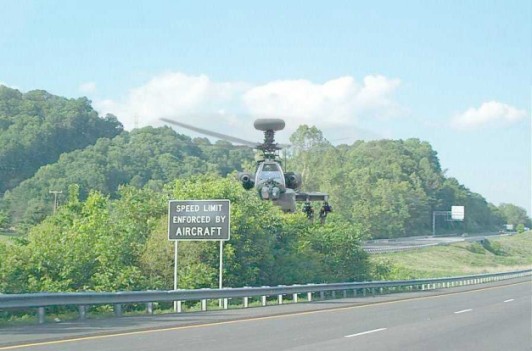
speed-trap.jpg
 
"All the more reason to say the cameras are there for revenue raising purposes. Let's get the cameras on every corner, buy them cheap and rake the money in. "

I agree, if people want to drive like idiots I'm all for them paying for the privilege.
 
shanek said:
Um, everything BTox said. If you don't consider miles driven in your figures, all you've basically got is a bunch of meaningless numbers.

I've pointed out before how fatality rates plummeted in Montana when they completely did away with speed limits, only to come back up when speed limits were reinstated. And I know all of the statistics they were touting in NC a few years ago showing the rate of accidents increasing with the speed limits were bogus for the same reason; they were comparing the areas with the raised speed limits, which were long stretches of rural interstates, with the lower speed limits, which were shorter stretches near the cities. Of course the shorter stretches are going to have fewer overall accidents! Doy!

Besides, I'll bet you can get people to slow down by lining the sides of the roads with tanks and threatening to shoot anyone speeding. That doesn't mean it's justified.

There is a sensible way to enact a speed limit policy; but it's not a way that generates much in the way of revenues for the government, so good luck actually getting it implemented.

http://www.motorists.org/stealthis/coincidence.html
http://www.motorists.org/issues/speed/speed_limit_research.html
http://www.motorists.org/issues/speed/speed_limit_articles.html

No, no need to shoot anyone. A simple fine is very efficient and mostly painless.

The problem with no enforcement, or the previous policy of tolerating speed of 10km/h over the speed limit is that at peak hour, you have to go with the flow, or you will rammed up the rear end and abused. If everyone has to drive at the slower speed, they do, and there is no compulsion to speed.

It is much easier and safer if we all just stick to the limits posted. My wife and family are far more in danger from speeding motorists than the home invader.
 
http://www.atsb.gov.au/road/index.cfm

From 1970 until 2002 the fatality rate dropped from 30.4 to 8.8 deaths per 100,000 population. This reduction has been achieved in spite of a huge increase in motor vehicle use. From 1970 to 2002, the fatality rate per 10,000 registered vehicles has dropped from 8.0 to 1.4. In terms of 100 million vehicle-kilometres travelled the fatality rate has dropped from 4.4 in 1970 to 1.0 in 2000.

1 death per 100,000,000 vehicle kilometres.

At a conversion rate of 1.6 km/mile, That is 0.625 deaths per 100,000,000 vehicle miles. This is a drop from about 2.4 in 1974, when we were just getting used to wearing seat belts.

Compare this to the US, Fatalities per 100 Million Vehicle Miles Traveled 1.51 The drop from 1994 is only 0.2. Not a measurement over the same period of time, but still a rough indication that Australia has achieved a greater reduction, and a reduction that is still in progress, not one that has levelled off, as the US rate has.

Another interesting stat (http://tssu.atsb.gov.au/Query_DB.cfm), is that most of the fatatalities happen at the lower speeds, like 60km/h. This is where the major focus is on with the speed fines.
 

Back
Top Bottom