
• Quick note - the problem with Youtube videos not embedding on the forum appears to have been fixed, thanks to ZiprHead. If you do still see problems let me know.

God or The Higgs Boson

BillyJoe

Penultimate Amazing
Joined
Aug 4, 2001
Messages
12,531
From "WHAT'S NEW" by Robert L. Park; Friday, 30 Mar 07; Washington, DC

In November, on schedule, protons will begin circulating in the
27km ring of the Large Hadron Collider. After 15 years and
$3.8B, the LHC is nearing completion at CERN in the tunnel used
for LEP. The largest and most complex scientific instrument ever
built, the LHC involves the collaboration of more than 2,000
physicists from 34 countries. The primary objective is to find
the Higgs boson, the particle that catalyzed the creation of mass
from energy to form the universe. Nobel laureate Leon Lederman
called it "the God particle." It is the only particle predicted
by the Standard Model of particle physics that hasn't been found,
but physicists are confident that the Higgs will be found by the
LHC... [W]e are on the threshold of spectacular advances in
understanding the creation of the universe.
Better a God particle than a God.

Is Interesting Ian still around?
 
From "WHAT'S NEW" by Robert L. Park; Friday, 30 Mar 07; Washington, DC
Quote:
In November, on schedule, protons will begin circulating in the
27km ring of the Large Hadron Collider. After 15 years and
$3.8B, the LHC is nearing completion at CERN in the tunnel used
for LEP. The largest and most complex scientific instrument ever
built, the LHC involves the collaboration of more than 2,000
physicists from 34 countries. The primary objective is to find
the Higgs boson, the particle that catalyzed the creation of mass
from energy to form the universe. Nobel laureate Leon Lederman
called it "the God particle." It is the only particle predicted
by the Standard Model of particle physics that hasn't been found,
but physicists are confident that the Higgs will be found by the
LHC... [W]e are on the threshold of spectacular advances in
understanding the creation of the universe.
Better a God particle than a God.
Is Interesting Ian still around?
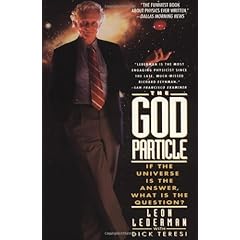
I read something recently (if I think about it some more, I might remember where) that stated that Lederman really called it the "God-damned particle".

Linda
 
I read something recently (if I think about it some more, I might remember where) that stated that Lederman really called it the "God-damned particle".

Well, he definitely called it "The God Particle".
In fact, he wrote a book called....

0385312113.01._AA240_SCLZZZZZZZ_.gif


But perhaps he called it the God-damned particle as well.
 
Here's a really good a recent read...

http://www.newscientist.com/article/mg19325954.200

The pair ran simulations to see if their string-nets could give rise to conventional particles and fractionally charged quasi-particles. They did. They also found something even more surprising. As the net of strings vibrated, it produced a wave that behaved according to a very familiar set of laws - Maxwell's equations, which describe the behaviour of light. "A hundred and fifty years after Maxwell wrote them down, here they emerged by accident," says Wen.
That wasn't all. They found that their model naturally gave rise to other elementary particles, such as quarks, which make up protons and neutrons, and the particles responsible for some of the fundamental forces, such as gluons and the W and Z bosons.
From this, the researchers made another leap. Could the entire universe be modelled in a similar way? "Suddenly we realised, maybe the vacuum of our whole universe is a string-net liquid," says Wen. "It would provide a unified explanation of how both light and matter arise." So in their theory elementary particles are not the fundamental building blocks of matter. Instead, they emerge from the deeper structure of the non-empty vacuum of space-time.
 
Related to the LHC: one of its quadrupole magnets has failed:

On Tuesday, March 27, there was a serious failure in a high-pressure test at CERN of a Fermilab-built “inner-triplet” series of three quadrupole magnets in the tunnel of the Large Hadron Collider. The magnets focus the particle beams prior to collision at each of four interaction points around the accelerator.
[...]

At this point the consequences, if any, for the LHC schedule are not yet known.
 
Well, he definitely called it "The God Particle".

Yes. My comment makes no sense unless you assume that I already knew that.

Not that I would ever ask anyone to consider that my comments might make sense....

Linda
 
This is sounding very much like Vacuum Genesis, which I cam across back in the mid 1980's.
 
i heard that present thinking indicated that the higgs might exist over a larger energy range than was at first expected.
 
Yes. My comment makes no sense unless you assume that I already knew that [Lederman called it "The God Particle".]

You said:

"I read something recently...that stated that Lederman really called it the "God-damned particle"."

In order for me to assume that you already knew that Lederman called it "The God Particle", I would have to assume that Lederman did call it "The God Particle". In fact, Robert Parks could have been wrong. Lederman may have been misquoted. He may never have called it "The God Particle" and what you read may have been pointing out that what he actually called it was "The God-damned Particle". It may have been like one of those famous misquotes.

Not that I would ever ask anyone to consider that my comments might make sense....

It was more a case of not assuming you have complete knowledge on any and every subject that comes up on this forum, however much it might seem like you do. ;)

regards,
BillyJoe
 
In his book, Lederman does call it the Goddamn Particle (p. 22), because of "its villainous nature and the expense it is causing," but "the publisher wouldn't let us call it the Goddamn Particle."

The book is a good read, by the way, giving a humorous, general-reader history of particle physics in addition to its main subject. There's even an informative anti-woo chapter explaining how revolution happens in science. Physics-literate readers probably won't get much from the book (aside from some chuckles over Lederman's Fermilab anecdotes), but I liked it.
 
It is the only particle predicted
by the Standard Model of particle physics that hasn't been found

This doesn't sound right. To my knowledge the graviton has never been found or proven to exist, and it most certainly is required by the Standard Model.
 
This doesn't sound right. To my knowledge the graviton has never been found or proven to exist, and it most certainly is required by the Standard Model.

The Standard Model of Particle physics does not include a theory of gravity, so really, there's only the Higgs to find. The SM is just QCD and the electroweak thory because no one has made a (successful) quantum field thory for gravity, yet.
 
The Standard Model of Particle physics does not include a theory of gravity, so really, there's only the Higgs to find. The SM is just QCD and the electroweak thory because no one has made a (successful) quantum field thory for gravity, yet.

Sorry, I missed the Particle physics part. The complete Standard Model does include gravity, and the graviton.
 
Technically, kalen is right- the SM does not include gravity. The reason is because the SM is primarily and almost exclusively a model of the interactions of quanta, of matter quanta like quarks and leptons, and of energy quanta like photons and gluons. Since there is no consistent quantum theory of gravity, it's impossible to bring it into the SM as anything but a field, a most unsatisfactory procedure.

In addition, gravity is so weak that it can generally be ignored on all but the largest scales- for example, one must account for its effects in the design of a mile-wide supercollider or storage ring, but over the scale of events in the bubble chamber, it has no measurable effect and need not be accounted for to explain the interactions of the particles we see there to the precision and accuracy we can measure their behavior to. And when it is brought in to design the storage or collider ring, it is, as I say, brought in as a field, not an interaction.
 
Technically, kalen is right- the SM does not include gravity. The reason is because the SM is primarily and almost exclusively a model of the interactions of quanta, of matter quanta like quarks and leptons, and of energy quanta like photons and gluons. Since there is no consistent quantum theory of gravity, it's impossible to bring it into the SM as anything but a field, a most unsatisfactory procedure.

In addition, gravity is so weak that it can generally be ignored on all but the largest scales- for example, one must account for its effects in the design of a mile-wide supercollider or storage ring, but over the scale of events in the bubble chamber, it has no measurable effect and need not be accounted for to explain the interactions of the particles we see there to the precision and accuracy we can measure their behavior to. And when it is brought in to design the storage or collider ring, it is, as I say, brought in as a field, not an interaction.

Yes and no. The Standard Model SU(3) X SU(2) X U(1) is the fully supported model of the three forces used in quantum physics. Gravity is not accounted for in that model, but it was originally the Standard Model which predicted the existence of gravitons. The graviton being the massless force carrier that was hoped to somehow add it to the model at (0).

Which is why I consider it missing just as equally as the Higgs Boson. But technically, I stand corrected.
 

Back
Top Bottom