
One of the many points of contention between conspiracy theorists and the official story is the influence of the fires in the World Trade Center buildings on the steel members of the central core. Truthers often claim that the fires were not hot enough to melt the steel columns or even weaken them to the point of collapse.
From what I've read, most skeptics here don't require this to happen anyway. Rather, the somewhat lighter floor trusses are what fail from fire, essentially detaching a floor from its support columns, at which point it drops downwards onto the floors below, which also fail, because, while these trusses were not compromised by fire, the dynamic loading from the aforementioned collapsing floor essentially just snaps the trusses of the lower floor, starting a chain reaction of floors collapsing downward. In this scenario, the central core columns are largely isolated from the catastrophic event, its as if everything is just falling down around them, and this seems to be evidenced by the fact that if you look closely at many videos of the collapses, the core columns can be seen standing upright in the smoke for some time afterwards.
This is a special exception:
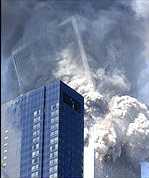
Clearly before the progressive failure of the floor trusses began, the top of this tower started to tilt over. This is almost certainly due to the softening of the central columns by the fire, progressive collapse then followed, indeed was probably triggered by, this tilting of the top.
It's my understanding that the weakening of steel by fire is really just an increase in the malleability of the steel. That is to say, it bends more easily.
So we arrive at the crux of my post, which deals with building 7. What's puzzling here is the "Straight down" nature of the collapse that conspiracy theorists are always espousing as the smoking gun evidence of controlled demolition. While I don't think it is, it doesn't seem to jive with what one would expect. Arguments about how "what you would expect means nothing unless you're a structural engineer" are in vain, as structural engineers don't govern the basic behaviour of materials under certain conditions. Even the layman is able to state with certainty that steel does not just collapse into itself.
Building 7 was not a victim of the same type of progressive collapse as the towers were, it resembled more closely a "conventional" looking demolition, in that it appears that the support was undermined at the very base of the building and the rest of it came down on top of it. If this was due to fire interacting with steel, would we not expecting to see the the entire building gradually lean to one side and just fall over? I can justify why I would expect to see this logically. Asymmetrical damage + asymmetrical heating = asymmetrical loading on support columns, which leads to stresses that will pull the steel members, and if they're weakened by fire they will easily buckle and lean over. What we actually see implies something different though. And I wonder if anyone here can describe a reasonable scenario of steel behaviour in Building 7. Did the columns fold up onto themselves like accordions? Did they break? I look forward to some clear answers.
From what I've read, most skeptics here don't require this to happen anyway. Rather, the somewhat lighter floor trusses are what fail from fire, essentially detaching a floor from its support columns, at which point it drops downwards onto the floors below, which also fail, because, while these trusses were not compromised by fire, the dynamic loading from the aforementioned collapsing floor essentially just snaps the trusses of the lower floor, starting a chain reaction of floors collapsing downward. In this scenario, the central core columns are largely isolated from the catastrophic event, its as if everything is just falling down around them, and this seems to be evidenced by the fact that if you look closely at many videos of the collapses, the core columns can be seen standing upright in the smoke for some time afterwards.
This is a special exception:
Clearly before the progressive failure of the floor trusses began, the top of this tower started to tilt over. This is almost certainly due to the softening of the central columns by the fire, progressive collapse then followed, indeed was probably triggered by, this tilting of the top.
It's my understanding that the weakening of steel by fire is really just an increase in the malleability of the steel. That is to say, it bends more easily.
So we arrive at the crux of my post, which deals with building 7. What's puzzling here is the "Straight down" nature of the collapse that conspiracy theorists are always espousing as the smoking gun evidence of controlled demolition. While I don't think it is, it doesn't seem to jive with what one would expect. Arguments about how "what you would expect means nothing unless you're a structural engineer" are in vain, as structural engineers don't govern the basic behaviour of materials under certain conditions. Even the layman is able to state with certainty that steel does not just collapse into itself.
Building 7 was not a victim of the same type of progressive collapse as the towers were, it resembled more closely a "conventional" looking demolition, in that it appears that the support was undermined at the very base of the building and the rest of it came down on top of it. If this was due to fire interacting with steel, would we not expecting to see the the entire building gradually lean to one side and just fall over? I can justify why I would expect to see this logically. Asymmetrical damage + asymmetrical heating = asymmetrical loading on support columns, which leads to stresses that will pull the steel members, and if they're weakened by fire they will easily buckle and lean over. What we actually see implies something different though. And I wonder if anyone here can describe a reasonable scenario of steel behaviour in Building 7. Did the columns fold up onto themselves like accordions? Did they break? I look forward to some clear answers.


