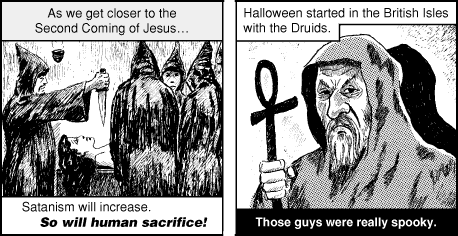
Well, yes, but we still have no idea what religion they were actually priests of.
We certainly have a great deal of insight into the answer. Diodorus Siculus, writing in the 1st century BCE, referred to the Druids' use of "seers", who "by their augural observances and sacrifice of... animals [could] foretell the future and... hold all the people subject to them...." (Library of History, V, 31, 2-3) Diodorus, Caesar, Strabo and Pliny tell us that prophecy and control of supernatural forces were key elements of the Druids' religious practices, and the latter two classical scribes wrote at length about the Druids' various functions as teachers, judges and royal advisers. The Coligny calendar (1st century CE), a fragmentary bronze plaque inscribed in Gaulish (a form of Celtic), provides us with a list of auspicious and inauspicious days for festivals and ceremonies.
Using these sources as a guide, along with Caesar's and other contemporary military histories, it is reasonable to conclude that most or even all religious archeological materials from pre-Roman, Bronze-Age Britain and Gaul relate to the Druids. Sacred structures, warrior burials, sacrificial deposits, regalia EG headdresses, badges of office, scepters and the like can all be linked to the Druids via logical inference, since all classical writers who refer to the Druids describe them as the sole cult officials of the region. Certain images in stone and bronze -- figures as well as carvings -- further detail and clarify the religion of the Druids.
Caesar explains the Druid's belief in reincarnation, "and they regard this as the strongest incentive to valour, since the fear of death is disregarded. They also have much knowledge of the stars and their motion, of the size of the world and the earth, of natural philosophy [meaning science], and the powers and spheres of action of the immortal gods, which they discuss and hand down to their young students."
This material taken as a whole points to a nature-based religion involving reverence for oak and mistletoe, well and stream, lightning and thunder, sun and moon -- in short, a nature religion. At least we can see by this truncated essay that the assertion "we still have no idea what religion they were actually priests of" is not supported by the great body of evidence, both documentary and material, which we possess regarding the beliefs, practices, rituals and functions of the pre-Christian Druidic religion.
The neo-Druids have as much (i.e. as little) connection with the originals as Wiccans do with post-medieval Catholic ritual magicians/cunning men/wise women/'healers'.
It is the proper skeptical position to state that 21st-century Druids have little in common with those of antiquity. However, it bears noting that Neo-Druids, as I understand them, incorporate all that we know from classical, pre-Christian sources into their traditions, and further employ motifs and rituals culled from literary sources such as the mythologies of Wales and Ireland. These were written down in the Middle Ages (~7th-13 centuries CE), but are generally regarded by scholars of the subject as deriving from much earlier oral traditions.
While it's certainly correct to state that druidism officially ended with the demise of the Irish druids in the 5th century CE, the revival of interest in these ancient practices began in the 16th century with the rediscovery of the classical authors I referenced above (Pliny ET AL.). 17th- and 18th-century antiquarians Aubrey and Stukeley reconstructed the Druid order based on these texts, and on clues found in the Irish Ulster Cycle and the myths of Wales.
Also in the 18th century, the Welsh Bard Iolo Morgannwg (ne Williams) drew connections between the Bardic tradition, which had existed historically since the early medieval period, and classical Druidism. Picking up from Aubrey and Stukeley, Morgannwg further codified this into "neo-Druidism" into a series of texts and rites; from that time to the present, other writers, poets and philosophers have contributed to and expanded the Druidic tradition.
Wicca is as much a religion as Druidism, Christianity, Scientology, or Pastafarianism for that matter. Just having a certain set of beliefs and more than one person who identifies with those beliefs constitutes a religion in my opinion. Whether it carries any weight or influence outside that group is a function of how rich and powerful its members are, how appealing its set of rules and rituals, and for some reason, how long it's been around for/is successfully claimed to have been around for.
I find no argument with the above paragraph.
It bears noting that my sources for this essay are all physical, printed books -- I derived not a word of it from any on-line source. Spence, Green, Nichols, Rutherford and Matthews have been my informants and educators in this field of study. Anyone can PM me, if they wish, to acquire a thorough bibliography of Druidic histories, writings and overviews.