
• Quick note - the problem with Youtube videos not embedding on the forum appears to have been fixed, thanks to ZiprHead. If you do still see problems let me know.

Did Harry Houdini believe in reincarnation?

PainKiller

Scholar
Joined
May 3, 2016
Messages
95
Location
Secret
Did Harry Houdini believe in reincarnation?

There was a press release for "The Grim Game" (a film that featured Harry Houdini), which quoted Houdini as saying.
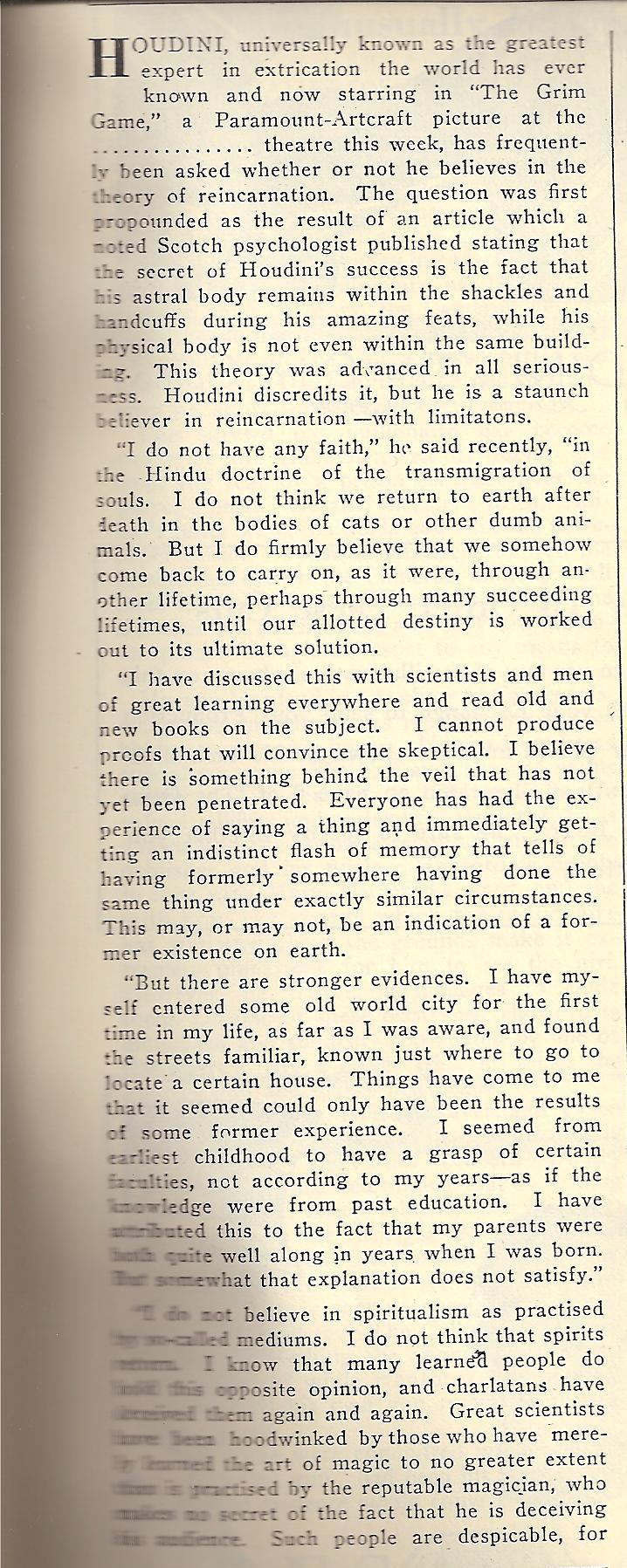
GG%20Reincarnation%20-%201a.jpg


http://harryhoudinicircumstantialevidence.com/?p=279

A full version can be found online here:

http://harryhoudinicircumstantialev...13/10/Fort-Wayne-Indiana-19-Oct-1919-Ad-4.jpg

There is also this from magician Norman Bigelow:

In 1975, I spent and entire afternoon talking shop with historian Walter Gibson. He spoke freely about Houdini's belief in reincarnation. Gibson told us he had research material in his files on two people whom Houdini claimed to be in former lives. One of them was a German magician named Von Treck who failed in a buried alive stunt. He also told us Houdini went around everywhere talking about reincarnation

http://www.wildabouthoudini.com/2012/01/houdini-reincarnation-and-man-named-von.html

In his book on Houdini entitled Death Blow (1983), Bigelow also writes:

The following is pure Houdini from the Literary Digest November 20, 1926: "In an interview Houdini gave the Free Press some time ago, he reiterated his ideas on the possibility of life after death, and we read on: he had faith that death meant a return to earth in another human form.

Houdini said, "There is something to the theory of reincarnation. Just how much, I cannot say, to nor do I believe it will greatly profit us to seek tear aside the veil. In due time it shall be lifted and we shall see with Milton, the bright countenance of truth. I firmly believe, and this belief is based in investigation, observation and, in a measure personal experience that somehow sometime we return in another human form to carry on, as it were, through another life time, perhaps through many succeeding life times, until some strange destiny is worked out to its ultimate solution. I cannot believe the good that is in us ever dies, that the great things we do are ever wasted, or that we — those of us who have developed individual traits of character or accomplish distinctive works for good —shall perish utterly or fail to reap the
reward of good things well done here on earth. Possibly the great intelligence that rules the universe plan beyond our ken knows what lives shall be most essential to the well being of the world and sends them back to finish what they have begun and have been forced to lay down before the beckoning finger of the dark angel."

So what do we think folks? I know the above information is controversial but I have not seen it discussed on this forum.
 
Does it?
He said he didn't believe in coming back as some other animal, but that:
"I do firmly believe that we somehow come back to carry on, as it were, through another lifetime, perhaps through many succeeding lifetimes, until our allotted destiny is worked out to its ultimate solution."

At least according to that clipping.
 
It seems Houdini was a good sceptic. He kept his options open, but not to the extent that he would just take something at face value.
So what does one do in that situation? You devise an experiment!
If I remember correctly, he made some kind of a deal with his wife to attempt to contact her when he died, and to tell her something
only he could have known. Or is that just another myth?
In any case, nobody heard anything form Houdini ever again when he died ...
Does that mean Death is the end? Or was he just constrained by some Demon in Hell inside some device even he couldn't escape from ...
The best sceptical working assumption is that Death is the end, but since it cannot be certain, you should be able to change your mind when new evidence
becomes available, when someone _actually_ has a proof for the afterlife. Like God, all evidence points into the direction that He doesn't exist so
the working assumption should be Atheism. But if God comes down from Heaven ...
 
Houdini wanted to believe in spiritualism; he was devastated by his mother's death and desperately sought to contact her through any number of seances and mediums. When they all failed, he concluded that all mediums were frauds and set out to debunk their tricks; being the most accomplished magician in the word, he was readily able to to that.

He also wanted to believe in the afterlife, and devised a code by which his wife would know that a medium's message was genuine. She contacted many mediums after his death; none of them gave her the correct answer. Unfortunately, she eventually sold out and pretended to receive the message from a medium, causing a brief stir.
 
Exactly.
There's no real evidence that Houdini was more than interested in the idea of reincarnation

Actually there is evidence Houdini believed in reincarnation. Above I showed a clipping where he states:

I do firmly believe that we somehow come back to carry on, as it were, through another lifetime, perhaps through many succeeding lifetimes, until out allotted destiny is worked out to its ultimate solution.

Magic historian Walter B. Gibson who knew Houdini well, stated that he believed he was the reincarnation of Friedrich von der Trenck:

220px-Friedrich-Freiherr-von-der-Trenck.jpg


http://www.wildabouthoudini.com/2012/01/is-this-houdini-in-past-life.html
 
The Grim Game was released in 1919, before Houdini's investigation of mediums and spiritualists in the 1920s, so even if he did believe that at one time, it seems pretty certain he changed his mind after further research.
 
The Grim Game was released in 1919, before Houdini's investigation of mediums and spiritualists in the 1920s, so even if he did believe that at one time, it seems pretty certain he changed his mind after further research.

No, I don't think this is right. Magician Norman Bigelow cited a 1926 press interview with Houdini before his death (Literary Digest November 20, 1926). I quoted this at the bottom of my first post. He states a belief in reincarnation.

Other Houdini scholars have cited this press release. I have no reason to dispute Bigelow on it, but I will look into it further.
 
Do you have anything concrete that doesn't come from a movie advert?

Yes, a personal interview with Houdini before his death. Which was re-printed in the Literary Digest November 20, 1926. I have quoted this, see my first post at the bottom.

The statements from magic historian Walter B. Gibson, a personal friend of Houdini.

Other comments from Houdini from interviews or magazines. For example:

The Stage, magazine, Jan 22, 1915

"I always find something familiar about bars and locks. It seem to me that some time or another I have seen and felt them before."

American Hebrew, June 13, 1924.

"Sometimes I wonder," said Houdini with a touch of sentiment, "whether I am truly a reincarnation, of some old magician because magic never did seem a mystery to me."
 
Yes, a personal interview with Houdini before his death.
Well, I suggest that if it were given after his death that would be interesting.
Which was re-printed in the Literary Digest November 20, 1926. I have quoted this, see my first post at the bottom.
That's when it was published, but it doesn't state when the interview actually took place, just says "an interview Houdini gave the Free Press some time ago".
 
Well, I suggest that if it were given after his death that would be interesting.

That's when it was published, but it doesn't state when the interview actually took place, just says "an interview Houdini gave the Free Press some time ago".

Pretty sure it was 1926 because it was his last interview and it was probably re-printed by others.

Marcello Truzzi in a very rare article "Reflections on the Wizards and its Relationships with Psychic Research" (translated from Spanish) writes:

Despite the skepticism of Houdini to the world of spirits, in his last interview (Anonymous, 1926), recognized personally believe in reincarnation and even claimed to believe in the existence of premonitions.

He lists this source as:

ANONYMOUS (1926, 1st. November). Death rings down curtain on Houdini. Detroit Free Press , pp. 1-11
 
Last edited:
Did Harry Houdini believe in reincarnation?


You should ask James Randi, who is probably Houdini's reincarnation. See: Whose reincarnation is James Randi?

There is also this from magician Norman Bigelow:

"In 1975, I spent an entire afternoon talking shop with historian Walter Gibson. He spoke freely about Houdini's belief in reincarnation. Gibson told us he had research material in his files on two people whom Houdini claimed to be in former lives. One of them was a German magician named Von Treck who failed in a buried alive stunt."


From Is this Houdini in a past life?:

"David suspects that the person Houdini had in mind (and body) was Friedrich von der Trenck. While he was wasn't a magician and he didn't die doing a Buried Alive stunt, he was German and famous for having made several daring escapes from a Prussian jail in 1746. He was later accused of being spy during the French Revolution and executed by the guillotine on July 25, 1794. (Oh dear, is this now ammunition for the "Houdini was a spy" theorists?)"

I would say that Houdini's "Von Treck" is a creation of Houdini with components from his own feelings about possible previous lives and (more or less accurate) information about a concrete person such as Friedrich von der Trenck. Nevertheless the hypothesis that Houdini (1874–1926), before his life as Robert-Houdin (1805–1871), was Cagliostro (1743–1795) still seems more plausible to me than the hypothesis Friedrich von der Trenck (1726-1794).

By the way, it seems that Ayrton Senna (1960–1994) is now Dutch.

Cheers, Wolfgang
 
Arguably, Houdini's skeptical crusade wasn't so much against irrationality itself as against criminal con-artists who exploited irrationality, on the accepted model of heroic 1920s "anti-racketeering" rather than of modern intellectual skepticism.

That said, later in the same 1919 article featured in the OP (which was a promotion for his movie The Grim Game), Houdini was quoted as dramatically describing his miraculous survival of a mid-air collision between two planes while filming a stunt sequence. In reality, although the planes did accidentally collide, Houdini was being doubled by stuntman Bob Kennedy and was not involved in the accident. It's possible that the article was actually written by a publicist, or that Houdini himself figured all was fair game in promoting a work of fiction.

Three years later in an article for the Washington Times (Aug. 23, 1922) Houdini was quoted as describing reincarnation as "only a theory - still it is of a highly interesting nature".
 
That said, later in the same 1919 article featured in the OP (which was a promotion for his movie The Grim Game), Houdini was quoted as dramatically describing his miraculous survival of a mid-air collision between two planes while filming a stunt sequence. In reality, although the planes did accidentally collide, Houdini was being doubled by stuntman Bob Kennedy and was not involved in the accident. It's possible that the article was actually written by a publicist, or that Houdini himself figured all was fair game in promoting a work of fiction.

Thanks for this information. It is entirely possible that it was just for promotion purposes. But the reason I do not personally believe this is because there are other pieces of evidence to take into account. The 1926 interview, other statements throughout his life, the statements of Walter B. Gibson, Henry Ridgely Evans etc who both knew Houdini.

Three years later in an article for the Washington Times (Aug. 23, 1922) Houdini was quoted as describing reincarnation as "only a theory - still it is of a highly interesting nature".

It shows you how little this topic has been discussed on the internet, I could only find one website that documented this quote.

August 23, 1922 "Houdini Answers Questions About Psychic Phenomena" "As regards genius, I agree absolutely with the scientific consensus that it is caused by mental abnormality, analogous to physical abnormality which makes giants, dwarfs, and other freaks of the human race.The fact that exceptional children are born of altogether unexceptional parents proves nothing. If the history of the family is traced, it will be found usually that some forefather was possessed, to a certain degree, of the genius exhibited by the latest generation. "This brings us to the question of reincarnation, by which souls who have not worked out their destiny return later to fufil their God given task. As far as I am concerned, this is only a theory. Still, it is of a highly interesting nature, and forms a basis for my motion picture, " 'The Man From Beyond.'"

It appears Houdini historian John Cox has hashed this out a few years ago with other Houdini experts.

http://forums.geniimagazine.com/viewtopic.php?t=38183

There is a statement there from magic historian Henry Ridgely Evans, who also claimed Houdini believed in reincarnation from a magazine article. Evans was a friend of Houdini.

I know this subject is emotional to some people, not many people have studied the history of magic in depth. They were brought up to just to associate the name Houdini with debunking anything paranormal so this might all be a bit of a shock to some people here. I do not believe in psychic phenomena, all I am trying to do is uncover some little known facts about Houdini.

There is a history of some magicians endorsing psychic phenomena. For example Henry Ridgely Evans who I cited above exposed the tricks of spiritualist mediums (even D. D. Home) and séance room phenomena of bogus mediums like Henry Slade but was a believer in telepathy.

Walter B. Gibson who exposed the tricks of mediums was also a believer in psychic phenomena and wrote a few books on the subject. Of course one could argue Evans and Gibson both had their own agenda and were thus were unreliable on this topic, but this appears unlikely. Gibson has been recognized as producing scholarly books on the history of magic (he has written a very useful book on Houdini). I know Evans has received some criticism from other magicians but for the most part his articles and books were well received.
 
Last edited:
I know this subject is emotional to some people, not many people have studied the history of magic in depth. They were brought up to just to associate the name Houdini with debunking anything paranormal so this might all be a bit of a shock to some people here. I do not believe in psychic phenomena, all I am trying to do is uncover some little known facts about Houdini.

I feel the same way - that's what I meant by noting that Houdini's skepticism was not so much of the modern, intellectual/rationalist kind, being more in the nature of a '20s moral crusade against con-artists who used magic tricks to exploit the superstitions of vulnerable people. On that basis, it's not unlikely that he was interested in reincarnation and gave it some degree of credence; similarly, he quite frequently professed belief in God, though in practice he doesn't seem to have been particularly religious.

I recently did a newspaper archive survey to try to confirm whether HH ever specifically debunked the Ouija phenomenon by referring to the ideomotor effect. Didn't find anything; he said that Ouija shouldn't be taken seriously and that it could drive people crazy, but never (as far as I can tell) actually troubled to explain how it worked. That may be because he wasn't intellectually concerned with debunking irrationality per se (the "DIY seance" craze), so much as with exposing professional psychic frauds who were conning folks out of their cash.
 

Back
Top Bottom