• Quick note - the problem with Youtube videos not embedding on the forum appears to have been fixed, thanks to ZiprHead. If you do still see problems let me know.

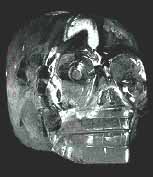
Crystal skull is a fake

CFLarsen

Penultimate Amazing
Joined
Aug 3, 2001
Messages
42,371
Full story

(S)cience can finally set the record straight and, in doing so, shatter one of the most enduring myths of an object steeped in historical fantasy. The crystal skull is a fake.

"We are not at all sure that there is a rock source in Mexico that would produce a rock crystal of this size. There is strong circumstantial evidence that it comes from Brazil," Professor Freestone said. "When you look at known, genuine Aztec rock crystals, they have a much gentler polish. This has the harsh, polished look you get with modern equipment," he said.

Ouch.

The scientists took impressions of the skull with the same flexible resin used by dentists to take precise impressions of teeth. This revealed minute rotary scratch marks around the eye sockets, teeth and cranium and was clear evidence that the sculpture had been cut and polished with a wheeled instrument - and the Aztecs never used the wheel.

Ouch.

Joshua Shapiro, an author who believes the skull has mystical properties, said it was difficult for him to comment on the findings. "It sounds like they wish to discredit the significance of their crystal skull and the possibility that it could have been carved or fashioned by the Meso-American people in Mexico where it was purportedly discovered," he said. "These questions might not even be as important as what this crystal skull represents within this field of study... Even if its origins or who made it are unknown, it helped to give people in the world an awareness that such objects do exist, and that they are revered by the indigenous people in the world."

Idiot.
 
Joshua Shapiro, an author who believes the skull has mystical properties, said it was difficult for him to comment on the findings.
I think the words "...without admitting to having been totally wrong" are missing from the end of this sentence.
 
This revealed minute rotary scratch marks around the eye sockets, teeth and cranium and was clear evidence that the sculpture had been cut and polished with a wheeled instrument - and the Aztecs never used the wheel.
No, but the Atlanteans who made it did ;)

There's a rather good Skepdic article on this subject - much of this skullduggery seems to be old news.

They're still quite cool objects though, even though their parentage seems to be in question.
 
Funny...I always <s>coveted</s> admired that skull, from way back (if this is the skull in question--no pic in the link) when I saw it in the National Geographic as a kid...and... um... had a skull collection. I never knew the alleged full story behind it, I just thought it was a tremendously aesthetic piece.

Now...it simply is.
 
Even if its origins or who made it are unknown, it helped to give people in the world an awareness that such objects do exist, and that they are revered by the indigenous people in the world. "

... unlike those of us who came here from Planet X, who see the skulls as nothing more than some really bitchin' paper weights.
 
is this the crystal skull that was in the opening credits of the Jack Palance hosted "Ripley's Believe it or Not"?
 
HarryKeogh said:
is this the crystal skull that was in the opening credits of the Jack Palance hosted "Ripley's Believe it or Not"?

Dunno, but Arthur C Clarke's Mysterious World in the UK had a similar opening sequence.

Amazing really, Clarke has written some great sci-fi books and shows some remarkable clarity of thought, but that programme was woo to the core.
 
Professor Freestone accepts that the latest findings are unlikely to convince those who believe that the crystal skull is anything but a fake. "As soon as we say that one part of it has been polished in a certain way, someone else says it's because it's been touched up later on. It's hard to make a cast-iron case, to be honest," he admitted. "You've only got to look at the shroud of Turin to see that some people will be hard to convince even in the face of overwhelming evidence."

Says nothing about the mystery of the missing quartz deposit...
 
Peter Morris said:
Are you sure?
http://www.straightdope.com/classics/a1_250.html
http://en.wikipedia.org/wiki/Wheel#History_of_the_wheel

It seems they had little wheels at least, and perhaps they were used as tools, not just toys.

From the first link:

The wheel evidently was familiar to the ancient Mexicans, the only known instance of its having been invented independently of the Sumerian version. Unfortunately, it apparently never occurred to anyone at the time that wheels had any practical application, and their use was confined to little clay gadgets that are thought to be either toys or cult objects.

From the second link:

The Inca and certain other western hemisphere cultures seem to have approached the concept, as wheel-like worked stones have been found on objects identified as children's toys dating to about 1500 BC.

"Perhaps", you say? Let's see evidence, instead of speculation.
 
Is this the Mitchell Hedges skull, at last report is was in private hands, what evidence is there that it is a fake?

http://www.dreamscape.com/morgana/nereid2.htm

At the site above it says this:

There is a pair of similar skulls known as the British Crystal Skull and the Paris Crystal Skull. Both are said to have been bought by mercenaries in Mexico in the 1890s, possibly at the same time. They are so similar in size and shape that some have guessed that one was copied to produce the other. In comparison to the Mitchell-Hedges skull, they are made of cloudier clear crystal and are not nearly as finely sculpted. The features are superficially etched and appear incomplete, without discretely formed jawbones. The British Crystal Skull is on display at London's Museum of Mankind, and the Trocadero Museum of Paris houses the Paris Crystal Skull.

Further examples of primitively sculpted skulls are a couple called the Mayan Crystal Skull and the Amethyst Skull. They were discovered in the early 1900s in Guatemala and Mexico, respectively, and were brought to the U.S. by a Mayan priest. The Amethyst Skull is made of purple quartz and the Mayan skull is clear, but the two are otherwise very alike. Like the Mitchell-Hedges skull, both of them were studied at Hewlett-Packard, and they too were found to be inexplicably cut against the axis of the crystal.

end of quotation

So with tehnology of the time the Mitchell hedges skull was bought at auction could anyone make it?
 
The most famous crystal skull is the Mitchell-Hedges "skull of doom," allegedly discovered by a 17-year old Anna Mitchell-Hedges in 1924 or 1927 while accompanying her adoptive father on an excavation of the ancient Mayan city of Lubaantun in Belize, where the elder Mitchell-Hedges believed he would find the ruins of Atlantis. The evidence collected by Joe Nickell proves beyond a reasonable doubt that Mitchell-Hedges bought the skull at a Sotheby's sale in 1943 for £400.

From the Skeptic's Dictionary

In regards to the HP examination...

In 1970, Anna let Frank Dorland, a crystal carver, examine her skull. Dorland declared that it is excellent for scrying and it emits sounds and light, depending on the position of the planets. He claimed that the skull originated in Atlantis and was carried around by the Knights Templar during the crusades. He claims they had the skull examined at a Hewlett-Packard lab. D. Trull uncritically reports that the lab found that the skull

had been carved against the natural axis of the crystal. Modern crystal sculptors always take into account the axis, or orientation of the crystal's molecular symmetry, because if they carve "against the grain," the piece is bound to shatter -- even with the use of lasers and other high-tech cutting methods.

Dorland's claims formed the basis of Garvin's book on crystal skulls.

As I read it, no one's got a record of the actual lab results, we simply have accounts of lab results. I'll have to get to a library to do further research, but so far it seems the only evidence given is the accoutns of Mitchell and his daughter (contradicted by others supposedly involved and/or present at the important times) and ubsubstaniated accounts of the testing, which may or may not have been done and may or may not have found what is claimed to be found.
 
The most famous crystal skull is the Mitchell-Hedges "skull of doom" ...

There is a pair of similar skulls known as the British Crystal Skull and the Paris Crystal Skull. Both are said to have been bought by mercenaries in Mexico in the 1890s, possibly at the same time.
Mitchell-Hedges Skull
cryskull.jpg


British Museum's Photo of Crystal Skull
Crystal-Skull-museum.jpg


Paris Crystal Skull
crystalskullparis.jpg
 
...had been carved against the natural axis of the crystal. Modern crystal sculptors always take into account the axis, or orientation of the crystal's molecular symmetry, because if they carve "against the grain," the piece is bound to shatter -- even with the use of lasers and other high-tech cutting methods.

I don't get it. I've seen quartz spheres; how can one make a sphere without cutting it "across the grain" at some point?

I remember seeing "the largest discovered piece of unoccluded quartz" at the smithsonian. It was carved into a sphere. Not something you'd do with such a remarkable object if there was even a chance of it shattering.
 
Huntsman said:


In regards to the HP examination...

.had been carved against the natural axis of the crystal. Modern crystal sculptors always take into account the axis, or orientation of the crystal's molecular symmetry, because if they carve "against the grain," the piece is bound to shatter -- even with the use of lasers and other high-tech cutting methods.

Mule fritters. You can carve or shape just about anything against the grain -- even highly figured woods -- simply by taking your time and not taking as aggressive a cut. The fact that the item was shaped without regards to the crystal's orientation suggests that whoever carved the item had no way to determine the orientation.

IIRC, orientation is vital if you're cleaving a crystal (like splitting a diamond into smaller pieces), but for a grinding operation, you're just abrading away the surface with a bunch of small microfractures. For telescope mirror grinders, they exploit the fact that the grit gets rolled between the tool and the mirror blank to do the gross shaping. When it's time to do the final polishing, they use a soft pitch lap or coating on the tool where the polishing grains sink into the surface and tend to work more like a plane blade than a tumbling boulder.

The fact that Dorland claimed the skull is excellent for scrying and would make sounds when the planets are aligned correctly would make me reluctant to use him as an expert witness. Once again, this is based on hearsay. I'd like to see some person with some reasonable credentials present some of their own findings. It doesn't have to be a geologist or chemist, or some other academe'. I tend to accept the latest version on how damascus steel was produced simply because it was worked out by a long-time bladesmith (named Pendragon, IIRC) who's been looking into the matter for some time. Of course, the Scientific American article was written by (I think) a PhD who had connections with the smith.

Anyone know if the other two skulls are carved "off-axis" as well?

Regards;
Beanbag
 
Well, of course the skull's polish looks like it was made with modern type machinery. The Atlanteans were pretty advanced, after all, don't you know? It all makes perfect sense when you look at it logically.

;)
 
There is this cool crystal skull in the National Museum in Mexico, it was carved with brass tools and sand, apparently they used brass pipes and sand to cut much of it. It is really pretty.
 
There are some other photos of crystal skulls here. To give you a flavor of the site there is this picture and caption at the end of the article.

sar_6_1d.jpg

Here a group of researchers based in Belgium, using what is called a Lecher Antenna (like a dowsing rod but able to measure specific frequencies of energy) test “Portal de Luz”.
They were amazed to find that our crystal skull was broadcasting all the same frequencies as a human being: “The senses of ‘Sight’, ‘Smell’, ‘Taste’ and even ‘Hearing’ “


(edit: Well, the picture showed up in Preview - But I don't see it here, sorry.)
 

Back
Top Bottom