• Quick note - the problem with Youtube videos not embedding on the forum appears to have been fixed, thanks to ZiprHead. If you do still see problems let me know.

Chargers

carlitos

"más divertido"
Joined
Jul 15, 2009
Messages
24,384
Location
USA! USA!
This is a bit of a rant, but I'm genuinely curious as to why. Why do different devices use different shapes of charger? I'm not talking about different amperage AC chargers, but the stuff that hooks up to your computer via USB cable, or to a plug-in AC adaptor that accommodates the cable via a USB interface.

I have 3 different sizes of charger to deal with, besides iPad / iPhone / iPod. One is the "thick blackberry charger" that fits 2 cameras, the Tom Tom and my Garmin wristwear running GPS. Another is the "thin blackberry charger" that fits my blackberry, one camera, the bluetooth earphone and ALMOST fits the nook. Lastly, the "long version of the thin blackberry charger," which fits the nook and only the nook. Same opening, longer plug-in end, it fits into, but will not charge, the blackberry and vice-versa for the blackberry charger.

All of these devices charge via USB, or via the same USB-based plug-in AC adaptor. Why do they require different shapes? Is there a competing technology or patent race at work here?
 
I imagine manufacturers will say that their device is delicate and could be damaged with the wrong voltage/amperage. If all plugs were the same, you could accidentally plug in a 20v charger to a device that really only wants 6.7v.

So, in the interest of fewer warranty returns, they use proprietary plug-ins.

ETA: of course, the easy solution would be to have everything simply have a USB port and nothing else. 500Ma @ 5v might not be enough to charge some devices adequately, though.
 
Last edited:
Space.

As devices get smaller, the amount of real estate for connectors goes down. Can you imagine trying to put a DB-9 serial port on a mobile phone?

So after you get USB, someone says we can make it smaller, but just as reliable. *poof* you have 3 different generations of USB connectors with decreasing sizes.

The Apple/iPod connector has USB lines it, but it has standards for others (such as audio and video out). So it's not *just* USB.

The thick one is probably mini-USB, the thin one is probably micro-USB.

Don't know anything about the nook.
 
ETA: of course, the easy solution would be to have everything simply have a USB port and nothing else. 500Ma @ 5v might not be enough to charge some devices adequately, though.

I'm sure that I'm not the only one that does this ...

I use the smallest available AC plug-in that fits a USB. Right now, that's the one from Research in Motion, aka Blackberry. It plugs into my 110V outlet, and into it I can insert a USB-shaped cord. I use the same plug, and various cords, to charge all devices referenced above. I have done this for years with no damage noted.

Not all of them charge when connected to a PC / Mac via the USB. Some give the 'this is not enough voltage to charge this device' or similar error.

ETA - Yes, BowlOfRed, these are mini and micro USB, along with a long version of micro-USB for the nook. At least now I know what to call them - thanks.
 
Last edited:
ETA: of course, the easy solution would be to have everything simply have a USB port and nothing else. 500Ma @ 5v might not be enough to charge some devices adequately, though.

Several of the connectors are (different flavors) of USB.

The connector does not guarantee what's on the other end. I have a few devices that can charge (barely) on spec USB, but they also have dedicated AC adapters with the same connector that can charge more quickly.

I can imagine there is a way to abuse this and use the dedicated adapter with something not expecting it and damage the electronics. I don't think I've done that yet.
 
In the case of USB alone, you have several standards-compliant normal , mini and micro sized connectors, along with an even wider variety of non-standards compliant connectors available. Every camera manufacturer in the last decade seemed to want to use a different hookup for example.

I like the BNC ConnectorWP: there's a satisfying click when it's twisted into place; though a bit of a pain to wire up.
 
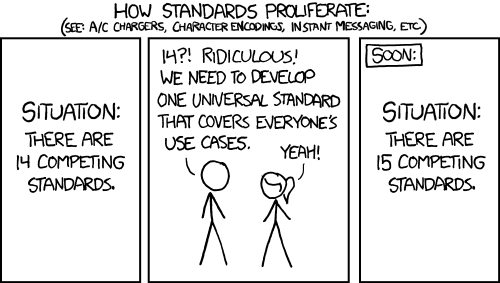
Also:

standards.png
 

Back
Top Bottom