
Cassini spots mysterious Titan anomoly

Cylinder

Philosopher
Joined
Jun 10, 2005
Messages
6,062
Location
Arkansas

Image courtesy NASA/JPL-Caltech/ASI/Cornell

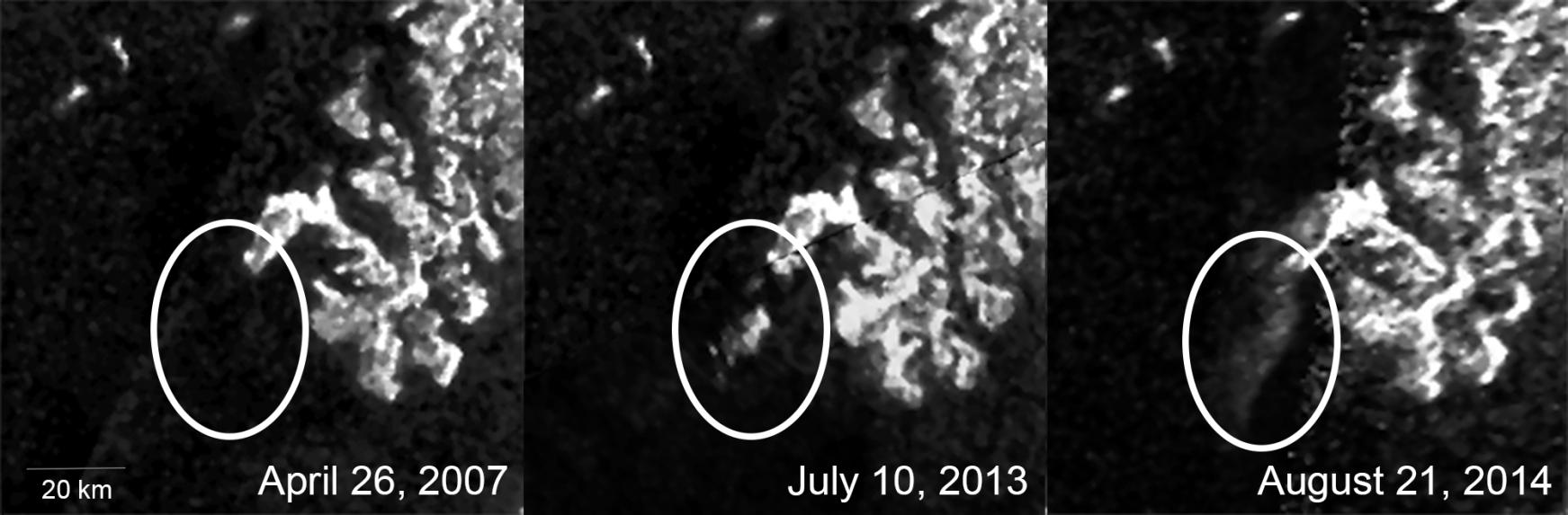
These three images, created from Cassini Synthetic Aperture Radar (SAR) data, show the appearance and evolution of a mysterious feature in Ligeia Mare, one of the largest hydrocarbon seas on Saturn's moon Titan. The views, taken during three different Cassini flybys of Titan, show that this feature was not visible in earlier radar images of the same region and its appearance changed between 2013 and 2014.

In the images, the dark areas represent the sea, which is thought to be composed of mostly methane and ethane. Most of the bright areas represent land surface above or just beneath the water line. The mysterious bright feature appears off the coast below center in the middle and right images.

The mystery feature had not been seen in preceding SAR observations of the region from 2007 to 2009. After its first appearance in early July 2013, it was not visible in observations by Cassini's Visible and Infrared Mapping Spectrometer, obtained later in July and in September 2013. Low-resolution SAR images obtained in October 2013 also failed to recover the feature.

The SAR observation from Cassini's August 21, 2014 Titan flyby shows that the feature was still visible, although its appearance changed during the 11 months since it was last observed. The feature seems to have changed in size between the images from 2013 and 2014 -- doubling from about 30 square miles (about 75 square kilometers) to about 60 square miles (about 160 square kilometers).

Ongoing analyses of these data may eliminate some of the explanations previously put forward, or reveal new clues as to what is happening in Titan's seas.

The Cassini radar team is investigating possible origins for the feature, including surface waves, rising bubbles, floating solids, solids that are suspended just below the surface or perhaps something more exotic. Researchers suspect that the appearance of this feature could be related to changing seasons on Titan, as summer draws near in the moon's northern hemisphere. Monitoring such changes is a major goal for Cassini's current extended mission.
 
Tidal effects? Any large bodies around there that could produce such tides?

The problem with attributing the feature to sea level changes is that the nearby shoreline isn't similarly affected. I suppose it could be possible that all of the surrounding features but this could be tall enough to mask the change.

One explanation from brown-water boating - a neutrally-buoyant feature that rises and falls according to pressure applied by currents in the fluid.
 
With respect to tides:

The mystery feature had not been seen in preceding SAR observations of the region from 2007 to 2009. After its first appearance in early July 2013, it was not visible in observations by Cassini's Visible and Infrared Mapping Spectrometer, obtained later in July and in September 2013. Low-resolution SAR images obtained in October 2013 also failed to recover the feature.


Unless there a long long long time between high and low, I think it would've emerged again.
 
Tidal effects? Any large bodies around there that could produce such tides?

Titan is tidally locked to Saturn, its orbital and rotational period are identical (22 days 15 hours) so it always presents the same face to Saturn (just like our moon does to Earth)

The only way tidal effects might possibly occur on Titan would be if its orbit was highly eccentric so that its varying proximity to Saturn might be a cause. However, Titan's orbital eccentricity is only 0.029. The difference between periapsis (the closest point to Saturn) and apoapsis (the furthest point from Saturn) is only about 70,000km (semi-major axis is 1.2 million km, so that only a ±2.9% variation)

For there to be significant tidal effects to be happening on Titan one or both of two things would been to come into play

1. Something weird going on with Saturn's gravitational field

2. The oceans of Titan would need to be VERY deep because it is unlikely that a solid planet would deform over a short period like 22 days.

I don't know enough about Saturn or Titan to know if either of the above is true. IMO, the fact that this has been previously unseen suggests that tidal forces are unlikely to be any more than a minor contributing factor.
 
Last edited:
The only way tidal effects might possibly occur on Titan would be if its orbit was highly eccentric so that its varying proximity to Saturn might be a cause. However, Titan's orbital eccentricity is only 0.029. The difference between periapsis (the closest point to Saturn) and apoapsis (the furthest point from Saturn) is only about 70,000km (semi-major axis is 1.2 million km, so that only a ±2.9% variation)

For there to be significant tidal effects to be happening on Titan one or both of two things would been to come into play

1. Something weird going on with Saturn's gravitational field

2. The oceans of Titan would need to be VERY deep because it is unlikely that a solid planet would deform over a short period like 22 days.
That 2.9% might be small, but Saturn is massive. Could the "weird" thing going on in Saturn's gravitational field just be that it's huge?

ETA: Thinking about this a bit more I think Saturn's size might be an issue. That 1.2 million km is greater than our Moon's distance, but with Saturn's radius Titan is much deeper in Saturn's gravity well.
 
Last edited:
Whatever it is, I love it. I love that we are seeing such incredible things on other planets/moons for real.
 
Seeing what can be done remotely I'm less convinced than ever that manned space travel would be the best use of research money. The Cassini mission has been tremendous. Congrats to the planetary scientists who spent years of their lives waiting to see if their spacecraft would arrive safely and respond to commands needed to blast in and out of various orbits.

The problems of getting a crew to Mars and staying any length of time would surely yield advances that might be useful in other applications. But for sheer gathering of data space robots have yielded such spectacular results that these missions are IMO superior in terms of cost vs. benefits.
 
How about sand (or something like it) moving around? If there is a river nearby then sand could build up in one location and then due to a change in currents be moved away.
 

Back
Top Bottom