Delvo
Дэлво Δε&#

I ran across an interesting archeological discovery a couple of days ago... through a Christian source that was blathering about how it totally proves a particular story in the Bible true, which proves another one true, which proves the whole thing true, which proves God real and totally destroys the nonsense of all those mean atheists/skeptics who've been so horribly "persecuting" them by not believing it all. Given the mostly-religious presentation about it so far, I find it suspicious that religious organizations apparently got their hands on it before its official publication in a peer-reviewed journal, which is supposed to be coming soon. Releasing this to them first looks like an attempt to get their spin on it out there and in people's brains first, before any aspect of it that doesn't fit their narrative gets a chance.
It's hard to find a source on it which gets to the original facts instead of just the religious spin & propaganda, but this one isn't bad:
https://www.haaretz.com/archaeology...-mt-ebal/00000180-5b9b-dc66-a392-7fdbc7790000
Also, here's an informative video about the general category of artifacts that this new discovery is said to be a member of, "curse tablets": https://www.youtube.com/watch?v=5_sDsFq6VnU
They're not well named; instead of tablets, they're really sheets of metal, with a curse scratched/gouged into one side and then hidden by rolling/folding the sheet up. You can see their typical size in that video: comparable to a modern standard piece of paper, because people need to be able to write on them, usually a few sentences plus some other extra stuff, with tools that don't allow them to write super-tiny.
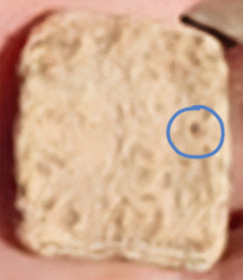
That's one odd thing about the one they say they found in Isreal recently: it's more amulet-sized or CPU-sized or stamp-sized than sheet-sized, so the curse, in addition to being shorter & simpler than most, still had to be written super-tiny to fit there, so tiny I don't know how they'd do it. And it's folded in half instead of rolled. And it's supposedly (although with some debate about this) from the Bronze Age rather than Iron or Historiographic. And it's in Israel instead of Italy or Greece. Specifically, it was found at a hill that apparently everybody had already somehow agreed was Mount Ebal, which is associated with a story in Deuteronomy about curses.
amulet in hand:
https://www.thetrumpet.com/files/W1...06703d/20220331-stripling interview-1.jpg.jpg
They didn't want to risk damaging it by trying to open it, so they scanned it with something like a CT scanner, and say they've now read what was written inside it. The result includes, as the name of the god who's supposed to enforce the curse, "JHW" (yahoo!). It's missing the H at the end to be the usual representation of the name of the Hebrew god Yahweh/Jehovah, but at least one of the articles I've seen on this says it's written that way in the Bible sometimes. I guess the idea is that H, which is silent at the ends of Hebrew words now, had already gone silent at the ends of words that early so it didn't always seem necessary to write it.
The discoverers have published a sketch of only that word, not the whole inscription, and no images of the direct CT scanner output:
https://biblearchaeology.org/images...2022/415fe585-5f63-211d-62d2-94b9236b62bc.jpg
The sketch shows, contrary to what some religionists have been saying, not the Hebrew alphabet or even Proto-Hebrew, but Proto-Sinaitic or Proto-Canaanite, a stage so early that you can still see how it's derived from Egyptian writing, before we even get to the Phoenician alphabet, which would then become the Aramaic one, which would then become the Hebrew one. That's consistent with the dates they've given for this thing, around 1400-1200 BCE. Unfortunately, in the whole inscription as they've quoted it in some of the articles about it, the most common letters would be 'alp and ra'š, which, at that super-tiny size, would be the same as just rough-edged but vaguely round pits or bumps... exactly the kind of thing you'd think you saw a bunch of if you were trying to read letters into just a randomly non-smooth surface, not actual writing at all. Sometimes people just make flat metal objects by mashing the metal out thinner & wider than necessary and then folding it, and sometimes the result is just lumpy. Also, curse tablets in general don't seem to be typical of Hebrew or other Canaanite religion, so if that's what this is, then just the idea that it's somebody from that time & place doing curse tablets at all would be a bit of news even if it were normal size and perfectly clear.
If it does say what they say it says, it's the second indication we have of Yahweh-worshipping precursors to the Hebrews living in that area at about that time. But the other is an Egyptian reference to "the nomads of Yahweh" as one of a list of nomadic groups the Egyptians knew about, so this would be the oldest appearance of that name (or anything else written at all I think) in a precursor to Hebrew instead of Egyptian. It would be a mild surprise to me to find them that far north back then, because Yahweh worship later on is more associated with the south, but that's no big deal. It's also not clear to me what nomads are doing with even this amount of lead, so we'd have a sign here of either lead-carrying nomads or Bronze-Age Yahweh-worshippers who aren't nomads. Either way, it generally fits the big picture I already had but puts a little unexpected twist on it.
It's hard to find a source on it which gets to the original facts instead of just the religious spin & propaganda, but this one isn't bad:
https://www.haaretz.com/archaeology...-mt-ebal/00000180-5b9b-dc66-a392-7fdbc7790000
Also, here's an informative video about the general category of artifacts that this new discovery is said to be a member of, "curse tablets": https://www.youtube.com/watch?v=5_sDsFq6VnU
They're not well named; instead of tablets, they're really sheets of metal, with a curse scratched/gouged into one side and then hidden by rolling/folding the sheet up. You can see their typical size in that video: comparable to a modern standard piece of paper, because people need to be able to write on them, usually a few sentences plus some other extra stuff, with tools that don't allow them to write super-tiny.
That's one odd thing about the one they say they found in Isreal recently: it's more amulet-sized or CPU-sized or stamp-sized than sheet-sized, so the curse, in addition to being shorter & simpler than most, still had to be written super-tiny to fit there, so tiny I don't know how they'd do it. And it's folded in half instead of rolled. And it's supposedly (although with some debate about this) from the Bronze Age rather than Iron or Historiographic. And it's in Israel instead of Italy or Greece. Specifically, it was found at a hill that apparently everybody had already somehow agreed was Mount Ebal, which is associated with a story in Deuteronomy about curses.
amulet in hand:
https://www.thetrumpet.com/files/W1...06703d/20220331-stripling interview-1.jpg.jpg
They didn't want to risk damaging it by trying to open it, so they scanned it with something like a CT scanner, and say they've now read what was written inside it. The result includes, as the name of the god who's supposed to enforce the curse, "JHW" (yahoo!). It's missing the H at the end to be the usual representation of the name of the Hebrew god Yahweh/Jehovah, but at least one of the articles I've seen on this says it's written that way in the Bible sometimes. I guess the idea is that H, which is silent at the ends of Hebrew words now, had already gone silent at the ends of words that early so it didn't always seem necessary to write it.
The discoverers have published a sketch of only that word, not the whole inscription, and no images of the direct CT scanner output:
https://biblearchaeology.org/images...2022/415fe585-5f63-211d-62d2-94b9236b62bc.jpg
The sketch shows, contrary to what some religionists have been saying, not the Hebrew alphabet or even Proto-Hebrew, but Proto-Sinaitic or Proto-Canaanite, a stage so early that you can still see how it's derived from Egyptian writing, before we even get to the Phoenician alphabet, which would then become the Aramaic one, which would then become the Hebrew one. That's consistent with the dates they've given for this thing, around 1400-1200 BCE. Unfortunately, in the whole inscription as they've quoted it in some of the articles about it, the most common letters would be 'alp and ra'š, which, at that super-tiny size, would be the same as just rough-edged but vaguely round pits or bumps... exactly the kind of thing you'd think you saw a bunch of if you were trying to read letters into just a randomly non-smooth surface, not actual writing at all. Sometimes people just make flat metal objects by mashing the metal out thinner & wider than necessary and then folding it, and sometimes the result is just lumpy. Also, curse tablets in general don't seem to be typical of Hebrew or other Canaanite religion, so if that's what this is, then just the idea that it's somebody from that time & place doing curse tablets at all would be a bit of news even if it were normal size and perfectly clear.
If it does say what they say it says, it's the second indication we have of Yahweh-worshipping precursors to the Hebrews living in that area at about that time. But the other is an Egyptian reference to "the nomads of Yahweh" as one of a list of nomadic groups the Egyptians knew about, so this would be the oldest appearance of that name (or anything else written at all I think) in a precursor to Hebrew instead of Egyptian. It would be a mild surprise to me to find them that far north back then, because Yahweh worship later on is more associated with the south, but that's no big deal. It's also not clear to me what nomads are doing with even this amount of lead, so we'd have a sign here of either lead-carrying nomads or Bronze-Age Yahweh-worshippers who aren't nomads. Either way, it generally fits the big picture I already had but puts a little unexpected twist on it.
Last edited: