Merged Global Warming Discussion II: Heated Conversation

Status
Not open for further replies.
about those colder NH winters......Alaska would beg to differ...
Much of the Arctic would.

I haven't caught up : are we still on the "widespread boreal winter cooling" which is taken to mean the whole northern hemisphere? If it is I'll excuse myself, it must have got pretty boring by now.

On snow-cover (and excuse me if I'm covering old ground), it strikes me that winter snow insulates the ground, so come spring when the snow melts in the Sun the ground has a bit of a head-start on the year. Looking at the monthly extent figures at Rutgers I notice positive anomalies for winter, a mix in March, then some quite major negative anomalies into the start of autumn. Warmer ground where the snow first melts leads to warmer air leading to faster melting of remaining snow, with all the albedo implications of that.

Frankly, increased northern snow-cover is not good ammunition to use against AGW. The extra ground being covered has always been freezing in winter, it just used to be too far from the sea for any snow to reach it. Now the waters and the air are warmer (due to the enhanced greenhouse effect) there's still some moisture left when the air gets there. Since it's freezing the snow doesn't go away,and the ground is insulated so it doesn't warm the air above it. Hence colder temperatures in that region by the end of winter but warmer ones later.
 
If you check, and see that I am right, of course, then you if you disagree with the data, that's not my problem. Among climate researchers, there is no disagreement that the global mean hasn't continued to rise since 1995, or 1998, or 2002, that isn't a dispute at this point.

It's WHY it happened that is so interesting to me.

Stop invetning you own "facts" The overwhelming opinion of climate researches is that nothing has changed since the 90's and the world continues to warm. So while there is no disagreement you have the position they take backwards.

What seems to be utterly confusing you is the concept of statistical significance. It takes 20 or more years for a trend to be statistically significant. If there is no statistically significant trend in the last 20 years it means there is no evidence to support any change in the preexisting trend, a trend which IS statistically significant.
 
Hmmm...looks like the warming stopped in the red-data part.
How so? The rend line runs right through the red dots. The only way to get a "stop" in there is to start you trend line above the green line in the graph, but this implicitly assumes the4re was a step increase in the 90's something that doesn't exist in climate systems.
 
On snow-cover (and excuse me if I'm covering old ground), it strikes me that winter snow insulates the ground, so come spring when the snow melts in the Sun the ground has a bit of a head-start on the year

A lot of boreal winter covers permafrost regions so the effect would be marginal - one impact tho is the north is greening as well which certainly does have albedo implications tho there is not much radiation to pick up in NH winter....something some seem to forget when the "look record cold" comes up.

A stalled high pressure in mid winter means cloudless skies and the earth radiating to space like crazy and it will get colder and colder.
Add in lower than anticipated C02 in the region for winter ( still under investigation ) and a lot of heat can be radiated out....a good thing.

That might be the very first glimpse of a negative feedback tho I suspect methane/CO2 release from melting permafrost in the summer overwhelms it.

Still with a lot of warmth moving up from the tropics both in air flow and ocean currents and the polar vortex protective layer ( protecting cold ) breaking down due to a weak jet stream there is lots going on north of 60.

The antipode polar vortex on the other hand is doing a sterling job of keeping the main ice sheet in the south intact and even growing a bit due to increased moisture in the atmosphere. Again a good thing.

In some senses we have been lucky.

The orbital influence was toward a cooling climate and continues tho it's minor in the short term.

We did a decent job on CFC abatement and so unknowingly bought a decade of less increase.

The ocean seems to be trending toward more La Nina so heat is getting buried.

We have a "quiet sun". Even tho solar is below GHG by a magnitude ....every bit helps buy time.

Even a volcano or two has helped and tho China and India are increasing C02 their brown cloud is a sunshade ......tho they are choking on it.

Now if we can use the borrowed time to kill coal burning in the first world, reduce deforestation in the third world and get rolling toward carbon neutral in the first world......we might dodge the worst of AGW

Not all that hopeful.:(
 
Hmmm...looks like the warming stopped in the red-data part. What are the dates corresponding to the x-axis?

Ok, let's take this slowly.

I plotted a graph of monthly global average temperature data from the NCDC. The graph has two series. The first series shows the warming from 1975 to 1995. A trendline was calculated, and extrapolated to Nov 2013. A second series was plotted, from 1975 to 2013, and the trendline calculated. The trendlines coincide, suggesting that there was no change in the warming trend.


Next I plotted a similar graph, also of monthly global average temperature data from the NCDC. Again, the graph has two series. The first series shows the warming from 1975 to 1998. This was selected because it is the year normally cherrypicked by deniers to start the calculation of recent warming trends. You can verify that it includes the warmest months of the 1998 El Nino. A trendline was calculated, and extrapolated to Nov 2013. A second series was plotted, from 1975 to 2013, and the trendline calculated. The trendlines this time don't exactly coincide, but are statistically indistinguishable, suggesting that there was no change in the warming trend.


At most, what we can infer from the graph is that the warming accelerated in the beginning of the 00s, but due to solar forcing and strong repeated La Nina events returned to trend in the 10s. But if it is interesting speculation it is largely irrelevant, because the variations around the trend are noise, and the trend hasn't changed. Add to this the undisturbed trend of the ocean's heat content, and it becomes clear as cristal that warming hasn't stopped.
 
"ridiculously resilient ridge"

Good article on blocking highs...

Is climate change behind California's dry spell?
19 hours ago by Ker Than

California's parched landscapes are receiving a much-needed soaking this week as heavy rainstorms roll across the West Coast. The break in the state's dry spell is due to a weakening of an atmospheric anomaly that has been hovering above the northern Pacific Ocean. Dubbed the "ridiculously resilient ridge" by a Stanford graduate student, this enormous region of atmospheric high pressure has been squatting off the coast of western Canada since January 2013, diverting storms northward, away from California and toward Alaska.

In recent weeks, however, this blocking ridge has begun dissipating enough to allow a highly concentrated "atmospheric river" of moisture originating near Hawaii – nicknamed the "Pineapple Express" – to break through and soak Northern California in early February, and for a new round of storms to penetrate the state this week.

But the much-needed downpour won't be nearly enough to end the state's current drought, which is the worst in its recorded history.
"It's the driest period in San Francisco since at least the Gold Rush," said Daniel Swain, a graduate student in the lab of Noah Diffenbaugh, an associate professor of environmental Earth system science at Stanford. "At this point, we would need at least 10 fairly big storms to achieve normal precipitation levels. But if we were to actually get that much rainfall between now and late March, it would likely result in flooding."

Average annual precipitation levels vary widely across the Bay Area, from 15 inches in San Jose to more than 50 inches in parts of the Santa Cruz Mountains. But the key point, Swain said, is that in every locale, the amount of rainfall is well below 50 percent of average for this point in the 2013-2014 water year.

There are also signs that the recent waning of the ridiculously resilient ridge – or "Triple R" for short – is temporary. "While it's certainly not as strong right now as it was in January, there are signs that it may be strengthening during the second half of February," said Swain, a lifelong resident of Northern California who has an undergraduate degree in atmospheric science from the University of California-Davis.

The dreaded Triple R
Swain said he coined the term "ridiculously resilient ridge" to highlight the unusually persistent nature of the offshore blocking ridge. He first used it last fall in a posting on his blog, the California Weather Blog. It was quickly picked up by the popular media.

Blocking ridges frequently form in the atmosphere and can span thousands of miles, but they typically break up after a month or two. The Triple R, however, has persisted for more than a year, and the longer it hangs around, the less likely it is to break up. "It's a self-reinforcing process," Swain said. "Once it's been there for a long time, it rearranges the temperature distribution in the atmosphere and that reinforces the fact that the jetstream wants to move in a northern direction."

http://phys.org/news/2014-02-climate-california.html

more
 
Last edited:
Models only work at large scales, due to the limitations of technology.
False.

The ability of RCMs to simulate the regional climate depends strongly on the realism of the large-scale circulation that is provided by the LBCs (e.g., Pan et al., 2001). Latif et al. (2001) and Davey et al. (2002) show that strong biases in the tropical climatology of AOGCMs can negatively affect downscaling studies for several regions of the world. Nonetheless, the reliability of nested models, that is, their ability to generate meaningful fine-scale structures that are absent in the LBCs, is clear. A number of studies have shown that the climate statistics of atmospheric small scales can be re-created with the right amplitude and spatial distribution, even if these small scales are absent in the LBCs (Denis et al., 2002, 2003; Antic et al., 2005; Dimitrijevic and Laprise, 2005). This implies that RCMs can add value at small scales to climate statistics when driven by AOGCMs with accurate large scales. Overall, the skill at simulating current climate has improved with the MMD AOGCMs (Chapter 8), which will lead to higher quality LBCs for RCMs
http://www.ipcc.ch/publications_and_data/ar4/wg1/en/ch11s11-10-1-2.html
 
Here we see the same thing that happened last year, at the point where a few people realized that yes, there is this colder winter trend happening, and the snow amounts are trending higher, so then it was claimed that the winter cooling trend was predicted by the climate models.

It wasn't true then, and it isn't true now. What has happened, is after the fact people are trying to explain why the colder winter trend is happening. The 2010 paper is the result of what happened. In no way is it evidence that climate models predicted the colder winters that have already happened. So CapelDodger and others are attempting to provide evidence of climate modles predicting colder winters, based on models created after it has happened. Which is just so dishonest.
We present a conceptual model that may explain the nonlinear local atmospheric response in the B-K seas region by counter play between convection over the surface heat source and baroclinic effect due to modified temperature gradients in the vicinity of the heating area.
http://onlinelibrary.wiley.com/doi/10.1029/2009JD013568/abstract

In fact his model is to try and show a link. It has nothing to do with the false claim I challenged. The misunderstanding is great with this one.
Models suggesting an increased probability of cold winter events over parts of the Northern Hemisphere due to loss of Arctic sea-ice, which as we all know is due to the enhanced greenhouse effect caused by humanity's industrious activity.
Yes, his "conceptual model" is about assigning the cold to decreasing sea ice. It has nothing to do with the claim I debunked.

The ironic part is that at the same time CapelDodger is trying to say climate models predicted colder winters, CapelDodger is claiming the cooling trend isn't happening.

It's too ironic for words.
 
Here we see the same thing that happened last year, at the point where a few people realized that yes, there is this colder winter trend happening, and the snow amounts are trending higher, so then it was claimed that the winter cooling trend was predicted by the climate models.

It wasn't true then, and it isn't true now.

You mean except for the evidence and graphs posted, right ?

Hasn't it already been explained to you that "global warming" means more energy in the atmosphere, more atmospheric movement, and therefore displacement of cold air as well as hot air ? Wouldn't that just result in more extreme weather, even if it were, on average, slightly warmer ? How can you post so much about this topic without understanding even its most basic points ?

What has happened, is after the fact people are trying to explain why the colder winter trend is happening.

No, that is your opinion.
 
In regards to this model nonsense, one more try..

"The models predict it will rain in three days, heavy long lasting rain"

A week later, no rain at all. Instead, dry and dusty conditions.

"The models were correct, we just didn't plan on a shift in the wind."

Then how can you say the model was right?

"If the wind hadn't shifted, they would have been right"

But the wind did shift, and they were wrong

"You don't understand how science works. We can't predict exactly when the rain will happen, but we can predict that it will"

Yeah, so what?

"It's like with global warming. There might be natural factors stopping it for now, but it will happen"

Just like it will eventually rain?

"Exactly. Science deals in probabilities, not accuracy"

So, you are just guessing. You don't really know what is going to happen, or when.

"Exactly, But it will be bad."

And you don't hear how that sounds?

"Clearly you hate science"

No, but you on the other hand, I think you are insane!

"Colder winters are a prediction of climate models!"

OMG! Are you kidding me? Seriously? You just said that?

"If you read blogs you would already know this"

Every climate model there is predicts the most warming in winter.

"That can't be true. You are a troll."

That's an absurd position to take. Why don't you try and

"Lalala I can't hear you"

Climate models are easy to research, you can even run one yourself.

"It's not true that climate models predicted warming in winter. I don't believe you."

Why not? Go look it up. The IPCC isn't some mystery.

"You are a denier!"

:rolleyes:
 
Last edited:
What has happened, is after the fact people are trying to explain why the colder winter trend is happening.

Continuing to repeat something that has been shown to be factually incorrect, does not make it any more true than discussing the nature and existence of unicorns.
It falls into the same pathology.

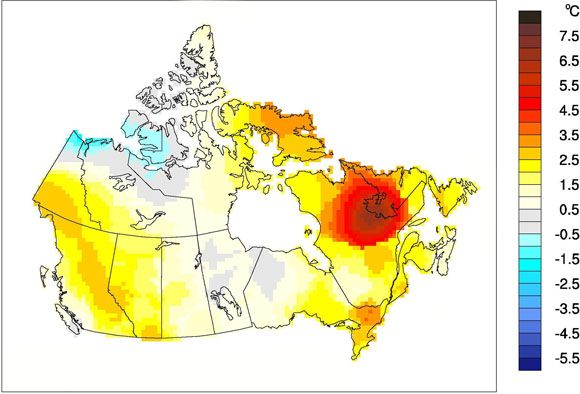
Canada's winter is up 3.2 degrees in 60 years.

CTVB_Winter_2013_temp_map_E_zps51bfb7dc.jpg


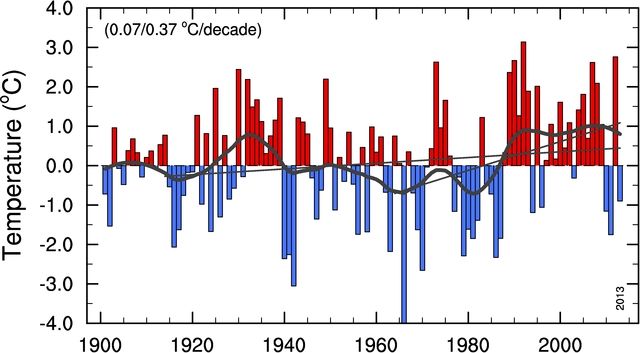
Norway's trend line for winter is up

bar-640px_zps836f0b88.jpg


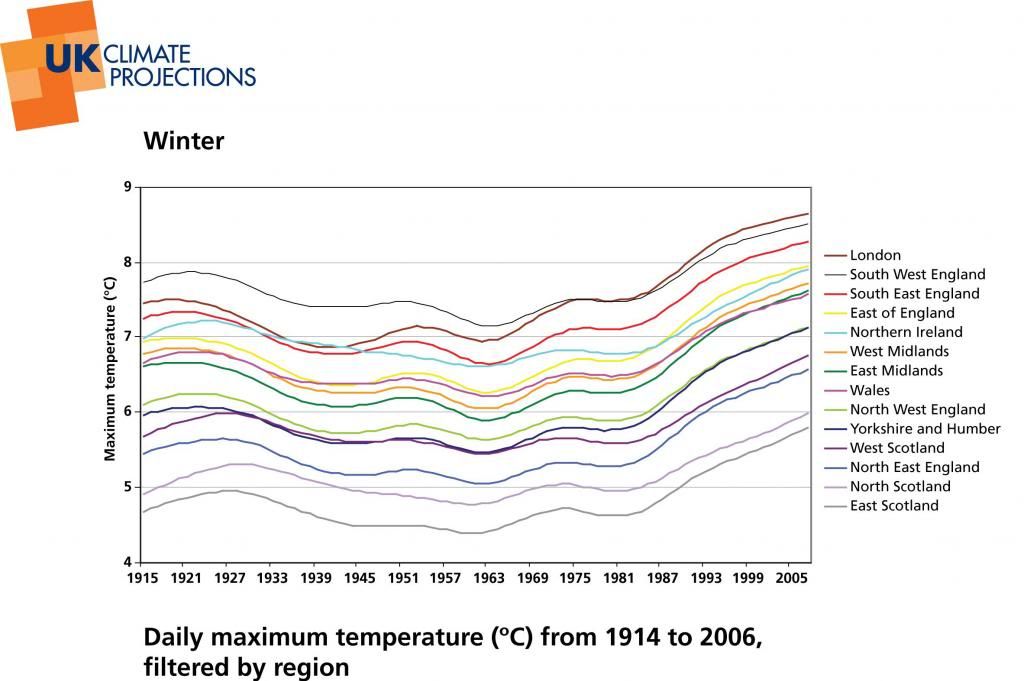
and in Britain

Tmax_winter_large_zpsdc0695d3.jpg


If you wish to discuss why the extremes regionally - that is current and interesting....it does NOT represent a trend to colder NH winters.

It would be equally interesting to discuss why Alaska and Siberia to name two are seeing an hilariously warmer winter while other parts have some historic cold snaps.

THAT is reality....more extremes....

Move on - your thesis of a trend to colder NH winters is wrong and not based on fact.....wishful thinking or inability to interpret data on your part.

It's okay to be wrong....it's pathological to persist with a wrong view in face of evidence contradicting that view.
 
Last edited:
Ok, let's take this slowly.

At most, what we can infer from the graph is that the warming accelerated in the beginning of the 00s, but due to solar forcing and strong repeated La Nina events returned to trend in the 10s. But if it is interesting speculation it is largely irrelevant, because the variations around the trend are noise, and the trend hasn't changed. Add to this the undisturbed trend of the ocean's heat content, and it becomes clear as cristal that warming hasn't stopped.

I disagree. It looks like the warming has stopped.
 
Recapping February

"...a doubling of Katrina magnitude events associated with the warming over the 20th century...The empirical evidence here demonstrates a greatly increased Atlantic hurricane surge threat in a warmer world (Figs. 3 and 4,
and Fig. S1). The escalating threat from cyclone-driven storm surges is further exacerbated by rising sea level (1, 2, 21, 40). Additionally, the observed recent increase in Atlantic coastal wave power (41) is concomitant with these increases in surge index. Finally, we find that ∼0.4 °C global average warming results in a halving of the return period of Katrina magnitude events. This is
less than the warming over the 20th century. Therefore, we have probably crossed the threshold where Katrina magnitude hurricane surges are more likely caused by global warming than not..." - Projected Atlantic hurricane surge threat from rising temperatures -http://www.pnas.org/content/early/2013/03/14/1209980110.full.pdf

IPCC WG1, Climate Change 2013: Basis of Physical Science, was published Feb. 5, 2014 - http://www.ipcc.ch/report/ar5/wg1/

Bacterial Biofuels take a step forward - http://www.eurekalert.org/pub_releases/2014-02/acs-ahi020514.php

Can't forget the AAAS meeting!
Santa's Revenge: The Impacts of Arctic Warming on the Mid-Latitudes
Research Challenges in Climate Change: What’s New and Where Are We Going?

Donald J. Wuebbles, University of Illinois
The U.S. National Climate Assessment: Key Research Challenges in Climate Science

Ben Kirtman, University of Miami

Lessons from IPCC on Key Research Challenges in Climate Science

Michael Wehner, Lawrence Berkeley National Laboratory
Research Challenges Affecting Extreme Events in a Changing Climate

Peter U. Clark, Oregon State University
Research Challenges in Understanding Sea Level Rise

Noah S. Diffenbaugh, Stanford University; Chris Field, Carnegie Institution for Science and Stanford University
Research Challenges in Managed and Natural Ecosystem Responses to Climate Change

Rosina Bierbaum, University of Michigan
Research Challenges for Adaptation and Mitigation of Climate Change

Very early warning of next El Niño -
abstract -
The most important driver of climate variability is the El Niño Southern Oscillation, which can trigger disasters in various parts of the globe. Despite its importance, conventional forecasting is still limited to 6 mo ahead. Recently, we developed an approach based on network analysis, which allows projection of an El Niño event about 1 y ahead. Here we show that our method correctly predicted the absence of El Niño events in 2012 and 2013 and now announce that our approach indicated (in September 2013 already) the return of El Niño in late 2014 with a 3-in-4 likelihood. We also discuss the relevance of the next El Niño to the question of global warming and the present hiatus in the global mean surface temperature.
http://www.pnas.org/content/111/6/2064.abstract

Future Arctic climate changes: Adaptation and mitigation time scales:
"...Arctic sea ice volume has decreased by 75% since the 1980s. Long-lasting global anthropogenic forcing from carbon dioxide has increased over the previous decades and is anticipated to increase over the next decades. Temperature increases in response to greenhouse gases are amplified in the Arctic through feedback processes associated with shifts in albedo, ocean and land heat storage, and near-surface longwave radiation fluxes. Thus, for the next few decades out to 2040, continuing environmental changes in the Arctic are very likely, and the appropriate response is to plan for adaptation to these changes..."
http://onlinelibrary.wiley.com/doi/10.1002/2013EF000162/full
 
I disagree. It looks like the warming has stopped.

Disagreeing does not change the facts. If you can demonstrate valid statistical analyses that support your perceptions, then we would have something to discuss.
 
In regards to this model nonsense, one more try..

"The models predict it will rain in three days, heavy long lasting rain"

A week later, no rain at all. Instead, dry and dusty conditions.

"The models were correct, we just didn't plan on a shift in the wind."

Then how can you say the model was right?

"If the wind hadn't shifted, they would have been right"

But the wind did shift, and they were wrong

"You don't understand how science works. We can't predict exactly when the rain will happen, but we can predict that it will"

Yeah, so what?

"It's like with global warming. There might be natural factors stopping it for now, but it will happen"

Just like it will eventually rain?

"Exactly. Science deals in probabilities, not accuracy"

So, you are just guessing. You don't really know what is going to happen, or when.

"Exactly, But it will be bad."

And you don't hear how that sounds?

"Clearly you hate science"

No, but you on the other hand, I think you are insane!

"Colder winters are a prediction of climate models!"

OMG! Are you kidding me? Seriously? You just said that?

"If you read blogs you would already know this"

Every climate model there is predicts the most warming in winter.

"That can't be true. You are a troll."

That's an absurd position to take. Why don't you try and

"Lalala I can't hear you"

Climate models are easy to research, you can even run one yourself.

"It's not true that climate models predicted warming in winter. I don't believe you."

Why not? Go look it up. The IPCC isn't some mystery.

"You are a denier!"

:rolleyes:

The continued presentation of hyperbolic straw-man fictions does not support your assertions, nor lend any credibility to your apparent confused and distorted understandings of climate science.
 
Some regions are experiencing colder winters. Overall the Northern Hemisphere is not getting colder. Do you agree or not?
You have to define what you mean for the question to have any real meaning.

"Some regions are experiencing colder winters" is meaningless. Cohen et al clearly states, and shows in their papers, what regions have cooled, and by how much, and over what time period. The answers are all in the peer reviewed science. It's not a mystery.

"Overall the Northern Hemisphere is not getting colder" is also meaningless. You have to be specific, when you make statements like that.

When they say "large scale cooling for the boreal winters", it has a specific meaning. Even so they show with diagrams, sources and sound science what they mean by that. This pretense that it isn't true, it's denial of science.

After I first stated the winters were getting harsher, with more snow, I supplied multiple links to scientific sources, and explained why I stated what I did.

For example this post

Nothing about it is hard to read, and it is sourced, and logical.

That's how science works.

As for the entire NH, it's funny because a year ago I said
No, they are not saying the world is cooling, they are saying that the winters have become colder, in the Americas, Europe, China, Russia, that kind of thing. For the entire northern hemisphere to be colder is impossible. It's over the land masses.

And it's theorized that warming is causing the cooling, as in colder winters. Don't live in denial.

However, after doing the math, the entire NH mean, as well as the global mean, may very well be slightly negative since 2001, completely because of the colder winter trend for the NH. That's what the data shows. Which means I was wrong last year. It is possible.

I know, you won't believe it. That's why you should just check for yourself.
 
Last edited:
Status
Not open for further replies.

Back
Top Bottom