Continuation Part 5: Discussion of the Amanda Knox/Raffaele Sollecito case

Status
Not open for further replies.
Only in Italy would they build a house in front of the stage......
.
.
It is even worse than that Danno. They build a house around the stage. Then to release the sound they make a small opening in the house that faces away from the audience. And finally they cover the opening.

Not exactly the theater of Epidaurus!
.
 
Dear Machiavelli,

re:

For the record, has Vogt EVER recanted her story about, "I was there"? Vogt led Seattle readers to believe that Knox had been secretly audiotaped confessing to her mother that she really was back at the cottage.

That's what Vogt reported. Yet when that comment is put into the context of the recording, Knox was saying she had been back at Raffaele's.

It seems the Cassazione too definitely agrees with Vogt, rather than with you. Matteini, Ricciarelli, Micheli and Massei; which means, look: all existing court judgements (Pratillo Hellmann was annulled) happen to agree with Vogt, about what was the obvious meaning of Knox’s statement. Plus Mignini, Comodi, Costagliola and Galati, and all magistrates and judges at Cassazione (and now, likely, Florentine prosecutors) seem to agree with Vogt...

and

.. only an idiot would locate "I was there, I can't lie" in her discussion with her family as "at Raffaele's apartment".
Btw think at the statement "I can't lie". It means her parents were asking her to lie. To lie about what? About being at Sollecito's apartment?

Now, here is the transcript of the call read into the record during the trial:

CDV:I'll just quickly give some details, and I will try to be very brief. In relation with the phone call of Nov 17 2007, from a conversation in prison with your mother, I will read exactly the following text (page 6 and page 7) ...

... on page 6 that you said in that conversation: "Yes, when I was in the room with him, I said something," between parentheses 'laughs', "and then when I went back into the room, I was crying. I was very, very worried about this thing with the knife, because there's a knife from Raffaele's..."

.... Then right after, your mother says: "Here, here are the facts: we talked yesterday with the lawyer, and we asked him about the knife" -- maybe I'll skip this, because this part isn't relevant. Then you say: "It's crap, yes it's crap, total crap, a piece of crap, a total invention. That's what they're doing now. They're just lying." And later, page 8 of the transcript of the conversation, you say "It's all an invention." And you say: "It's stupid. I can't say anything other than the truth, because I know I was there. I can't lie about that. There's no reason to do it."


Now, Machiavelli, you are Italian, and I give you a pass on this. Having worked my way through enough ambiguous pronoun attributions in Google Italian to English translations, I allow you your wrong opinion without judgment.

However, not even an idiot, raised in an english speaking country, would fail to understand the crystal clear meaning of the phrase 'I was there' as used in the passage above.

- if her parents were asking her to lie, they obviously did not do so during this phone call, because the court has the complete transcript and it never came up. By the same obvious reasoning, they did nothing to imply she should lie. We would all know about it if they did.

- what would the preceding phrase 'it's stupid' imply if 'I was there' referred to the cottage? It's stupid to lie? Give me a break! Lying is, according to you, what she does non stop. No, 'It's stupid' clearly continues from 'It's all an invention" which continues from 'It's crap, yes it's crap, total crap, a piece of crap, a total invention. That's what they're doing now. They're just lying.'

Who do you envision 'they' in the phrase 'They're just lying' refers to?.

The obvious and only possible interpretation of this conversation is that Knox is relating to her mother that the police are lying about the knife. The police have 'invented' the evidence. It is stupid, like a stupid trick. She can't say there is some truth to what the police say ( in an attempt to throw the blame on Sollecito) because she knows, she was there (at Sollecito's apartment). She knows the evidence about the knife is just made up, an invention. She cannot tell a lie about that (to blame Sollecito). There is no reason to do it.

Again, Machiavelli, I give you a pass. But what about all the others you mention: Matteini, Ricciarelli, Micheli and Massei - Mignini, Comodi, Costagliola and Galati, and all magistrates and judges at Cassazione (and now, likely, Florentine prosecutors) and of course Vogt.

Are they all morons?

 
Last edited:
Amplified is a better word. Dan doesn't think there are rocks in hills and shares photos of the cottage with a limited view of trees; there are better ones that show hills on all sides, perhaps I can post a better one. Perugia is surrounded by hills make up of calcareous breccias a type of rock.

There are some basic principles in acoustics that proves that Briars needs to go back to school. They are absorption, reflection, refraction and reverberation. These simple principles of sound proves that Nara did not hear Meredith's scream.

The first is absorption. When ever sound encounters a surface even air molecules the sound is absorbed and reflected by that surface. The softer the surface, the more sound is absorbed. Absorption also explains higher frequency sounds do not travel as well as lower frequency sounds. Think of a thunder storm. If the lightning strikes close to you, you hear a loud clap. But if the thunder comes from a distance, it ends up sounding like a low rumble.

Higher frequency sounds have shorter waves and are absorbed more quickly than lower frequency sounds which are longer. In fact, the number one reason why I know that Nara wouldn't have been able to discern Meredith's scream comes from this principle. The cottage walls would have absorbed and filtered all of the high frequency sound out leaving only the lower frequencies of Meredith's scream. Rudy could hear Meredith's scream because he was in the room with Meredith. Nara could not because walls and windows absorbed the vast majority of that screacm.

The second is reflection. Sound travels in straight lines and reflects in the exact same way a billiard ball without spin bounces off the rails of a pool table. It reflects or bounces in a straight line. The vast majority of the sound pressure from Meredith's scream was kept in the bedroom of the cottage. So the sound bounced around the bedroom until it ran out of energy just as a billiard ball bounces off the rails until it comes to a rest. Reflection also explains how you hear an echo. Sound pressure waves bounces off the surface and back at you. Now consider the valley and how sound traveling out that cottage window would move. The sound waves would moving directly out and way from Nara's flat. Now picture the walls of the valley. The edges of the sound waves would reflect the sound away from the cottage and Nara's flat NOT back toward it. Also the short high frequency sound waves are not likely to reach out to the valley walls. Don't believe me Briars? Turn a stereo on and stand directly in front of a speaker and then move off to the sides. As you move to the side you lose the higher range of the music.

Refraction and reverberation. Without these two principles it is unlikely that Nara could have heard ANY of the sound from Meredith's scream. As it is, I'm very confident that if she heard any sound at all, it would have been distorted so much as to sound more like a soft low whisper than a high pitched scream.

Refraction is how sound transmits around a surface. Since sound travels in a straight path from its source, how does it get around corners? You already know that if you and your friend are standing on either side of a wall and there is an open door nearby, you will be able to hear what your friend says. Because you would not hear your friend if the door was closed, sound is not traveling through the wall. Instead, it must be going around the corner and out the door.

You hear your friend because of sound diffraction. Diffraction uses the edges of a barrier as a secondary sound source that sends waves in a new direction.
BTW* notice the very significant difference between talking toward the wall and away from the wall. The amount of diffraction is significantly less.

Reverberation is how sound transmits through an object. Reverberation demonstrates how the sound pressure moves the window pane or the cottage wall.

Heres is a great place to learn about the the physics of sound. http://www.physicsclassroom.com/class/sound/

Then feel free to review these links on acoustics.
http://science.howstuffworks.com/acoustics-channel.htm
http://maji.utsi.edu/courses/08_aer..._and_Applications_of_Acoustics_2e_Raichel.pdf

There are countless others. Read and learn Briars
 
.
It is even worse than that Danno. They build a house around the stage. Then to release the sound they make a small opening in the house that faces away from the audience. And finally they cover the opening.

Not exactly the theater of Epidaurus!
.

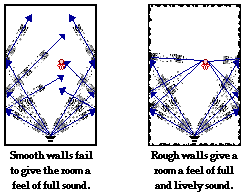
How sound moves
u11l3d1.gif


The cottage actually acts like a bandshell focusing the sound down the valley. Here is a famous band shell in the US. It is the backdrop of the Hollywood Bowl. You can find bandshells that direct sound toward the audience in great concert theaters around the world. They don't put the band shell between themselves and the audience. This is the audio engineering reason why Nara and Monaccia testimony would be terrible to use to pinpoint Meredith's TOD.

File:Hollywood_bowl_and_sign.jpg
 
Last edited:
Dear Machiavelli,

However, not even an idiot, raised in an english speaking country, would fail to understand the crystal clear meaning of the phrase 'I was there' as used in the passage above.

- if her parents were asking her to lie, they obviously did not do so during this phone call, because the court has the complete transcript and it never came up. By the same obvious reasoning, they did nothing to imply she should lie. We would all know about it if they did.

- what would the preceding phrase 'it's stupid' imply if 'I was there' referred to the cottage? It's stupid to lie? Give me a break! Lying is, according to you, what she does non stop. No, 'It's stupid' clearly continues from 'It's all an invention" which continues from 'It's crap, yes it's crap, total crap, a piece of crap, a total invention. That's what they're doing now. They're just lying.'

Who do you envision 'they' in the phrase 'They're just lying' refers to?.

The obvious and only possible interpretation of this conversation is that Knox is relating to her mother that the police are lying about the knife. The police have 'invented' the evidence. It is stupid, like a stupid trick. She can't say there is some truth to what the police say ( in an attempt to throw the blame on Sollecito) because she knows, she was there (at Sollecito's apartment). She knows the evidence about the knife is just made up, an invention. She cannot tell a lie about that (to blame Sollecito). There is no reason to do it.

Again, Machiavelli, I give you a pass. But what about all the others you mention: Matteini, Ricciarelli, Micheli and Massei - Mignini, Comodi, Costagliola and Galati, and all magistrates and judges at Cassazione (and now, likely, Florentine prosecutors) and of course Vogt.

Are they all morons?

Great post moodstream.
 
Machiavelli and other guilters go on about what a noble man mignini is who has been unfairly attacked. I assume that the guilters would be more than happy for Mignini to be the prosecutor if they were accused of a crime. I asked the guilters if they would feel comfortable having mignini as the prosecutor if they were on trial. No one was willing to answer this question. It is strange how people who worship mignini are unwilling to have mignini as a prosecutor if they were on trial.
 
acbytesla said:
moodstream said:
snip
Again, Machiavelli, I give you a pass. But what about all the others you mention: Matteini, Ricciarelli, Micheli and Massei - Mignini, Comodi, Costagliola and Galati, and all magistrates and judges at Cassazione (and now, likely, Florentine prosecutors) and of course Vogt.

Are they all morons?
Great post moodstream.
Well except that, contrary to Mach's claim, it does not appear that all or any of these judges (apart from Riciarelli) swallowed the 'I was there' thing. Bill quoted Massei and showed that he made no finding that it meant she was there and I can't find it (so far) in the ISC ruling. I have also looked in Hellman, but only in the sections on calunnia and behaviour after the murder, and not found any reference there either. I have even tried to find reference to the point in the Galati appeal, again without success.

It therefore seems to be false for Mach to say in post 11020

Machiavelli said:
It seems the Cassazione too defintely agrees with Vogt, rather than with you. Matteini, Ricciarelli, Micheli and Massei; which means, look: all existing court judgements (Pratillo Hellmann was annulled) happen to agree with Vogt, about what was the obvious meaning of Knox’s statement. Plus Mignini, Comodi, Costagliola and Galati, and all magistrates and judges at Cassazione (and now, likely, Florentine prosecutors) seem to agree qith Vogt, about what the “larger context” was.

Everybody at alll courts agreed with Vogt; everybody (except the defence) thought that there was absolutely no "plain" context where the meaning of Knox's statement was "at Raffaele's" .
The point seems never to have been before Matteini. Riciarelli is conceded. Micheli (?) chucked it out at prelim (according to Amanda's book), Massei mentioned it in passing without offering an opinion that she was placing herself at the scene, Hellman-Zanetti is silent, Galati makes nothing of it and nor does Cassazione. Things could not be more different than your claim in the quoted extract above, which you used to buttress the claim that everybody understands what she said in the same way and that Vogt's reporting is in line with this view. On the contrary, even those who think or found her guilty appear to agree the point is of no consequence.

You described Vogt as a journalist. Surely her job is to report, not distort. She seems either to be a bad journalist on this particular point or worse.

ETA an article concerning Andrea Vogt by Bruce Fischer has just appeared at Ground Report. It concludes:

In my opinion, from this point forward, Andrea Vogt should be viewed as nothing more than an anti-Amanda Knox blogger when it comes to her reporting on the Meredith Kercher case.
 
Last edited:
Well except that, contrary to Mach's claim, it does not appear that all or any of these judges (apart from Riciarelli) swallowed the 'I was there' thing. Bill quoted Massei and showed that he made no finding that it meant she was there and I can't find it (so far) in the ISC ruling. I have also looked in Hellman, but only in the sections on calunnia and behaviour after the murder, and not found any reference there either. I have even tried to find reference to the point in the Galati appeal, again without success.

It therefore seems to be false for Mach to say in post 11020


The point seems never to have been before Matteini. Riciarelli is conceded. Micheli (?) chucked it out at prelim (according to Amanda's book), Massei mentioned it in passing without offering an opinion that she was placing herself at the scene, Hellman-Zanetti is silent, Galati makes nothing of it and nor does Cassazione. Things could not be more different than your claim in the quoted extract above, which you used to buttress the claim that everybody understands what she said in the same way and that Vogt's reporting is in line with this view. On the contrary, even those who think or found her guilty appear to agree the point is of no consequence.

You described Vogt as a journalist. Surely her job is to report, not distort. She seems either to be a bad journalist on this particular point or worse.

ETA an article concerning Andrea Vogt by Bruce Fischer has just appeared at Ground Report. It concludes:


What? Mach would never obfuscate the facts. That's just not him anglo. :rolleyes:
 
What? Mach would never obfuscate the facts. That's just not him anglo. :rolleyes:

No, I am sure he would not. One last point on this, because Mach stressed the 'I cannot lie' part. Raffaele explains the context in Honor Bound at location 1372:

The context for the line was Amanda's exasperation that she was being asked to change her story and concede that she wasn't with me on Corso Garibaldi on the night of the murder. So the word there did not refer to Via Della Pergola at all, but my flat.

He makes the good point that Edda made no reaction to what would otherwise have been a stunning revelation. This gives the PGPs a problem which they have solved by attributing guilty knowledge to Edda.

The truth of the matter is revealed by Mach himself upthread :

Machiavelli said:
The discussion with her mother was an argumet from the preliminary hearing, and was used by Mignini to keep Knox under cautionary custody. That was the original purpose of the piece of evidence. It is a pice of evidence with an inherent lower standard. But it is a pice of evidence nonetheless.

If it were really a piece of evidence it would be devastating to the defence. It would not be evidence 'with an inherent lower standard' at all. It would be an unguarded, free admission of presence at the scene of the crime and would have been trumpeted all the way to the ISC. Instead, it was cynically used to keep her in custody, just like other spurious evidence was placed before Matteini for the same purpose.
 
Last edited:
The point seems never to have been before Matteini. Riciarelli is conceded. Micheli (?) chucked it out at prelim (according to Amanda's book), Massei mentioned it in passing without offering an opinion that she was placing herself at the scene, Hellman-Zanetti is silent, Galati makes nothing of it and nor does Cassazione. Things could not be more different than your claim in the quoted extract above, which you used to buttress the claim that everybody understands what she said in the same way and that Vogt's reporting is in line with this view. On the contrary, even those who think or found her guilty appear to agree the point is of no consequence.

I concede you ar right about Matteini. The conversation had not taken place yet at the time.
But you are wrong about both Micheli and Cassazione. Partly wrong about Micheli, because even if you consider it "chucked out", in fact that was an argument at the trial discussion, it was also in the prosecution closing arguments. And that weight definitely justifies a journalist report. But the argument is also in Cassazione; albeit the Cassazione does not quote the phrase "I was there", they point out the importance of the conversation in general and urge the judges to consider it.


You described Vogt as a journalist. Surely her job is to report, not distort. She seems either to be a bad journalist on this particular point or worse.

I instead appreciate her, and also on this particular point. I think she was good in pointing out even the "I was there" statement as a piece of evidence, I think she made a thorough work, because I think the conversatin indeed is an existing element among the pices of circumsntantial evidence, and even about the "I was there statement", despite defence claims such piece of evidence exists. Moreover, I point out that the intercepted conversations contained even heavvier elements, which Vogt left out from the report: the stateent by Knox where she says she is worried by the knife (it is not reasonable to assume as likely the alternative phrase proposed by the defence, where "knife" becomes "night"). There is also her expressing a feling of guilt for Lumumba (of which the Cassazione correctly points out the implication).
But overall, Vogt left out a long series of pieces of evidence from her reports; she was in no way "unfavorable" in her balance of information. Actually, the truel evidentiary situation of Knox within the trial was even heavier than what Vogt conveyed.
 
How sound moves
[qimg]http://www.physicsclassroom.com/class/sound/u11l3d1.gif[/qimg]

The cottage actually acts like a bandshell focusing the sound down the valley. Here is a famous band shell in the US. It is the backdrop of the Hollywood Bowl. You can find bandshells that direct sound toward the audience in great concert theaters around the world. They don't put the band shell between themselves and the audience. This is the audio engineering reason why Nara and Monaccia testimony would be terrible to use to pinpoint Meredith's TOD.

[qimg]http://en.wikipedia.org/wiki/File:Hollywood_bowl_and_sign.jpg[/qimg]


The air is crisp and clear, all is quiet except for the occasional sound of the burner disturbing the perfect serenity that surrounds you. You float majestically somewhere between the trees and heaven watching life drift slowly past below. You take it all in, and think just how perfect this day has become and how awesome this experience is and wonder why you didn't do this sooner.
Balloons Over the Rainbow balloons ready to take off in the St. Louis area
 
I concede you ar right about Matteini. The conversation had not taken place yet at the time.
But you are wrong about both Micheli and Cassazione. Partly wrong about Micheli, because even if you consider it "chucked out", in fact that was an argument at the trial discussion, it was also in the prosecution closing arguments. And that weight definitely justifies a journalist report. But the argument is also in Cassazione; albeit the Cassazione does not quote the phrase "I was there", they point out the importance of the conversation in general and urge the judges to consider it.
So when you said to me: 'you're kidding' you now accept that I was not kidding and that Cassazione also does not major on the 'I was there' part of the conversation.


I instead appreciate her, and also on this particular point. I think she was good in pointing out even the "I was there" statement as a piece of evidence, I think she made a thorough work, because I think the conversatin indeed is an existing element among the pices of circumsntantial evidence, and even about the "I was there statement", despite defence claims such piece of evidence exists.
But this is weird Mach, with respect. It's like the lamp the PGPs go on about (without any of them understanding it). This 'piece of evidence' is a phantom. It played no part in the conviction and consequently none in the successful appeal and Galati made nothing of it either. How can it be a piece of anything?


Moreover, I point out that the intercepted conversations contained even heavvier elements, which Vogt left out from the report: the stateent by Knox where she says she is worried by the knife (it is not reasonable to assume as likely the alternative phrase proposed by the defence, where "knife" becomes "night"). There is also her expressing a feling of guilt for Lumumba (of which the Cassazione correctly points out the implication).
I accept this but it's not what we are talking about. We are focused on the 'I was there' statement and Vogt's use of it. The argument on 'our' side is that a reputable journalist who had followed the case as closely as she has could not properly refer to that quote in a professional and balanced way without mentioning that it was not regarded by the court as probative.

The interesting thing about it, to me, now that I have Raffaele's explanation of the context (which I accept) is who was leaning on her to withdraw his alibi?

But overall, Vogt left out a long series of pieces of evidence from her reports; she was in no way "unfavorable" in her balance of information. Actually, the truel evidentiary situation of Knox within the trial was even heavier than what Vogt conveyed.
Others can take up the cudgels on this. I am not a follower of the media coverage, nor of any of the journos from either side.
 
Machiavelli and other guilters go on about what a noble man mignini is who has been unfairly attacked. I assume that the guilters would be more than happy for Mignini to be the prosecutor if they were accused of a crime. I asked the guilters if they would feel comfortable having mignini as the prosecutor if they were on trial. No one was willing to answer this question. It is strange how people who worship mignini are unwilling to have mignini as a prosecutor if they were on trial.


You silly person, Your question is illogical to them because they themselves would never be on trial. In their world view, trials are for criminals.
 
Well except that, contrary to Mach's claim, it does not appear that all or any of these judges (apart from Riciarelli) swallowed the 'I was there' thing. Bill quoted Massei and showed that he made no finding that it meant she was there and I can't find it (so far) in the ISC ruling.


Haven't you learned anything about the Italian justice system? You are looking at the wrong ISC ruling. They delt with the 'i was there' statement while confirming Rudy's conviction. It's already an established legal fact before Hellmann improperly ignores it.
 
Haven't you learned anything about the Italian justice system? You are looking at the wrong ISC ruling. They delt with the 'i was there' statement while confirming Rudy's conviction. It's already an established legal fact before Hellmann improperly ignores it.

Got a cite?
 
Dear Machiavelli,

- if her parents were asking her to lie, they obviously did not do so during this phone call, because the court has the complete transcript and it never came up. By the same obvious reasoning, they did nothing to imply she should lie. We would all know about it if they did.

- what would the preceding phrase 'it's stupid' imply if 'I was there' referred to the cottage? It's stupid to lie? Give me a break! Lying is, according to you, what she does non stop. No, 'It's stupid' clearly continues from 'It's all an invention" which continues from 'It's crap, yes it's crap, total crap, a piece of crap, a total invention. That's what they're doing now. They're just lying.'

(..)

In the semantics of the conversation, clearly Knox is contending with someone. There are basically two possibilities, about who is the second referent (or "actant"). Either she is contending with her parents about a version her lawyers suggested her (lawyers suggested her to not lie about the fact that she was at the cottage, and she tells this to her mother that there is no reason why she should lie - but the mother disagrees), or she is contending not against a person present there but against a theory which the police (or prosecution) is suggesting (she puts forward her argument against the police theory: there is no reason why I should lie).

In the first case, her parents are asking her to lie; in the second scenario, the phrase "I have no reason to lie" is merely emphatic, she wants her parents to believe her and puts forward an argument for that.

I bear in mind that Knox comes from a hearing before a judge (Matteini) where she decided to remain silent (she refused to answer questions, she refused to make statements; so she stuck to her ambiguous hand written notes) and she is elaborating the strategy about the defensive line she needs to keep at a coming interrogation by the public minister.
Indeed, the question about what her version could be is not stupid at all. She could be thinking of putting forward a recollection where she was at the cottage but she is innocent, something similar to her 05:45 spontaneous statement (I'm sure her lawyers suggested that was the best strategy). It might be indeed stupid to lie if she actually was at the cottage, which is what her lawyers believed.
But let's say that her parents said: no! And in order to convince her, they suggested that the police was lying, that their evidence fas false. Curt and Edda Knox wanted a hard line, because they agreed to that strategy under suggestion of a PR firma. The conversation betwen Knox and hr mother might be about this. I don't think this is stupid at all. Also because this resembles to what Sollecito's parents did with Raffaele: his father pressured him to keep some defensive line rather an another.
 
Last edited:
The air is crisp and clear, all is quiet except for the occasional sound of the burner disturbing the perfect serenity that surrounds you. You float majestically somewhere between the trees and heaven watching life drift slowly past below. You take it all in, and think just how perfect this day has become and how awesome this experience is and wonder why you didn't do this sooner.
Balloons Over the Rainbow balloons ready to take off in the St. Louis area

Well the air is all you have going for you. Sound does move better through dry air than moist air. But I was under the impression by so many of the guilters that it was raining that night. That would mean the air was moist. After all I've read countless remarks even by you that the ground was muddy and if Rudy climbed the wall he would have transferred mud to the wall. Which is it? Was it overcast and the air moist? Or was it cold crisp and dry?

I notice you didn't acknowledge any of the properties of sound I described to you. First, are you still of the belief that sound directed down the valley would ever reflect back?

Second how do you respond explain Nara originally said it may have been a tire squeal? I think it would be fair to say that anything that could be possibly be described as a squeal would be a high pitched or high frequency sound. ANY SCREAM FROM INSIDE A BOX IS NOT going to be high pitched outside the box. Put a flute concerto on your stereo and walk outside. It's not going to sound at all like a flute. At best it would sound like a muffled bass trombone.

I've offered you many different experiments as well as links that clearly demonstrate that the SCIENCE of acoustics shows that NARA couldn't have heard a high pitched scream from inside the cottage.

So Briars, I'm curious, do you think that evolution and global warming are also myths? Or can you learn?
 
But this is weird Mach, with respect. It's like the lamp the PGPs go on about (without any of them understanding it). This 'piece of evidence' is a phantom. It played no part in the conviction and consequently none in the successful appeal and Galati made nothing of it either. How can it be a piece of anything?

The lamp absolutely is a piece of evidence. You might consider it a phantom, the way Marx called Communism a phantom, but it exists in the trial papers and was never explicilty disproven. The assessment that it played no part in a conviction might well be wrong, but anyway it is misleading. The avsence of a pice of evidence from a report is not evidence of its absence.

I accept this but it's not what we are talking about. We are focused on the 'I was there' statement and Vogt's use of it. The argument on 'our' side is that a reputable journalist who had followed the case as closely as she has could not properly refer to that quote in a professional and balanced way without mentioning that it was not regarded by the court as probative.

But I find this kind of criticism hypocrite and unbalanced at the utmost. You should consider that Vogt left out a metric ton of details which are unfavourable to Knox and put them into the equation. The you should also consider the crazy, gotesque pro-Knox campaign played by English-speaking mainstream media, instead of providing actual information. And you should put this into the equation. You can't just judge Andrea Vogt picking up an isolated "assessment" about a detail (she did not give two sides of this detail) while you are on a standing point of acceptance of a media coma, you never complained about it. You can't enter a living room walking out of a marsh, and complain that a corner of the carpet is not properly polished. While are sullying everything, while you are splashing into mud, you are not in the position for pointing the fingers against imperefctions of clean things. Intellectual dishonesty consists exactly in this.
 
Last edited:
For the sake of truth, as it was already proven more than once on forums, Italy is not the champion of human right abuse in Western Europe. We know that Italy has a problem with lengh of proceedings. More than other countries in Westarn Europe. But doesn't have more problems with human rights abuse than the average Western European countries at all, by its courts.

No, that hasn't been shown in these foruns. What people tried to do was to minimise the importance of the right to speedy trial. But the reality is that this a very important human right and an actual violation of Article 6 of the European Convention on Numan Rights, the right to a fair trial.

Italy is the worst offender in western europe, and the italian courts know it but chose to ignore it.

So please don't try to sweep it under the carpet.
 
Status
Not open for further replies.

Back
Top Bottom