Newtons Bit
Penultimate Amazing

- Joined
- Apr 12, 2007
- Messages
- 10,049
You have no idea what that quote means. (hence the smile)
I know, right? "truthers" have "ah hah!" moments based on complete ignorance of the topic.

You have no idea what that quote means. (hence the smile)

Why would I? Bask in your "victory".You're welcome to explain it for me, DGM.


Why would I? Bask in your "victory".
You might want to stop "explaining".I don't believe NIST's scenario talks about failing core columns. Does it?
And you're aware that Usmani et al don't talk about a pull-in force?


The explanation is still valid despite those two issues.I don't believe NIST's scenario talks about failing core columns. Does it?
And you're aware that Usmani et al don't talk about a pull-in force?
I've posted the simple "Column Inwards Bowing For Dummies" version several times.You might want to stop "explaining".
The explanation is still valid despite those two issues.
The more important complication is that the recent discussions in this thread have focused on a simplified one column one truss model. That does not meet the OP challenge which was clearly a "full WTC actual collapse" setting involving failure of multiple columns and trusses.
The one column/one truss model is orders of magnitude simpler to analyse than the full setting of the actual cascade failure. And the isolated single column will fail easier that the same single column would fail if it was joined to its neighbours in the whole of wall real collapse. (How big the difference would be is difficult - maybe impossible to say. One big factor would be temperature variance along the building.)
Valid to whom? It's not NIST's model.
Yes, and I understand that NIST used random and hypothesized truss disconnections, not core column failure, to get the sag they needed on the remaining pull-in trusses. So of what relevance is Newton's explanation?
A) Valid for anyone interested in what actually happened with inwards bowing.Valid to whom? It's not NIST's model.
I'm explaining what happend - not defending NIST....Yes, and I understand that NIST used random and hypothesized truss disconnections, not core column failure, to get the sag they needed on the remaining pull-in trusses.
Newton's (and enik's) explanation is a valid explanation of the main part of the mechanism viz a one truss one column simplified model. It doesn't lose validity if we take out the specific initiator of core column movement the key points are that:So of what relevance is Newton's explanation?
In this post, which you linked to, the primary pull-in force you are describing is from the downward displacement of a severed core column.
Newton's Bit, could you state, in your own words, what you think your explanation is?
You can't even get the source of the pull-in force right, much less figure out the details of what the pull-in force is actually doing. But go ahead and try to teach me how to do structural engineering.In this post, which you linked to, the primary pull-in force you are describing is from the downward displacement of a severed core column.
Sure, ergo.
The exterior columns failed through a combination of heat, loss of lateral support and a small pull-in force. The pull-in force could have been from core displacement or tension developed from the floor trusses in catenary action or some combination of the two.
Now, compare that with your explanation of my analysis:
You can't even get the source of the pull-in force right, much less figure out the details of what the pull-in force is actually doing. But go ahead and try to teach me how to do structural engineering.

I just want the casual reader to understand this.

Really? You show all that in your single post? Wow.
You realize, I hope, that this is all just hypothetical and that NIST does not identify core column displacement as the cause of the truss sag. So as an academic exercise I'm not sure why this is even in the 9/11 subforum. But hey, have fun.
You told me to look at the "pictures". Your "pictures" describe a pull-in force occurring from downward displacement of a severed column.
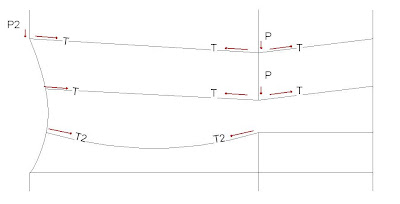
Moreover, as I've pointed out before, that post seems to want to give the impression that you're explaining the NIST WTC failure model, which you're not. I just want the casual reader to understand this. Do you agree?
That would be me I guess.
No matter what the result of this discussion is between you, ozeco and Newtons Bit is, I am 100% confident, even as a casual reader, that I know what didn't happen to WTC 7.
No explosives, no nano termites.
1) Damage from the attack started
2) Fire and that fire was never fought. First time that's ever happened. And because of it,
3) Damage and fire took down WTC7. Took like 7 hours. It was a long, long process.
For the record, this is about WTC1&2. Though a few people do keep trying to shift it to WTC7 or to the NIST reports (which is not the topic of this thread either).

Correct on "No CD" but it is not the topic. The thread is about a challenge to prove some engineering aspects of WTC1/WTC2 collapse. Ergo keeps trying to derail the thread.I just want the casual reader to understand this.
That would be me I guess.
No matter what the result of this discussion is between you, ozeco and Newtons Bit is, I am 100% confident, even as a casual reader, that I know what didn't happen to WTC 7.
No explosives, no nano termites.
Correct and both Newton and ozeco have "called" ergo for the attempted derails and off topic nonsense....NIST's explanation is quite irrelevant to this thread. Stop trying to lurch off-topic...
Correct. Newton has several times shown the maths and I have repeatedly outlined the principles involved....I never claimed to be explaining the NIST model. All I did was show the math behind why the exterior columns would bow as much as they did....
Agreed as this comment relates to ergo...however for NoahFence's benefit my recent post may help - I called it the "Column Inwards Bowing For Dummies" version and it is in post #267....Anyways, you've exhausted my quota of "explain easy things to stubborn ignorant people" for the month. Back on ignore you go.
Correct. It is the specific inwards bowing mechanism observed for WTC1 - mostly analysed by means of a simplified model.For the record, this is about WTC1&2. Though a few people do keep trying to shift it to WTC7 or to the NIST reports (which is not the topic of this thread either).
Understood and agreed. However just sort the arguments into ones which deal with the topic - and those ones have been well answered already - and those which are derail or evasion attempts which don't need to be answered in this thread.my bad...
Sometimes its hard to tell because the arguments are nearly the same.