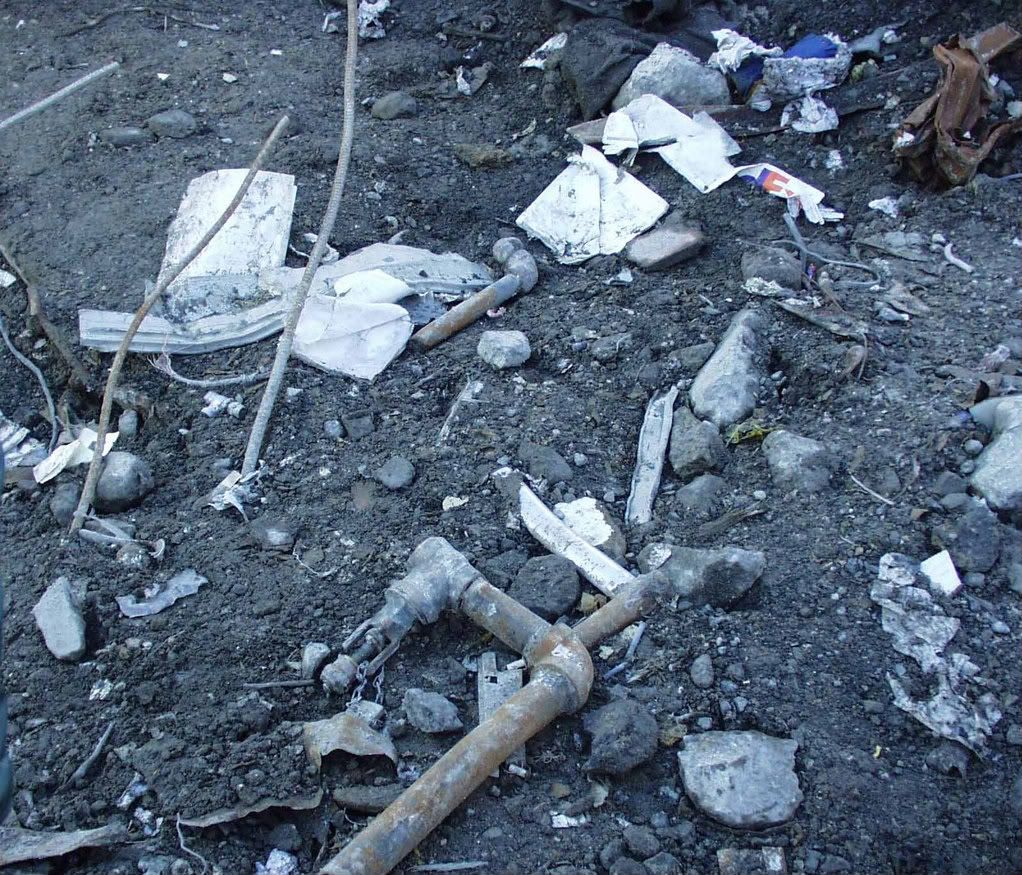
I agree with you on this, most of the bodies remained in the towers until the collapse. And when that firs floor collapsed, there was not much air pressure, since windows and walls were blown out and collapse speed started from 0. So there is no force ejecting these people anywhere.
Let us do a quick calculation on a simple model:
Let us assume that the first floor to collapse did so by coming down vertically, at 0.7g, until it hit the floor below.
Each story was 12 feet high. Subtracting 4 inches for the thickness of the concrete slabs plus a bit for ceilings, floor covers, office contents, that will work out to a drop distance of 3.5 meters (being European, I prefer metric).
0.7g is 6.8635 m/s
2
Velocity after moving s=3.5 m at a=6.8635 m/s
2, from rest, is
v(3.5 m) = SQRT(2*a*s) = 6,93 m/s.
And this took
t(3.5 m) = SQRT(2*s/a) = 1,01 s.
Let's make that 1 s even

The story, from floor to metal deck, has an volume of 63*63*3.5 meters filled mostly with air and movable objects. That's 13,891.5 m
3 of air, which get blown mostly out the windows (some can escape up and down the core shafts, giving rise to pressure pulses in other stories). Window openings are 2/3 of the width of the facades (column width is close to 1/3 column distance center to center) - 63*4*2/3 = 168 meters - and 2,34 meters high (vertical distance between spandrels), so air can escape through a maximum of 393.12 m
2 of openings.
Of course, openings get smaller as the floor collapses - from 393.12 m
2 to 0. I'll ignore that effect for the moment.
So 13,891.5 m
3 of air are escaping through 393.12 m
2 of openings within 1 s of time - that should work out to an
average air speed of over 35 m/s = 127 km/s = 79.5 mph (just divide the two numbers).
This is ignoring that openings get smaller as the floor collapses. Near the end of that second, with collapse velocity the highest and openings the smallest, nozzle velocities will be MUCH higher than that.
Starting from a height of ca. 300 meter (South Tower; North Tower higher), objects of suitable size should be able to travel some distance when blown out with such high winds.
On the second floor and all that follow, air will escape a
lot faster (although more victims from the plane crashes were probably above the first collapsed floor than below - a bit more tricky to assess collapse velocity of the floors above relative to the collapses zone where floors are piling up).
ETA:
We need:
mechanism for some 1300 people to be turned to small pieces
We need two mechanisms for the dismemberment of people: One that accounts for body parts that were ejected during the collapse. You already agreed that the plane crashes can easily account for more than 100 victims being shred to suitable pieces. And another that accounts for those bodies not identified at all. That one is easy, too: They all fell from a hieght of 300 or higher, and had an average of 10-12 floors collapsing down on them, in a chaotic avalanche of 300,000 tons of steel and concrete per tower. And then their remains were subjected to weeks and months of fires, then rain, possibly episodes of acidic considtions etc., all of which degrade body tissue to an extent that can make it unrecognizable or unidentifyable.
mechanism for tiny human piece to fly 100-200m after being first blasted into tiny pieces.
You seriously underestimate air pressure and air speeds as floors 63x63 meters wide collapse. See above.
We have two. You incorrect one, and the reality I just described.