WTC7 - The fires failed Girder 44-79

"The Journal of 9/11 Studies" has published this article by Ronald H. Brookman, structural engineer (P.E. in California) and board member of AE911Truth:

A Discussion of "Analysis of Structural Response of WTC 7 to Fire and Sequential Failures Leading to Collapse" Therese P. McAllister, Robert MacNeill, Omer Erbay, Andrew Sarawit, Mehdi Zarghamee, Steven Kirkpatrick and John Gross. Journal of Structural Engineering, January 2012, Vol. 138, No. 1

The autors of the paper he discusses are members of the NIST team that prepared the report on WTC7.

I speculate that Brookman may have tried to publish this piece at the Journal of Structural Engineering itself, but was rejected, so he went to the (lightly less strictly peer-reviewed :p) JoNES of Kevin Ryan.


I think his main points have been debated at length in this thread. They are:
  1. NIST did not include a revision of the design drawing that show shear studs on the critical girder, and instead assumed there were none
  2. Axial walk-off was not possible
  3. NIST cited a wrong lenth for the bearing plate; this problem is not voided by the FAQ addendum that explains a typographical error
  4. NIST model does not account for presence of web-flange stiffeners
  5. NFPA 921 Guidelines weren't followed - apparently by including speculation not based on observation.


Googling for
Code:
link:http://www.journalof911studies.com/resources/Brookman-Vol-33-Oct2012.pdf
gives no results - apparently, Brookman's Discussion hasn't really gone viral yet :D
 
The third page of this discussion states the following:
revision_I_sentence.png


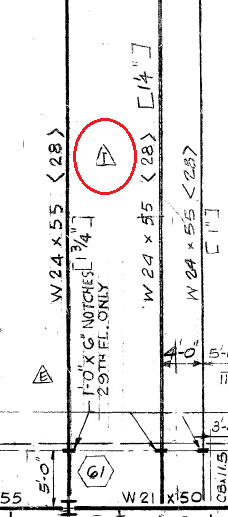
This above statement is completely false. Following is the revision triangle "I" that I had found on drawing S-8. It resides to the immediate right of the beam connecting columns 54 and 61:
revisionI.png


Along with the revision "I" shown above revision "H" in the title block. It is very light and cannot be seen, but there is definitely something there. The whole drawing is full of "faded" or "light" lines and text.
revision_I.png


gerrycan had made this claim to me of the missing revision "I" on S-8 numerous times, and when I showed him the above, he never responded.
 
Furthermore, the Cantor drawing S-8 was a typical floor drawing for floors 8 through 20 and floors 24 through 45.

Drawings S-8-10, S-8-19, and S-8-20 were duplicated FROM drawing S-8 above because of the variations on these particular floors (10, 19, 20) that differed from the typical S-8 drawing, hence the revisions ON these drawings.

Revisions letters are not exclusive to an entire drawing series, but are exclusive to certain drawings, and are sequential. For example, I can have revision "I" on drawing 1 referring to a dimension change, and have a revision "I" on drawing 47 referring to a plate to be welded to the underside of a beam.

Once you use a revision letter on a drawing, it does not exclude from being used to refer to a change ever again in that project "book" of blueprints.
 
Thanks, Gamolon.

To further my understanding, a couple of questions:

a. Does the revision letter refer to only a single change somewhere on the drawing? In other words, if I find in the title block an explanartion "/I\ 9-9-85 revised as circled", would I find exactly one "I", or possibly several?

b. What is "completely false" in that "above statement" - only that the NIST FOIA didn't include Revision "I", or also that Revision "I" "clearly shows 30 shear studs"?
 
Last edited:
Furthermore, the Cantor drawing S-8 was a typical floor drawing for floors 8 through 20 and floors 24 through 45.

Drawings S-8-10, S-8-19, and S-8-20 were duplicated FROM drawing S-8 above because of the variations on these particular floors (10, 19, 20) that differed from the typical S-8 drawing, hence the revisions ON these drawings.

Revisions letters are not exclusive to an entire drawing series, but are exclusive to certain drawings, and are sequential. For example, I can have revision "I" on drawing 1 referring to a dimension change, and have a revision "I" on drawing 47 referring to a plate to be welded to the underside of a beam.

Once you use a revision letter on a drawing, it does not exclude from being used to refer to a change ever again in that project "book" of blueprints.

This depends on the project manager's preference. I've done sheet revisions as numbers unique to that sheet, and I've done them as numbers used sequentially through the entire project.

Also: the construction documents for WTC7 aren't blueprints.
 
This depends on the project manager's preference. I've done sheet revisions as numbers unique to that sheet, and I've done them as numbers used sequentially through the entire project.

Also: the construction documents for WTC7 aren't blueprints.

In the case of the WTC7 project, it is clear revisions letters were used per sheet. I had never been on a project that used a revision letter or number through an entire project and was exclusive to that revision. But that was some time ago...

:D

I use the word "blueprints" as a generic term for all drawings. A habit I picked up from the "old dogs" I used to work with. Everything was blueprints to them.
 
Thanks, Gamolon.

To further my understanding, a couple of questions:

a. Does the revision letter refer to only a single change somewhere on the drawing? In other words, if I find in the title block an explanartion "/I\ 9-9-85 revised as circled", would I find exactly one "I", or possibly several?

b. What is "completely false" in that "above statement" - only that the NIST FOIA didn't include Revision "I", or also that Revision "I" "clearly shows 30 shear studs"?

See also Newton's Bit's reply regarding the use of revision letters or numbers and how they were used at the discretion of the project manager. I can only speak about what my experiences were.

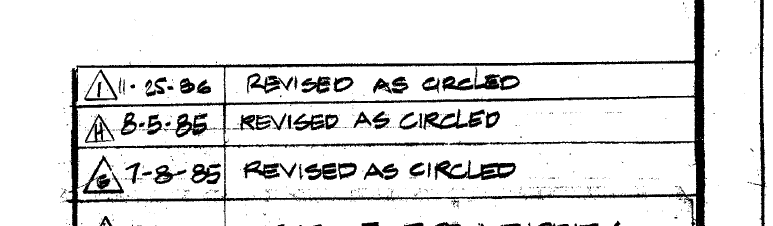
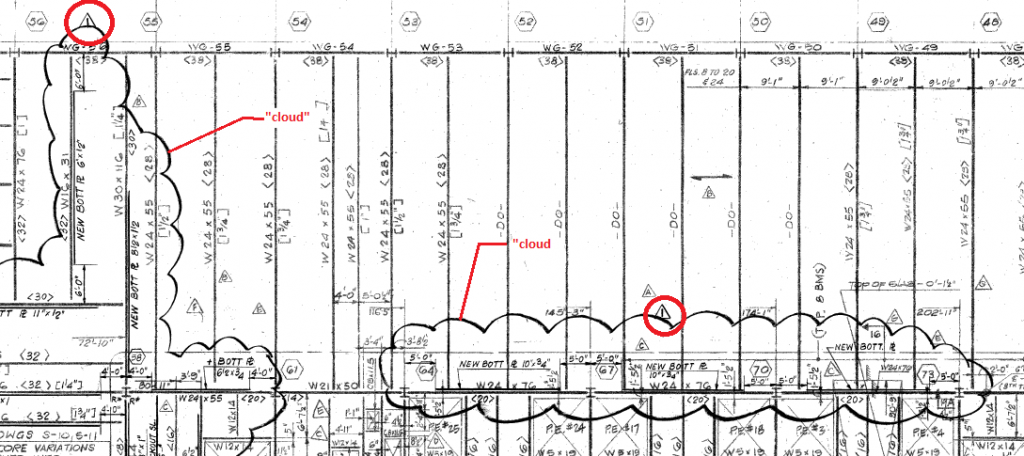
a. It depends on the revision. If the revision impacted several different areas on one drawing, each area would have a "cloud" (I used grease pencils in my early days before I designed things in AutoCAD to circle the revised area) around it with the revision "triangle" touching each cloud. The first image is of revision "I" in the title block of drawing S-8-10:
revisionexample1.png


Here is a view of two of the actual "clouded" revision referred to in the title block shown above (also on drawing S-8-10). Notice that the "clouds" are separate areas:
revisionexample.png


b. I am simply stating that the claim that drawing S-8 does NOT include a revision "I" is false. There is a revision "I", but it cannot be seen what that is in the title block, possibly due to a scanning imperfection or the text may have been done too lightly to show up in the scan. Who knows? Maybe it was erased from the title block altogether. The only way to see what the actual description of revision "I" was would be to get the original. From what I can tell, revision "I" had to do with something in the area of the beam between column 54 and 61. Since drawing S-8 was typical for floors 8 through 20 and floors 24 through 45, that revision would be applied to all those floors in that area.

As stated drawings S-8-10, 19, and 20, look to be COPIES of drawing S-8 and used to make changes (revisions) for those particular floors that differed from the typical drawing S-8 structure. The example images above ALSO refers to a revision "I", but only on drawing S-8-10 and looks to show the addition of plates welded to the bottoms of certain beams. Floor 10 was to be designed as shown on drawing S-8, BUT, with the addition of the plates shown on S-8-10.
 
Something else to take into account. Some truthers take Salvarinas' document as gospel regarding what was there. To further their point that shear studs were on the beam in question.

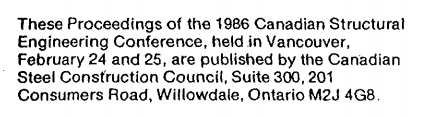
The problem with that is the following. Here is an image taken at the end of the paper:
salvarinasdocument.png


The document was written for the Canadian Structural Engineering Conference held February 24th and 25th of 1986. That means it was written BEFORE that date.

Some of the photos shown in his document have dates within the photo as being taken in October and November of 1985.

Revision "I" shown on drawing S-8-10 in my previous post is dated November 25th, 1986, 9 months (maybe more) AFTER that document was written. How many revisions took place in the time AFTER that document was published? How can it be taken as proof to what was there when it was published WAY before the construction was even completed and there is proof to changes made to the structural drawings AFTER it was supposedly written?

That's just one of the questions I have asked when people throw this document up as proof and have never gotten an answer.
 
Excellent, Gamolon, thanks

My pleasure.

:)

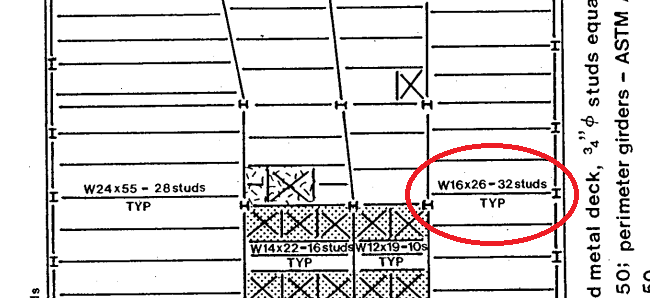
Here's more. Below is Salvarinas' drawing showing shear studs on the W16x26 beams that was included in his 1986 paper. Notice he calls out 32 studs as being typical for all the W16x26 beams:
salvarinasstuds.png


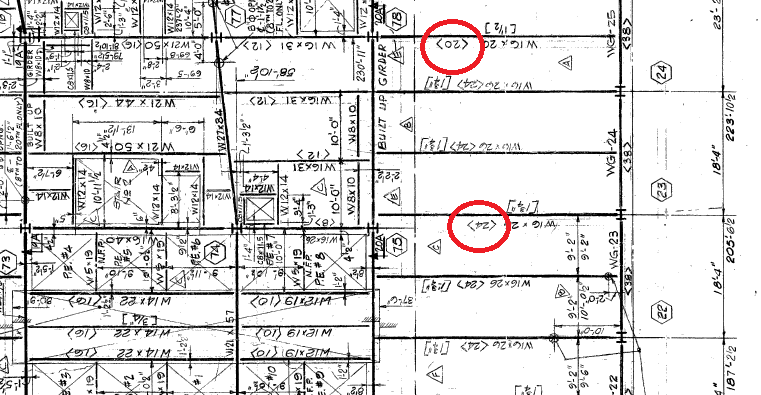
But wait... The typical floor drawing S-8 shows something different! The drawing calls out <24> or <20> shear studs (in the red ovals)as being typical for all the floors, not 32:
salvarinasstuds1.png


How was this mistake made in his paper? The funny thing is that drawing S-8-10, the drawing for floor 10 only, calls out <32> shear studs on those beams.
 
Deleted breaches of Rule 0, Rule 10, and Rule 12.
Replying to this modbox in thread will be off topic  Posted By: LashL
 
Last edited by a moderator:
In the case of the WTC7 project, it is clear revisions letters were used per sheet. I had never been on a project that used a revision letter or number through an entire project and was exclusive to that revision. But that was some time ago...

:D

I use the word "blueprints" as a generic term for all drawings. A habit I picked up from the "old dogs" I used to work with. Everything was blueprints to them.


Interesting, because I would never use revisions per sheet and have always used them per revision issue.
 

Back
Top Bottom