German court bans circumcision of young boys

Well, it's good that so many men who've been subjected to this unnecessary body modification without their consent aren't unhappy about it. It's when this causes them to embark on a crusade to ensure that the same thing is done to as many more babies as possible that it becomes a problem.

I fear that's the motivation behind many of these militant pro-circumcision activists. The people who succeeded in normalising the procedure, the people who put pressure on new parents to have it done, because it was "medically necessary", or because "everybody does it", or because "he'll be teased at school if he's not like the others."

Realisation is setting in though.

Rolfe.

Going out on a limb, it seems the mechanism behind its perpetuation is quite like that behind the perpetuation of hazing rituals.
 
http://en.wikipedia.org/wiki/Melanocytic_nevus


http://en.wikipedia.org/wiki/Neoplasm

I'm too lazy to check their sources, but if you find anything contradicting them, I'm happy to be corrected.
Their sources didn't seem to contain anything which said "moles are benign neoplasms." One source contained a reference to an article entitled "Benign Melanocytic Neoplasms." Doing a search on that term led me to this article, which says

Whether melanocytic nevi are hamartomas or neoplasms has been subject to long-standing debate.

So I suppose, medically, saying "a mole is a tumor" is justified. On the other hand, medically, a tumor is also just a swelling which indicates inflamation, which means a mosquito bite is a tumor under similarly lax/precise rules for medical terminology.

If anyone who said "well, of course it's okay to remove a mole surgically; it's a frikken' TUMOR" would be equally comfortable substituting "mosquito bite" for "mole" in their original sentence, I will credit their honesty.
 
It is their choice how they describe themselves.

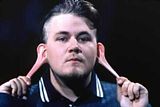
Out of curiosity, would you consider someone who had their earlobes cut off disfigured?

If a woman is not satisfied with her breast size or shape and seeks to alter it via surgery, or someone is unhappy with the shape of his nose and hopes to reshape it, I would be reluctant to agree that they've been "disfigured by nature" but I'd still say it's their call.

I am not sure that is a compatible situation. You seem to be talking about a situation where a women is not happy with her naturally, with in the typical range, body. I wouldn't call that 'disfigured by anything'. If instead you're talking about a clear birth defect that might be different.

Knowing no such individuals personally, I'd say men who feel they've been disfigured by circumcision were probably either disfigured or have issues with their parents which go beyond circumcision, but I could be wrong.

Knowing several people personally, the only problem that some of them have with their parents is that they agreed to a medically non-therapuetic disfigurement of their penis. Most describe their circumcision as 'typical'.
 
Indeed, I would go as far as to say a mole is not typically a dysfunctional part of the body. Surgery to remove moles is done for purely cosmetic reasons in the vast majority of cases.

I think you're right that this is the case, and as I said I think it's probably the most relevant parallel example to non-therapuetic circumcision. But I do see differences. Congenital melanocytic nevus (which I think we're talking about) appears to only occur in about 1% of infants born in the US. Of those with this type of birth mark, it seems only 15% or so have it around their neck or face which I only think is interesting because there would probably be less of a chance of intervention if it's in other locations. My guess is that surgical alteration only occurs in the small fraction of those born for whom the birth mark either shows some characteristic that leads one to consider a biopsy or where the birth mark is so large that it may cause a social problem.

Strictly speaking, the latter case is non-therapuetic but at the same time I think one may also consider it a birth defect at some point. Similarly, some people are born with webbed toes or fingers and though this is another example of, potentially, a non-therapuetic surgery, its categorization as a birth defect would provide justification for non-therapuetic intervention. A foreskin, on the other hand, is not a birth defect, and nearly all boys are born with them; interestingly being born without a foreskin (Aposthia) is considered a birth defect. One might say that in circumcising your son you're imposing a birth defect on him.

Now back to the mole, I'd be interested to hear what the prevalence is, and under what circumstances are, of these being removed. Are we talking about small freckles? Or are we talking about much larger marks, at what point (if any) would such marks (which clearly can occur) be considered a birth defect? If a child is born with a small mark (say 1 cm or less) are doctors soliciting cosmetic correction? It's a situation that clearly requires more digging but I suspect that the occurrence of cosmetic correction is based on individual evaluation of need and relatively rare.

When my parents had my wisdom teeth removed, they were removing functional teeth. In retrospect, I would have to say that they were serving a non-essential function, since the remaining teeth seem to get the job done just as effectively.

I don't see this as a strong analogy. Wisdom teeth removal is frequently done when it appears that there are potential problems, impaction, failure to erupt, decay, and others I am probably not thinking of. There is no question that some are just done but I am not sure I agree that most are performed unnecessarily. (I admit I could be wrong on this point, in my case there was clear need.) Which brings me to the second point, this procedure is typically considered and performed in late adolescence; at a time when one can begin to actively take part in those decisions. I would have little problem with circumcision if someone around the same age, 17 or so, made the choice for themselves.

And it trivializes FGM.

I really don't see how. One can acknowledge that some forms of FGM are far worse than typical MGM and that doesn't trivialize FGM it's just stating a fact.

 
Last edited:
If a child is born with a small mark (say 1 cm or less) are doctors soliciting cosmetic correction? It's a situation that clearly requires more digging but I suspect that the occurrence of cosmetic correction is based on individual evaluation of need and relatively rare.

My son has a café au lait birthmark on the lower part of one of his calves. Initially it was only a couple of centimeters at its longest part, but has grown with him, so is now several centimeters. I've never even considered having it removed (apparently they can be treated with lasers) as it is totally benign, and doesn't bother him at the moment. If he wants it removed when he's older, that's his choice.

Also my brother has a congenital mole on his torso - larger than a normal acquired mole, but not huge - that has never been removed.
 
Last edited:
Out of curiosity, would you consider someone who had their earlobes cut off disfigured?
Not necessarily.
th_earlobes.jpg
 
My son has a café au lait birthmark on the lower part of one of his calves. Initially it was only a couple of centimeters at its longest part, but has grown with him, so is now several centimeters. I've never even considered having it removed (apparently they can be treated with lasers) as it is totally benign, and doesn't bother him at the moment. If he wants it removed when he's older, that's his choice.

Also my brother has a congenital mole on his torso - larger than a normal acquired mole, but not huge - that has never been removed.

I was born with a couple of wine-red birthmarks running from my ankle up my leg, some 10 centimeters. They weren't removed and I never saw a reason for bothering with it.

I was also born with polydactyly. I had a sixth "finger" - lacking a bone - that was simply tied off. It may have contained a nerve, the little dot next to my little finger where it once was tingles when touched. I also had a real sixth toe, which was surgically removed (well, the fifth one was removed). It never bothered me - my feet are wide enough as they are, and the finger would have been useless anyway. But as we're here discussing the definition of "mutilation", would the removal of superfluous body parts count as such?

FWIW, I wouldn't lightly give up the possession of a finger, that would make touch typing or piano playing quite difficult if not impossible.
 
But as we're here discussing the definition of "mutilation", would the removal of superfluous body parts count as such?
I wouldn't call it mutilation. It sounds like some here would.

I wonder - would surgery for syndactyly also be mutilation?
 
I certainly wouldn't call removing an abnormality mutilation - regardless of whether I think it is worth removing, myself. Removing a normal body part from someone too young to consent, on the other hand, I would. On a consenting adult, i would call it body modification.
 
Last edited:
I really don't see how. One can acknowledge that some forms of FGM are far worse than typical MGM and that doesn't trivialize FGM it's just stating a fact.

Does the circumcision protocol include a penectomy as well?
 
My son has a café au lait birthmark on the lower part of one of his calves. Initially it was only a couple of centimeters at its longest part, but has grown with him, so is now several centimeters. I've never even considered having it removed (apparently they can be treated with lasers) as it is totally benign, and doesn't bother him at the moment. If he wants it removed when he's older, that's his choice.

Also my brother has a congenital mole on his torso - larger than a normal acquired mole, but not huge - that has never been removed.

My guess is that most who are similarly situation follow the same path, which is what I would expect. I wonder if the possibility of 'removal' is even brought up, by the doctor in particular.

Not necessarily.
[qimg]http://i1157.photobucket.com/albums/p587/zeggman/th_earlobes.jpg[/qimg]

I wouldn't call it mutilation. It sounds like some here would.

I wonder - would surgery for syndactyly also be mutilation?

I think in these cases we're talking about clearly abnormal development at which point corrective surgery is an appropriate consideration. I am curious thought about surgical removal of earlobes (I am thinking of the lower part BTW). I can't think of anything that they do or that I can do now that I wouldn't be able to do. So is surgically removing them mutilation? Perhaps not by your definition.

I certainly wouldn't call removing an abnormality mutilation - regardless of whether I think it is worth removing, myself. Removing a normal body part from someone too young to consent, on the other hand, I would. On a consenting adult, i would call it body modification.

This is about where I am.
 
I think you're right that this is the case, and as I said I think it's probably the most relevant parallel example to non-therapuetic circumcision.


I would nevertheless advance the case for the pulling out of babies' toenails as being a stronger parallel. There are arguable medical benefits relating to prevention of toenail-related problems in later life. Arguable benefits for convenience and cleanliness in that cutting the toenails and cleaning beneath them are chores that won't have to be done. And it's quite possible that the possessors of toenail-less feet would be perfectly happy with the result, even to the point of laughing at other kids who still had their toenails. I suspect the rate and severity of complications of toenail removal would be less than with circumcision. And I'm sure people would still be able to play football perfectly well.

I advance a hypothetical case, because neonatal toenail removal is not something that is currently fashionable, or indeed carried out at all. We let people risk onychodystrophy in later life, and only suggest toenail removal to the people it actually happens to. The idea of pulling out the toenails of tiny babies horrifies us.

Remove the cachet of its being a currently sanctioned procedure, and circumcision would appear just as barbaric if not more so.

Rolfe.
 
And for the record, I have an oddly shaped finger on my right hand, which I have no problem calling "deformed" - which I think is the natural equivalent of mutilated.
 
And for the record, I have an oddly shaped finger on my right hand, which I have no problem calling "deformed" - which I think is the natural equivalent of mutilated.


Sshhhhh, whisper it, but many years ago I had an elective surgical procedure for cosmetic reasons. I was and am extremely happy with the result. But I would have no problem acknowledging that such surgery meets the definition of a mutilation.

Rolfe.
 
I certainly wouldn't call removing an abnormality mutilation - regardless of whether I think it is worth removing, myself. Removing a normal body part from someone too young to consent, on the other hand, I would. On a consenting adult, i would call it body modification.
Yes, that sounds right.

I wonder - would surgery for syndactyly also be mutilation?
No, that's corrective surgery. Not having five fingers is a clear disability in this computer era.
 
Again, this is the problem. The idea that one's penis might be less than perfect is too much for many men to handle. I might actually be in the same boat if I had been circumcised.

My, how you do project!

Just because your culture considers something aesthetically pleasing that my does not in itself dpes not mean that the practice is mutilation. You are substituting a subjective, aesthetic judgement for a objective, biological evaluation.

But here's the thing, your penis is disfigured. Doesn't mean it's non-functional, or less capable. I'm sure we would have noticed the population crash in the US if that was the case.

No-one claimed that mutilation renders a body part functionless. The claim is that mutilation reduces the function of a body part, an argument you have yet to support with any evidence pertaining to circumcision.

But it is not fully functional. You are missing an important mechanical part, so it couldn't be. Again, I'm not trying to imply any degrees of "manhoodness" here. It's just reality. You are different because of something done to you that was beyond your control.

Different doesn't mean mutilated or disfigured. The former simply doesn't carry the connotation on being in complete that the latter does. You efforts to conflate them imply a less-than-objective approach to the issue.

But as I said earlier in the thread, if nobody had a nose in your society, you would comfortably fit in after your parents had your nose cut. You would feel normal, accepted and happy. But you would still be disfigured.

Removing the nose is not purely aesthetic and does reduce the ability for the body to function. You have no presented evidence that removal of the prepuce actual reduces the functioning of the penis.
 

Back
Top Bottom