• Security incident: ISF was recently accessed by intruders. Please change your password, and change it anywhere else you used it. Read more

Ever wonder why the Tea Party hates building green?

The attitudes expressed in this thread by those who lean leftwards well illustrates the blind faith, reckless spending, and total disregard for business realities that shows why someone...

...such as the Tea Party...

....is needed to stand up and point out the irrational attitudes of Greenies.
 
Last edited:
It seems to me that this is just an ad hominem.

Without offering supportive evidences, I'd have to agree. Even though I'd privately agree that this seems a prime motivator for all current major party factions.
 
Concerning the hilited area: Would you care to share these documents? Do you really believe the U.N. is behind green architecture, energy solutions, etc.?


So, the question remains: Do you think private industry is willing to spend money on this?

So, Mhaze, am I going to get an answer to these questions?
 
Recall reading that the California high speed train was having cost issues largely. Seems even the California governor is loosing interest in the project. The project was to be another marriage of green ideas, built by union labor. For a blue state as California, in the past that was a match made in heaven. In todays world of high regulation and environmental law suites, doing these big projects is difficult to accomplish.

Liked Walter Russell Mead's article on the problems being faces on high speed trains.

"California Rail Fail: Captain Brown and the Great White Train"

http://blogs.the-american-interest....fail-captain-brown-and-the-great-white-train/

sample from the article:

...Brown’s vision is backward looking and preservationist rather than futuristic. The high speed rail project aims to preserve Blue California rather than to lay the foundations of a 21st century, cutting-edge state. The interests behind it are protecting existing turf rather than pioneering something new. The unions and the big city mayors want to preserve or even revive the political economy and urban geography of the mid 20th century. They want a California of strong urban cores rather than exurban sprawl, and they want to return to a large unionized labor force guaranteed lifetime employment, and they want the state government to supply long term funding to make it all work. They want new canals in the age of rail.
But the stuff that used to work doesn’t work anymore. Between the unions, the legal system and the various regulations and requirements that have built up over the years, the big projects cost much more than they used to. Because California’s economy is so heavily bogged down by excessive regulation, litigiousness and a culture of benefits and entitlements, growth is too sluggish to support huge new expenditures. And high speed rail is of all forms of mass transit the one most poorly suited to the decentralized, exurban, car-based society Californians continue to build.
The blue social model can’t produce great results anymore. If you want to think big, you can no longer think blue. This is Governor Brown’s problem in a nutshell. The political coalition that backs him cannot produce coherent and workable plans anymore. The greens, the unions, the planning bureaucrats, the mayors and so forth each bring so many requirements to the table that the only designs that make them all happy are so cumbersome and expensive that they cannot be built. The political imagination of the blue coalition can no longer visualize the future: it can only project its nostalgia ahead.
California, like the country as a whole, is desperate for new ideas and a new vision. Governor Brown is completely correct that the state cannot passively drift into the new century but neither he nor the coalition behind him has any idea how to get California moving again.

 
So, Mhaze, am I going to get an answer to these questions?


Do you really believe the U.N. is behind green architecture, energy solutions, etc.?

So, the question remains: Do you think private industry is willing to spend money on this?

Various parts of the UN are certainly working with "green" operations and advising on carbon cap and carbon trading schemes in various countries. But you've twisted the question around a bit from the actual OP, and I am sure you understand that the OP itself twisted reality quite a bit....we can find nutcases within the Tea Party, yes, but they are not representative of the whole. I view the UN as a self serving and self propagating bureaucracy, which at the same time is notably corrupt.

Let's say that the version and style of a moon base that private industry will spend on, may not be what politicians would think a moon base should be. They'd likely think it would be a cool resort they could go to. In fact it might be 500 robot mechanisms operating a chemical process and essentially strip mining, with minimal facilities for one or several humans at a time.

As previously mentioned he3 is a likely item for mining in terms of materials valuable enough to return to earth. Titanium likely does not have the value to warrant return to earth, although that could change. An electric rail launcher on the moon would likely make it profitable to return packages of titanium in large quantities. Need a clear section of ocean for the splashdowns, of course.
 
Recall reading that the California high speed train was having cost issues largely. Seems even the California governor is loosing interest in the project...

what leads you to that belief?

Governor Brown Advances High-Speed Rail Support
Tue, 14 Feb 2012 12:56 PM
Governor Jerry Brown and United States Transportation Secretary Ray LaHood reaffirmed their support for building High-Speed Rail in California...
The project was to be another marriage of green ideas, built by union labor. For a blue state as California, in the past that was a match made in heaven. In todays world of high regulation and environmental law suites, doing these big projects is difficult to accomplish.

law suites? really? In the current environment, further deregulation is a recipe for disaster, the Great recession should have been a clear demonstration of the problems associated with dependancy on corporations to do the right thing on their own.

Liked Walter Russell Mead's article on the problems being faces on high speed trains.

politics often complicates doing the smart thing, especially when it is based on false premises and confirmational biases. For a more fact based analysis, something like these reports seems to be a much more balanced and extensive explorations of the benefits, economics and potential problems.

High Speed Rail in America: An Evaluation of the Regulatory, Real Property, and Environmental Obstacles a Project will Encounter - http://works.bepress.com/cgi/viewcontent.cgi?article=1012&context=darren_prum

California High-Speed Rail and Economic Development: Station-Area Market Profiles and Public Policy Responses - http://www.its.berkeley.edu/volvoce...omic_Development_Paper_-murakami_cervero2.pdf

Personally, I think an initial LA to Vegas HSR route would make more sense and give more concrete reference numbers for use in pricing LA-SF and other service leg plans.
 
Last edited:
And WHY.....is CA broke?

:)

Over-zealous and unnecessary tax cuts for those who didn't need them mostly. The obvious isn't as elusive as those with an agenda often seem to portray it.
 
...

Personally, I think an initial LA to Vegas HSR route would make more sense and give more concrete reference numbers for use in pricing LA-SF and other service leg plans.

I agree with you, and I still believe that the line should be terminated at the airports of the respective cities as the parking and transit infrastructure is already there, and then you can make connections and have luggage checked through.
 
Over-zealous and unnecessary tax cuts for those who didn't need them mostly. The obvious isn't as elusive as those with an agenda often seem to portray it.

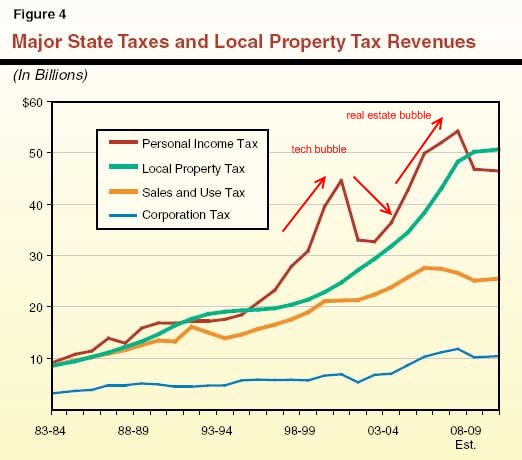
And yet, California state revenues grew considerably over the last few decades.


So if revenues kept going up, then how could the state possibly have financial problems? Something's missing. I wonder what it could be. What's that you say? Spending also matters? Nonsense! Poppycock!
 
I agree with you, and I still believe that the line should be terminated at the airports of the respective cities as the parking and transit infrastructure is already there, and then you can make connections and have luggage checked through.

It certainly makes sense, especially for Vegas to LA as it would most likely be a straight through run with most of the traffic replacing air-shuttle runs anyway. But I'm sure Vegas would accomodate and perhaps elaborately over-compensate on bringing their end of the connection straight to the Strip if they could arrange it!
 
Over-zealous and unnecessary tax cuts for those who didn't need them mostly. The obvious isn't as elusive as those with an agenda often seem to portray it.
California did that? Cite?
 
So if revenues kept going up, then how could the state possibly have financial problems? Something's missing. I wonder what it could be.
Gollygee Billy Bob, ya think the state's population having increased by about fifty percent during that time period might have anything to do with it? Or the fact that a 2009 dollar was worth less than half of a 1983 dollar?

Yeah, you're missing some stuff, all right.
 
People want to teleport around Star Trek style so they don’t need to travel at all but that doesn’t mean they get to do it. The universe is funny that way; it doesn’t provide things just because we want to have them.

Flight time from SF to LA is half the transit time by the planned HSR. You don't need Star Trek.

People start using more natural gas and the price goes up, not down. That’s how supply and demand works. ...

Yeah, brilliant comment - now tell me what happens when supply increases faster than demand and also market competition increases.

Perhaps you are out of touch with the facts but several major NG companies have cut back drilling and exploration as there isn't sufficient demand yet. There is no national retail distribution of compressed NG for vehicles, however at least two companies are working toward this - initially for trucks. There are parallel developments in CNG freight truck conversion.

I' m in favor of a carbon tax (tho' none of the proposed ones meet the common-sense test). Still that doesn't justify HSR.

http://www.google.com/url?sa=t&rct=...sg=AFQjCNGU29A9NqplV_zGU0iEkz0_9dd2Rg&cad=rja


Greenhouse Gas Reduction
Claims about HSR’s environmental benefits have been greatly overstated. California HSR will do
little to reduce CO2 emissions (greenhouse gas emissions). Based upon California Air Resources
Board projections, HSR would ultimately remove CO2 emissions equal to only 1.5% of the current
state objective. This is a small fraction of the CHSRA’s exaggerated claims of “almost 50%” of the
state objective. The Intergovernmental Panel on Climate Change (IPCC) has indicated that for
between $20 and $50 per ton of reduced greenhouse gases emissions, deep reversal of CO2
concentrations can be achieved between 2030 and 2050. A McKinsey report indicates that
substantial CO2 emission reductions can be achieved in the United States for less than $50 per ton.
Yet the cost per ton of CO2 emission removal by HSR is far higher—between 39 and 201 times the
international IPCC ceiling of $50. The reality is that HSR’s impact on CO2 would be
inconsequential while being exorbitantly costly.
Hence, HSR’s CO2 emission reduction strategy cannot be legitimately included as an element of a
rational strategy for reducing GHG emissions. In view of the untenable traffic impact projections
and other factors, CHSRA’s claims are considered specious. There is a need for an objective,
independent assessment of HSR’s CO2 impacts, including both operations and construction. Until
such an analysis is completed, CHSRA should cease making any statements about CO2 or other air
quality impacts.


HSR as a greenhouse gas reduction scheme is vastly expensive compared to other approaches. That's the main problem - it addresses an emotional desire, or green-fetish, but ignores economic reality. It's right up there with PV panels as a uneconomic feel-good money-waster.
 
Last edited:

ISF - Join now!

Every member here is approved by hand. No bots, no spam, just people who care about evidence and honest debate.

Membership is free!

Create your free account

Back
Top Bottom