Except we're only talking about 25 miles away and viewed through 8 times lenses. And the airborne observers probably ended up closer at one point because of the travel time at their speed of 200 plus MPH.
OK, so because us helpful sceptics like to consider all the possibilities. Lets consider for one moment that ufology is correct and do some calculations based upon his theory.
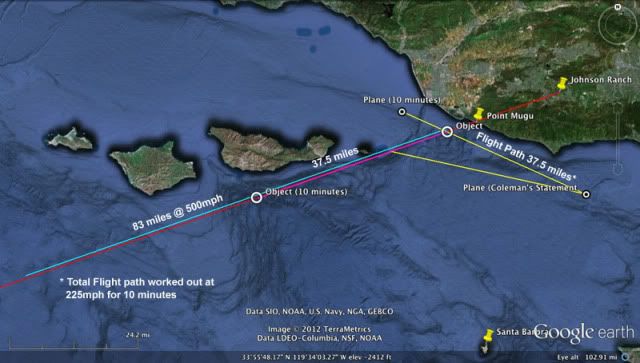
I've put the plane at it's closest possible position according to the flight crew information (Coleman's statement) So it's
"off the coast in the vicinity of Santa Monica"
In this scenario, taking Coleman's statement as accurate, they watched the object for 10 minutes. Marrying that up against ufology's theory, Travelling at 225mph towards the object in a slight left hand curve to get directly behind it as it sped away from them.
The lower yellow line represents where the plane would intersect the flight path of the object if they had taken the shortest route towards it, so in reality, the plane would arrive directly behind the object (or close enough) at a point between the two yellow lines (or somewhere within the triangle created by the two yellow lines and the flight path of the object).
For the purposes of making this more possible, I've presumed the object was only traveling at the same speed as the plane because all the crew members agree that they were not closing in on it.
After ten minutes, the object would also have traveled 37.5 miles and it's position is shown at the most Easterly end of the pink line.
Now ufology is going to explain to us how the flight crew didn't manage to spot that the object they insisted was hovering motionless, managed to fly over a small island and right infront of a bigger island, without the flight crew realising that it must be moving and not as they all reported "motionless".
Also, it would be interesting to hear how the flight crew could see an object with a maximum width of 200' from at least 23 miles away, bearing in mind that any sharp clear edged smoke trailing from the engines of the object that allowed Johnson to first see the object, would look like a long line of smoke to someone looking at it from an angle of about 45° and vise versa.
Margin of error time.
I've done these calculations based upon the information that is most forgiving to ufology's theory.
The margin of error we have for the length of time that the flight crew watched the object is anywhere between 5 and 10 minutes.
Any time taken off the viewing time, will effect the ability of the plane to get anywhere near the flight path of the object to be able to get into a position that would prevent them from seeing lateral movement.
The margin of error for the position of the plane when they first spotted the object is between 23 miles away (Coleman) and 61 miles away (Ware)
For this diagram, I have used the closest reported position for the plane. Any other possibility would mean the plane was further away and would not be able to get to a position that would prevent the flight crew from seeing lateral movement of the object.
The margin of error for the calculated speed of the object is between 225mph and 500mph. The lower estimate is based upon the speed of the following Lockheed and the high estimate is based upon the maximum speed of flying wing type aircraft and B-52 type aircraft.
Note that as the Lockheed was not able to gain on the object it must have been traveling at at least the same speed as the Lockheed. If it was travelling for the full distance at 500mph, it would have traveled 83 miles (marked on the diagram as a blue line). The end point at which the crew lost sight of the object would have to be somewhere between the Eastern end of the pink line and the Eastern end of the blue line.