• Quick note - the problem with Youtube videos not embedding on the forum appears to have been fixed, thanks to ZiprHead. If you do still see problems let me know.

Religion is not evil

Well, things have changed in those centuries. The development of the scientific method since the 17th century has given humanity a reliable method of determining what is true - something that wasn't available previously.

Maybe. I'm not sure. But the undisputable existence of a huge number of moderate (ie. non-fundamentalist) theists suggests that there is hope.

Some things may have changed in those centuries but religion still clings to the putrid bathwater. How much grace do they need exactly? What science do you need to know that its not nice to do horrible things to people?

Now in some ways I can forgive the religious for believing these things if that's what their religion tells them. But I don't forgive the religions for continuing to peddle them.

Opposing gay marriage, contraception or abortion are examples of not particularly fundamentalist positions with respect to religious belief. It wouldn't be unusual to find an average moderate believer who supports these positions (or many others) on religious grounds.

Should we wait another 400 years for the religious to catch up and simply respect their positions in the meantime?
 
Incorrect interpretations of what it actually says in the bible, and misdirection by people hiding the fact so as to discredit the primary religions involved for control over their religion, their people.

The CT sub is thataway --->
 
They've already had 400 years. I'd say they're on the verge...

And as I've stated several times, those positions that are unethical should not be supported.

On the verge of genuinely throwing out the putrid bathwater? Honestly? Do you honestly see a move from our major religions towards willingly and proactively discarding their multitude of arbitrary pronouncements on things like homosexuality, whether its alright to eat pork and whether men need their genitals hacked into at birth?
 
In the case of a death, respecting whatever beliefs the grieving person has would be the compassionate, polite, and generous thing to do, regardless of your own beliefs. Would you accord a religious person the same respect you demand for your belief?

Obviously. But apparently even that's not enough for some people.

I was told by one member of a group of friends, who are nice enough otherwise, that he wouldn't want me at any of their funerals, even if I didn't say or do anything to express my thoughts, simply because he knows what I'd be thinking.

While I'm used to the idea that Christians want atheists to sit quietly at the back of the bus and not say or do anything disrespectful (metaphorically speaking), that was the first time someone told me I wouldn't even be allowed on the bus. :boggled:
 
I actually didn't know that; what do you think the reason is that there is so much ant-atheism in England? Obviously attacks on anyone is wrong and not benign. But for the record, by benign I mean exactly that- your typical neighborhood church/synagogue/mosque that is not spewing hate against anyone.

I think "England" may be a typo for "USA," since the post you quoted said that atheism was generally accepted in England but not the US.

Here's an example, on a topic that would attract mostly US commenters:

Fox News Page on 9/11 Cross
Generates Death Threats Against Atheists

While in most cases the hatred isn't that overt, it's hard to get around the idea that most U.S. Christians, if they follow their church's teachings, think atheists should and will be tortured, while atheists generally don't hold the same opinion about Christians, as far as I know.
 
Again, please read my posts before running off your mouth. To express it yet again, NO. I am not happy to see that. It should be stamped out. My point yet again is that it can be stamped out without destroying the good that faith-based organisations do.

Except that you're rather missing the point here.

Religion, as an entity such as it can be described as one, can provide a framework for charity. It is well known to provide a network of people who are ready to help, and indeed many religious organisations make good use of this to provide charity to many.

However, the problem comes when you declare that you can keep the aforementioned good work separate from the bad things religions do. This isn't possible. Not because "religion" is a bad thing, but because individual religions are not set up in such a compartmentalised way. An example of this is Operation Christmas Child.

On the surface, a wonderful, benevolent organisation that supplies children in 2nd and 3rd world countries with Christmas gifts, toys and games that they would otherwise not receive due to their poverty, or lack of family. On the surface, I can't think of a better way to use a religious foundation (the organisation itself and the giving spirit of the religious festival Christmas). However once you dig a little deeper, you find out that this organisation, which portrays itself as a benevolent force for good is actually a disgusting and base taint. In addition to the donated gifts, this organisation packs the present boxes full of Christian propaganda, of the sort which condemns and threatens the very people they claim to help with hell-fire and torture if they refuse to convert. Indeed, the organisation uses the generous gift giving as a cover for its real mission, the spread of its own particular brand of Christianity.

There is no denying that the gifts given to these impoverished children are wonderful, generous and a worthy act of charity from those who give them, but when it comes to OCC, you can't have the good without the foul. Similarly, most (although not all) religious charity work is done either with the express goal of, or with the additional benefit of pushing the specific religious ideology of that charity. When a group called "Christian Whatever Group" comes and provides a well, the message is that Christians are providing the well. When that group provides sect specific literature as well, the intent was clearly not even to provide the well in the first place. The well is a bargaining chip, or the sugar to sweeten the pill of the actual mission. Conversion.

Also, not to belabour the point but when it comes to the works of great religious organisations like the RCC, there truly is no way to separate the good works it does from the foul, harmful crap it spews. There simply is no way to remove one without the other, not because they are totally inter-connected as entities, but because the minds of those who lead the great moves towards providing clean water are the same people who push anti-condom nonsense and because of their religious beliefs both acts are seen as vital charity work. Whereas if you took one of the numerous secular groups who do similar charity work, there isn't the same scope for pushing ideas on to these people.

Of course there are organisations that are essentially wholly benevolent such as (as far as I'm aware) the Salvation Army who are religious and do good because they are good people, and you could say that the religious aspect was the framework for such an organisation, but in reality, religion is a frippery. A useless appendage that could be replaced by anything else which brings people together, or indeed nothing at all. That there are plenty of secular movements like Médecins Sans Frontières proves that the last true argument in favour of religion as a great motivator for charity is false. If people, diffuse wholly different and unique people can come together and form a group that's as far reaching and noble as MSF, then what is religion for?

Sure, religion can bring people together to do good, but it isn't necessary. It can provide a ready made network of charitable types, but so can lots of other things. Thus, religion is not a force for good, merely one in any number of groupings that can potentially bring people together. Even if you ignored the evils of the world caused by religion, it's a wholly worthless artefact when it comes to doing good.

Religion isn't evil, it's just that it's an utterly worthless and extraneous thing that is wholly separate from the notion of charity, but too often not the brutality that it inflicts. Since it's so worthless when it comes to the good and so active and vital when it comes to the bad, why on Earth defend it?

 
And the argument that religions contradict each other is only true to a point. When you get rid of the gobbly gook and get to the POINT of most religions it comes down to: be a good person and that we are part of something larger than ourselves.

No it don't.

I'm pulling this out because my objection to it is the same as to Arthwollipot's OP: you don't get to cherrypick others' religion like that. Freedom of religion is a funny thing. In return for being allowed to act and think what you will in the name of your god or lack thereof, you have to grant the same consideration to everyone else. For many people the "gobbly gook" is the POINT, while hippy-dippy being a good person crap will get you sent to Hell... and they're just as correct as you are.

Deism may work fine for you, but you can't write off the offensive elements of religion as individuals missing the POINT. Ultimately it's their baby and their bathwater. Respect it all or reject it all, you don't get to pick up the baby for them to throw the rest out.
 
I don't know why this distinction is so important to some people, I'm not a theist but I don't think her statement is all that wrong.

While technically there may be a continuum of belief that goes 'Believing X; not believing X, Believing not X' the middle ground is only really relevant where we are ignorant of what is being discussed.

Do you believe in a flargypumpfrot? Not knowing what one is, I can't believe there are no flargypumpfrots in existence or that they exist without knowing more so I say 'No, I do not believe in flargypumpfrots'. That is meaningfully different from I believe there are no flargypumpfrots.

However, if you then go on to tell me that a flargypumpfrot is an invisible, Portuguese speaking monkey that lives under my bed and steals socks from my sock drawer while I am asleep then either you believe that or you don't. Even if you still feel that intellectually you do not have enough data to make a conclusion then you will still have to decide whether to proceed about your business as if there is a flargypumpfrot or not.

So while there might be some technical philosophical difference between the two propositions, at a practical level there is no difference between the behaviours of 'I don't believe in God' and 'I believe there is no God'

Let's see:

I don't believe in god = I believe in god.

divide by "in god"

then:

I don't believe = I believe.

Seems like there's a contradiction here.
 
You're a little off the track, now. The point is, you can be against an act without being against the person performing the act. You can be against a belief without being against the person having the belief.
I agree this can be done ... and I can easily think of examples that support it. Even extreme ones.

However, I think it basically hinges on a person doing two things: first of all, they don't take the person "personally", and they are able to do just that ... separate out the belief from the person. Their actions and reactions will reflect this. And secondly, they treat the belief as though it were an actual thing/entity/real that was guilty and worthy of blame, they recognize it as such, and they DO take that personally. I think when those aspects get confused and misdirected, the one "taking it personally" isn't being intellectually honest, and the focus of their "anti______" is without substance and produces little more than hamsters running in wheels in cages ... thus, why there is no resolve. And I'm not talking about "universal resolve" ... I'm talking about personal resolve, within that person who has the issue in the first place.
 
I don't know why this distinction is so important to some people

Because truth matters a lot to me, and the statement isn't true. Belief and lack of belief are not the same thing. Lack of belief is not one form of belief and there is no way to say that it is without revealing a religious bias, in my opinion.

However, if you then go on to tell me that a flargypumpfrot is an invisible, Portuguese speaking monkey that lives under my bed and steals socks from my sock drawer while I am asleep then either you believe that or you don't. Even if you still feel that intellectually you do not have enough data to make a conclusion then you will still have to decide whether to proceed about your business as if there is a flargypumpfrot or not.

So ? Belief, in this case, is a decision made IN SPITE of evidence, while disbelief is a temporary conclusion based on insufficient evidence, or actual evidence to the contrary.
 
I agree this can be done ... and I can easily think of examples that support it. Even extreme ones.

However, I think it basically hinges on a person doing two things: first of all, they don't take the person "personally", and they are able to do just that ... separate out the belief from the person. Their actions and reactions will reflect this. And secondly, they treat the belief as though it were an actual thing/entity/real that was guilty and worthy of blame, they recognize it as such, and they DO take that personally. I think when those aspects get confused and misdirected, the one "taking it personally" isn't being intellectually honest, and the focus of their "anti______" is without substance and produces little more than hamsters running in wheels in cages ... thus, why there is no resolve. And I'm not talking about "universal resolve" ... I'm talking about personal resolve, within that person who has the issue in the first place.

Just do it like I do: treat the person with respect and his/her beliefs like total crap.
 
Just do it like I do: treat the person with respect and his/her beliefs like total crap.
That's never really done much for me :) ... if I'm threatened by someone or something or taking it personally I'm usually more direct with my release of aggression. Plus, I'm not much for "boxing" where there's rules and mouth guards in place. I either walk away or I like the result of my punches to be where the thing I'm punching doesn't get up again. And treating something like crap ... I personally don't like playing with crap. Flush it away and get it TFA from me :). It's almost the equivalent to petty smack talking or bullying to me ... about as satisfying as having sex with no orgasm. Or maybe what having sex with a blow up doll must feel like :D
 
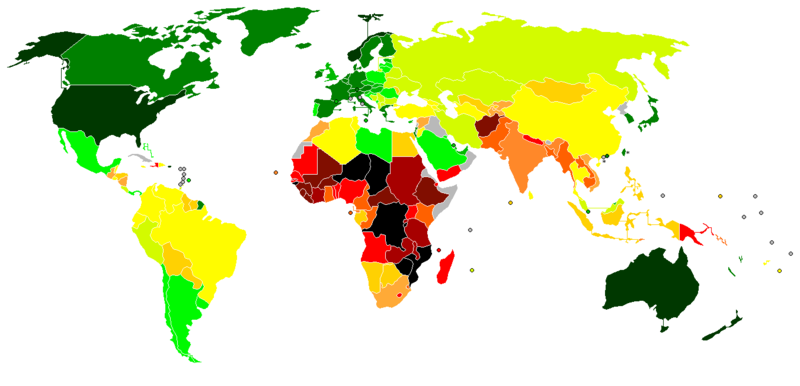
Human Development Index
800px-UN_Human_Development_Report_2010_1.PNG


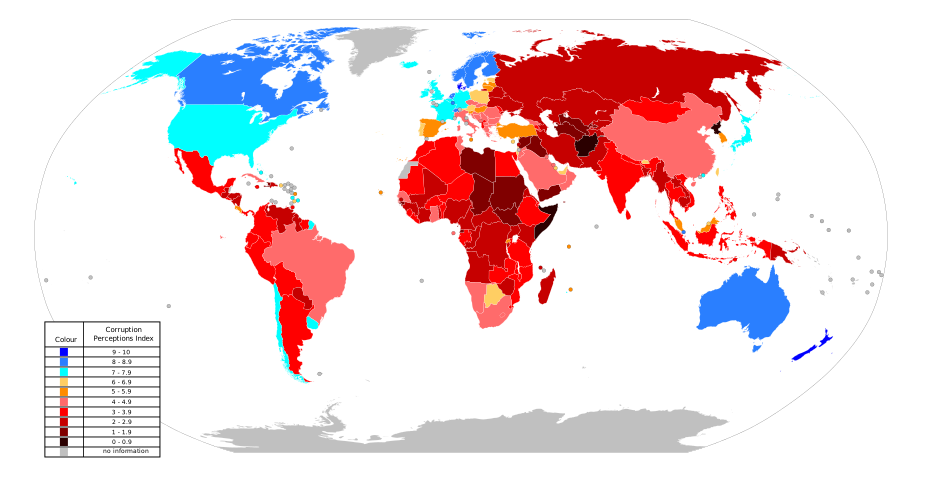
Corruption Perception Index
World_Map_Index_of_perception_of_corruption_2010.svg


Importance of religion
800px-Religion_in_the_world.PNG


Does anyone see some sort of correlation?:rolleyes:
 
Not really. If you have a bunch of people with conflicting religious beliefs, including atheists, it seems to me that their beliefs can't all be true - simply because they are conflicting or contradictory beliefs. Therefore most of those people have false beliefs. My opinion isn't relevant to the argument. Nicole had said she would think it wrong for them all to believe the same thing, which is an odd thing to say if, for example, what they all believed was true.

However, as a practical matter - when a lot of people all believe the same thing, there is very little correction to that belief being taken to extremes. When a number of different people believe different things, and are tolerant of each other's beliefs, then the extremes are corrected. Of course, when they aren't tolerant of each other's beliefs, then we end up with the Balkans.

All of this applies to atheists as well.
 

Back
Top Bottom