Merged Psychological conditions are illusory

Brains don't have problems. We have problems.

This is world class stupid Jonesboy. Alzheimers patients have recorded neuron loss and degeneration. Something is WRONG with their brain. It's having REAL problems. It's not a subjective view of consciousness, it's a demonstrable problem in the brain.

I cannot believe you to be so oblivious to this, so I am assuming you're just denying that the brain has neurons that can degenerate.

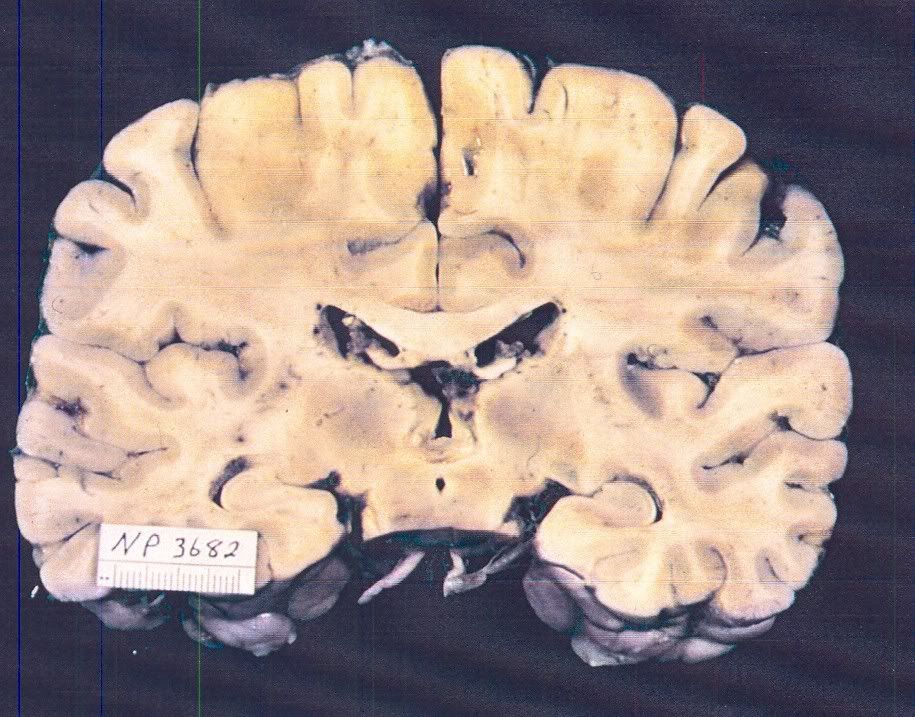
Healthy brain:

brain_normal.jpg


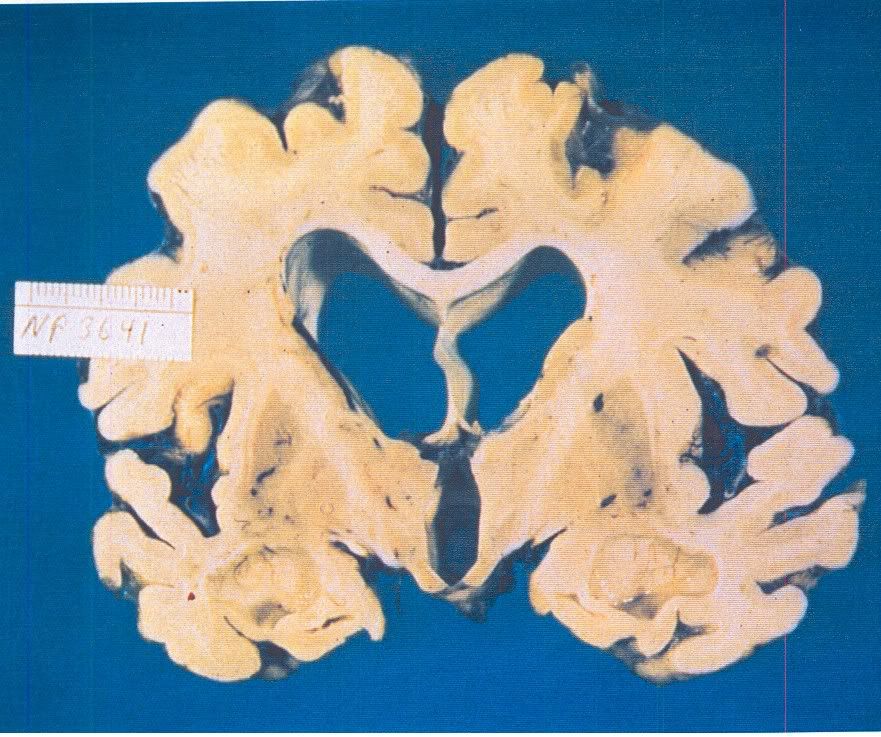
Alzheimer's Brain

brain_alz.jpg


(found on Google Images)


Jonesboy, do you even know what a brain is?
 
Last edited:
I think Jonesboy is playing with words and thus avoiding some issues. I was thinking about this as I was out working today, and propose the following scenario for Jonesboy's consideration and response.

Let us enter into the world of pure mechanism for a moment, and see if we can get some general understanding of what we mean when we say certain things.

Fortunately, I quit philosophy before it turned my mind to ambivalent mush, and am thus still able to manage to hold a wrench.

I was driving my truck recently and when I came to an intersection I flicked on the turn signals, and the signal did not work. I expected it to work. It did not. So I consulted the wiring diagram for the vehicle and got out my test equipment and I diagnosed the problem. For the moment, let us stipulate that I am a competent mechanic and able to do this. By testing and elimination and circuit manipulation, I determined that the signal flasher was not working. Semantic quibbles aside, it could be characterized as "defective," since it does not do what it was designed and expected to do.

So I went out and bought a new flasher. To my dismay, the signals still did not work. Confident of my earlier diagnosis, I did not bother to retest the vehicle's components. I tested the new flasher on the bench. It was clearly defective, so I got a third flasher. That one was not defective, and now my signals work again.

OK, so here we are. I contend that the defective flasher caused failure to flash. I contend that the two are not the same thing. The flasher is just as burned out, just as defective, its state unaltered in that respect, when I am not attempting to use the signals. It's true that I only become aware of the issue, and one might even say it's only a "problem" for me, when I go to use the signals, but the defect exists, and it would not be a gross misuse of language to say that the flasher has a problem, whether or not it manifests itself to me. We can call it a defect, a failure of the part, a problem in potentia, or whatever, but the flasher is just as broken when it sits in the driveway as it is when I am unsuccessfully trying to signal a turn. The new flasher was defective while it hung on the rack at the auto parts store, even if I did not know this when I bought it.

So, jonesboy, here is what I think, and wonder if you can agree with it:

1. The turn signal flasher causes the turn signals to flash (consider me, for the purposes of this argument, to be knowledgeable in the mechanism and circuitry of automotive electrical systems). Clearly other conditions also must apply for the signals to work, but the inclusion of a flasher is what makes this a flashing circuit as differentiated from some other kind of circuit.

2. Failure of the flasher itself (e.g. a burned out coil, a bad transistor in the case of electronic ones, corroded contacts in the case of mechanical ones, etc...) prevents the turn signals from flashing.

3. The defect in the flasher, whenever we notice it, exists independently of the need to operate it. The flasher can be diagnosed by means other than attempting to operate the turn signals. I could, for example, take a hammer and smash the flasher, or melt its circuitry with a torch, and be quite certain that this renders the flasher inoperative without ever needing to try the signal stalk.

4. The failure to flash is a symptom, not a synonym, of flasher failure. Other things can cause failure to flash.

Jonesboy, does that make any sense to you? Is it comprehensible? Are we speaking more or less the same language? Can you comment on this without digression or misdirection?
 
Oh, you mean she's in on it(TM)!

Blind people are perfectly normal! Scientists have manipulated them into thinking they need guide dogs to keep them from attaining true happiness!

You can't compare a physical difficulty with an experience.

You don't get rid of not seeing. If you did there would be no need for eyes.
 
Not quite. My understanding is that flashbacks generally relate to an experience that was so traumatic that the brain is still trying to process and make sense of the data. Instead of the memory being processed and moved from short-term memory to long-term memory it keeps recurring because the brain simply doesn't know how to process it.

Psychiatric treatments such as cognitive behavioural therapy (CBT) can often help people to process these memories, which will stop or reduce the flashbacks.


We take time to process things, and flashbacks begin when that process is underway. The brain "not knowing what to do with it" is cynical pathologisation.

Flashbacks are easily resolvable. Cognitive therapy is too weak, it limits expression, and its conceptual foundations also work against it.
 
Jonesboy, can I ask you something?

I've been skimming this thread, and you've been making a whole lot of statements on the subject, but I see very little if anything in the way of actual evidence? I really don't think it could hurt if you told us a little about where you got these ideas from and what convinced you they were true.

Claims don't support themselves.

Flashbacks can often be completed by hyperventilating. Sometimes a memory can be helped to re-emerge by working on a physical spot that is causing problems. A belief in Medicine's pathological model can negatively influence outcome as it promotes self-doubt.
 
You can't compare a physical difficulty with an experience.

You don't get rid of not seeing. If you did there would be no need for eyes.

Wittgenstein wouldn't have needed eyes. Wittgenstein would have bloody well THOUGHT his way around, with or without sight.
 
Jonesboy,
I am the wife of an army veteran. As you may know, domestic violence is a huge issue in the army, particularly for soldiers with untreated PTSD or other trauma related disorders. There was a big story several years ago where 4 soldiers at one army base killed their wives shortly after arriving home from war in something like a one month time span.
Is it your contention that the spouses and children of soldiers who are beaten, and their lives perhaps even threatened by the veteran as a result of that trauma, should not treat the soldier's behavior as destructive and should encourage this abusive behavior even if it leads to their own deaths?

Bear in mind that many out of character murders and suicides are caused by antidepressants. (There was even a BBC Panarama program warning on this, also there are movements in the USA to sue for such events.)

An experience can fix people in a violent framework. Stan Grof describes these and how by allowing their expression in a supportive enviroinment they can be defused in what can be a liberating experience. Unresolved Death/rebirth experiences brought up by severe trauma is one model that may help as explanation.. As early as the 1950's, and later in the 60's before its illegalization, lSD was used in catharsis for war veterans with great success. The model that worked the best was the non-patholkogical model, where experiences were encouraged. It is their suppression that leads to sudden violence.
 
I really wonder if Jonesboy doesn't realized that symptoms of PTSD go far beyond things like laughing or crying excessively.

For instance, my husband suffered from PTSD. He did not become either emotionally or physically abusive, thank goodness, but he did become very nervous and paranoid. Loud noises would frightened him terribly, and to this day he feels very uncomfortable around loud noise. But more than anything else, he became very paranoid. He would interperet completely innocuous glances or statements by people as an act of hostility, and was becoming increasingly convinced that people close to him were "out to get him" in some way or another. He had a very close knit family and friend support structure that did not denigrate his experiences or emotions, but he still was convinced that everyone secretly hated him and were only pretending to be nice to him. This ultimately hit a climax when he accused a close family member of wanting to kill him - which of course was horrific to hear for the family member, who had never been anything but loving and supportive to my husband.
And of course, with someone less stable than my husband, such a situation could have proven very dangerous. Someone more mentally unbalanced may have acted on his feelings that people were out to get him (even kill him) and committed violence against the people he thought were after him.

Jonesboy, in what way is thinking the people who are most kind to you, most supportive of you, and most loving to you are actually trying to kill you a normal, healthy thing that should be encouraged? Do you really think such emotions in and of themselves are not harmful to the soldier? That he or she would be perfectly happy going around thinking no one really loved them and actually wished they were dead...that their mental distress is in fact only due to the fact that society imposes the belief upon such a soldier that it's not a good thing to think your loved ones secretly hate you and might want to kill you?

Laughing at funerals can be productive as it changes to crying - but its pathologised. A prolonged bout of sobbing is more pwerful than any psychiatric suppression.

Paranoia can arise when inner experiences are trying to emerge in an inappropriate environment. It's not good to go into an altered healing state in a supoermarket or at hoime, or in the surgery when everyone tells you taht its a sign of madness or illness.


Hyperventilation is a healing mechanism that can, if the body needs it, plunge us into extreme pain, pounding heart, and dread of imminent death. I've been through this and seen it in workshops. Nobody really bats an eye when it happens. It's so common, and the outcome always positive, that it's considered normal.
It's also liberating to divorce oneslef entirely from the pathology model whose teachings and drugs forces onto us a picture of the human psyche as fundamentally flawed. These aren't illnesses. They are common to all.

It is the suppression of negative experiences that cause problems. Psychiatry suppresses them to a degree where they mostly cannot emerge, but they are still left unresolved, and very draining. By going the other way, by allowing the experience of death and violence, the person can be freed from it. Grof describes the transition from BPM 3 to BPM 4 (also termed birth experiences) in this regard, and regularly saw them even in in people who had no problems. They are very primal experiences, shaking, screaming, fear of death, extreme sweating, pounding heart, feeling of going mad, alternation between victim and victimiser etc. Going through them is necessary for positive resolution. if you suppress them may, and do, burst out in an environment where new trauma is added, rather than resolved. Also remember that medication suppresses naturalk healing.
 
Last edited:
So treatments that work are 'weak'? And I don't see a lot of emotional puritanism into recognizing the reality of the symptoms of PTSD and treating them. Please point to any evidence that the approach you are advocating results in anyhting other than years of pain and suffering.


They don't work. What they do is provide coping strategies and comforts, and help to defuse a small part of what is a relentless program of pathologisation.
It never works to offer a cure in an environment where the full expression of healing is pathologised.
 
No, of course not. Anything "bad" associated with PTSD is the result of our "emotional puritanism" and the soldiers' friends and family's unwillingness to support them on their natural course of healing.

Clearly, the dead family members were to blame for not accepting the soldiers' violent cries for help. :boggled:

To find support in a non-pathological environment is difficult. It means turning away from psychology and its pathology based model. http://www.virtualcs.com/se/dxtx.html is one place but the term spiritual might put many off. Grofs technique, which I have employed, offers a more technical appreoach.
 
So treatments that work are 'weak'? And I don't see a lot of emotional puritanism into recognizing the reality of the symptoms of PTSD and treating them. Please point to any evidence that the approach you are advocating results in anyhting other than years of pain and suffering.

Emotional puritanism is part and parcel of most Christian Churches, Buddhism, and psychology, especially counselling and psychoanalysis. THis is why the Church has attached itself to psychology.
 
We take time to process things, and flashbacks begin when that process is underway. The brain "not knowing what to do with it" is cynical pathologisation.

Could you please explain the hilited section as I do not understand what you're trying to say.

Flashbacks are easily resolvable. Cognitive therapy is too weak, it limits expression, and its conceptual foundations also work against it.

Could you please expand this. A friend of mine has been trying to resolve flashbacks of her father abusing her for 30 years.
 
Is the naturalistic fallacy all you've got? Bleeding to death from a deep cut is natural, too, isn't it?

Psychology pathogises experience. So Psychologys approach would be to patholgise bleeding. We would never bleed, Blood would no longer be liquid.
 
Originally Posted by Jonesboy View Post
We take time to process things, and flashbacks begin when that process is underway. The brain "not knowing what to do with it" is cynical pathologisation.
Could you please explain the hilited section as I do not understand what you're trying to say.

Originally Posted by Jonesboy View Post
Flashbacks are easily resolvable. Cognitive therapy is too weak, it limits expression, and its conceptual foundations also work against it.
Could you please expand this. A friend of mine has been trying to resolve flashbacks of her father abusing her for 30 years
Could you please explain the hilited section as I do not understand what you're trying to say.


Could you please expand this. A friend of mine has been trying to resolve flashbacks of her father abusing her for 30 years.

There is no multiquote button sorry.

When we worked with abuse we let the experience emerge in a non-pathological environment. The technique was to use prolonged hyperventilation, loud music, and no verbal interaction in groups. This quickly plunges someone into an altered state where the experience most pertinet for resolution naturally arises. It can look frightening to people and medics who aren't used to seeing it as there's a lot of vocalising and abreaction.
 
How many people have you encountered with PTSD symptoms? So you're suggesting that leaving the person with PTSD alone is going to reduce the symptoms associated with the condition? Where is the research that supports this claim?

Obviously if you're suggesting that the symptoms aren't a problem we need not be bothered with your claims any longer.

Apart from myself, it was quite common. No figures are kept but in a workshop of twenty maybe two or three have come with flashbacks or some other recurring natural healing event that they are in the middle of.
 
Okay, so it's natural.

Okay, maybe it can. That is not enough to convince me that hyperventilation is an effective treatment regiment or under what conditions it should be induced, and it doesn't really tell me much about PTSD.

Okay, maybe some doctors do use it as a technique. That does not tell me if it's an effective treatment regiment or under what conditions it should be induced, and it doesn't tell me much about PTSD.

Okay, maybe flashbacks can be resolved by allowing them to emerge. But this doesn't tell me if encouraging flashbacks is an effective technique, or under what conditions flashbacks should be encouraged.

You're repetitively using "can" language, but that's not good enough. I "can" get a lot of money in the stock market if I invest all of my funds in it, but that's not useful to me. I need to know what the risks are, the likelihood of payback, and the like.

In order to convince me that a treatment is effective, telling me how natural it is tells me nothing useful. Telling me what it can do tells me nothing useful. Telling me whether or not there exists people who use it tells me nothing useful. I believe treatments can only be called effective if they have an established likelihood to achieve a desired end without causing more harm. Whether they merely have the possibility to bring about a desired end is severely undershooting this dare I say very reasonable burden.

And this is less than useful to me. You're simply speculating on why people don't agree with you. This doesn't tell me anything at all about the validity of your views. Even if this speculation is entirely true--even if we develop an intolerance to the notion of hyperventilation treatment and encouraged flashback regiments because we're somehow culturally influenced by christianity--it could still be a bad thing. Whether or not it is true, therefore, has no use to me.

The motivations that people have behind forming an opinion for or against a treatment regiment tells me nothing about the effectiveness or lack thereof of the treatment. Again, what I need is something that convinces me that you have knowledge of its likelihood to effect a desired outcome without causing greater harm (and by knowledge, I do not mean certainty or belief, because I'm already convinced you have that, and that does me no good; I mean, instead, some sort of reason to think that the actual truth of your claim is the cause for your belief, as opposed to the banal psychological forces that people use to convince themselves of things that are not the case.)

I'm careful of langugae. Hyperventilation is never treatment, even when it is mechanically initiated or controlled in some way.

It's easy to enter an altered state where deep experiences can emerge productively. Some people don't need triggers, but we provided triggers.

My personal approach was to be wary of someone looking for treatment and cures. We offered none and no figures were kept. This is because we didn't employ those regimens. There is a difference between treatment, cure, and self-actiualization or taking responsibility fopr ones own path or process. The best approach is to maintain a positive view of all of one's experiences, and to be sober and responsible about the vigor of the journey they find themselves on.

Workshop participants always claim their process as their own, and sharing was always postive and enriching. All we provided was the trigger. As far as I am aware it is one of the most powerful non-psychological approaches, far outstripping any of those given by psychology.

If you came to a workshop and expected results for your money I would have to tell you that it was the wrong approach and that you have to go with what you trust, for good or bad. A model that might help would be that of an anthropolgist in a tribal drug ceremony. If he went in looking for data and results, and saw it as panacea or treatment, he would get short shrift.
 
Last edited:

Back
Top Bottom