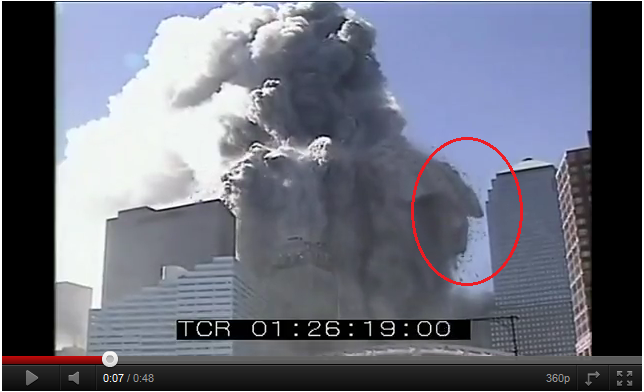
How many second do you think it was?
At least twelve, probably more. Seven seconds is clearly wrong. So you're asking us to believe 1500 people who signed up to a statement that's clearly factually incorrect.
I think the relative point is and even nist finally admits freefall:
Your opinion is that it's relevant. The opinion of every competent structural engineer who's commented on it is that it isn't.
Freefall means there were no supports. No supports means they were removed with explosives of some kind.
Rubbish. No supports means that the supports had failed in some way over multiple storeys. This doesn't require explosives.
Even a single intact vertical column would have caused an asymmetrical collapse.
Since the collapse was asymmetrical, that's not a problem.
I had one guy the other day saying 'it wasn't symmetrical, that's a lie!"
How can I argue with that? 'Symmetrical' means in the manner of controlled demolition. (not along the straight edge of a ruler).
So your argument is that it must have been a controlled demolition because the collapse was symmetrical, which is the way a controlled demolition collapses, but symmetrical doesn't mean symmetrical, it means that it collapsed in the same way as a controlled demolition. In other words, your evidence that it collapsed in the same way as a controlled demolition is that you've asserted that it collapsed in the same way as a controlled demolition.
Let's just get back to reality for a moment, shall we? Firstly, controlled demolitions may be symmetrical or asymmetrical, depending on how they're planned. If there are structures nearby on one side only, a controlled demolition will be planned to drop the building away from them. So whether the collapse was symmetrical or not, it's completely irrelevant to the question of whether it was controlled or not. And secondly, controlled demolition doesn't result in buildings falling at freefall, so whether it fell at freefall or not, that's completely irrelevant too.
Now you;re telling me it wasn't 6.5 seconds.
How many was it? And why do you think that difference matters when freefall has been established to have occurred?
It doesn't. None of it matters. Nothing in the collapse time or the observed acceleration of the building demonstrates anything at all about the collapse initiation mechanism, other than that it took place over a height of around four storeys. Since this is easily explained in terms of a collapse due to fire damage [1], but is not easily explained in terms of a controlled demolition [2], it strongly suggests that the collapse was caused by fire damage; but it's not entirely conclusive either way. And neither, of course, is your uninformed opinion that:
It looks exactly like what it was; a planned implosion
What is conclusive, however, is that it doesn't sound like a planned implosion; and that makes it absolutely certain, to anyone who understands what they're looking at and listening to, that it wasn't one.
Dave
[1] ISTR from the NIST report that the required unbraced length for column 79 to fail was about 8 storeys. This would leave adjacent core columns also unbraced over about 8 storeys, resulting in their collapse over a similar length. This would then leave the perimeter columns unbraced over the same 8 storeys, resulting in an 8-storey high buckle. As the buckle developed, the initial acceleration of the facade would be less than 1G, until the point where the hinges fractured, where it would increase to about 1G. This would then be maintained until the falling structure struck the remaining fixed structure, 8 storeys further down, resulting in exactly the acceleration profile observed.
[2] Demolition charges are normally placed on a single storey only, because this is more than enough to initiate a self-sustaining collapse. This would result in no period of freefall acceleration. A period of freefall acceleration equal to an 8-storey drop, as observed, could be achieved by setting two floors' worth of charges, 8 storeys apart, and possibly additional charges in between to fragment the intervening structure; however, quite apart from requiring more than twice the amount of explosives (and, of course, making even more noise that nobody heard), this would produce an initial period of freefall acceleration, rather than the initial increase in acceleration that was actually observed.
Truthers can't bring themselves to admit that, when you actually
think about the acceleration profile of WTC7, you realise that it's
virtually impossible for it to have been caused by explosives.