Beelzebuddy
Penultimate Amazing

- Joined
- Jun 10, 2010
- Messages
- 10,972
Welp, for starters I'd like to point out that all of your questions are fully answerable by my bayesian definition, which it would seem you still have not fully digested. Your last response consisted of a restatement of the need for bayesian inference, pulled from a random webpage.
However, I'm noticing two other errors that I'll call out explicitly.
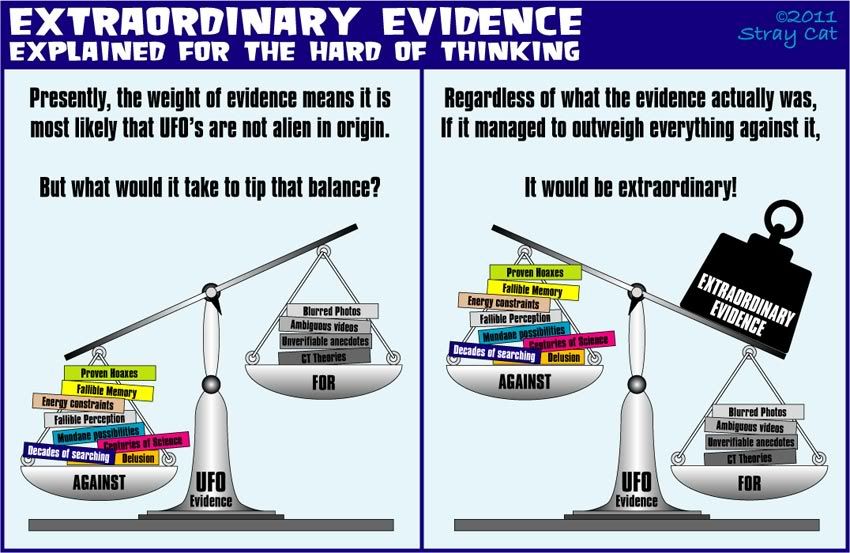
Anecdotes, etc can never be extraordinary evidence, because for extraordinary claims they are never reliable and unfalsifiable enough to demonstrate P(A|E) >> 0.95, all on their lonesome.
That is not to say they aren't evidence, though.
Every Kansas hick who swears he got buttraped by ET improves the net probability of aliens, though not by very much. If you have enough of these anecdotes, you should be able to make the argument that alien visitation is no longer an extraordinary claim - P(A|X) !<< 0.95.
Incidentally, each Kansas hick who turns out to have faked the whole thing to get attention bumps the odds back down. And there have been many, many demonstrated alien hoaxes.
It would be perfectly valid to say there is no practical amount of anecdotal evidence that would make aliens believable, which is what people mean when they tell you not to bother. I'd disagree with that though: an alien craft touching down in the middle of Central Park would generate hundreds of matching anecdotal observations, sufficient to make a pretty good argument for aliens. Backwoods Kentucky, seen by one hick and his dog? Not so much.
This is your second error, the notion that devoid of evidence either way, the slightest amount of incredibly ****** evidence is sufficient to prove the claim until evidence against it is presented, like this is some sort of talking heads political debate.
The prior probability of aliens visiting us is very low because they have never been observed, never been inferred or somehow detected indirectly, and there are numerous laws of physics they'd have to bust in two just to get here in the first place. If you think the probability should be higher than "vanishingly small," that's something you, the proponent of the claim, needs to argue. Once evidence starts piling in the odds quickly approximate that given by the evidence, but without evidence the default position is not "maybe," but "no."
Otherwise you need to acknowledge the 50/50 chance that a real live leprechaun is staring at you right now, where you can't see him. He's riding an invisible pink unicorn. The leprechaun's not invisible though, he's just very good at hiding.
However, I'm noticing two other errors that I'll call out explicitly.
rramjet said:You have therefore simply supplied another definition for extraordinary evidence that allows any evidence whatsoever (hearsay, anecdotes, photographs…) to be extraordinary evidence and to fulfil the criteria of ECREE.
Anecdotes, etc can never be extraordinary evidence, because for extraordinary claims they are never reliable and unfalsifiable enough to demonstrate P(A|E) >> 0.95, all on their lonesome.
That is not to say they aren't evidence, though.
Every Kansas hick who swears he got buttraped by ET improves the net probability of aliens, though not by very much. If you have enough of these anecdotes, you should be able to make the argument that alien visitation is no longer an extraordinary claim - P(A|X) !<< 0.95.
Incidentally, each Kansas hick who turns out to have faked the whole thing to get attention bumps the odds back down. And there have been many, many demonstrated alien hoaxes.
It would be perfectly valid to say there is no practical amount of anecdotal evidence that would make aliens believable, which is what people mean when they tell you not to bother. I'd disagree with that though: an alien craft touching down in the middle of Central Park would generate hundreds of matching anecdotal observations, sufficient to make a pretty good argument for aliens. Backwoods Kentucky, seen by one hick and his dog? Not so much.
rramjet said:What if there is no evidence (or hearsay evidence) against a claim and anecdotal evidence for it? By your definition that anecdotal evidence then becomes extraordinary evidence.
This is your second error, the notion that devoid of evidence either way, the slightest amount of incredibly ****** evidence is sufficient to prove the claim until evidence against it is presented, like this is some sort of talking heads political debate.
The prior probability of aliens visiting us is very low because they have never been observed, never been inferred or somehow detected indirectly, and there are numerous laws of physics they'd have to bust in two just to get here in the first place. If you think the probability should be higher than "vanishingly small," that's something you, the proponent of the claim, needs to argue. Once evidence starts piling in the odds quickly approximate that given by the evidence, but without evidence the default position is not "maybe," but "no."
Otherwise you need to acknowledge the 50/50 chance that a real live leprechaun is staring at you right now, where you can't see him. He's riding an invisible pink unicorn. The leprechaun's not invisible though, he's just very good at hiding.


 Your unfounded assertion is legitimately dismissed.