• Quick note - the problem with Youtube videos not embedding on the forum appears to have been fixed, thanks to ZiprHead. If you do still see problems let me know.

Lambda-CDM theory - Woo or not?

Status
Not open for further replies.
Not credible, you have to embed a picture of a planet from Wikipedia.

Yes:
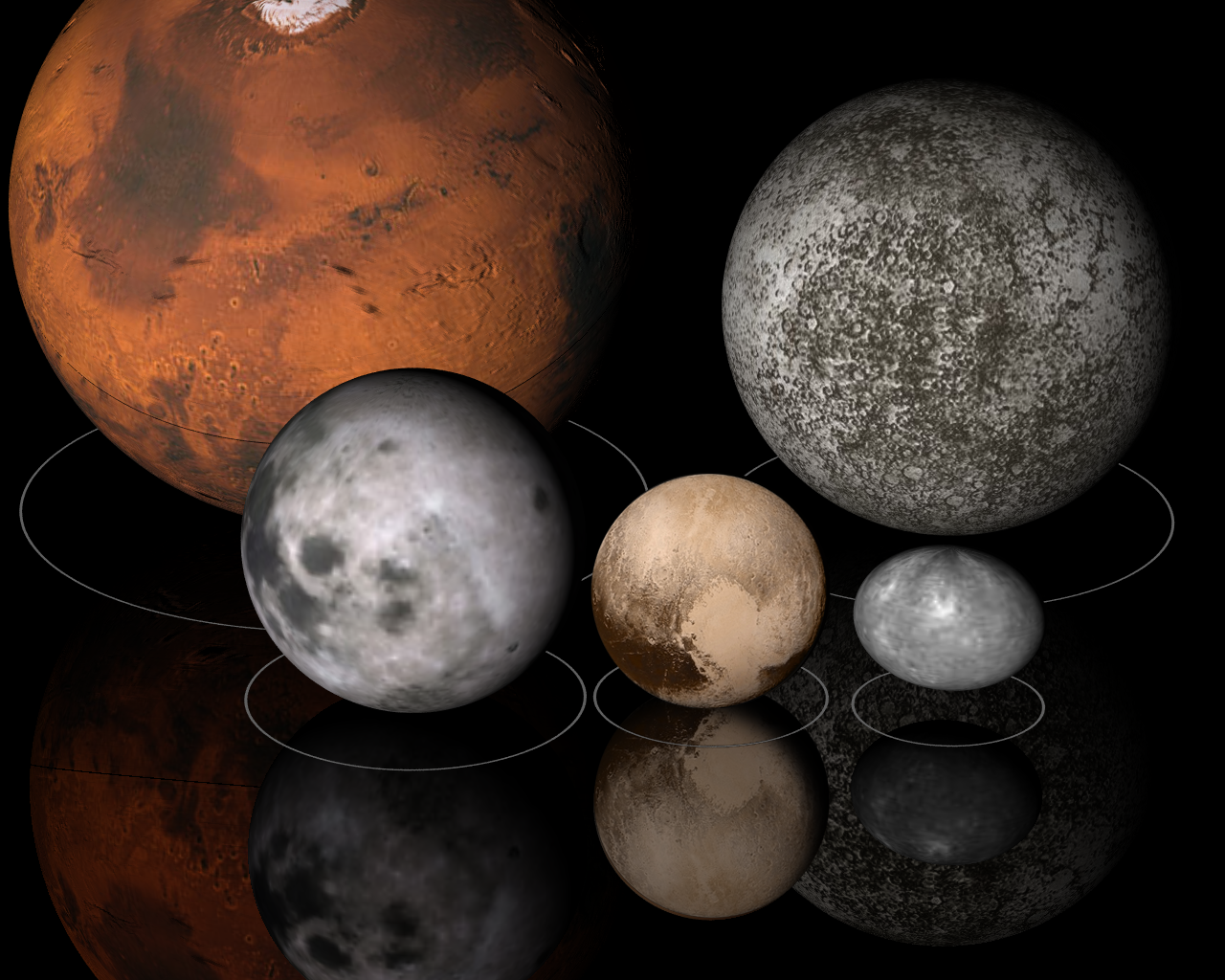
1e6m_comparison_Mars_Mercury_Moon_Pluto_Haumea_-_no_transparency.png
 
A few months ago you folks were telling me in this thread or one of the other threads that you'd already accounted for every chuck of material out there down to the size of a small moon.
Well, I didn't.

Regardless, the point stands that you can't build anything like a dark matter halo out of low mass planetary-size probably quite high metallicity baryonic matter that presumably follows broadly the same general distribution as gas and stars.
 
Science by Press Release Loses Again

Several years ago (3?) we found out that the black holes in the center of galaxies are significantly larger than first estimated. Something like three years ago we found out that you folks grossly underestimated the amount of light and number of stars in a galaxy due to dust. For all you know there could be twice as many large stars in a galaxy as you first estimated. Two years or so ago we found out that you grossly underestimated the number of smaller stars compared to the "larger" ones we could observe. It turns out that there could be four or five times more small stars in a galaxy than you realized, meaning you guys probably underestimated the total number of ordinary stars in a galaxy by whole order of magnitude. Now we find out that there are more detached Jupiter sized objects out there than here are stars in the heavens. Even still, nothing has been done to rectify the "problems" in your "dark matter' theories, or to minimize the need for non-baryonic exotic forms of matter, not even a *SINGLE* percent. Why?
Because there is no "problem" to rectify. You don't understand what you are reading. But if that wasn't bad enough, you think you can use press releases and news reports as if they are "science". There is no problem to rectify, there is just you making a whole bunch of fairly obvious mistakes.

"Grasping at straws", as they say.
Here is the research paper for Mozina's first news report: The Black Hole Mass, Stellar Mass-to-Light Ratio, and Dark Halo in M87; Karl Gebhardt & Thomas Jens; Astrophysical Journal 700(2): 1690-1701, August 2009

Abstract:
We model the dynamical structure of M87 (NGC4486) using high spatial resolution long-slit observations of stellar light in the central regions, two-dimensional stellar light kinematics out to half of the effective radius, and globular cluster velocities out to eight effective radii. We simultaneously fit for four parameters: black hole mass, dark halo core radius, dark halo circular velocity, and stellar mass-to-light (M/L) ratio. We find a black hole mass of 6.4(±0.5) × 109 Msun (the uncertainty is 68% confidence marginalized over the other parameters). The stellar M/LV = 6.3 ± 0.8. The best-fit dark halo core radius is 14 ± 2 kpc, assuming a cored logarithmic potential. The best-fit dark halo circular velocity is 715 ± 15 km s-1. Our black hole mass is over a factor of 2 larger than previous stellar dynamical measures, and our derived stellar M/L ratio is two times lower than previous dynamical measures. When we do not include a dark halo, we measure a black hole mass and stellar M/L ratio that is consistent with previous measures, implying that the major difference is in the model assumptions. The stellar M/L ratio from our models is very similar to that derived from stellar population models of M87. The reason for the difference in the black hole mass is because we allow the M/L ratio to change with radius. The dark halo is degenerate with the stellar M/L ratio, which is subsequently degenerate with the black hole mass. We argue that dynamical models of galaxies that do not include the contribution from a dark halo may produce a biased result for the black hole mass. This bias is especially large for a galaxy with a shallow light profile such as M87, and may not be as severe in galaxies with steeper light profiles unless they have a large stellar population change with radius.

So how big of a "problem" is this for standard dark matter cosmology? At worst, we have underestimated the masses of the galactic central black holes by about a factor of 2. The black hole in M87, reported here, is the most massive galactic central black hole known, and with a mass as reported in this paper, constitutes about 0.25% of the dynamic mass of the galaxy. So a factor of two uncertainty means that what used to be 0.125% is now 0.25% of the galaxy mass. Hurrah, our galaxy masses are in error by 0.125%. I guess that kills dark matter dead. But of course, this assumes that all supermassive black holes are that large a fraction of the galaxy mass. But in the case of our Galaxy, where we know the black hole mass with significant precision, it weighs in at about 0.0004% of the dynamical mass of the galaxy. So an error as large as 0.125% is a worst case scenario, the real number likely being somewhat smaller. Besides, note the second hilite note in the abstract. The authors recognize a bias in their data which they suspect is exaggerated in this case by the radial distribution of stars in the galaxy, so the effect might not even be real at all across galaxies in general, but only in the case of galaxies that fit this distribution. So 0.125% is a doubly worst case scenario.

But even if we were off by a factor of 10, that translates into a doubly worst case scenario 1.25% error in galactic mass. But dark matter constitutes over 90% of the observable universe. So a 1.25% error, while perhaps significant in other contexts, would be insignificant in the context of dark matter. So it goes without saying that 0.125% is a considerably more insignificant error.


Now here is the research paper for Mozina's second link: The Energy Output of the Universe from 0.1 to 1000 μm; Simon Driver, et al; Astrophysical Journal Letters 678(2): L101-L104, May 2008

Abstract:
The dominant source of electromagnetic energy in the universe today (over ultraviolet, optical, and near-infrared wavelengths) is starlight. However, quantifying the amount of starlight produced has proved difficult due to interstellar dust grains that attenuate some unknown fraction of the light. Combining a recently calibrated galactic dust model with observations of 10,000 nearby galaxies, we find that (integrated over all galaxy types and orientations) only 11% +/- 2% of the 0.1 μm photons escape their host galaxies; this value rises linearly (with logλ) to 87% +/- 3% at 2.1 μm. We deduce that the energy output from stars in the nearby universe is (1.6+/-0.2)×1035 W Mpc-3, of which (0.9+/-0.1)×1035 W Mpc-3 escapes directly into the intergalactic medium. Some further ramifications of dust attenuation are discussed, and equations that correct individual galaxy flux measurements for its effect are provided.

Note the hilite comments. We are looking at the photons from 0.1 to 2.1 μm, but the title reads "from 0.1 to 1000 μm". The fact is none of that 0.1 to 2.1 μm energy is missing, it has already been seen (and therefore counted) in energy budgets as long wavelength submillimeter thermal dust emission. The paper says that the photons in the 0.1 to 2.1 μm range are by some significant fraction not escaping "directly" into the intergalactic medium. But they do escape indirectly by heating the dust, and therefore supplying the energy for the longer wavelength emission. So this has nothing to do at all with dark matter or dark energy and poses no imaginable problem in that context.


Now here is the research paper for Mozina's third & final link: Evidence for a Nonuniform Initial Mass Function in the Local Universe Gerhardt Meurer, et al., Astrophysical Journal 695(1): 765-780, April 2009

Abstract
Many of the results in modern astrophysics rest on the notion that the initial mass function (IMF) is universal. Our observations of a sample of H I selected galaxies in the light of Hα and the far-ultraviolet (FUV) challenge this result. The extinction-corrected flux ratio F/fFUV from these two tracers of star formation shows strong correlations with the surface brightness in Hα and the R band: low surface brightness (LSB) galaxies have lower F/fFUV ratios compared to high surface brightness galaxies as well as compared to expectations from equilibrium models of constant star formation rate (SFR) using commonly favored IMF parameters. Weaker but significant correlations of F/fFUV with luminosity, rotational velocity, and dynamical mass as well as a systematic trend with morphology, are found. The correlated variations of F/fFUV with other global parameters are thus part of the larger family of galaxy scaling relations. The F/fFUV correlations cannot be due to residual extinction correction errors, while systematic variations in the star formation history (SFH) cannot explain the trends with both Hα and R surface brightness nor with other global properties. The possibility that LSB galaxies have a higher escape fraction of ionizing photons seems inconsistent with their high gas fraction, and observations of color-magnitude diagrams (CMDs) of a few systems which indicate a real deficit of O stars. The most plausible explanation for the correlations is the systematic variations of the upper mass limit Mu and/or the slope γ which define the upper end of the IMF. We outline a scenario of pressure driving the correlations by setting the efficiency of the formation of the dense star clusters where the highest mass stars preferentially form. Our results imply that the SFR measured in a galaxy is highly sensitive to the tracer used in the measurement. A nonuniversal IMF would also call into question the interpretation of metal abundance patterns in dwarf galaxies as well as SFHs derived from CMDs.
The initial mass function is the distribution if stars as counted per mass bin. In other words, how many stars do we count for each stellar mass? The total mass is already accounted for in the dynamical mass of the galaxy, which is derived from motion and is independent of any stellar distribution. So this too has nothing at all to do with dark matter, it constitutes no problem because it does not introduce any alteration in the mass. It concerns only the statistical distribution of star sizes that make up that mass, or make up the total star light. In the context of evolution of the stellar population of a galaxy, this is significant. However, in the context of cosmic dark matter it is a non-starter.

All 3 of Mozina's links constitute no problem for dark matter cosmology, either individually or all together. As has been said many times, you can't do science by press release, or news reports. Mozina does not try to see beyond the press release, and so gets the science all wrong, seriously overestimating the effect on dark matter cosmology.
 
Since random links is the theme:

http://scienceblogs.com/startswithabang/2011/05/dark_energy_confirmed_again.php

Well, the WiggleZ team from Australia just released their results this week: the most comprehensive survey -- of 200,000+ galaxies -- designed to measure dark energy by this method.

Their results are a spectacular confirmation of the best prediction of our Universe: one where 70-75% of the energy is dark energy, and where the total amount of baryons is only about 4-5%, with the rest being dark matter. They also found, to the best of their measurements, that dark energy is, in fact, a cosmological constant, with no change over time and the correct equation of state. (I.e., it gives the right pressure/energy density combination to be a cosmological constant.)
 
Mozina does not try to see beyond the press release, and so gets the science all wrong, seriously overestimating the effect on dark matter cosmology.

I think the causality goes the other way. Mozina wants something to kill dark matter cosmology; to do that he needs to get the science all wrong. Stopping at the press release is a help, not a hindrance. :)
 
A few months ago you folks were telling me in this thread or one of the other threads that you'd already accounted for every chuck of material out there down to the size of a small moon. We were talking about "rocks" at that point because our studies were "sooooooooo good".
You are wrong as usual.
This was your unphysical "dark matter = rocks" idea in the Fermi and dark matter thread.
It was easy to show that this idea was invalid
  • If your rocks were MACHOs then the science tells us that they can make up at most 5% of dark matter (and that % decreased with new observationsa and so is likely to decrease a bit more with more observations).
  • If your rocks were smaller than MACHOs then the number of them required to match dark matter would mean that they would collide as pointed out by ben m, disintegrate into dust and plasma, i.e. heat up and not be dark.
No one stated that we had a database of every rock in the universe :jaw-dropp.

But if you want to continue with your "dark matter = rocks" idea, perhaps you can answer the following outstanding questions in the Fermi and dark matter thread from 23rd November 2009.
The answers to these questions seem to be outstanding, MM:


So how big of a "problem" is this for standard dark matter cosmology? At worst, we have underestimated the masses of the galactic central black holes by about a factor of 2. The black hole in M87, reported here, is the most massive galactic central black hole known, and with a mass as reported in this paper, constitutes about 0.25% of the dynamic mass of the galaxy. So a factor of two uncertainty means that what used to be 0.125% is now 0.25% of the galaxy mass. Hurrah, our galaxy masses are in error by 0.125%. I guess that kills dark matter dead. But of course, this assumes that all supermassive black holes are that large a fraction of the galaxy mass. But in the case of our Galaxy, where we know the black hole mass with significant precision, it weighs in at about 0.0004% of the dynamical mass of the galaxy. So an error as large as 0.125% is a worst case scenario, the real number likely being somewhat smaller. Besides, note the second hilite note in the abstract. The authors recognize a bias in their data which they suspect is exaggerated in this case by the radial distribution of stars in the galaxy, so the effect might not even be real at all across galaxies in general, but only in the case of galaxies that fit this distribution. So 0.125% is a doubly worst case scenario.
I think it may be even worse than that for Michael (though I'd not swear by it). If we've underestimated the mass in the centre of galaxies then as we move out away from the centre we'd expect the rotation curve to drop off more quickly. To rectify this with the observed flatish rotation curve would require more dark matter, not less. Of course it is a teeny tiny amount more but it nicely illustrates the stupidity of making wild claims about mainstream incompetence whilst being almost completely ignorant about the subject oneself.
 
Any chance we could get an acknowledgement/apology from Michael?

"I realize now that this free-planet discovery does not contribute to my desire to explain galaxy dynamics using ordinary matter. Thanks for explaining it. I won't bring it up again, I promise."

"I realize now that mainstream astronomy has put a lot of work into attempts to explain galaxy dynamics using regular matter in various forms. Although I hope to find such an explanation someday, in the future I will not leap to the assumption that simple things were merely overlooked."

(ETA: "Next time, I'll take the time to try to learn what is already known about the topic, or ask for help in so learning.")

... or something?
 
Last edited:
Any chance we could get an acknowledgement/apology from Michael?

"I realize now that this free-planet discovery does not contribute to my desire to explain galaxy dynamics using ordinary matter. Thanks for explaining it. I won't bring it up again, I promise."

"I realize now that mainstream astronomy has put a lot of work into attempts to explain galaxy dynamics using regular matter in various forms. Although I hope to find such an explanation someday, in the future I will not leap to the assumption that simple things were merely overlooked."

(ETA: "Next time, I'll take the time to try to learn what is already known about the topic, or ask for help in so learning.")

... or something?

Considering it was you personally that was suggesting that we'd already seen and accounted for everything the size of a moon, and the fact that I just cited 3 different recent observations of "dark matter" actually being related to "normal" matter, you'll pardon me if I don't much feel like "apologizing". You guys haven't budged a single percentage yet. When you do, wake me up. Then "maybe". :)
 
Well, I didn't.

No, you didn't. ;)

Regardless, the point stands that you can't build anything like a dark matter halo out of low mass planetary-size probably quite high metallicity baryonic matter that presumably follows broadly the same general distribution as gas and stars.

Maybe. Maybe it's spread into thin orbits around the galaxy, much like a planetary ring. The mainstream has yet to acknowledge 'current' as a force of nature in space, so I'm not exactly holding my breath waiting for them to revisit Peratt's computer models and his work. Interestingly enough, he created basic "shapes" of galaxy (rotation patterns) that look a lot like modern galaxies *WITHOUT* exotic forms of matter.

Like I've been saying all along, "missing mass" isn't necessarily exotic mass anymore than an "unidentified flying object" is necessarily from a another planet. Our technology is still pretty primitive, and our understanding of the importance of currents in space is simply pathetic, IMO.
 
Like I've been saying all along, "missing mass" isn't necessarily exotic mass anymore than an "unidentified flying object" is necessarily from a another planet. Our technology is still pretty primitive, and our understanding of the importance of currents in space is simply pathetic, IMO.


That would, of course, be an argument from a wholly unqualified opinion.
 
Considering it was you personally that was suggesting that we'd already seen and accounted for everything the size of a moon, and the fact that I just cited 3 different recent observations of "dark matter" actually being related to "normal" matter, you'll pardon me if I don't much feel like "apologizing". You guys haven't budged a single percentage yet.

Do you want to quote anything I've said on the topic that was incorrect?

I never said "we saw and accounted for everything as small as moons", I said "objects as small as moons can't add up to more than X% of the Milky Way mass".

There's a difference. Among the differences: you can make statements like "not as much as" about things you've failed to see, as well as things you have seen. For example: I've picked up a few dozen pieces of beach glass, but never once found a gold coin. I can confidently say that gold coins are a minority---a very small minority---of flat objects found on local beaches. (You couldn't refute this by simply finding a gold coin or two, could you?)

I see you still don't understand it.
 
Maybe. Maybe it's spread into thin orbits around the galaxy, much like a planetary ring.

It's not.

The mainstream has yet to acknowledge 'current' as a force of nature in space,

Sure we have. You just don't like the way we do it, and you don't like the answer.

Like I've been saying all along, "missing mass" isn't necessarily exotic mass

Then why do you have such a hard time coming up with non-exotic mass models that aren't ruled out already?
 
Considering it was you personally that was suggesting that we'd already seen and accounted for everything the size of a moon, and the fact that I just cited 3 different recent observations of "dark matter" actually being related to "normal" matter, you'll pardon me if I don't much feel like "apologizing". You guys haven't budged a single percentage yet. When you do, wake me up. Then "maybe". :)

Did any of these papers even mention what effect the results would have on dark matter estimates?
 
Maybe. Maybe it's spread into thin orbits around the galaxy, much like a planetary ring.
Two questions:
1) Do you know what a galactic rotation curve is?
2) Do you understand Newtonian mechanics?
If the answer is yes to both the previous then it should be possible to determine a reasonable form approximation for the dark matter distribution and to show whether or not it is possible for the distribution you suggest above could account for the observed rotation curve.
If the answer is no to both 1) and 2) what makes you think you could possibly be in a position to adequately and accurately judge the methodology, results and interpretations of the professional astronomers. The only thing I can think of which can possibly explain such confidence without even knowledge of the fundamentals in question is pure arrogance.

The mainstream has yet to acknowledge 'current' as a force of nature in space, so I'm not exactly holding my breath waiting for them to revisit Peratt's computer models and his work.
That's because current, or `current' isn't a force of nature.

Interestingly enough, he created basic "shapes" of galaxy (rotation patterns) that look a lot like modern galaxies *WITHOUT* exotic forms of matter.
And without gravity. Meaning the similarity is either:
a) coincidental
or
b) due to extreme fine-tuning of free parameters.

Like I've been saying all along, "missing mass" isn't necessarily exotic mass anymore than an "unidentified flying object" is necessarily from a another planet.
You can say this all you want. Unfortunately your claims are contrary to hundreds, probably thousands, of pieces of quantified, complementary experimental evidence.

Our technology is still pretty primitive, and our understanding of the importance of currents in space is simply pathetic, IMO.
But it is just an opinion. The opinion of someone who's grasp on physics is tenuous at best. Someone who is completely in capable of understanding the quantitative nature of physics and barely capable of quantifying their own ideas. That compares to the hundreds of papers written by those with often decades of training in maths, physics and astronomy. Who've spent large fractions of their working life coming to terms with the relevant discoveries of the last 100 years, the precise details and limits of their instrumentation, possible sources of bias and so on... Who to believe?
 
If the answer is no to both 1) and 2)

That's the safe bet.

what makes you think you could possibly be in a position to adequately and accurately judge the methodology, results and interpretations of the professional astronomers.

He can look at pretty pictures and tell us what he thinks they look like to him. Isn't that enough of a qualification?
 
That's the safe bet.
That's where my money would be, although I actually meant to say "either or both of 1) and 2)...".

He can look at pretty pictures and tell us what he thinks they look like to him. Isn't that enough of a qualification?
Its a key qualification for a navel-gazer. An astronomer (a star-gazer I suppose)? Not so much.
 
Considering it was you personally that was suggesting that we'd already seen and accounted for everything the size of a moon, and the fact that I just cited 3 different recent observations of "dark matter" actually being related to "normal" matter, you'll pardon me if I don't much feel like "apologizing".
You are lying or delecuded otherwise you would have clited the posts where that was stated.
No one stated that this. What was stated was
  • If your rocks were MACHOs then the science tells us that they can make up at most 5% of dark matter (and that % decreased with new observationsa and so is likely to decrease a bit more with more observations).
  • If your rocks were smaller than MACHOs then the number of them required to match dark matter would mean that they would collide as pointed out by ben m, disintegrate into dust and plasma, i.e. heat up and not be dark.
MACHOs are bigger than moons (brown dwarfs, neutron stars, etc).

You are definitely lying about the papers as Tim Thomson's posts makes it clear that they do not discuss dark matter: Science by Press Release Loses Again

The only paper that has implicaitons for dark matter is The Black Hole Mass, Stellar Mass-to-Light Ratio, and Dark Halo in M87. That implies that galaxies may be a tiny % heavier than we clalculate now (0.25% more for M87).

The further implication is that because this mass is in the center of the galaxy, there must be more dark matter then previously calculated to explain the galaxy rotation curve
 
The mainstream has yet to acknowledge 'current' as a force of nature in space, so I'm not exactly holding my breath waiting for them to revisit Peratt's computer models and his work. Interestingly enough, he created basic "shapes" of galaxy (rotation patterns) that look a lot like modern galaxies *WITHOUT* exotic forms of matter.
Ohh the ignorance :eye-poppi !
Other posters have pointed out the ignorance that currents are not forces of nature and electrical fields are a fundemental part of space science (try reading a plasma physics textbook sometime Michael Mozina).

So we are left with Anthony Peratt's Plasma Model of Galaxy Formation.
No one would revisit Peratt's computer models because they produced nothing that matches a galaxy.
The results of the computer simulations are maps of the distribution of plasma particles in a plane through the plasma filaments. These are maps of the distribution of the mass in the galaxies since all of the mass is in plasma. Peratt then proceeds to compare these mass distribution maps to radio and optical images. But
* Radio galaxies are almost universally hosted in elliptical galaxies.
* The reason that spiral galaxies look like they have spiral arms is not because there are actual arms (with no matter in between them) but because they are "arms" of high mass density containing lots of bright young stars. The density of matter in between the arms is 10-20% less than the density of matter in the arms (not 100%).
The mass distribution of elliptical galaxies is ellipsoidal so a plane through them produces various ellipses from nearly a circle to flattened to a large degree.
The mass distribution of spiral galaxies is a central bulge contained within a flat disk along with a near-spherical halo outside the disk and bulge. The mass distribution of a plane running through the disk produces a disk with minor variations in density.

Neither mass distribution matches the results from the computer simulations.
 
Last edited:
We have been down this road before,

If you have ~10% of the matter accounted for and 90% unaccounted for, a variance of 2x-3x within that 10% is not going to make it anywhere near enough, even if the whole thing is wrong and it is 4x and teh whole caboodle, that leaves 60% un accounted for.

Even Perrat does not use his work the way the cult of electro dynamics, with inadequate charges and field strengths does.
 
Status
Not open for further replies.

Back
Top Bottom
