• Quick note - the problem with Youtube videos not embedding on the forum appears to have been fixed, thanks to ZiprHead. If you do still see problems let me know.

Merged nuclear power safe?

Next Big Future blog applies the Chernobyl casualty estimates from the Union of Concerned Scientists to civilian air travel in the US and comes up with startling conclusions of their own.

UCS all things nuclear has an analysis of how many deaths occurred at Chernobyl based on linear no threshold view of radiation. So 0.01 milliSieverts (1 milliRem) for each of 6 billion people in the world is calculated to add 4000 deaths from cancer. 0.3 milliSieverts (30 milliRem) for 500 million people in europe is calculated to add 9000 more deaths from cancer.

Using the same analysis, 79,000 and 40,000 are reasonable estimates of the number of excess cancers and cancer deaths attributable to the flying in the past decade. The numbers increase even more over the 25 years since Chernobyl and would be 200,000 excess cancers and 100,000 excess deaths from commercial aviation over the last 25 years.

As the US EPA explains, exposure to cosmic radiation depends on altitude, latitude, and solar activity, but the EPA estimates that "a typical cross-country flight in a commercial airplane" results in "2 to 5 millirem (mrem)" of dose from radiation.
 
If it would be the case we would be seeing increase of cancer in a young/middle age age range , the one which has currentely a lot of disposable income or do a lot of duty travel. As far as I can tell from satatistic this is not happenning.
 
Radiation leak (possibly from fuel ponds) at Tsuruga plant, which had to shut down because of it.
 
This is happening a lot faster than expected.

Germany's dramatic rethink over nuclear power has thrown up new problems, as the consequences of a retreat from atomic technology emerge.

Link
 
the claims are popping up again, can anyone help me with this?

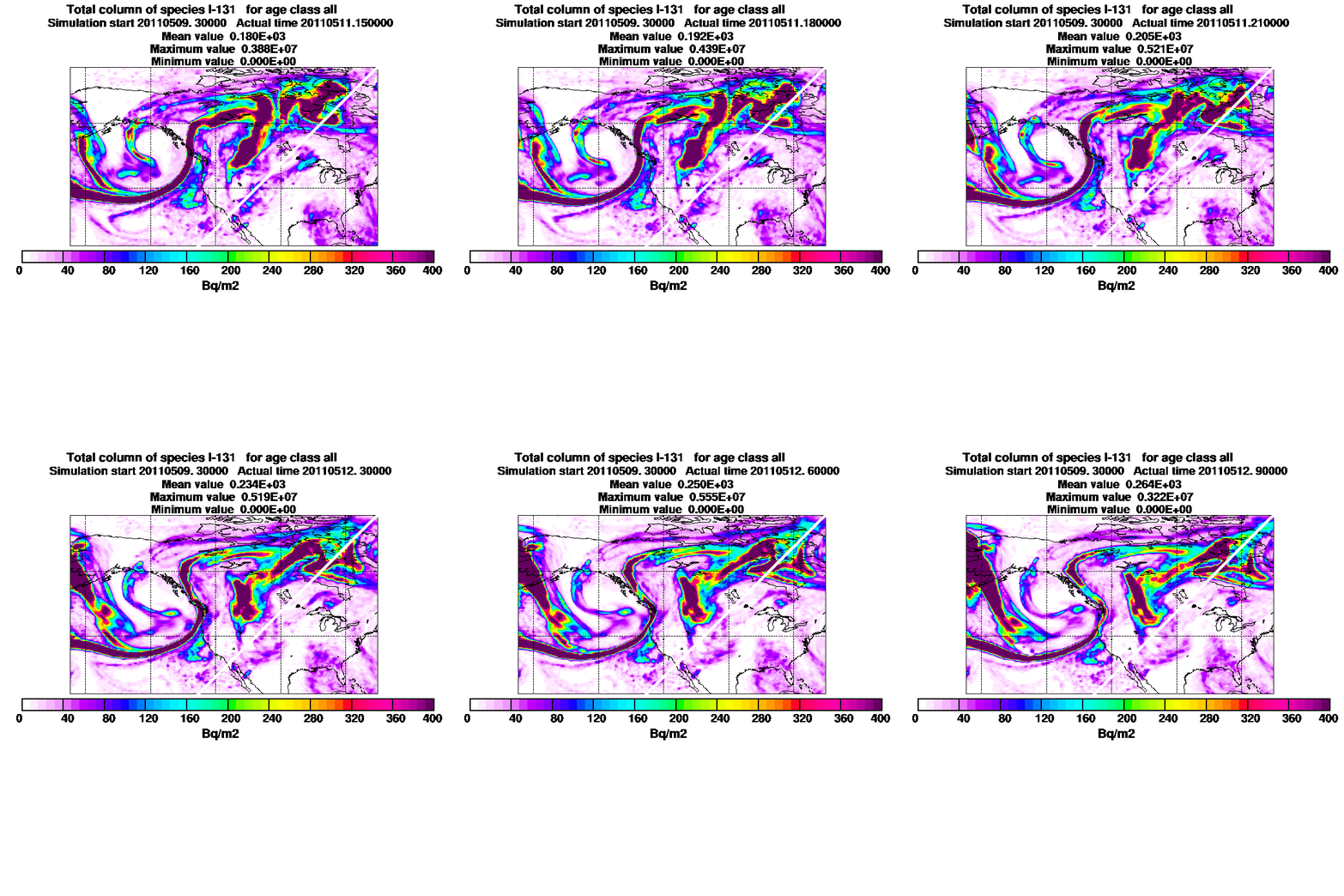
tracer_h_2019.gif


Iodine-131 (131I), also called radioiodine (though many other radioactive isotopes of this element are known), is an important radioisotope of iodine. It has a radioactive decay half life of about eight days. Its uses are mostly medical and pharmaceutical. It also plays a role as a major radioactive hazard present in nuclear fission products, and was a significant contributor to the health effects from open-air atomic bomb testing in the 1950s, and from the Chernobyl disaster, as well as being a threatening presence today in the Japanese nuclear crisis. This is because I-131 is a major uranium, plutonium and indirectly thorium fission product, comprising nearly 3% of the total products of fission (by weight).
 
1) link to graphic , at the moment you don't attribute it, you hot link it, which might be a breach of member agreement, but I may be wrong. Unless you made it yourself.

2) link to the web page purporting doing the simulation, and what parameter they used, what model, how much emission they calculated.
 
What would 400 bq/m2 mean? Should it be m3 instead of m2?

According to this, up to 2000 bq/kg is considered fit for human consumption in the case of vegetables. (I don't know why that's an appropriate level, but that's what it says).

http://fukushimafaq.wikispaces.com/Radiation+Allowable+Levels

Then there's the question of whether that animation is accurate about what the levels are

I thought the same thin originally about m3, but then sometimes to make simulation simpler I approximated thin layer with a zero thickness and density per m^2 instead of volume and density per m^3. If the dispersion in the atmosphere is on the lower level, comapred to the spread, it can be justified.

But here we don't know anything so all it looks like is a pretty graphic, and for all we care they could have put "faerie. Celsius-1".
 
OK, Jane, then let's see your scientifically proven figures. If they happen to arise from a certain Greenpeace article I'm aware of, then we'll know something of the caliber of your science.

As a matter of fact, the IAEA and the Chernobyl Forum (a consortium of the USA, Russia, Ukraine, Beyelorus and other governments in the area say the official death tole is 56. That number is the number of official recorded deaths that were a direct result of the disaster. They go on to say that there has been no detectable "bump" in hard or soft cancers, nor in birth defects; the one exception is thyroid cancers, which are 98+% curable today.

That is not quite the same thing as saying that there were only 56 deaths in the accident; obviously there were probably more, but there is no official trace of them. Blame for that fact, in the face of a monumental accident and the Soviet need to secrecy, can be argued (and will be) far after we're long gone.

So they guess - they say, based on other public health statistics, that 4,000 sounds like a good number, but the real number may be a factor of ten either way from that, and no one will ever be able to prove it. You have the Greenpeace guess of 250,000, and other who guess that the proven 56 number sounds right. Unless, of course, Jane has something she's been hiding for 25 years.

Your video is just another polemic in the info war.

It's not my video. I wonder why you'd need to personalize the issue.

I'll ask my question again as you haven't answered it. Does anyone know of any research into the fate of the tens of thousands of "bio-robots"/"liquidators" sent in to try and clean up the horrific disaster? Does anyone care?
 
Last edited:
I thought the same thin originally about m3, but then sometimes to make simulation simpler I approximated thin layer with a zero thickness and density per m^2 instead of volume and density per m^3.

Or alternatively it's the integrated content over the entire column of atmosphere from ground level to the top - simulated in 3D, but projected into 2D for visualization.

But here we don't know anything so all it looks like is a pretty graphic, and for all we care they could have put "faerie. Celsius-1".

Indeed.
 
http://www.asahi.com/english/TKY201105130192.html
TEPCO officials concluded that water had accumulated in only about 20 percent of the volume of the No. 1 reactor's pressure container.

Other specialists had long warned that the situation at the No. 1 reactor was much more serious than the scenario that TEPCO officials were presenting
.

http://www.asahi.com/english/TKY201105130370.html
Tokyo Electric Power Co. concealed data showing spikes in radiation levels at the Fukushima No. 1 nuclear power plant in March, one day before a hydrogen explosion injured seven workers.

The Asahi Shimbun obtained a 100-page internal TEPCO report containing minute-to-minute data on radiation levels at the plant as well as pressure and water levels inside the No. 3 reactor from March 11 to April 30.

The data has never been released by the company that operates the stricken plant.
 
It looks like the Japanese are serious about preventing yet another serious reactor problem, by shutting down reactors and making them safe enough to withstand a major earthquake and tsunami.

What a rational and scientific approach!

But then while shutting down a reactor they have terrible problem!

http://criticality.org/2011/05/hamaoka-shutdown-underway-problems/

I get a kick out of how polite and understated even the news is from Japan.

http://search.japantimes.co.jp/cgi-bin/nn20110516a5.html

The Nagoya-based firm said the problem in the reactor's cooling system was found Saturday evening after a gauge indicated that around 400 tons of seawater had flowed into the condenser at around 4:30 p.m., most likely because of a piping problem.

The water also found its way into the reactor, making it necessary to desalinate it, the company said.

Of course this is also the same culture that describes the explosion of Fukushima 1 Reactor Building #3 as "a loud noise was heard and white smoke observed".

That is what they have in the official report. Same for building 1! "A loud noise was heard and white smoke observed".

So now when I hear "The water also found its way into the reactor" and they waited 20 hours to mention this to anyone, I don't believe for a second that is what really happened.
 
A bequerel is a single nucleus decay per second. As a measurement it is indescribably tiny; the Hiroshima bomb is estimated to have released 8x10^24 Bq of radiation. The more useful quantity of radiation rate is the Curie, which is 3.7x10^10 Bq.

The average human has about 4400 Bq of potassium-40 aboard at all times. It is the largest single radioactive factor present in the body, but is not a majority of it.

Your model is showing that some unit quantity of air in the atmosphere has upwards to 5 million Bq of I-131 at a given time, presumably mostly from the leakage in Japan. The question is how that translates into actual ground dosages to the average person. Also note that the Iodine decays with a half-life of 8 days, so after a year it is essentially homeopathic. It decays into non-radioactive Xenon by beta emission.

From wiki:

wiki said:
...testing in the United States found 0.8 pico-curies per liter of iodine-131 in a milk sample, but the radiation levels were 5,000 times lower than the FDA's "defined intervention level." The levels were expected to drop relatively quickly [12]

.8 picoCuries is .003 Bq per liter.


EDT: I see they did specify the amount of air: a 1 meter square column through the whole atmosphere. That is quite a bit of air, and it takes no account for the altitude of the majority of the iodine; at 60,000 ft it doesn't have much effect on the average body at all. And remember it has a time limit; getting washed out of the stratosphere in 6 months isn't going to cut it for dangerous.

And that's all assuming it is accurate as a simulation...
 
Last edited:

Back
Top Bottom