
You are using an out of date browser. It may not display this or other websites correctly.
You should upgrade or use an alternative browser.
You should upgrade or use an alternative browser.
Merged Discussion of femr's video data analysis
- Thread starter tfk
- Start date
tsig
a carbon based life-form

- Joined
- Nov 25, 2005
- Messages
- 39,049
Funny that you should mention "exhaustive"... A good description of this whole circle jerk.
And now you have 10 angels dancing on the head of an utterly irrelevant pin.
The velocity & acceleration profiles of the collapse of the north wall facade are completely & utterly irrelevant to NIST's assignment: explain why the building collapsed. Regardless of whether that acceleration was constant, variable, sub-g, g or super-g.
NIST completed their assignment competently.
Their explanations are in their report. The collapse of the north face plays zero role in the causal factors in the collapse of the building. The velocity & accelerations of the north face are the very late results of the collapse.
They were tasked with providing explanations of causes. Not results.
When NIST was dragged into this specious issue by Mr. Chandler's incompetence, they gave it the comparatively superficial attention & explanation that it deserved.
You may as well have applied your SynthEyes to tracking a single piece of the Challenger after it blew up. And then claimed that you "out performed NASA", because they didn't do the same to the silly extent that you did.
You've outperformed nobody. You bought yourself a tool. You wield it without judgment or understanding.
To someone who only has a hammer, everything looks like a nail.
Looks like he's fighting nano strawmen.
ozeco41
Philosopher

My narrow focus was deliberately limited to the context of the current discussion and for reasons which should be obvious.Ozeco, a second purpose is to produce the best data on the subject to date. It is an added bonus. The more accuracy the better. Why not?
Correct. Things like perspective correction, deinterlacing, pixel column method and static data extraction can be quantified fairly simply.What he does not state is the quantity of error that each could introduce.
Correct. Things such as sample rate are sampling process independant, but well, skipping over 90% of the available frames really doesn't help build detailed velocity or acceleration profile data.However for several of them it would appear impractical or impossible to quantify.
Important to note that factors such as the method being based upon a pixel column, rather than a feature on the building are quite serious.But surely it is sufficient to know that a number of factors introduce error.
It is not a factor which affects the accuracy of a sample as such, but more what it actually relates to.
As the building moves east-west in the frame, the pixel column being looked at ends up being the position of a different part of the building.
The most significant (and simplest) improvement is simply that every frame is sampled, rather than 1 in ~54.And we have strong evidence that femr2's methods yield more accurate results.
Without that increase in data volume, it would not be possible to generate any kind of profile detail.
Other improvements, such as static point extraction, simply increase the accuracy of each individual sample position, with the intent to maximise accuracy and minimise noise.
ozeco41
Philosopher
That was the one that "jumped out of the list" at me...Important to note that factors such as the method being based upon a pixel column, rather than a feature on the building are quite serious.
It is not a factor which affects the accuracy of a sample as such, but more what it actually relates to.
As the building moves east-west in the frame, the pixel column being looked at ends up being the position of a different part of the building...

W.D.Clinger
Philosopher

No.And we have strong evidence that femr2's methods yield more accurate results. The post by W.D.Clinger, whilst critical of excessive detail and some other matters of femr2's approach, actually confirms that his work is better than NIST on the factors in question.
So isn't it 'case proved' unless someone rebuts both femr2's claims and the support given by W.D.Clingers post?
For all your talk about context, you're paraphrasing me out of context so you can commit a fallacy of equivocation with respect to "femr2's methods".
femr2's methods for extracting data points from video are better than NIST's, and I'm inclined to think that several of femr2's related methods are also better than NIST's. Some of femr2's other methods, such as his cavalier use of high-degree polynomial curve fitting, are worse than NIST's methods. femr2 relied on those inferior methods when he argued that his results will convince cmatrix.
I do not know whether femr2's methods yield more accurate results overall. I certainly do not know of any strong evidence for that conclusion.
Part of the problem is that femr2 has not described his methods in enough detail for their accuracy to be evaluated properly. If you don't understand what I'm talking about, then I suggest you pick one of femr2's acceleration curves and attempt to calculate its residual sum of squares.
I know NIST described their methods and stated their conclusions with greater professionalism.
The result of a curve fit is better than a linear approximation, regardless of whether you think the range of plots with varying degrees presented is *cavalier*.Some of femr2's other methods, such as his cavalier use of high-degree polynomial curve fitting, are worse than NIST's methods.
Comparison with the profile using smoothed data only is testament to that, and is very similar in terms of trend, providing a much clearer view of acceleration over time, that being the purpose.
Bear in mind this is simply an ongoing forum discussion, not a formalised *paper* eh.
I have all sorts of graphs generated by differing methods. cmatrix hasn't responded to question 1, so there's no justification for you to suggest reliance upon a particular individual graph. You are also carrying forward your personal opinion that a linear fit is superior to a curve fit. I'm afraid I don't agree.femr2 relied on those inferior methods when he argued that his results will convince cmatrix.
Come now. Two totally differing methods, one employing curve fitting, the other employing Savitsky-Golan smoothing, with significant similarity in profile trend...I do not know whether femr2's methods yield more accurate results overall. I certainly do not know of any strong evidence for that conclusion.
http://femr2.ucoz.com/_ph/7/350095033.png
http://femr2.ucoz.com/_ph/7/628055186.png
...one of...
http://femr2.ucoz.com/_ph/7/408829093.gif
...as opposed to...
http://femr2.ucoz.com/_ph/7/659040095.png
..the red line.
Let's keep some perspective eh.
Again, I suggest that rather than apply your time to reverse engineering pre-existing graphs (as you apparently cannot find enough detail in the thread to replicate) that you simply use the base data to produce your own. I am pretty sure that whatever methods I used, regardless of the volume of additional information provided (including the actual data) you will still find something to complain about. M.O.I suggest you pick one of femr2's acceleration curves and attempt to calculate its residual sum of squares.
Last edited by a moderator:
Yes, especially significant with the Cam#3 perspective.That was the one that "jumped out of the list" at me
Here is the extent of NW corner horizontal motion within the frame during descent...
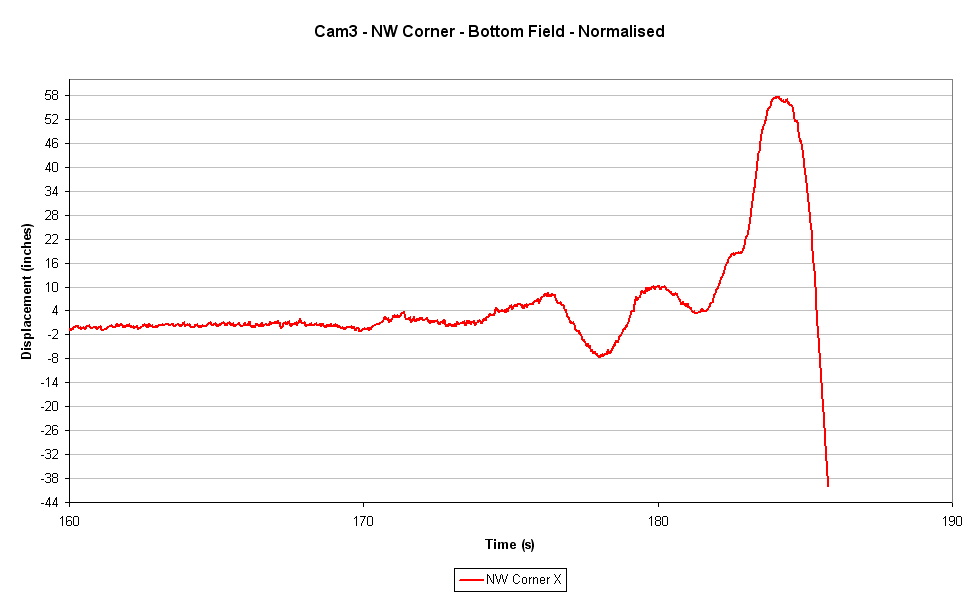
...which includes extraction of the horizontal camera motion...


Not that I care. I think that that part of their study is already of very little relevance, if at all.Regardless of whether you think it is a *noise generator*, the NIST data suffers from the following (non-exhaustive) series of technical issues, each of which reduce the quality, validity and relevance of the data in various measures...
Yet you use that "trend" to discredit NIST's "2.25 seconds of freefall". Not very wise. If they are a trend, the precision of ±7.5 ft/s² that I named is reasonable, therefore your data does not disprove NIST's assertion.The curve fit graphs are really not intended to provide more than the trend...as I keep saying.
That has the implicit assumption that there's an anyone here who cares. Which seems not to be the case. Guys such as cmatrix have their conclusion decided beforehand, and no data will convince them otherwise, which is specially true if the data comes from the debunking side of the debate, therefore it's highly unlikely that anyone will care, at least for the purpose that you claim to have.Absolutely. Anyone... not happy with/hasn't found/needs explicit detail about... my methods for generating acceleration profile graphs has full access to the raw position/time data and is welcome to produce their own.
The fact that you don't understand it, doesn't mean it's crap.HAnyone can verify that crap has made it through peer review. The capacity to verify and reproduce means everything. Peer review gives you crap like BLGB.
What I would say instead is that your inability to properly understand a technical paper makes you utterly incompetent in evaluating it. Fortunately, peer reviewers were competent.
And thanks for helping me prove my point about noise generation.
Then don't waste your timeNot that I care.

Incorrect. I *use* that trend to highlight the abundantly obvious...that there was no sustained period of *exactly freefall*, which is the interpretation of many.Yet you use that "trend" to discredit NIST's "2.25 seconds of freefall".
It's very funny that you are incapable of separating criticism/clarification and intent to discredit. Says a lot about you.
How many times do I have to say it before it actually sinks in through the NIST-flag-waving ? I am personally fullly aware of the implied (but unstated) approximate nature of the 2.25s period of time NIST states as *gravitational acceleration*. HOWEVER, there are many who do not. I have repeatedly stated that the nist metric is inaccurate (and based on poor data with grey meaning). I have repeatedly stated that their wording can be very misleading if interpreted literally.your data does not disprove NIST's assertion
If *you don't care*, don't pollute the thread (or if you do post, make sure you are right, yeah ?)
tsig
a carbon based life-form
- Joined
- Nov 25, 2005
- Messages
- 39,049
Then don't waste your time
Incorrect. I *use* that trend to highlight the abundantly obvious...that there was no sustained period of *exactly freefall*, which is the interpretation of many.
It's very funny that you are incapable of separating criticism/clarification and intent to discredit. Says a lot about you.
How many times do I have to say it before it actually sinks in through the NIST-flag-waving ? I am personally fullly aware of the implied (but unstated) approximate nature of the 2.25s period of time NIST states as *gravitational acceleration*. HOWEVER, there are many who do not. I have repeatedly stated that the nist metric is inaccurate (and based on poor data with grey meaning). I have repeatedly stated that their wording can be very misleading if interpreted literally.
If *you don't care*, don't pollute the thread (or if you do post, make sure you are right, yeah ?)
The goal of analysis is to reach a conclusion so after all the pixel pinching and graph gazing why did the towers collapse?
alienentity
Illuminator

- Joined
- Feb 21, 2009
- Messages
- 4,325
How many times do I have to say it before it actually sinks in through the NIST-flag-waving ? I am personally fullly aware of the implied (but unstated) approximate nature of the 2.25s period of time NIST states as *gravitational acceleration*. HOWEVER, there are many who do not. I have repeatedly stated that the nist metric is inaccurate (and based on poor data with grey meaning). I have repeatedly stated that their wording can be very misleading if interpreted literally.
Hmm, I think you've been trying to have your cake and eat it too. On one hand you have focused on a small part of a larger analysis and taken it literally - 'NIST are not stating approximately gravitational acceleration. They are stating gravitational acceleration.' In fact you vociferously argued that the many uses of the word 'approximate' in the paragraphs from which the phrase 'gravitational acceleration' is plucked should be eliminated from the picture.
You even ridiculed those who pointed this out to you.
Now you're complaining that others are taking these words too literally?
btw, I bolded part of your post which is IMO misleading for this reason. The approximate nature of the measurements is not 'unstated' as you claim. It is evident throughout the NIST explanation.
End result is that your measurements show that the building did not 'instantaneously' enter into freefall, as truthers erroneously claim; partly it fell at a rate approximately that of freefall (ie near freefall), depending on where you decide to measure the descent.
This is not much different from what the NIST report states, even though their measurements were made differently.
If anything it may indicate that NIST 'caved in' to the social pressure coming from 9/11 Truthers and agreed that the data can be interpreted as freefall - depending on the method applied.
Did they get defensive and launch into a long, technical argument as to why David Chandler's measurements were 'sloppy' or 'nonsense'? NO. And it would have been the worst of several bad options available to them, to engage in a public argument with the less rational observers of the WTC collapses.
I'm quite sure someone at NIST was aware that the argument would never have satisfied critics, so was quite futile. Ironically perhaps, the incessant nitpicking of Femr2 is proof that some critics will NEVER be satisfied; they will just keep chewing at this bone and grumbling about NIST.
To some, Femr2's work augments the work of NIST by providing another viewpoint, one which demonstrates that the claims of truthers are based on poor understanding of the physics, reliance on quotemining and overly-literal interpretation of key statements in the NIST reports, FEMA and 9/11 Commission reports and any other materials they chance upon.
And most important - Femr2's data do NOT show that the NIST engineering analysis of the WTC 7 collapse was incorrect in any meaningful way. Certainly it is not perfect, but then nothing is perfect. That would be asking far too much.
Nonsense. I have stated that it is taken literally.you have focused on a small part of a larger analysis and taken it literally
Nonsense. Don't be a drama queen. I highlighted the focus of the included approximates, sure (well at least one of them). Vociferously argued ? Nah. lol.In fact you vociferously argued that the many uses of the word 'approximate' in the paragraphs from which the phrase 'gravitational acceleration' is plucked should be eliminated from the picture.
Nonsense. Again, don't be a drama queen. Feel free to quote the vociferous ridicule you are accusing me of.You even ridiculed those who pointed this out to you.
Too funny.Now you're complaining that others are taking these words too literally?
It is unstated. Implied, sure.The approximate nature of the measurements is not 'unstated' as you claim. It is evident throughout the NIST explanation.
That is one simplistic observation, sure. Other behaviours and observations can be extracted from the data. So, no, not quite *end result*End result is that your measurements show that the building did not 'instantaneously' enter into freefall, as truthers erroneously claim; partly it fell at a rate approximately that of freefall (ie near freefall), depending on where you decide to measure the descent.

aka don't highlight how poor a job NIST did, coz I don't like it. Lol.Ironically perhaps, the incessant nitpicking of Femr2 is proof that some critics will NEVER be satisfied; they will just keep chewing at this bone and grumbling about NIST.
I'm afraid all of my critical observations of the section in question still stand, and I note you are not even attempting to refute them, which is a jolly good idea as most are pretty obvious (and pretty poor show on NISTs part, imo)
Which is fine. You also need to sort out your reliance on quotemining and improve your retention of context (interpretation).To some, Femr2's work augments the work of NIST by providing another viewpoint, one which demonstrates that the claims of truthers are based on poor understanding of the physics, reliance on quotemining and overly-literal interpretation of key statements in the NIST reports
alienentity_wdc_tfk_and_many_others said:The approximate nature of the measurements is not 'unstated' as you claim. It is evident throughout the NIST explanation.
It is unstated. Implied, sure.
You are wrong about this.
You've been told multiple times that you're wrong.
You've been shown exactly where NIST states that it is approximate.
You're too "experimental data illiterate" to understand.
aka don't highlight how poor a job NIST did, coz I don't like it. Lol.
NIST didn't do a poor job.
They are pros.
You are an abject amateur.
And dwell in the delusion that you can purchase technical competence for the price of a feature tracking program.
You're wrong about that, too.
Tom, if you are a pro too, why have we seen you make so many mistakes every time you go into insult mode with femr?
We would have to have short memories to take the posturing seriously.
Can you try adding a little proof to the posturing? I don't see any in that last post.
We would have to have short memories to take the posturing seriously.
Can you try adding a little proof to the posturing? I don't see any in that last post.
Last edited:
Tom, if you are a pro too, why have we seen you make so many mistakes every time you go into insult mode with femr?
You & femr have "seen me make so many mistakes" because you suffer the same liabilities: incompetence, wishful thinking and the delusion that "saying something will somehow make it true."
Can you try adding a little proof to the posturing? I don't see any in that last post.
So, you are saying that you ALSO don't understand exactly where NIST said that their estimate of the acceleration was "approximately g"?
Thanks for making my "incompetence" point above.
tsig
a carbon based life-form
- Joined
- Nov 25, 2005
- Messages
- 39,049
The goal of analysis is to reach a conclusion so after all the pixel pinching and graph gazing why did the towers collapse?
Nonsense. I have stated that it is taken literally.
Nonsense. Don't be a drama queen. I highlighted the focus of the included approximates, sure (well at least one of them). Vociferously argued ? Nah. lol.
Nonsense. Again, don't be a drama queen. Feel free to quote the vociferous ridicule you are accusing me of.
Too funny.
It is unstated. Implied, sure.
That is one simplistic observation, sure. Other behaviours and observations can be extracted from the data. So, no, not quite *end result*
aka don't highlight how poor a job NIST did, coz I don't like it. Lol.
I'm afraid all of my critical observations of the section in question still stand, and I note you are not even attempting to refute them, which is a jolly good idea as most are pretty obvious (and pretty poor show on NISTs part, imo)
Which is fine. You also need to sort out your reliance on quotemining and improve your retention of context (interpretation).
So why did the buildings fall?
You & femr have "seen me make so many mistakes" because you suffer the same liabilities: incompetence, wishful thinking and the delusion that "saying something will somehow make it true."
So, you are saying that you ALSO don't understand exactly where NIST said that their estimate of the acceleration was "approximately g"?
Thanks for making my "incompetence" point above.
Like with WTC 1 tilt, I'll go with the real measurements and leave such arguments to you experts.
Do you remember how badly you screwed up the WTC1 tilt measurements and never admitted to your mistakes? Or the way you screwed up so many times when discussing subpixel tracking? I expect the same from you here.
I got what I wanted when femr made quality measurements. I'll leave you to suffer the NIST defense. I don't think I would have defended my very first love the way you have defended the NIST's every blunder.
Puppy love can do that.
Last edited: