• Quick note - the problem with Youtube videos not embedding on the forum appears to have been fixed, thanks to ZiprHead. If you do still see problems let me know.

Merged nuclear power safe?

This one was bigger than anything they had been hit with previously though. They had sea walls to protect from tsumani and safe points located so that people would know how far to run of one was coming, both failed.

Not to make light of the tragedy, but the image that pops into my head is the dude in The Princess Bride who keeps saying "Inconceivable!" every time his assumptions are proven wrong.

The 1960 Chile Earthquake/Tsunami, the 2004 Indian Ocean Earthquake/Tsunami and others showed what is possible at the upper limit. And no reason I am aware of why the same wouldn't be expected to occur in Japan eventually too given its proximity to a subduction zone.

I certainly wasn't out there saying that preparations were inadequate before the disaster. But for these people on the committee it was their job to anticipate and prepare for things like this. I'm not saying they were negligent. But maybe a little too complacent.
 
So, what kind of earthquakes should they expect in the future?

8.5
9.0
9.8
11.7?

And why that and not some other magnitude?

9.8 sounds like a nice solid figure. The average of the top 10 quakes is 9. The standard deviation is 0.22. The maximum value is 9.5. Add one standard deviation to 9.5 and you get 9.72, make it 9.8. Taking into account the logarithmic nature of the scale 0.3 over 9.5 is quite a bit. If you can afford the money or the installation is mission critical make it 10.0
 
You mean, aside from the fact that it's the worst earthquake ever and not likely to occur again for quite some time ?

Yea and that four years later (1964) a 9.2 hits Alaska which is right next door. That's six years prior to the plant being commissioned. Then forty years later a 9.1-9.3 quake hits Indonesia. Also near by. Also tilting the earth, also changing the rotation of the earth and also producing a tsunami that goes around the world in the news. Unless they had their heads inside the reactor cores they would have heard about it.
 
You mean, aside from the fact that it's the worst earthquake ever and not likely to occur again for quite some time ?

No. Only the largest magnitude earthquake since instruments to measure the magnitude of earthquakes were invented. Is there any reason to expect fewer large magnitude earthquakes in the next hundred years than the last hundred years?
 
This came up on Google News:
Aerial video shows immediate aftermath of 14m tsunami at Fukushima


Maybe they can surround the nuclear power plants with 20-meter high tsunami walls next time? Is that unreasonable for a tsunami-prone area? According to Wikipedia, the "design basis" for tsunamis was 5.7 meters.
 
Yes it is. What would you expect? For it to be at the door step to begin to take measures? Oh wait, that is what happened.

Hint for you : the probability of earthquake and the strength of the earthquake , the other side of earth of 1/4 to the side has mostly no bearing on the local probability , strength and potential tsunami in japan.

Otherwise France would have to take into account earthquake in iran when making their nuke plant , and take into account tsunami in groenland. This is absurd on so many level... About as absurd as averaging earthquake strength coming from various place.
 
If the plant survived the earthquake and not the Tsunami, maybe they should have look at historical Tsunamis in the area, not just earthquake data.

http://en.wikipedia.org/wiki/1896_Meiji-Sanriku_earthquake

Note that the wave height listed in the article is from the second reference. the first reference gives a more modest wave height, but still larger than the wave generated by the Tohuku quake.
 
57,000 pound of salt, is 26,000 Kg about and thus about 26 tons of salts. Assuming sodium chloride mainly, at 2 g per cubic centimeter in solid phase that is 13 cubic meter... That would mean they pumped (at 35 g salts per liter) at least 750 tons of sea water, which subsequently 100% evaporated.

I have no idea if it is a lot or not.

They have been adding about 130 to 140 tons per day to the # 4 pool, but it is likely that much of that is leaking out not evaporating.
 
No. Only the largest magnitude earthquake since instruments to measure the magnitude of earthquakes were invented. Is there any reason to expect fewer large magnitude earthquakes in the next hundred years than the last hundred years?

Yes, my bad for not being more precise.

Still, they usually don't build stuff to withstand meteors, either. Perhaps TEPCO was complacent in wishing to maintain the plant longer than they should've, but if you build for 9.5 and a 9.8 happens, were you lacking in foresight ?
 
Yea and that four years later (1964) a 9.2 hits Alaska which is right next door. That's six years prior to the plant being commissioned. Then forty years later a 9.1-9.3 quake hits Indonesia. Also near by. Also tilting the earth, also changing the rotation of the earth and also producing a tsunami that goes around the world in the news. Unless they had their heads inside the reactor cores they would have heard about it.

1) You do know the difference between a 9.1 and a 9.5, right ?

2) Averages, man. And also, local.

Sorry, but - about 5500 km is "right next door"?
Yes it is.

There can be no reasonable discussion with you, then.
 
Yes it is. What would you expect? For it to be at the door step to begin to take measures? Oh wait, that is what happened.

I don't think you're advancing your argument by claiming that ~5500 km is "right next door". Seismic conditions can differ greatly over such (or lesser, come to think of it) distances. For example, the Calvert Cliffs nuclear power plant is roughly the same distance from the 1964 Alaska quake epicenter as is the Fukushima plant. But the strongest confirmed quake in Maryland history is only a 3.1.

There is a good discussion to be had about design standards for nuclear plants. You could argue that all plants should be designed for the 9.8 figure you mentioned earlier. But to make that, or other claims, based on "next door" arguments spanning thousands of km doesn't really help your line of reasoning.
 
That's right. Fires happen, they get put out. Floods happen, we rebuild. Hurricanes, droughts, tornadoes. People die all the time. The thing is, there is an end to those events. And you can start rebuilding, go back to living.

This nuclear horror doesn't end.

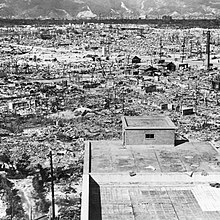
Indeed. I mean, just look at the continuing devastation in Hiroshima:
220px-AtomicEffects-Hiroshima.jpg

That's what it looked like right after they got hit by a nuclear bomb. So let's see this never-ending nuclear horror. This is what it looks like today:
220px-HiroshimaNight.jpg

Oh.... I guess they rebuilt and went back to living.
 
The word 'this' refers to a current or visible object or situation. You may have confused the word 'this', meaning the current disaster at the plant, with 'all' nuclear horrors.

The phrase "doesn't end" in regards to the current nuclear disaster is based on optimistic speculations that it may be possible to clean it up and make it safe in twenty years. And that land around the plant will not be useful ever again in human history.

That is all with the most optimistic outlook.
 

Back
Top Bottom