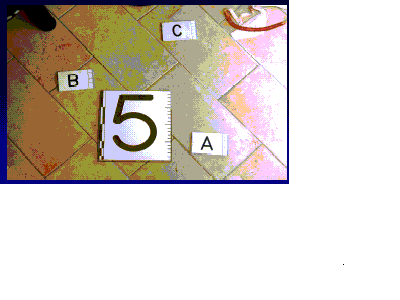
But it wasn't Filomena's lamp, it was Amanda's.
That is not a valid response to my question, which, I will remind you, was:
komponisto said:
If a lamp belonging to, say, Filomena had been found in Meredith's room, but otherwise everything else remained the same, how would your view of the case change?
Alt+F4 said:
At least two of Raffaele's alibis had nothing to do with police interrogation and where is the evidence that he was subjected to police interrogation that produced the other two?
Raffaele had only one alibi (Latin for "elsewhere", i.e. an account of one's location): he was at his house. Under police pressure he said that Amanda may have gone out; he retracted this later.
Alt+F4 said:
Often cases are judged on the nitty-gritty details. Those who believe in this pairs innocence seem to think that if the knife and bra clasp are thrown out by the court the prison doors will just open so the lovebirds can run out and do an interview with Oprah. Not gonna happen. Despite how constantly we are told that the two were just "confused" or "misremembered" it doesn't make this other evidence go away.
In case you missed it, I'll remind you that the strength of this other "evidence" is precisely what is being disputed here. Rhetoric will not suffice as an answer. The question, once again, is:
komponisto said:
do you really, truly think this kind of stuff raises the odds of guilt by more than a factor of, say, 1.1? ... Do you honestly think that the behaviors above are so far outside of "normal" that they constitute significant evidence of homicide? Just how unlikely do you think it is that an innocent Amanda would have behaved in such a way?
Alt+F4 said:
There is a HUGE difference between not thinking anything was taken and knowing nothing was taken. He knew nothing was taken because he knew there was no break-in.
Reasserting your opinion is not the same as justifying it. You have not provided any argument for your conclusion that "he knew there was no break-in" other than the fact that he said to the police that nothing was stolen. Once again, I put it to you that this could have been a judgement he arrived at from looking in the room. Do you have an argument showing that this is unlikely?
No he lied. It's that simple.
See above: reasserting your opinion is not the same as justifying it. I already know
that you believe he's guilty, thank you; now it's time for you to explain
why. You will need to show that your hypothesis is a better explanation of the data than mine, which entails a bit more work than saying "No, mine is right and yours is wrong."
Until someone involved in this case aquires Superman's vision you still can't see DNA with the human eye. You want to say sloppy police work, ok, but I'm not qualified to say contamination....are you?
In a word, yes.
There are only two possibilities: contamination (or other investigative error) or guilt.
Are you qualified to say guilt?
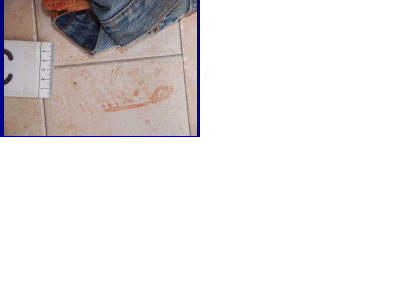
Moore said it was impossible for someone to leave Meredith's room without blood on the bottom of their shoes. Then how did someone leave that room, go to the bathroom, leave the footprint on the bathmat without leaving bloody footprints between the bedroom and bathroom - because there was none.
There's nothing here for me to address because you're simply mistaken. See
diagram.