
Proof of Photomanipulation

Your record on photo interpretation isn't great though, here's an example of some of your previous work,


[qimg]http://img.photobucket.com/albums/v499/swampmonster/september%2011/mobsightline.jpg[/qimg]

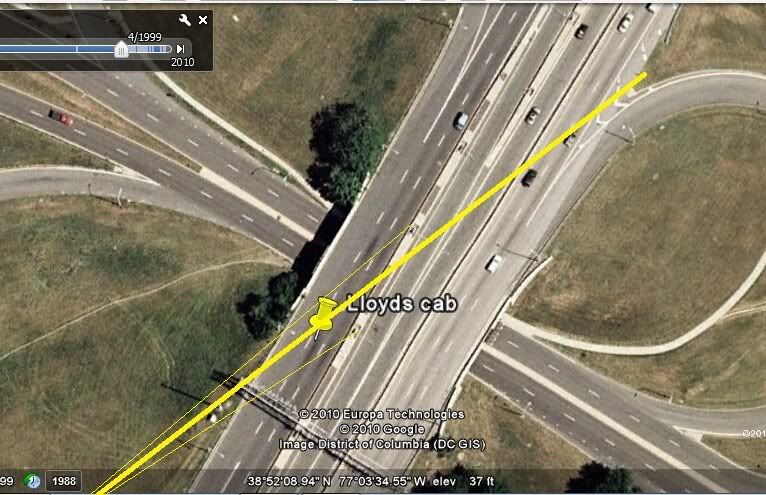
As you can see, from your sightline not only do the government ninjas need to knock down and stand up different light poles in broad daylight, they also have to remove a clump of trees and set fire to the wrong side of the pentagon.

You have clearly demonstrated that you have no idea what you're doing when it comes to interpreting photographic evidence.


OK, so you guys think I labelled the TAs wrong in that picture right? And that the TA on the right side should be TA3 and left side TA4?
 
No, I will not admit any such thing, because I would be lying if I did. If the coppage photo were the only thing to go on, I could be certain that the angle of impact was more than zero degrees and less than 90 degrees, because the angle of the Pentagon wall is clearly somewhere between the two; I know this, as I said, from the fact that I can see the face of a wall at right angles to it. To determine any more than this, I would need physical information on the dimensions of the Pentagon, or locations of objects in the photograph.
We know the locations of objects in the photograph.
 
We know the locations of objects in the photograph.

:boggled: Yes, and I already determined the angle from them. What I'm saying is that I need that information, in addition to the photograph itself, in order to determine the angle.
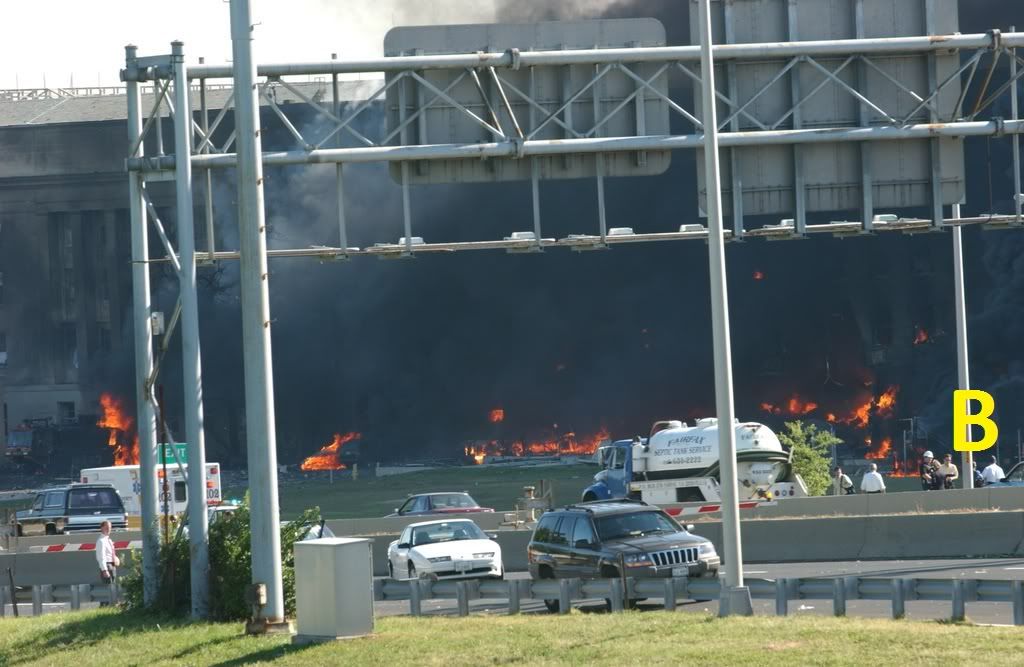
You're going round in circles here. You asked me if I could determine the angle from the photograph, and I said I could provided I knew the location of objects within the photograph. Then you asked me if I could determine the angle from the photograph alone, and I said I couldn't if I didn't know the locations of objects in the photograph. So we've got two options there: if we know the locations of objects, we can determine the angles, and if we don't know the locations of objects, we can't determine the angles.

I'm rather at a loss to know what possibilities you think that doesn't cover.

Dave
 
You're going round in circles here. You asked me if I could determine the angle from the photograph, and I said I could provided I knew the location of objects within the photograph.
Okay, I see where the confusion is. What I was asking is could we measure from the cab to the center of impact and get an angle using only the coppage photo. It seems pretty clear you are saying no.

Then you asked me if I could determine the angle from the photograph alone, and I said I couldn't if I didn't know the locations of objects in the photograph. So we've got two options there: if we know the locations of objects, we can determine the angles, and if we don't know the locations of objects, we can't determine the angles.

I'm rather at a loss to know what possibilities you think that doesn't cover.

Dave
Dave what you are saying, If I'm not mistaken, is that we can know the angles if we use an overhead map...but we can't using the coppage picture alone right?
 
The why in the photo in post #812 can't we see pole B?

Because it's just out of shot to the right.

You know what?

If you drew the *********** sight line you could work that out for yourself!!!!!


Dave

ETA: Or you could just look back nine *********** pages, where we *********** well drew it for you and told you where pole *********** B was.
 
Last edited:
I don't see how that is possible. What the picture depicts is the bridge being south of the cab. I haven't seen anything in researching Telephoto lens distortion that can account for that. Foreshortening makes things appear closer together.
 
[qimg]http://i1124.photobucket.com/albums/l564/dgmwood/DSC_0417.jpg[/qimg]

It's there in the background on the right of the uncropped image. You think you should be able to crop an image and have elements magically shuffle themselves closer together to stay in frame?
 
Oh and the picture depicts the bridge as being NORTH of the cab because the viewpoint is approximately North West.
 
I don't see how that is possible. What the picture depicts is the bridge being south of the cab. I haven't seen anything in researching Telephoto lens distortion that can account for that. Foreshortening makes things appear closer together.
b.jpg

revisedfieldofview.jpg
 
I don't see how that is possible. What the picture depicts is the bridge being south of the cab.

Guess what? Parallax, again.

Look, Mobertermy, I don't see any point in this any more. I've explained to you, with diagrams, how parallax works, and you've completely failed to comprehend it, as this latest misunderstanding shows. You have some very fundamental parts of your education completely missing, and I simply don't have the ability to get them through to you.

From now on, maybe I should just say "Parallax", "Foreshortening" or "Line of sight", and save my time and energy in case you ever come up with anything that isn't trivially explained by one of those.

Dave
 
Just out of curiosity I decided to use the GE Sept 7, 2001 imagery to draw a few line-of-sight matches for the pictures and pole "B". I don't see the problem. In every one of the Ingersoll images I examined, the pole is exactly were it should be.

I'm not going to read this whole thread, but I'm sure many of you have done the same thing. Whoever put this powerpoint together really should have done some real line-of-sight matching before making a complete idiot of themselves.
 
Last edited:
Just out of curiosity I decided to use the GE Sept 7, 2001 imagery to draw a few line-of-sight matches for the pictures and pole "B". I don't see the problem. In every one of the Ingersoll images I examined, the pole is exactly were it should be.

I'm not going to read this whole thread, but I'm sure many of you have done the same thing. Whoever put this powerpoint together really should have done some real line-of-sight matching before making a complete idiot of themselves.


That made me laugh for some reason. So there is nothing weird about how these picture depict where the bridge would be?
 
Guess what? Parallax, again.

Look, Mobertermy, I don't see any point in this any more. I've explained to you, with diagrams, how parallax works, and you've completely failed to comprehend it, as this latest misunderstanding shows. You have some very fundamental parts of your education completely missing, and I simply don't have the ability to get them through to you.

From now on, maybe I should just say "Parallax", "Foreshortening" or "Line of sight", and save my time and energy in case you ever come up with anything that isn't trivially explained by one of those.

Dave

Dave I completely agree with you.
 
So there is nothing weird about how these picture depict where the bridge would be?


Foreshortening has "weird" effects on photographs. But those effects are understood. You've been repeatedly pointed down a path that would lead you to that same understanding. Bizarrely, however, you've only ever taken a single step down that path and apparently have since turned back.

The lengths to which you go to actively avoid taking that path are absolutely astounding. And quite sad.
 
Last edited:

Back
Top Bottom