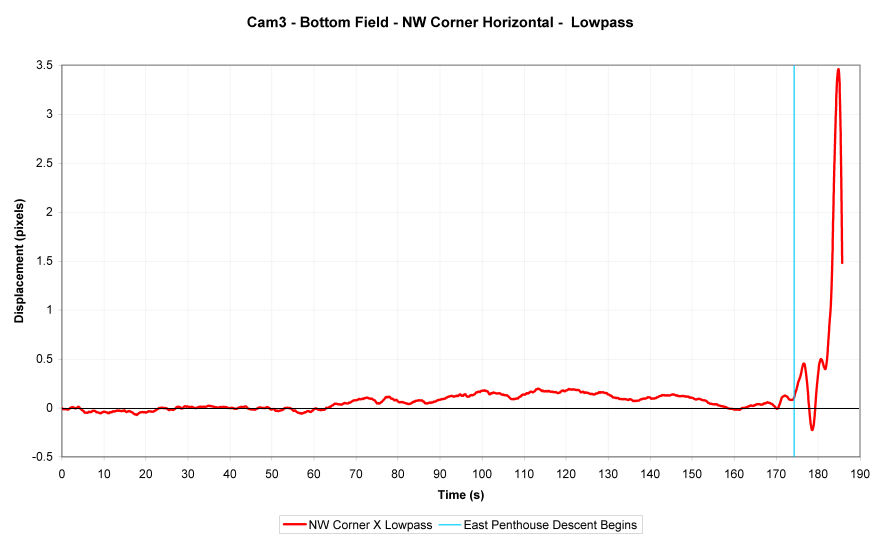
Okay

No. A simple deducement, determined by cross-referencing the information NIST themselves provide.
I really hope you're not going to suggest that NIST traced a diagonal, as highlighted by Achimspok earlier in this thread...
First, whatever happened to the word 'deduction?' I can't imagine Dr Watson exclaiming 'Brilliant deducement, Mr Holmes'. LOL
Anyway, I'm going to ignore the various ramblings from Femr2 for the moment, because I directed the answer to achimspok, not his personal pitbull.
achimspok made the allegation that NIST measured from the top of the screenwall, or maybe it was the West Penthouse????
But achimspok (and it seems Femr2) while constantly quoting NIST NCSTAR 1-9 fail to appreciate a couple of subtle, yet meaningful statements regarding the determination of collapse initiation, and rate of descent.
I'll quote (again, I know it's tedious) what NIST wrote:
'A single pixel close to the center of the north face roofline was selected and the color of the pixel, expressed as values of hue, saturation, and brightness, was recorded for each frame between 6.0 s and 7.8 s, where t = 0 s corresponds to the start of descent of the east penthouse (see Table
5-3). The brightness was found to provide the best indicator of change since the brightness of a pixel representing the sky above the building had a value of 100 percent while a pixel representing the roofline of the building (granite façade) had a brightness of roughly 60 percent for the pixel selected. The brightness of the selected pixel, expressed as a percent, is plotted versus time in Figure 12–75. From 6.0 s
to 6.9 s, the brightness is seen to oscillate around a value of 60 percent indicating no vertical movement.
Beginning at roughly 6.9 s the brightness increases irreversibly to a value of 100 percent at which time
the pixel under study represents the sky. Thus, the relative time at which the roofline began to move was
estimated as 6.9 s. The time when the roofline dropped from view behind the buildings in the foreground
was 12.3 s. Thus, the time the roofline took to fall 18 stories was approximately 5.4 s. '
This tells us that they used the brightness of a chosen pixel to determine when the parapet or 'roofline' changed to 'the sky'.
Nowhere do they mention that they used the screenwall nor the Penthouse as the point on the 'roofline'. Come to think of it, I don't think they ever confuse the terms anywhere in the report.
Truthers, however, are deliberately confusing the two. Read on...
Further on, NIST states 'To obtain a better understanding of the vertical motion of the building in the first several seconds of descent,
the motion of the north face was studied in more detail by tracking the vertical position of a point near the center of the roofline using the same video. In the following discussion, the time at which motion of the roofline was first perceived (6.9 s) is taken as time zero. '
NIST is vague here in two ways:
1) They don't specify where on the roofline the point was
2) They don't say whether or not the pixel previously chosen to determine the start of descent has any relation to this point or not....except
they had already determined, using the previous method, that the 6.9 s time would be taken 'as zero'.
So there are two methods outlined and at play here. Both achimspok and Femr2 incorrectly, IMO, treat them as one thing.
In other words, they are incorrectly assuming that these data points are taken at the same point along the roof; or in achimspok's case, he's gone so far as to assume that it was a point on the screenwall.
Yes, it's a preposterous claim really, and neither of them has lifted a finger to query NIST about this, in order to clarify the point. So I say, gentlemen, what on earth are you waiting for? If you were correct, you'd be more famous than David Chandler! Is that not a huge incentive?

btw, I went back to my FCP videos again, and did the timing of the descent (not the acceleration) using the screenwall/W Penthouse, as achimspok had alleged NIST had done.
My overall timing for the descent is roughly 6 s, not 5.4 s as I'd previously determined. There are two obvious implications from this:
1) Even if we allow for a few frames of slop, we're looking at .5 s added to the NIST number
2) Judging from the crumbling of the screenwall and W Penthouse, the initial acceleration might even be faster than it was for the general roofline below, as these structures fall
into the building while it begins to collapse.
The only way this can happen is if they have a higher velocity.
Have Messrs A or F done measurements along various parts of those upper structures to find out what the accelerations were? If they have, point me to that data please.
peace
AE
ETA, correction to the pixel brightness location. TFK correctly points out (I had replied before reading the rest of the posts) 'The chosen feature was the top of the parapet wall on the
roofline aligned with the east edge of the louvers on the north face. The distance was the difference
between the elevation of the roofline prior to the collapse and the last elevation where the roofline could
be observed before it was obstructed by a building in the foreground'
Let's repeat that in another way: Both Femr2 and achimspok have now been thoroughly schooled. They are just wrong.
The point has nothing to do with the things they allege.
Let's move on, shall we?